Emergency Dispatcher Resume Examples: what gets the call
Write an Emergency Dispatcher Resume That Survives the Console Test
By Mustafa Tarabya, founder of CVBooster · Published · Updated
Emergency dispatcher resume example, keyword list and guide covering CAD systems, call volume, protocol compliance and multi agency radio work.
Sample resumes for a emergency dispatcher
The same emergency dispatcher content laid out in three CVBooster templates, so you can see what the finished document looks like before you write a word.
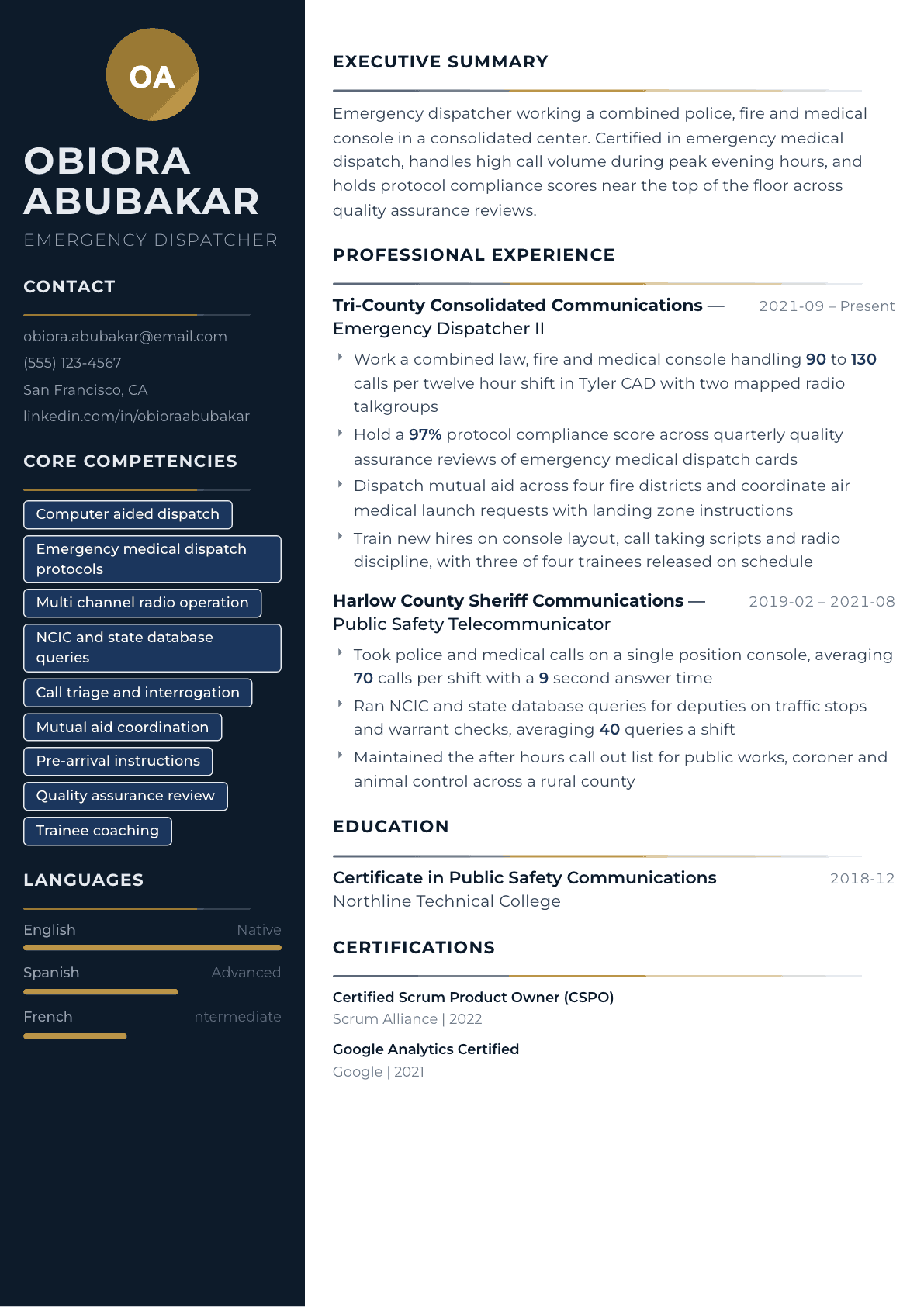
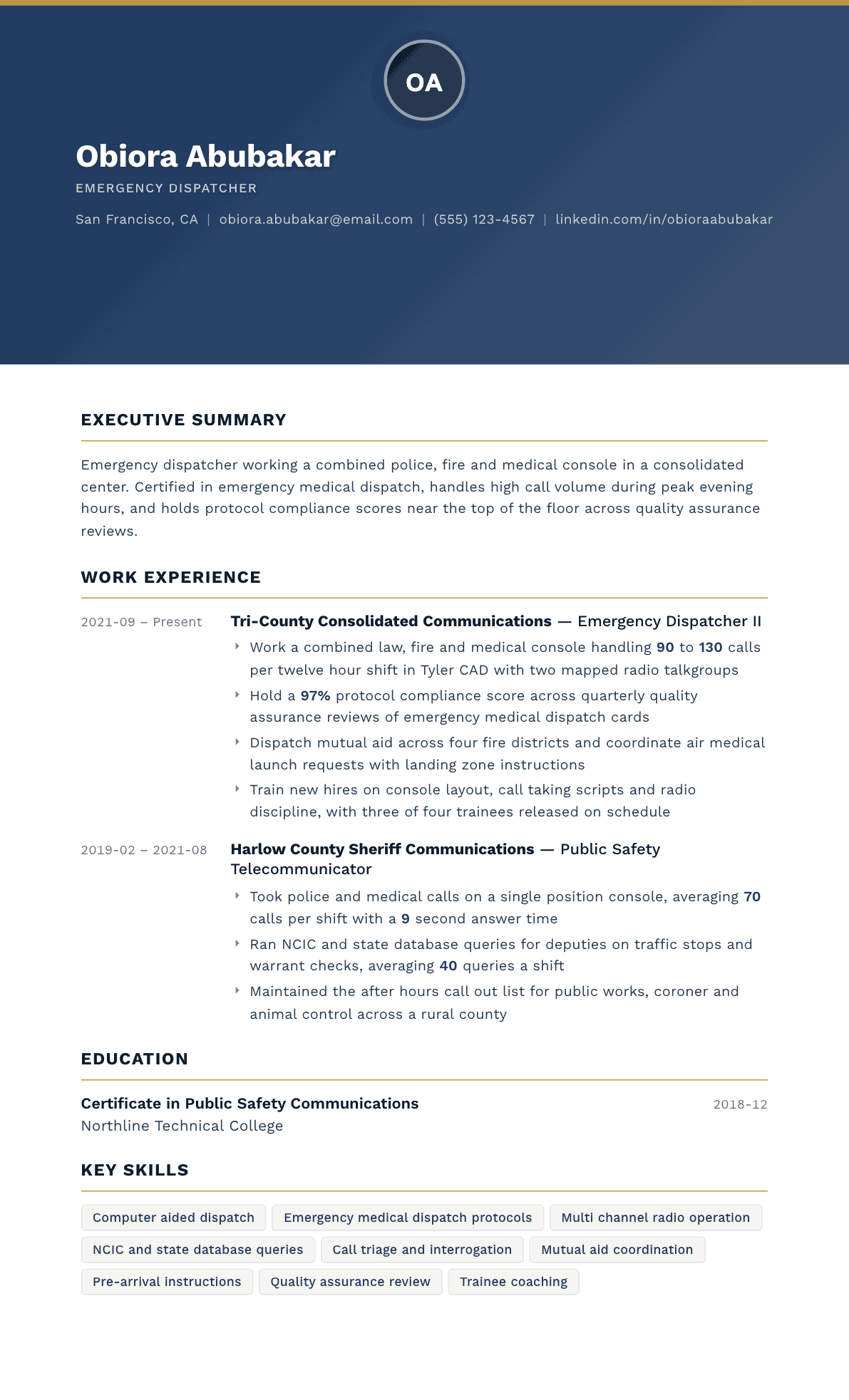
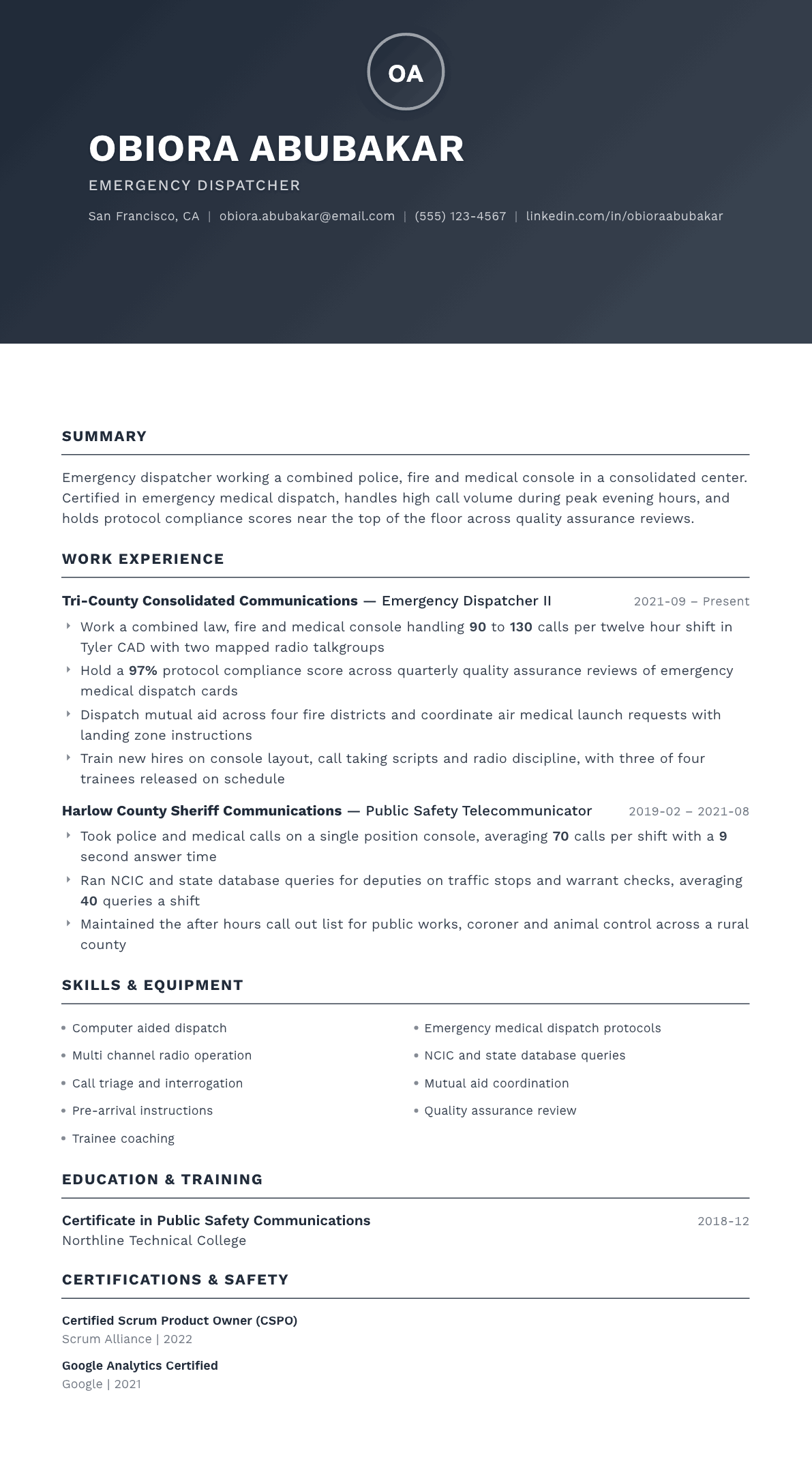
Example Emergency Dispatcher summary
Emergency dispatcher with six years on combined law, fire and medical consoles in a consolidated center, certified in emergency medical dispatch. Handles heavy evening call volume in a computer aided dispatch system, runs mutual aid across four fire districts, coordinates air medical launches, and holds high protocol compliance across quarterly quality assurance reviews. Trains new hires on console layout and radio discipline.
Skills to list on a Emergency Dispatcher resume
- Computer aided dispatch entry
- Emergency medical dispatch card use
- Emergency fire dispatch
- Call taking and interrogation
- Pre-arrival instructions
- Multi talkgroup radio control
- Unit status and time stamping
- NCIC and state criminal database queries
- Mutual aid and automatic aid dispatch
- Air medical launch coordination
- Text to 911 handling
- Alarm and after hours call out lists
- Quality assurance protocol review
- Communications training officer duties
- Mapping and address verification
- Active incident documentation
What actually gets this resume read
- Name the computer aided dispatch platform you use, because a center on the same system shortens your training weeks.
- Give your call volume per shift and the disciplines you handle, since a combined console is a different job.
- Put your emergency medical dispatch certification and its issuing academy on the page with the renewal status.
- Report your protocol compliance score from quality assurance if you have one, because centers audit every card.
- Say how many radio talkgroups and agencies you keep on your console, since span of control is the real workload.
- Mention any training officer work, because a center short on staff hires for the ability to grow the next dispatcher.
- List shift patterns you have actually worked, including nights and holdovers, so a scheduler knows what you can sustain.
How to write a emergency dispatcher resume
A communications manager filling a console seat is trying to predict two things from your resume: how long you will take to get released from training, and whether you will still be there in eighteen months. Both are expensive to get wrong, and both are answered by details most applicants leave off.
The pages that fail say the candidate answered emergency calls, dispatched units and remained calm under pressure. Every dispatcher does those things. What separates one applicant from another is the console configuration they have worked, the call volume they have carried, the protocol set they are certified in, and the quality assurance scores that show whether their card discipline holds when the floor gets loud.
This guide walks through the resume a center reads: the systems, the disciplines, the volume, the certifications and the training officer work, with summaries for a first console job, a settled dispatcher and a lead, plus the questions people ask when they move between a small sheriff center and a consolidated floor.
Format: one page, systems and certifications visible immediately
Keep it to one page unless you have supervisory or training officer history worth a second. A communications manager scanning applications wants three things on the first screen: the disciplines you handle, the computer aided dispatch platform you have used, and your protocol certifications. Everything else can wait until she has decided you are worth reading.
Put a short systems line under your summary listing the dispatch platform, the radio system type, the mapping tool and the records management system you have worked in. Centers train new hires on their own configuration regardless, but an applicant already fluent in the platform shortens that by weeks, and managers hire on that difference.
- Discipline line: law, fire, emergency medical, or combined, and whether you both take calls and dispatch.
- Systems line: computer aided dispatch product, radio console type, mapping, and records management system.
- Certification block: protocol certifications with the academy that issued them, plus state telecommunicator certification and CPR.
- Each job names the center type: municipal police, sheriff, fire district, consolidated regional center, or a private answering point.
- State your shift pattern history, because a manager staffing nights needs to know you have actually worked them.
Summary: disciplines, volume, protocol, span of control
Four facts carry this section. Which disciplines you work, how many calls you handle on a typical shift, which protocol set you are certified in, and how many talkgroups and agencies sit on your console. Those four define the job you have actually been doing, and none of them can be inferred from a title.
If you hold a strong quality assurance score, put it here rather than burying it in a bullet. Protocol compliance is the single most audited metric in a communications center, and a dispatcher who volunteers the number is telling a manager she has nothing to hide when the review sheets come out.
Experience: the console, the volume, the calls that were hard
Write each job around the console you sat. Say how many positions the center runs, whether you worked a call taking position or a combined call taking and dispatch position, and how many units you were responsible for. A dispatcher who has held four fire districts and an air medical program on one channel set is describing a different workload from one who handled a single agency.
Volume belongs in numbers. Calls per shift, answer time, and the peak hours you cover give a manager something to compare. If your center measures dispatch time from call receipt to unit assignment, use that too, because it is the metric agencies complain about most.
Then write the calls that separate dispatchers. Structure fire with entrapment, a working cardiac arrest where you gave compression counts through the phone, a pursuit that crossed jurisdictions, a caller who would not give an address. Two or three concrete incidents, written without identifying anyone, prove competence that a call count alone cannot.
Database work is easy to forget and worth a bullet. Running criminal history, registration and warrant queries for officers on a stop, entering and clearing warrants, and handling protective order confirmations are audited functions with their own certification in most states.
Training, quality assurance and the reasons centers keep people
Communications centers lose staff constantly, so any evidence that you help build the next dispatcher is valuable. Training officer work, mentoring, writing training material or running a position for a trainee all belong on the page, with how many trainees you have taken and how many were released on schedule.
Quality assurance goes both ways. If you have reviewed calls as a member of a quality team, say so, because reviewing is a different skill from being reviewed and centers struggle to staff it. If you have been reviewed and scored well, give the score with the review period so a manager can see it was sustained rather than a single good month.
- Communications training officer assignments, with trainee count and release outcomes.
- Quality assurance review participation, including the protocol set audited and the review cadence.
- Any specialized position: tactical dispatch, incident dispatch team, emergency operations center support, mutual aid coordination.
- Public education, ride alongs and agency liaison work that shows you understand the field side.
- Continuing education hours and the certifications you keep current between renewals.
Skills and keywords a center filters on
Postings use a narrow vocabulary: call taking, interrogation, pre-arrival instructions, unit status, time stamping, talkgroup, mutual aid, protocol compliance, criminal justice database queries, text messaging to the emergency number. Mirror the posting exactly once in your skills block and once inside a bullet where the work shows.
Two skills are undersold on almost every dispatcher resume. The first is address verification and mapping, which is what actually gets units to the right place when a caller is confused. The second is multitasking across radio and phone at once, which is better shown by describing a specific busy period than by claiming it as a trait.
Emergency Dispatcher resume summary examples
First console job
Public safety telecommunicator candidate with state certification complete, emergency medical dispatch certification in hand, and three years of high volume customer contact in a hospital switchboard handling code pages. Types 62 words a minute, has completed a 40 hour call taking academy, and is available for night rotation.
Four years on the floor
Emergency dispatcher working a combined law, fire and medical console, handling 90 to 130 calls per twelve hour shift with two mapped talkgroups. Holds a 97% protocol compliance score across quarterly quality assurance review, dispatches mutual aid across four fire districts, and coordinates air medical launch requests.
Lead dispatcher and training officer
Lead dispatcher with nine years in a consolidated center covering eleven agencies, serving as communications training officer and quality assurance reviewer. Has released seven trainees to solo status, rewrote the fire dispatch card set after a mutual aid failure in 2023, and works the tactical channel on major incidents.
Work experience bullets: before and after
Before: Answered emergency and non emergency calls.
After: Worked a combined law, fire and medical console handling 90 to 130 calls per twelve hour shift, with an average answer time under 10 seconds during the evening peak.
The console type, the volume and the answer time turn a duty statement into a measurable workload.
Before: Gave medical instructions to callers.
After: Delivered pre-arrival instructions from the emergency medical dispatch card set, including compression counts on 30 plus cardiac arrests, with protocol compliance scored at 97% across quarterly review.
Naming the protocol set, the case type and the audited score shows discipline rather than good intentions.
Before: Dispatched fire units to calls.
After: Dispatched four fire districts and one air medical program from a single position, running mutual aid box assignments and coordinating landing zone instructions with ground crews on the tactical talkgroup.
Span of control and the specific coordination tasks tell a manager exactly what you can hold on a console.
Before: Trained new dispatchers.
After: Served as communications training officer for four new hires, running daily observation reports and position sign offs, with three released to solo status on the scheduled week.
A trainee count and release outcomes are the evidence a center uses to judge whether training officer time paid off.
Before: Used the criminal database to look up information for officers.
After: Ran registration, criminal history and warrant queries averaging 40 per shift for deputies on traffic stops, and entered and confirmed protective orders under the state audit requirements.
Query volume plus the audited entry function shows database work as a certified responsibility, not a lookup habit.
Hard skills
- Computer aided dispatch entry and unit status
- Emergency medical dispatch card use
- Emergency fire dispatch card use
- Call taking and structured interrogation
- Pre-arrival instruction delivery
- Multi talkgroup radio console operation
- Criminal justice database queries and entries
- Mutual aid and automatic aid dispatch
- Address verification and mapping
- Air medical launch coordination
- Text messaging to the emergency number
- Quality assurance protocol review
- Communications training officer duties
- Incident documentation and time stamping
Soft skills
- Holding a caller on the line who is screaming and will not give an address
- Switching between phone and radio without losing either thread
- Recovering after a bad call and taking the next one clean
- Speaking at a pace a panicking caller can follow
- Accepting a quality review score without arguing the card
Certifications worth listing
- Emergency Medical Dispatch (EMD) (International Academies of Emergency Dispatch)
- Public Safety Telecommunicator 1 (APCO International)
- Emergency Number Professional (ENP) (National Emergency Number Association)
- Basic Life Support for Healthcare Providers (American Heart Association)
Mistakes that cost emergency dispatcher candidates the interview
- Claiming to stay calm under pressure without a single incident on the page that shows what pressure looked like.
- Leaving off the dispatch platform, which is the detail that decides how many training weeks a center has to fund.
- Giving no call volume, so a manager cannot tell whether your busy shift is her quiet one.
- Hiding the protocol certification at the bottom when it is a hard filter on most postings.
- Describing a combined console and a single discipline position in the same words, when they are different jobs.
- Omitting training officer and quality review work, which is exactly the experience understaffed centers are buying.
- Listing typing speed as the headline skill when card discipline and radio control are what the floor runs on.
Emergency Dispatcher resume questions
How do I get hired as a dispatcher with no public safety background?
Lead with high volume, high consequence phone work: hospital switchboard, airline operations, roadside assistance, crisis line. Add typing speed, any protocol certification you funded yourself, and a plain statement that you are available for the night and weekend rotation the center is actually trying to fill.
Should I put my quality assurance scores on my resume?
Yes, when they are good and sustained across several review periods. Give the score, the protocol set and the review cadence. A single high month reads as cherry picking, but a compliance figure held across a year is the strongest evidence a dispatcher can offer.
How do I describe difficult calls without breaking confidentiality?
Describe the call type, the actions you took and the outcome category, never the names, addresses or dates. Cardiac arrest with compression counts given until arrival is safe to write. Anything that could identify a caller or a family does not belong on a resume.
Does moving from a small center to a consolidated one need a different resume?
It needs a different emphasis. A consolidated floor cares about span of control, multi agency talkgroups and protocol discipline at volume, so raise those. A small center cares that you can work every position alone at three in the morning, so raise self sufficiency and database work instead.
How long should a dispatcher resume be?
One page for most applicants. Take a second page only when you have supervisory, training officer or quality assurance history that genuinely needs the room. Communications managers read quickly and a third page has never helped anyone get a console interview.
Related resume examples
- Dispatch Coordinator Resume example
- Paramedic Resume example
- 911 Dispatcher Resume example
- Police Officer Resume example
- Unarmed Security Guard Resume example
- Security Supervisor Resume example