Warehouse Supervisor Resume Examples: what gets the call
Write a Warehouse Supervisor Resume That Shows Shift Control
By Mustafa Tarabya, founder of CVBooster · Published · Updated
Warehouse supervisor resume example with headcount and productivity bullets, safety keywords, skills to list, and a guide to writing every section.
Sample resumes for a warehouse supervisor
The same warehouse supervisor content laid out in three CVBooster templates, so you can see what the finished document looks like before you write a word.
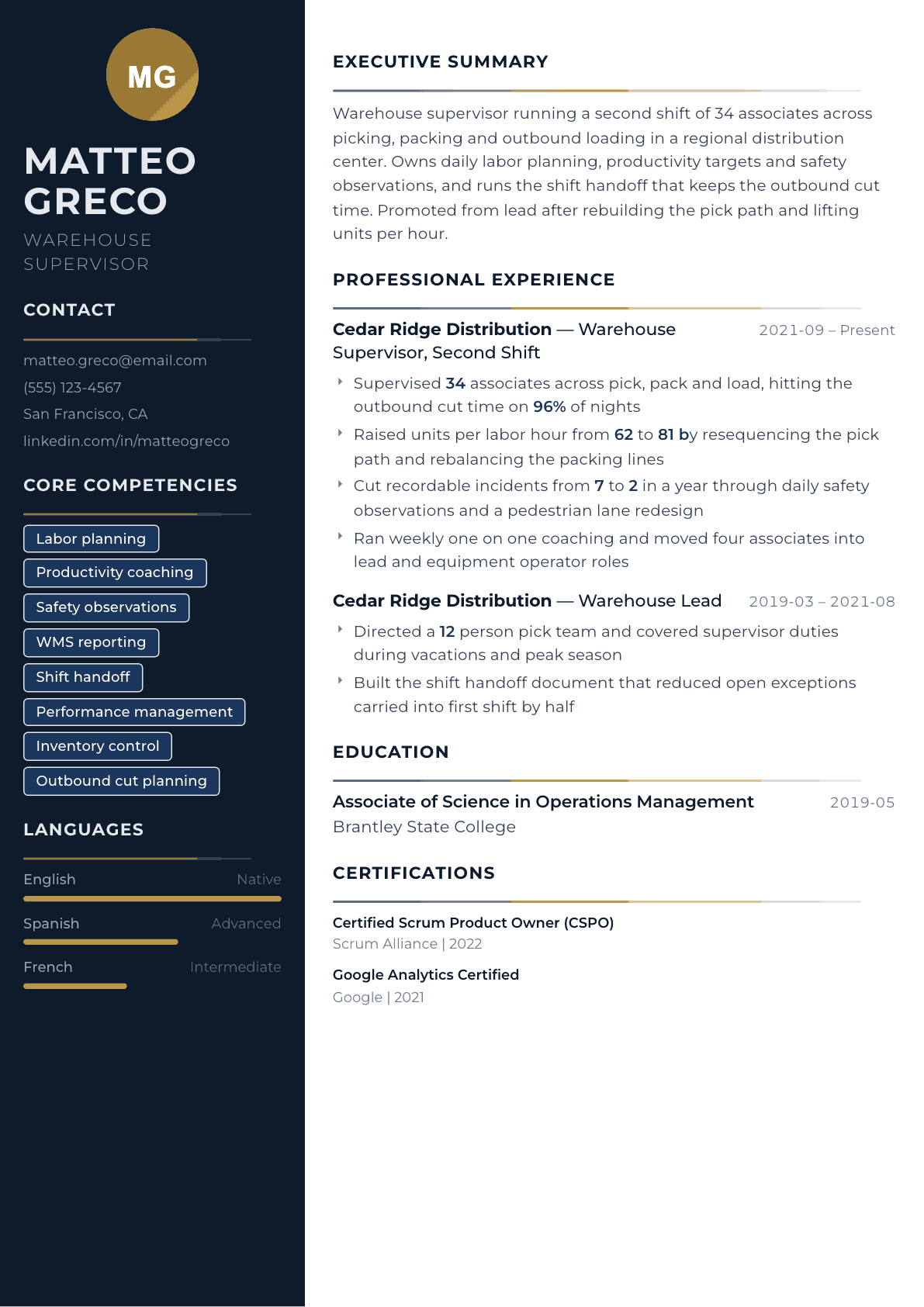
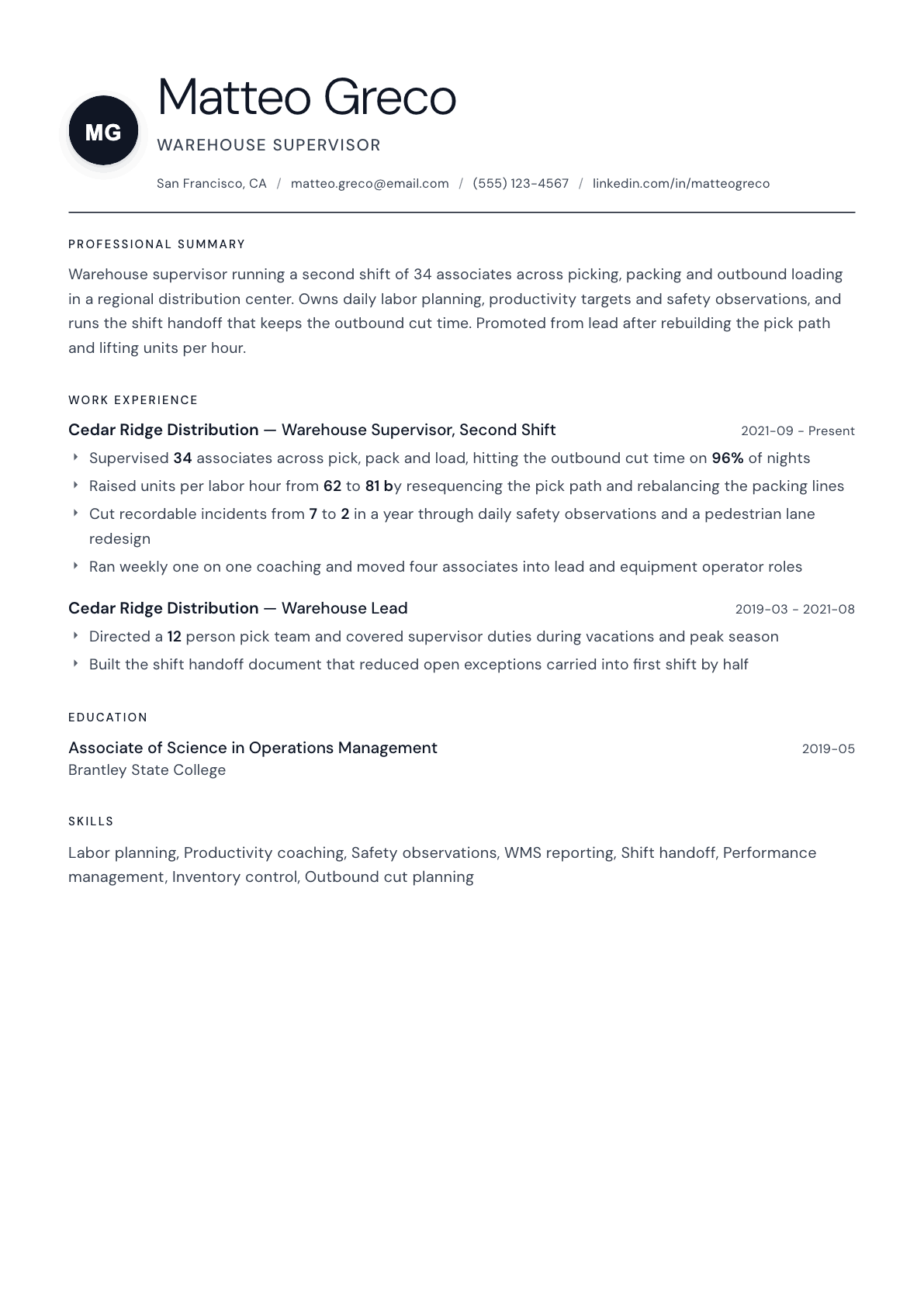
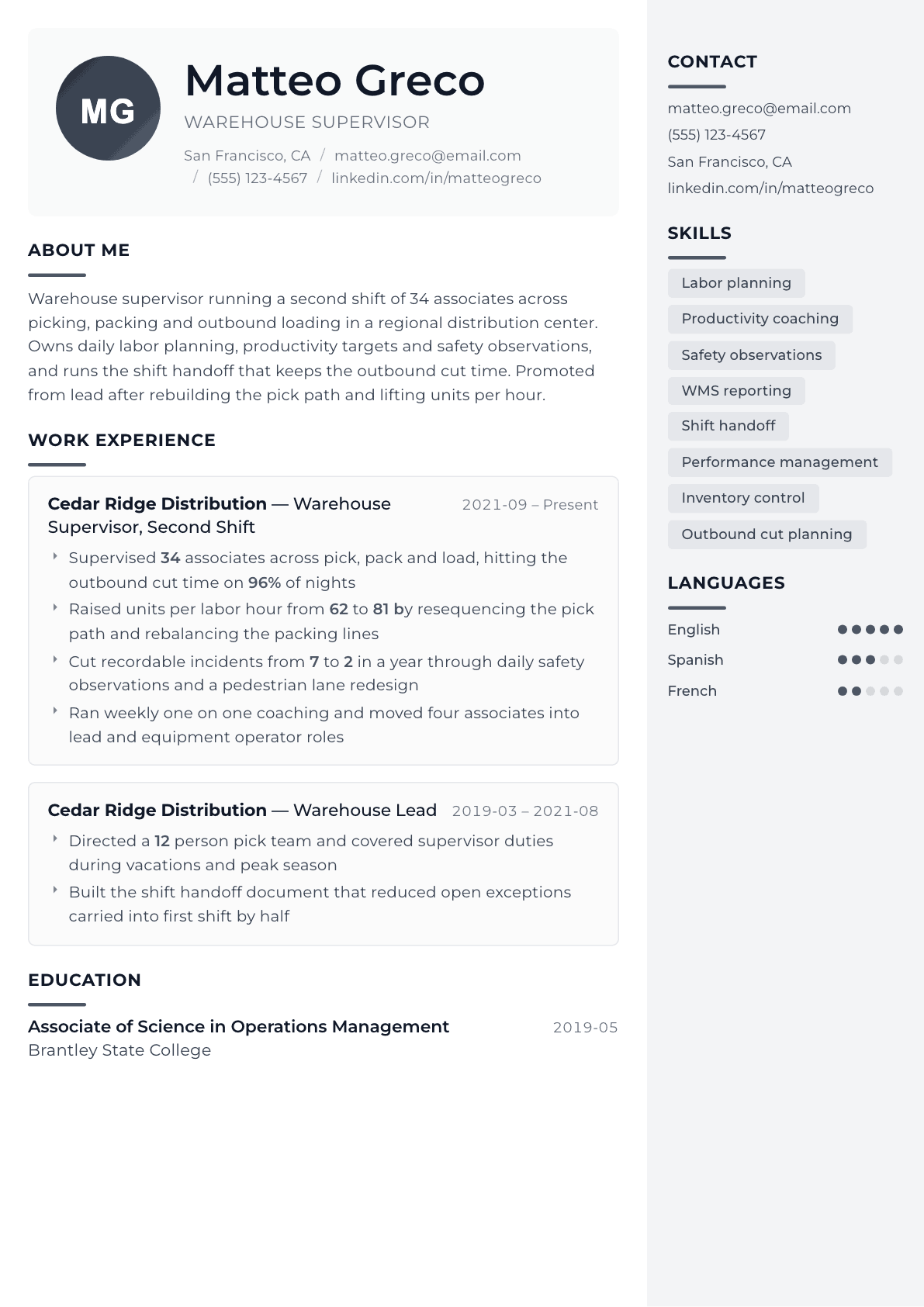
Example Warehouse Supervisor summary
Warehouse supervisor with six years leading second shift operations for a regional distribution center, currently responsible for 34 associates across pick, pack and load. Lifted units per labor hour from 62 to 81 by resequencing the pick path, and cut recordable incidents through daily safety observations. Promoted four associates into lead roles. Ready for an operations manager track at a larger site.
Skills to list on a Warehouse Supervisor resume
- Labor planning and scheduling
- Units per labor hour
- Pick and pack supervision
- Outbound load planning
- Safety observation programs
- Incident investigation
- Performance coaching
- Cycle count management
- WMS and labor management reporting
- Standard work documentation
- Cross-training plans
- Peak season staffing
- Root cause analysis
- Continuous improvement
What actually gets this resume read
- Lead every job with headcount, shift and function so a hiring manager sizes your span of control immediately.
- Report the metrics a warehouse manager tracks: units per labor hour, on-time cut, pick accuracy, recordable incidents.
- Show people development explicitly, naming how many associates you promoted or cross-trained during your tenure.
- Describe one process change end to end, since supervisors are hired to fix flow rather than to watch it.
- Name your labor management and warehouse systems, because sites screen for the platform they already run.
- Keep safety near the top with concrete practices such as daily observations, near miss reporting or lane redesign.
How to write a warehouse supervisor resume
A warehouse supervisor resume is read by an operations manager who is trying to work out one thing: if he hands you a shift, does the shift come back clean. Clean means the outbound cut was made, the labor plan held, nobody got hurt, the exceptions were closed, and no associate quit over how they were spoken to. Everything on the page is evidence for or against that.
The trap is writing the resume as a longer associate resume. Supervisors who list picking and putaway tasks are describing what their team does, not what they do. The supervisor job is labor planning, sequencing, coaching, escalation and safety, and the numbers that prove it are span of control, units per labor hour, on-time cut, incident rate and how many people you moved up.
This guide sets out the section order operations managers read, three summaries covering a newly promoted supervisor through to a multi-shift supervisor, before and after bullets that convert task language into supervision, and the questions supervisors ask when they try to write the promotion onto paper.
Format: one page under eight years, two after
Reverse chronological, single column, no charts. Distribution employers run applications through automated screening, and supervisors lose more often to a parsing failure than to a weak record. Keep the font ordinary and the section headings literal.
If you were promoted inside one site, list each title as its own dated entry under a single employer heading. Internal progression from associate to lead to supervisor is one of the strongest signals in this field, and collapsing it into one block throws that signal away.
- Header: name, city, phone, email, shift worked, and whether you are open to nights or weekends.
- Scope line under each title: headcount, shift, functions owned, site size.
- Sections: summary, experience, certifications and safety training, systems, education.
Summary: span, functions, and one result
Three lines that carry the scope before anything else. Headcount, shift, and the functions you own, then a single result you can defend in an interview. A supervisor who opens with responsibility for thirty four associates across pick, pack and load has already passed the first filter that most applications fail.
Avoid opening with years of experience alone. Two supervisors with the same tenure can be running a six person returns cell or a hundred person outbound operation, and the reader has no way to tell which one you are unless you say it.
Experience: manage the shift, then prove the shift
Lead each role with the scope line, then write bullets in the order an operations manager cares about. Labor and volume first: how you built the daily plan, how you flexed against forecast, what you did when volume arrived twenty over plan. Service second: on-time cut performance, exceptions carried into the next shift, order accuracy out of your functions.
Then productivity, and this is where supervisors either land the interview or do not. Give the metric your site used, the starting number, the number you moved it to, and the mechanism. Units per labor hour rose because the pick path was resequenced. Pack rate rose because the line was rebalanced and consumables were staged before the wave dropped. Without the mechanism a number reads as luck or as somebody else's project.
Safety gets its own bullets, and they should describe practice rather than outcome alone. Observation quotas met, near miss reporting you drove, an investigation you ran to root cause, a physical change such as a pedestrian lane redesign. Recordable rates fall for many reasons, and a manager wants to see the mechanism you own.
Close with people. Coaching cadence, corrective action handled correctly, associates cross-trained, associates promoted. Turnover is the expensive problem in distribution, and a supervisor who develops people is solving it.
Systems and reporting: the tools of the job
Name the warehouse management system and, separately, the labor management system if your site ran one. They are different tools that answer different questions, and a supervisor who has worked with engineered standards and discrete labor tracking is a different candidate from one who has not.
Add the reporting you built or ran: daily production recaps, cut plans, staffing models in a spreadsheet, dock schedules. Many distribution sites still run their shift on a spreadsheet that a supervisor maintains, and saying you own that artifact tells the reader you can walk in and take it over.
Certifications, training and the language of the field
General industry safety training, incident investigation coursework, forklift train the trainer, and continuous improvement credentials all belong in a short block near the bottom. They matter less than your record, but they resolve doubt when two candidates look similar.
Use the operating vocabulary correctly throughout, because it is a competence test in itself. Waves, cut times, dock to stock, units per labor hour, standard work, root cause, corrective action, cross-dock. Postings are written in that language and screened against it, so mirror the posting once in your summary and once inside a bullet where the practice is visible.
Warehouse Supervisor resume summary examples
Newly promoted supervisor
Warehouse supervisor promoted from lead, running a first shift outbound team of 18 associates across picking and packing. Owns the daily labor plan and the shift handoff, and lifted pack line output by rebalancing stations and staging consumables before each wave. Four years at the same distribution site.
Five years supervising
Second shift warehouse supervisor accountable for 34 associates across pick, pack and load at a regional distribution center. Hit the carrier cut on 96% of nights, raised units per labor hour from 62 to 81 through pick path resequencing, and cut recordable incidents through a daily observation routine.
Multi-shift supervisor
Senior warehouse supervisor covering two shifts and 70 associates in a 400K square foot facility, including inbound, outbound and returns. Owns the staffing model, the dock schedule and incident investigation, and developed six associates into lead roles over three years. Experienced through four peak seasons.
Work experience bullets: before and after
Before: Supervised warehouse employees on second shift.
After: Supervised 34 associates across picking, packing and outbound loading on second shift, building the daily labor plan against a forecast that moved 20% week to week.
Headcount, functions and the volatility you planned against give the reader the size of the job.
Before: Improved productivity on my shift.
After: Raised units per labor hour from 62 to 81 in eleven months by resequencing the pick path, rebalancing two pack lines and moving consumable staging ahead of the wave.
A start point, an end point and the mechanism make the improvement yours instead of the site trend.
Before: Focused on safety.
After: Held a daily safety observation quota with every lead, investigated four incidents to root cause, and redesigned the pedestrian crossing on the inbound dock after a near miss report.
Naming the routine, the investigations and a physical change shows the system you ran, not a value you hold.
Before: Trained and developed my team.
After: Ran weekly one on one coaching with every associate, cross-trained 15 people onto a second function, and moved four into lead or equipment operator roles.
Counting the coaching, the cross-training and the promotions turns development into a measurable output.
Before: Handled shift handoffs and reporting.
After: Built a shift handoff document covering open exceptions, equipment down and staffing gaps, which halved the exceptions first shift inherited each morning.
The artifact and its effect show process design, which is the difference between a supervisor and a lead.
Hard skills
- Daily labor planning and flexing
- Units per labor hour management
- Wave and cut time planning
- Outbound load planning
- Incident investigation and root cause
- Safety observation programs
- Cycle count oversight
- Warehouse management system reporting
- Labor management standards
- Standard work documentation
- Corrective action and performance management
- Peak season staffing models
Soft skills
- Direct coaching
- De-escalation on the floor
- Decision making under a cut clock
- Cross-shift communication
- Fair and consistent enforcement
- Recognizing and developing potential
Certifications worth listing
- OSHA 30-Hour General Industry (OSHA Outreach Training Program)
- Certified Logistics Technician (CLT) (Manufacturing Skill Standards Council)
- Certified Six Sigma Green Belt (CSSGB) (American Society for Quality)
- Certified in Planning and Inventory Management (CPIM) (Association for Supply Chain Management)
Mistakes that cost warehouse supervisor candidates the interview
- Listing associate tasks under a supervisor title, which tells the reader you never stopped doing the old job.
- Giving a productivity number with no baseline and no mechanism, so it cannot be distinguished from luck.
- Leaving headcount and shift off every role, which makes span of control impossible to compare.
- Collapsing an internal promotion path into one entry and losing the clearest evidence on the page.
- Claiming a safety result with no routine behind it, when managers hire for the routine.
- Ignoring turnover and development entirely in a field where staffing is the recurring crisis.
Warehouse Supervisor resume questions
What metrics belong on a warehouse supervisor resume?
Span of control, units or lines per labor hour, on-time cut or dock to stock performance, order accuracy, recordable incident count, overtime against plan, and turnover or promotions. Give the baseline alongside the result so the movement is legible.
How do I write the resume if I was just promoted from lead?
Split the two titles into dated entries and write the supervisor entry around planning, coaching and escalation rather than floor tasks. Then use lead accomplishments to show the runway: covering the supervisor, training hires, owning the handoff.
Should a warehouse supervisor resume be one page or two?
One page under roughly eight years of experience, two when you have multiple sites, several functions or a promotion history worth laying out. Two pages of substance beats one page achieved by deleting headcount and results.
Do I need a degree to be a warehouse supervisor?
Many supervisors come up from the floor without one and postings often say degree or equivalent experience. List whatever education you have without apology, then make the operational record carry the application.
How do I show safety leadership without an incident rate?
Describe the mechanisms you owned: observation cadence, near miss reporting, toolbox talks, equipment tag out discipline, layout changes you pushed through. A manager can evaluate a routine even when the site never published a rate to you.
Related resume examples
- Warehouse Worker Resume example
- Logistics Coordinator Resume example
- Warehouse Manager Resume example
- Warehouse Lead Resume example
- Distribution Center Manager Resume example
- Distribution Manager Resume example