Dispatcher Resume Examples: free ATS score and gap list
Build a Dispatcher Resume That Proves You Hold the Board
By Mustafa Tarabya, founder of CVBooster · Published · Updated
Dispatcher resume example with routing, driver communication and radio keywords, plus a writing guide for trucking, service and fleet dispatch applications.
Sample resumes for a dispatcher
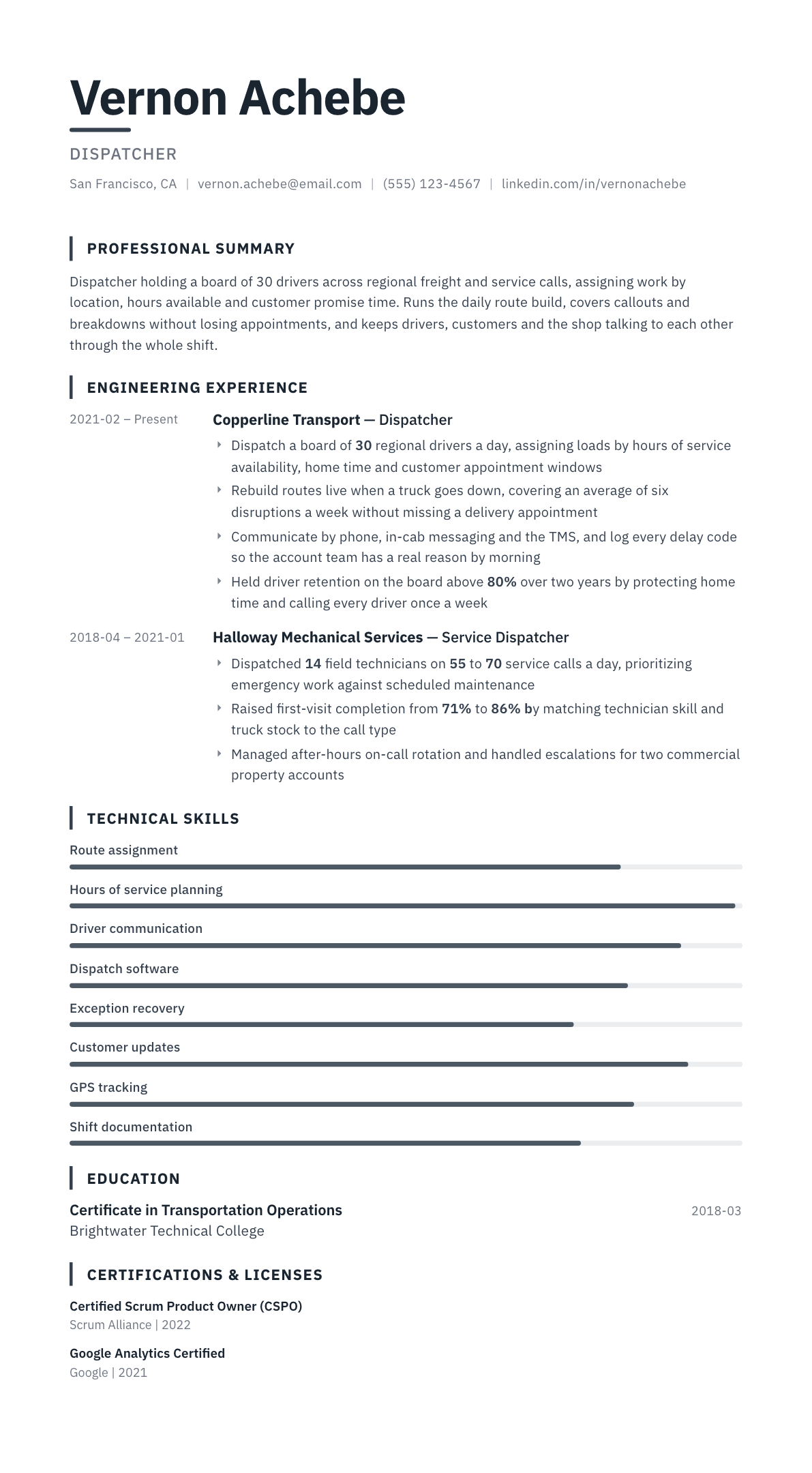
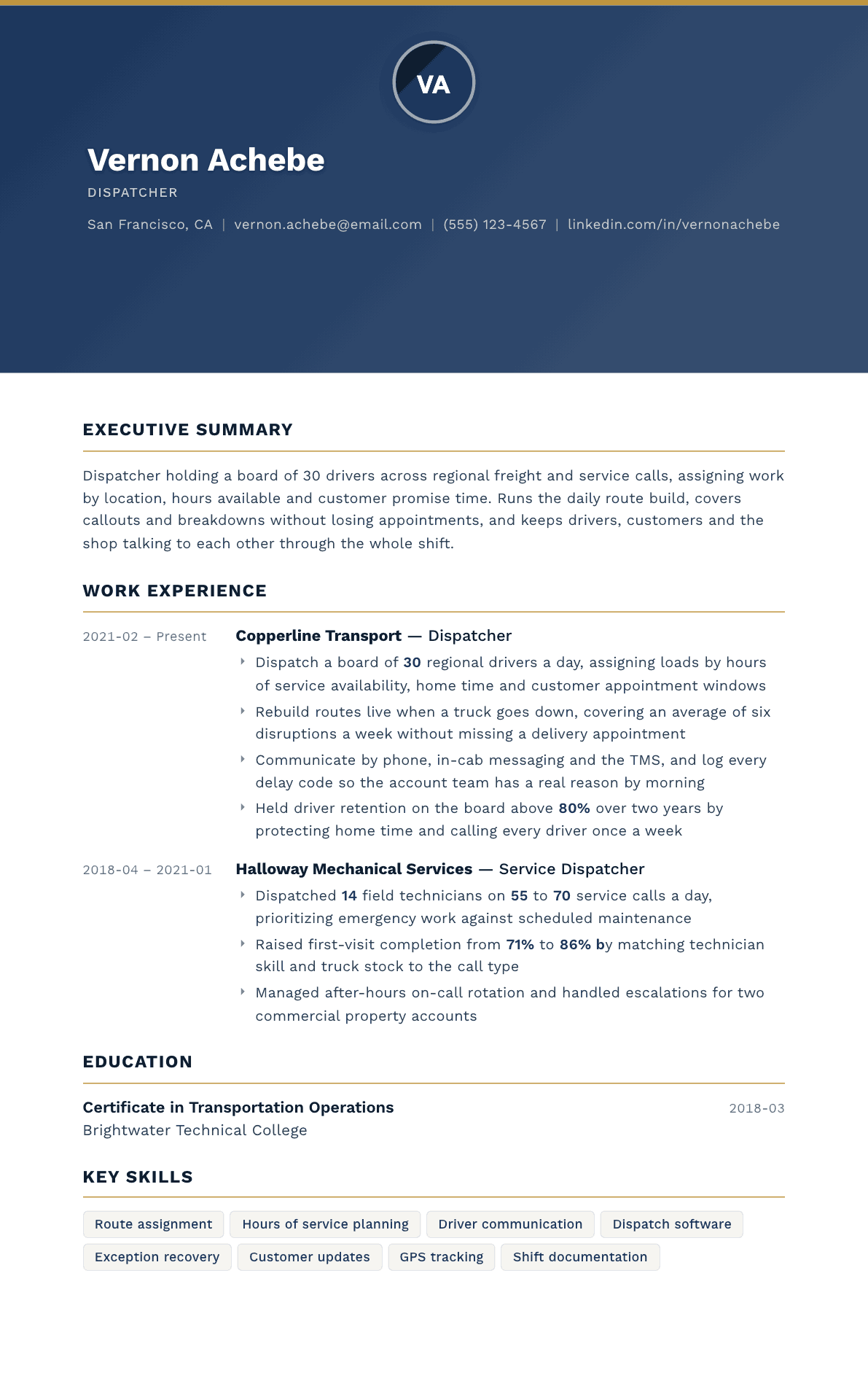
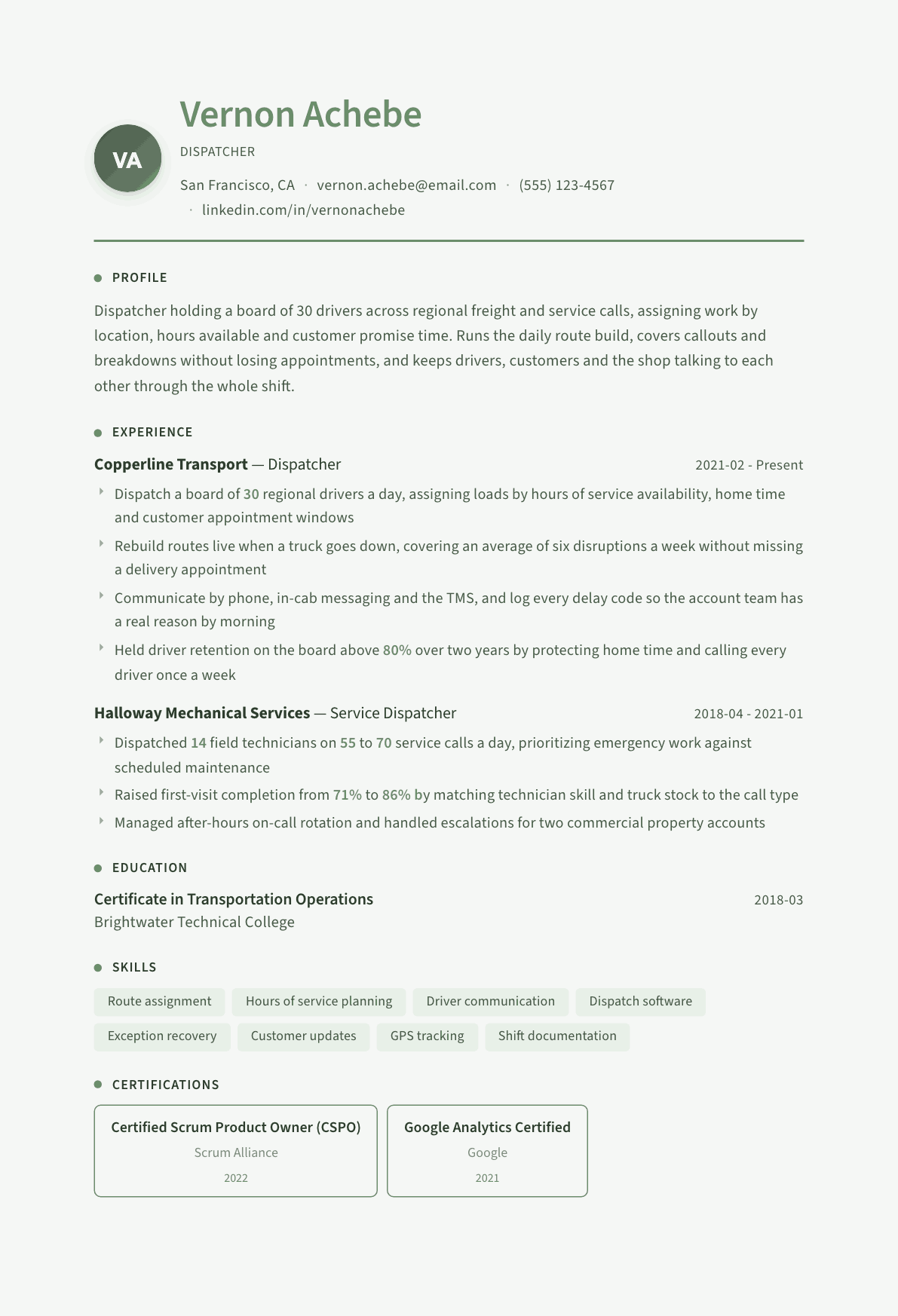
The same dispatcher content laid out in three CVBooster templates, so you can see what the finished document looks like before you write a word.
Example Dispatcher summary
Dispatcher with six years running boards in regional trucking and field service, currently assigning work to 30 drivers a day by hours available, home time and appointment windows. Rebuilds routes live around breakdowns and callouts without losing deliveries, and holds driver retention on the board above 80%. Raised first-visit completion from 71% to 86% in a previous service role.
Skills to list on a Dispatcher resume
- Load dispatching
- Route assignment
- Hours of service planning
- Driver communication
- Dispatch software
- GPS and telematics tracking
- Exception recovery
- Customer service
- Appointment management
- Two-way radio communication
- Breakdown coordination
- Shift handover documentation
- Peak volume planning
- DOT compliance awareness
What actually gets this resume read
- Say how many drivers or technicians were on your board and whether the work was local, regional or over the road.
- Show how you handled the bad shift: a breakdown, a callout, weather, and what you did to save the appointment.
- Name the dispatch and tracking software you used, since every operation runs a different platform and postings list theirs.
- Include hours of service knowledge if you dispatch trucks, because it is the constraint that shapes every assignment you make.
- Add a retention or driver satisfaction signal, since a fleet manager knows a good dispatcher keeps drivers from quitting.
- Keep the resume to one page, use plain headings, and list your schedule flexibility if you have worked nights or weekends.
How to write a dispatcher resume
A dispatcher owns a board, and everything about this resume should make the size and shape of that board visible. How many drivers or technicians, what kind of work, how far it travels, and what happens when a truck breaks down at the worst possible hour. The operations manager reading the page has had a bad dispatcher before and is screening for the person who holds a shift together instead of the person who forwards problems upward.
The word dispatcher covers several jobs. Truck dispatch is governed by driver hours and appointment windows. Field service dispatch is governed by technician skill and truck stock. Emergency dispatch is a different profession with its own certification path. Say which one you have done in the first line, because the skills only partly transfer.
Below is how to describe a board, why driver retention belongs on a dispatch resume, three summaries from a first dispatch seat to a lead, before and after bullets in the language people really use, and the questions dispatchers ask when they move between fleets and industries.
Format: one page, board size and software in the first six lines
One page, single column, reverse chronological. Dispatch hiring moves quickly because the seat is usually already empty, and the manager is reading between phone calls. Board size, the type of work and the software you have run should all appear near the top.
Add a short availability line if your schedule is flexible. Nights, weekends, holidays and on call coverage are real requirements in this field, and a candidate who states availability up front removes the first objection a manager has.
- Header: name, city and state, phone, email, and shift availability.
- Software line: dispatch or transportation platform, telematics, in-cab messaging.
- Sections: summary, systems, experience, certifications and training, education.
Summary: the board, the constraint, and how you keep drivers
Three facts belong here. How many drivers or technicians you dispatch, what constrains the assignment, and one durable result. In trucking the constraint is hours of service plus appointment windows. In field service it is skill match, parts on the truck and travel time. Naming the constraint proves you understand the puzzle rather than just filling slots.
The durable result that matters most is retention. Drivers quit dispatchers more often than they quit companies, and every fleet manager knows it. If your drivers stayed, say so and say what you did: protected home time, called everyone weekly, or gave honest answers about a load nobody wanted.
Experience: assignment logic, recovery, and communication
Write each job around three threads. Assignment logic is how you decide who takes what: available hours, location, home time owed, skill, customer requirements. Recovery is what you do when the plan fails, which is most days. Communication is how drivers, customers and the shop find out, and how early.
The recovery bullet is the heart of the resume. Give a frequency and an outcome, such as covering several disruptions a week without missing a delivery appointment. That single line answers what an interviewer will spend twenty minutes probing, because anyone can dispatch a smooth day.
For trucking roles, show that hours of service is something you plan around rather than discover at the end of a shift. Recap checking, clock management across a multi-stop day, and knowing when a driver cannot legally make an appointment are the differences between a dispatcher who prevents violations and one who causes them.
- Board: drivers or technicians dispatched daily, and whether local, regional or long haul.
- Volume: loads, stops or service calls assigned per day.
- Recovery: disruptions handled per week and what stayed on time.
- People: retention on your board, and how you communicated with drivers.
Systems and communication tools: name every channel
List the dispatch or transportation platform, the telematics and tracking system, in-cab messaging, and any customer portal you update. If you worked a two-way radio operation, say so, because radio discipline is a real skill and some fleets still run on it.
Documentation belongs here too. Delay codes, shift handover notes and driver call logs are what let the next shift and the account team function. A dispatcher who documents is worth noting, because the alternative is a board that only one person can read.
Keywords dispatch postings use
The recurring vocabulary is load assignment, route planning, hours of service, driver communication, dispatch software, GPS tracking, telematics, delivery appointments, service calls, on call rotation, breakdown coordination and delay codes. Use the words that match the kind of dispatch you did. Borrowing emergency services vocabulary for a trucking resume, or the reverse, reads immediately as a mismatch to a manager who has done both.
Dispatcher resume summary examples
First dispatch seat
Service dispatcher with a year assigning 55 to 70 calls a day to 14 field technicians, prioritizing emergency work against scheduled maintenance and matching truck stock to the call type. Comfortable on the phone with customers and technicians, and moving into freight dispatch.
Four years in
Dispatcher holding a board of 30 regional drivers, assigning loads by hours available, home time owed and customer appointment windows. Rebuilds routes live around breakdowns roughly six times a week without missing a delivery, and keeps retention on the board above 80%.
Lead dispatcher
Lead dispatcher over a three person desk covering regional and long haul freight across two terminals. Owns the daily load plan, the on call rotation and driver escalations, and trains new dispatchers on hours of service planning and appointment recovery.
Work experience bullets: before and after
Before: Dispatched drivers to their loads each day.
After: Dispatched a board of 30 regional drivers daily, assigning loads by hours of service availability, home time owed and customer appointment windows.
Board size and the three assignment constraints show the actual puzzle you solve every morning.
Before: Handled breakdowns and other issues.
After: Rebuilt routes live when a truck went down, covering an average of six disruptions a week without missing a delivery appointment.
Frequency plus the protected outcome proves recovery skill rather than exposure to chaos.
Before: Communicated with drivers throughout the day.
After: Communicated by phone, in-cab messaging and the transportation system, logging a delay code on every late event so the account team had a real reason by morning.
Naming the channels and the documentation habit shows the shift is readable to everyone after you.
Before: Kept good relationships with drivers.
After: Held retention on the board above 80% across two years by protecting home time and calling every driver at least once a week.
A retention figure with the two habits behind it is the most valuable claim on a dispatch resume.
Before: Assigned service calls to technicians.
After: Raised first-visit completion from 71% to 86% by matching technician skill and truck stock to the call type before assigning.
The metric and the matching logic show dispatch decisions changing the outcome of the work.
Hard skills
- Load and call assignment
- Route planning and resequencing
- Hours of service planning
- Dispatch and transportation software
- GPS and telematics tracking
- In-cab and two-way radio communication
- Breakdown and roadside coordination
- Appointment management
- Delay code documentation
- On call rotation coverage
- Driver payroll and trip paperwork support
- Peak volume planning
Soft skills
- Composure during disruption
- Direct honest driver communication
- Fast prioritization
- Customer updates under bad news
- Shift handover discipline
- Conflict handling
Certifications worth listing
- Certified in Logistics, Transportation and Distribution (CLTD) (Association for Supply Chain Management)
- Certified Safety Supervisor (CSS) (North American Transportation Management Institute)
- Emergency Medical Dispatch (International Academies of Emergency Dispatch)
- Public Safety Telecommunicator (Association of Public-Safety Communications Officials)
Mistakes that cost dispatcher candidates the interview
- Never stating board size, which leaves a manager unable to tell a six truck operation from a national desk.
- Writing only smooth day duties, when the entire value of the role shows up on the day the plan collapses.
- Mixing emergency services vocabulary into a freight resume, which signals the wrong kind of dispatch experience.
- Leaving driver retention off the page, when drivers quit dispatchers more often than they quit companies.
- Skipping hours of service knowledge on a trucking application, since it is the constraint behind every assignment.
- Hiding shift flexibility, when night, weekend and on call coverage is often the first requirement a manager checks.
Dispatcher resume questions
Do I need trucking experience to become a dispatcher?
Not always. Field service, utility and delivery dispatch all build the same core skills of assignment, recovery and communication. What you must add for freight is hours of service knowledge, and saying you are studying it is better than leaving the gap unaddressed.
How do I prove I can handle pressure on a dispatcher resume?
Give a frequency and an outcome rather than an adjective. Describe how many disruptions a typical week brought, what you did about them, and what stayed on time. Specifics survive an interview, while claims about thriving under pressure do not.
Should a dispatcher resume include driver retention numbers?
Yes, when you can defend them. Retention is one of the few results a dispatcher directly influences, and every fleet manager understands the cost of turnover. If you have no figure, describe the practices instead, such as protected home time or weekly calls.
What software should a dispatcher list?
Name the dispatch or transportation platform, the tracking and telematics system, and any messaging tool you used with drivers. Managers accept transferable platform experience, so the point is showing you have worked inside a real system rather than a spreadsheet.
How do I move from dispatch into a transportation supervisor role?
Show the work that sits above the board: covering the desk schedule, training new dispatchers, owning the on call rotation, or joining carrier and safety reviews. Those are the responsibilities a supervisor posting screens for, and they usually start informally.
Related resume examples
- Truck Driver Resume example
- Dispatch Coordinator Resume example
- Truck Dispatcher Resume example
- Fleet Coordinator Resume example
- Transportation Coordinator Resume example
- 911 Dispatcher Resume example