Academic Resume Examples: free score, then the gap list
Write an Academic Resume That Reads Like a Scholarly Record
By Mustafa Tarabya, founder of CVBooster · Published · Updated
An academic resume example with the section order search committees expect, teaching and research language, keyword list and a full writing guide.
Sample resumes for a academic
The same academic content laid out in three CVBooster templates, so you can see what the finished document looks like before you write a word.
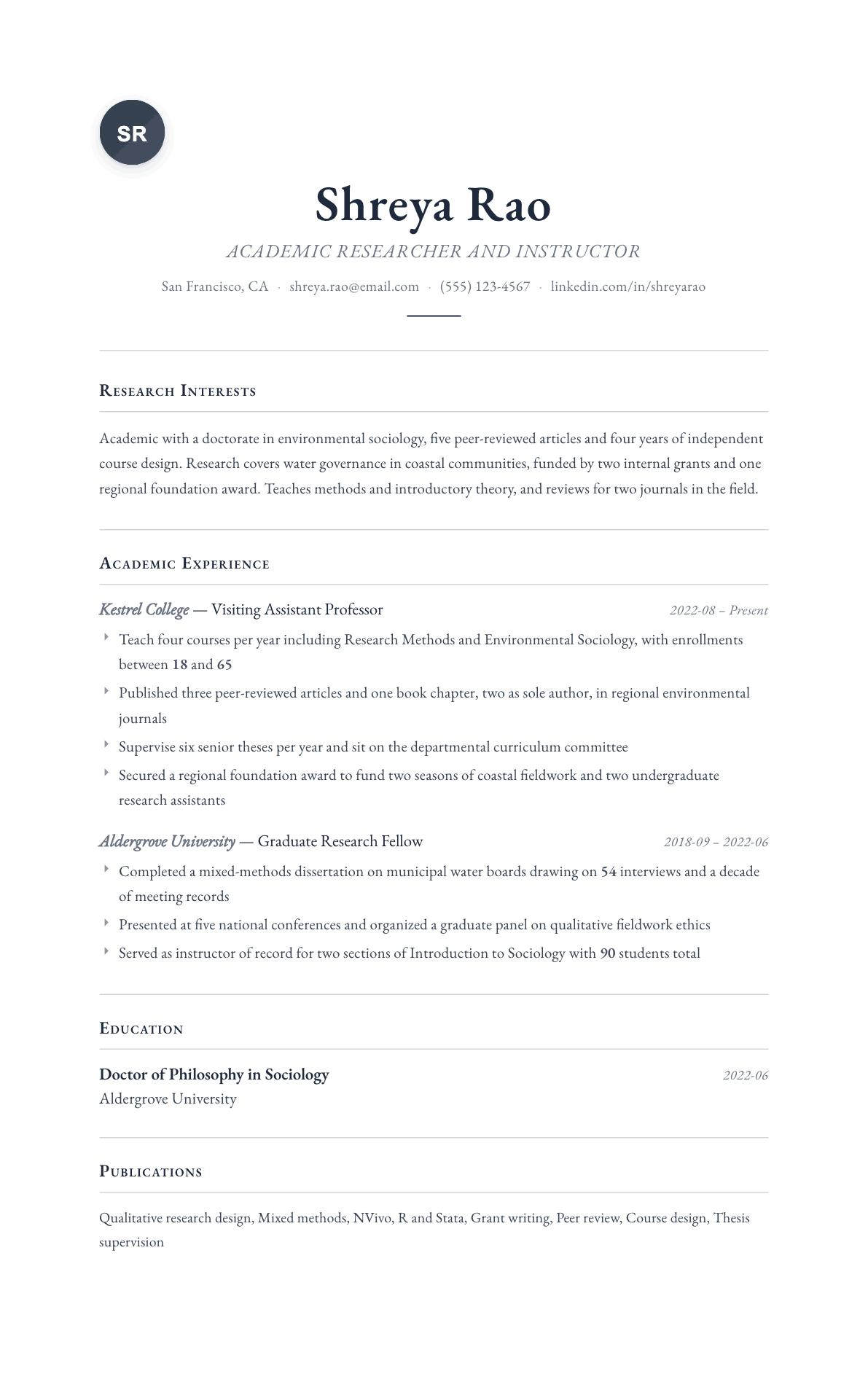
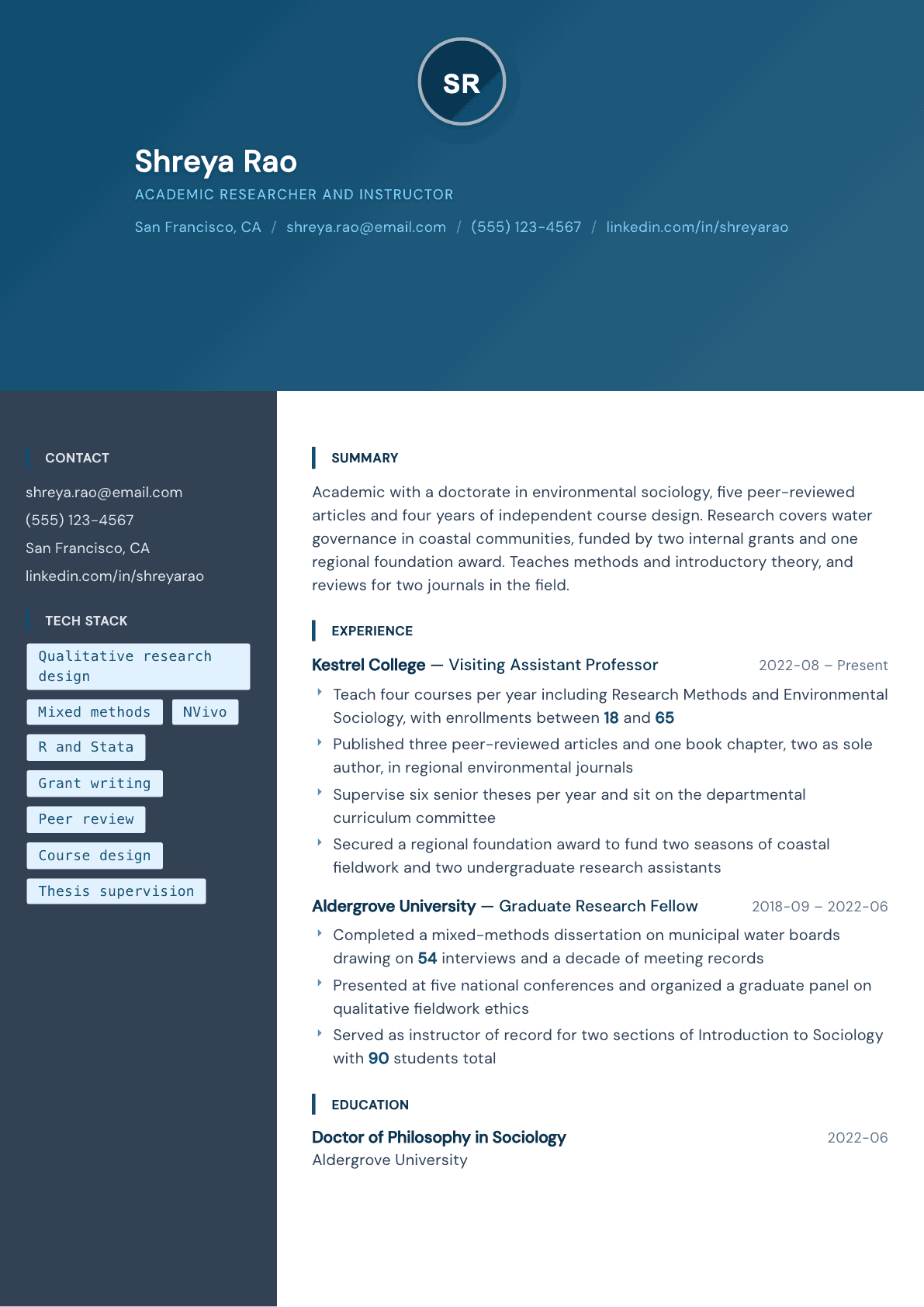
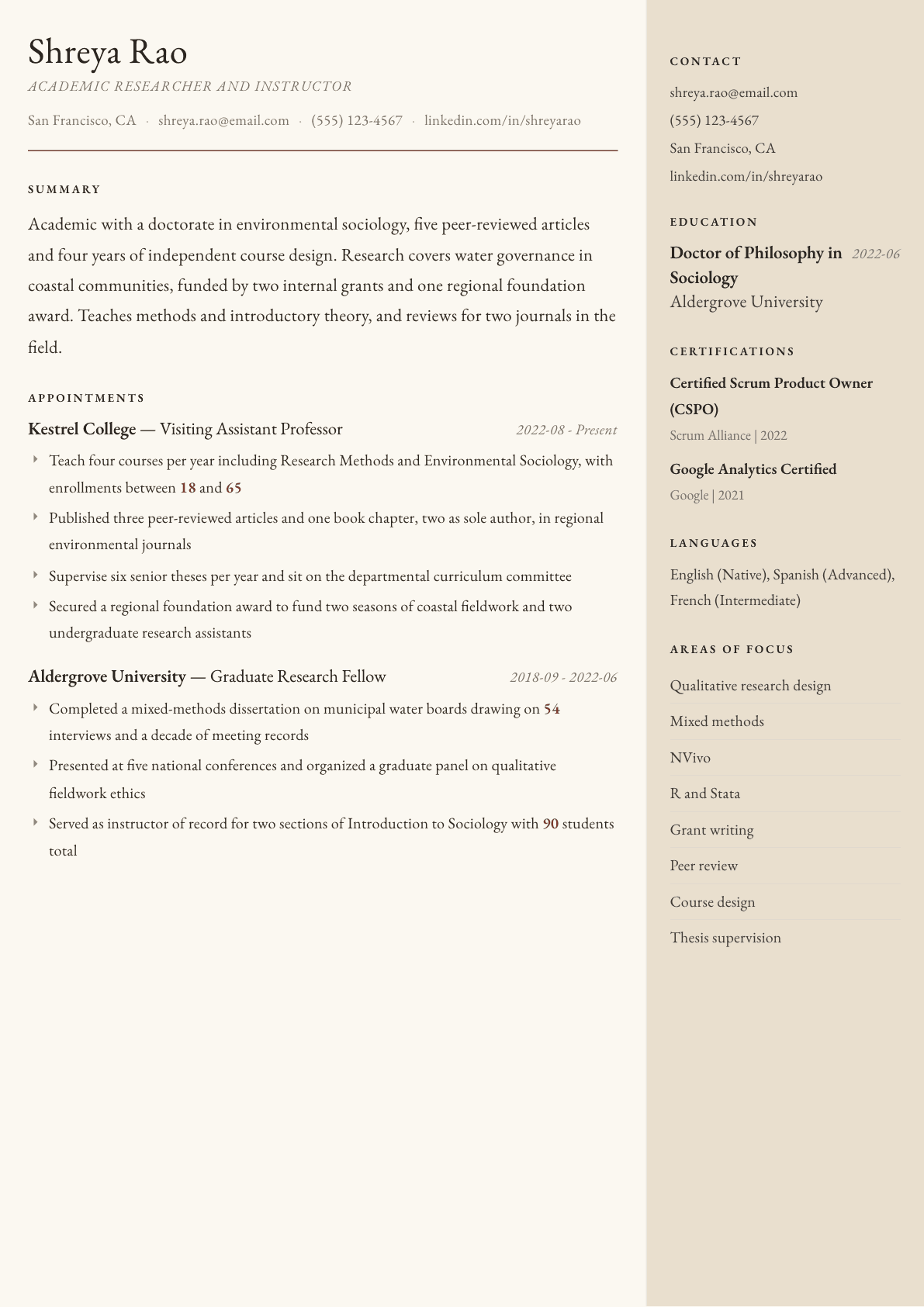
Example Academic summary
Academic sociologist with a doctorate in environmental governance and four years of independent teaching at a liberal arts college. Author of five peer-reviewed articles and one book chapter, with foundation and internal funding for coastal fieldwork. Teaches research methods and theory, supervises senior theses, and reviews for two field journals. Seeking a tenure-track position in a department with an environmental focus.
Skills to list on a Academic resume
- Research design
- Qualitative methods
- Quantitative analysis
- Mixed methods
- Academic writing
- Peer-reviewed publishing
- Grant writing
- Conference presentation
- Course design
- Undergraduate teaching
- Thesis and dissertation supervision
- Literature review
- NVivo
- R
- Institutional review board protocols
- Journal peer review
What actually gets this resume read
- Decide first whether the posting wants a two-page resume or a full curriculum vitae, because the two documents follow entirely different rules.
- Order the sections by what the committee is hiring for: research first for a research post, teaching first for a teaching-intensive department.
- Cite publications in the style of your discipline and mark your role clearly, since sole authorship and first authorship carry different weight.
- Give funding by source and purpose rather than by amount, and include internal awards, since committees read them as evidence of momentum.
- Name the courses you taught, the level, the enrollment and whether you were instructor of record or a section leader.
- Add service work as a short section: journal reviewing, committee seats, conference organizing and mentoring all count toward the file.
How to write a academic resume
The word academic covers a wide range of documents, and the first decision matters more than any sentence you write. A faculty search wants a curriculum vitae with no page limit and every publication listed. A research institute, a policy organization or a university administrative post wants a two-page resume that translates the same record into capability. Sending the wrong one is the most common failure in an academic job search.
Once you know which document you are writing, the rule is the same in both: order the sections by what the reader is hiring for. Research-intensive departments read publications and funding first. Teaching-focused colleges read the course list and evidence of student learning first. Nonacademic employers read what you can do next week.
This guide sets out how to structure an academic file, how to present publications, funding, teaching and service honestly, three summaries covering a job market candidate through an established scholar, before-and-after bullets, and the questions academics ask when they leave the departmental template behind.
Choose the document: curriculum vitae or resume
A curriculum vitae is a complete scholarly record and grows for a career. It lists every publication, presentation, grant, course, supervision and service item, in the citation style of the discipline. There is no length ceiling and no expectation of brevity.
An academic resume is two pages written for a reader outside your subfield. Publications become a count and two representative citations. Teaching becomes instructional design and communication. A dissertation becomes a project with a method, a dataset and a result. Nothing is hidden, but everything is compressed toward what the employer will use.
- Faculty, postdoctoral and fellowship applications: curriculum vitae.
- Industry research, policy, publishing, nonprofit and university administration: resume.
- Keep both current in the same file so one never drifts out of date behind the other.
Section order follows the hire
For a research post, put education, appointments, publications, funding, presentations, then teaching and service. For a teaching-intensive college, move teaching directly after education, list courses with levels and enrollments, and add a line about curricular design before the publication list.
For an administrative or nonacademic role, lead with a short professional summary, then a skills block, then experience written as accomplishments. Publications and presentations move to a compact section near the end where they read as evidence of written communication and subject authority.
Publications and presentations: precision beats volume
Use the citation format of your field and keep it consistent to the last comma. Group by type: peer-reviewed articles, book chapters, edited volumes, conference proceedings, preprints, and work under review. Never mix a manuscript in preparation into the peer-reviewed group, because a committee that catches it will discount the whole file.
Mark your role. Bold or otherwise distinguish your name, note first or corresponding authorship if your discipline signals it, and state author contributions where the field expects them. In collaborative sciences the position in the author list carries specific meaning, and a reader outside your subfield needs help decoding it.
Presentations should say invited or refereed, and name the venue. An invited seminar at a peer department reads differently from a poster at a regional meeting, and running both together loses you credit for the stronger one.
Funding, teaching and service: the three lines committees weigh
List grants and fellowships by agency, title, your role and the period. Give purpose rather than budget figures, and include internal seed awards and travel grants, especially early in a career, because committees read them as evidence that colleagues already invested in the work.
Teaching entries need the course title, the level, the enrollment and your role. Instructor of record, co-instructor, section leader and guest lecturer are not the same thing, and conflating them is a credibility risk. Add supervision separately: doctoral committees, masters theses, undergraduate research projects and their outcomes.
Service is not filler. Journal reviewing, editorial board seats, conference organizing, program committees, admissions and curriculum committees, and mentoring programs all show that you carry departmental weight. Keep it short and specific, and drop anything from more than a decade back unless it was significant.
Language and keywords for the screening layer
Even academic hiring passes through a portal now, and administrative roles pass through a full applicant tracking system. Use the terms the advertisement uses: research design, quantitative or qualitative methods, grant administration, undergraduate instruction, curriculum development, peer review, interdisciplinary collaboration.
For nonacademic applications, translate deliberately. Fieldwork becomes primary data collection. Dissertation supervision becomes mentoring and project management. A literature review becomes evidence synthesis. Conference organizing becomes event management with a budget and a committee.
Academic resume summary examples
Job market candidate
Doctoral candidate in environmental sociology completing a mixed-methods dissertation on municipal water governance drawn from 54 interviews and a decade of meeting records. Instructor of record for two sections of introductory sociology and author of one peer-reviewed article with a second under review.
Early-career academic
Academic sociologist with four years of independent teaching and five peer-reviewed articles on water governance in coastal communities. Holds a regional foundation award funding two fieldwork seasons and two undergraduate research assistants, supervises senior theses, and reviews for two field journals.
Established scholar
Associate professor with a sustained research program in environmental governance, three externally funded projects, and a monograph with a university press. Directs the graduate program, has chaired eleven doctoral committees, and serves on the editorial board of a field journal.
Work experience bullets: before and after
Before: Published several articles in academic journals.
After: Published five peer-reviewed articles and one book chapter on coastal water governance, two as sole author, in regional environmental journals.
The count, the type breakdown and the authorship role give a committee something it can actually weigh.
Before: Taught undergraduate courses.
After: Taught Research Methods and Environmental Sociology as instructor of record, four courses a year, with enrollments between 18 and 65.
Course titles, the role and enrollment range show teaching range instead of a generic claim to experience.
Before: Received grant funding for my research.
After: Secured a regional foundation award funding two seasons of coastal fieldwork and supporting two undergraduate research assistants through the project.
Naming the source and what the money did shows research management rather than a one-line honor.
Before: Did fieldwork for the dissertation.
After: Collected and coded 54 semi-structured interviews and ten years of municipal meeting records, then analyzed the corpus in NVivo alongside a panel dataset.
The method, the volume and the tools make the research legible to reviewers outside your subfield.
Before: Involved in departmental service.
After: Served on the curriculum committee, reviewed manuscripts for two field journals, and organized a graduate panel on qualitative fieldwork ethics.
Three named contributions prove departmental weight where the word involved proves nothing.
Hard skills
- Research design
- Qualitative methods
- Quantitative analysis
- Mixed-methods integration
- Academic writing and publishing
- Grant proposal development
- Peer review
- Course and curriculum design
- Thesis and dissertation supervision
- Conference presentation
- NVivo
- R and Stata
- Institutional review board protocols
- Evidence synthesis
Soft skills
- Independent project management
- Mentoring
- Collaborative authorship
- Public explanation of technical work
- Long-horizon planning
- Constructive critique
Mistakes that cost academic candidates the interview
- Sending a full curriculum vitae to an employer who asked for a resume, which reads as an inability to hear the audience.
- Mixing work in preparation into the peer-reviewed publication list, which costs you credibility across the entire file.
- Listing courses without the level, the enrollment or whether you were instructor of record.
- Hiding funding because the awards were internal, when early-career committees read internal support as a positive signal.
- Using discipline-specific jargon in a nonacademic application, so the reader cannot tell what you can do on day one.
- Letting the file run to fifteen unstructured pages with no grouping, so a reviewer with four minutes finds nothing.
Academic resume questions
How long should an academic curriculum vitae be?
As long as the record honestly requires. A job market candidate is often four to six pages, a mid-career scholar considerably longer. Length is not the problem, disorganization is. Group by type and keep every section in one citation style.
Where do publications under review belong?
In their own labeled group after published work, with the journal named only if the discipline considers that appropriate. Never place them among accepted articles, and remove anything that has been sitting unsubmitted for more than a year.
How do I write an academic resume for an industry job?
Two pages, a summary at the top, then skills and experience written as outcomes. Convert the dissertation into a project with a method, a dataset and a result, and reduce publications to a count with two representative citations.
Should I include teaching evaluations?
Only in a teaching portfolio or a dossier that asks for them. On the curriculum vitae itself, cite an award, a peer observation or a departmental comparison instead. Raw scores without institutional context invite misreading rather than credit.
What goes into the service section?
Journal reviewing, editorial roles, conference and panel organizing, departmental and university committees, and formal mentoring. List the body and your role, keep it to recent work, and drop routine attendance that carried no responsibility.