Assistant Professor Resume Examples: what gets the call
Craft an Assistant Professor Resume for a Tenure-Track Search
By Mustafa Tarabya, founder of CVBooster · Published · Updated
Assistant professor resume example covering research agenda, funding, teaching record and service, with keywords and a full writing guide.
Sample resumes for a assistant professor
The same assistant professor content laid out in three CVBooster templates, so you can see what the finished document looks like before you write a word.
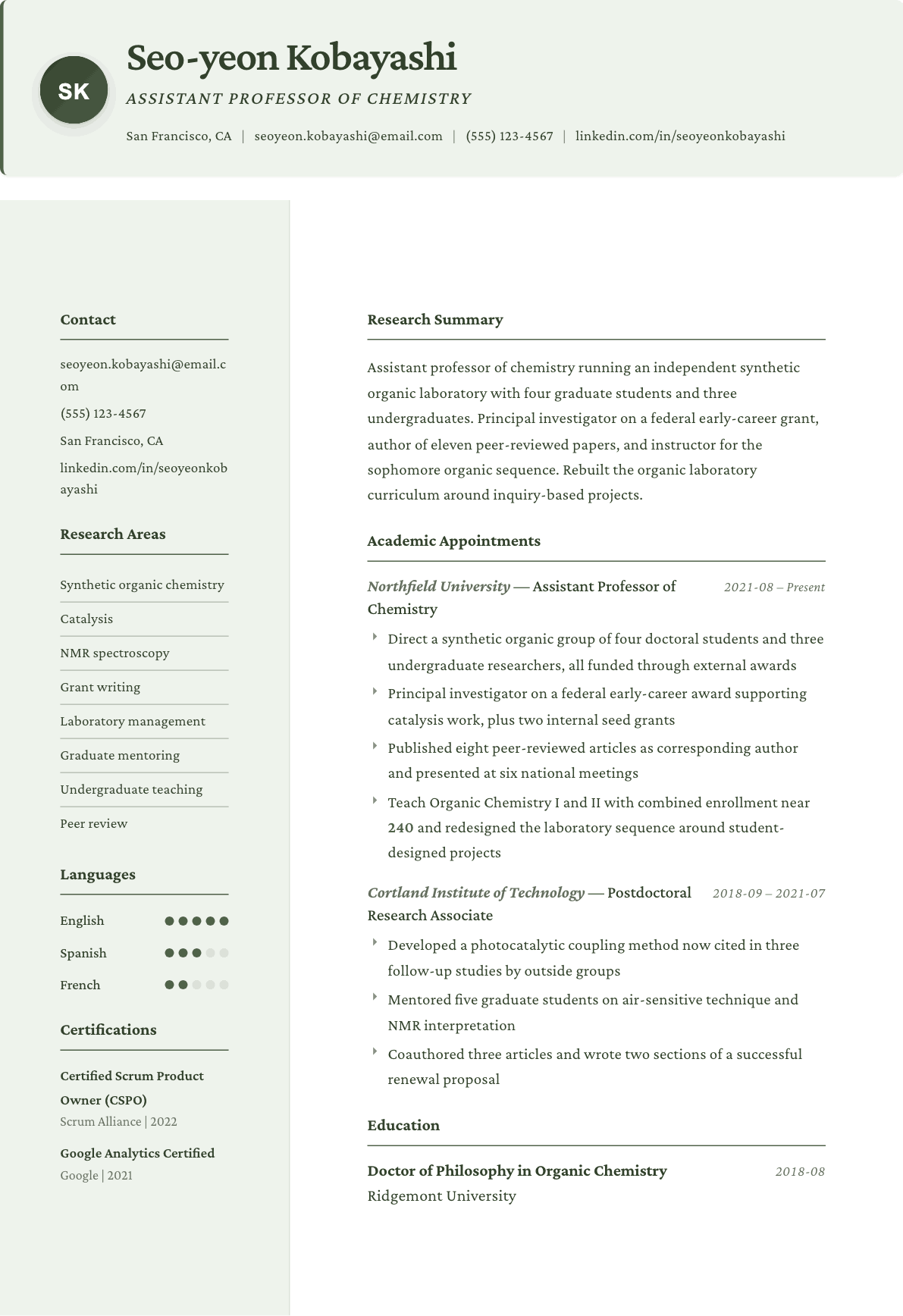
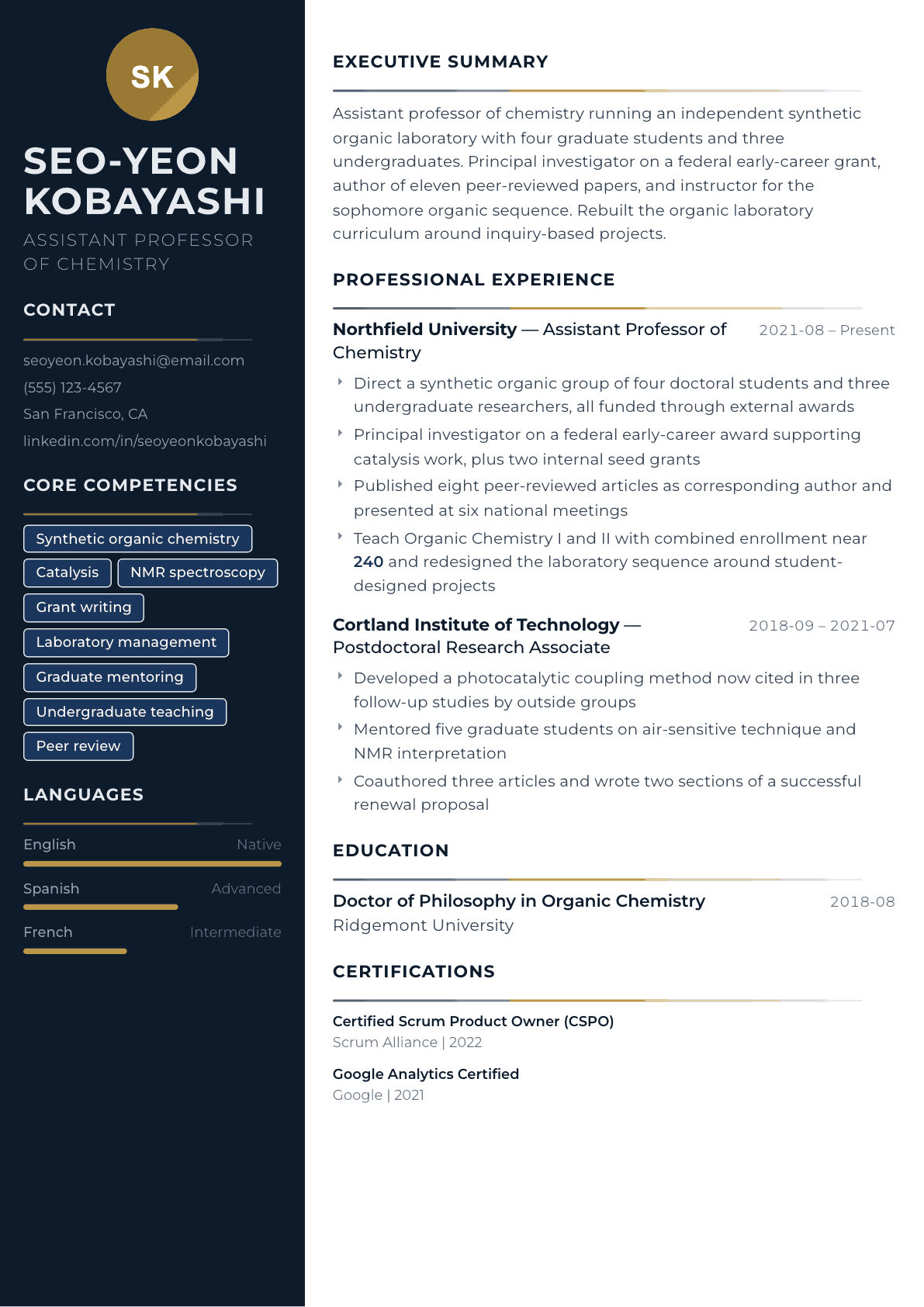
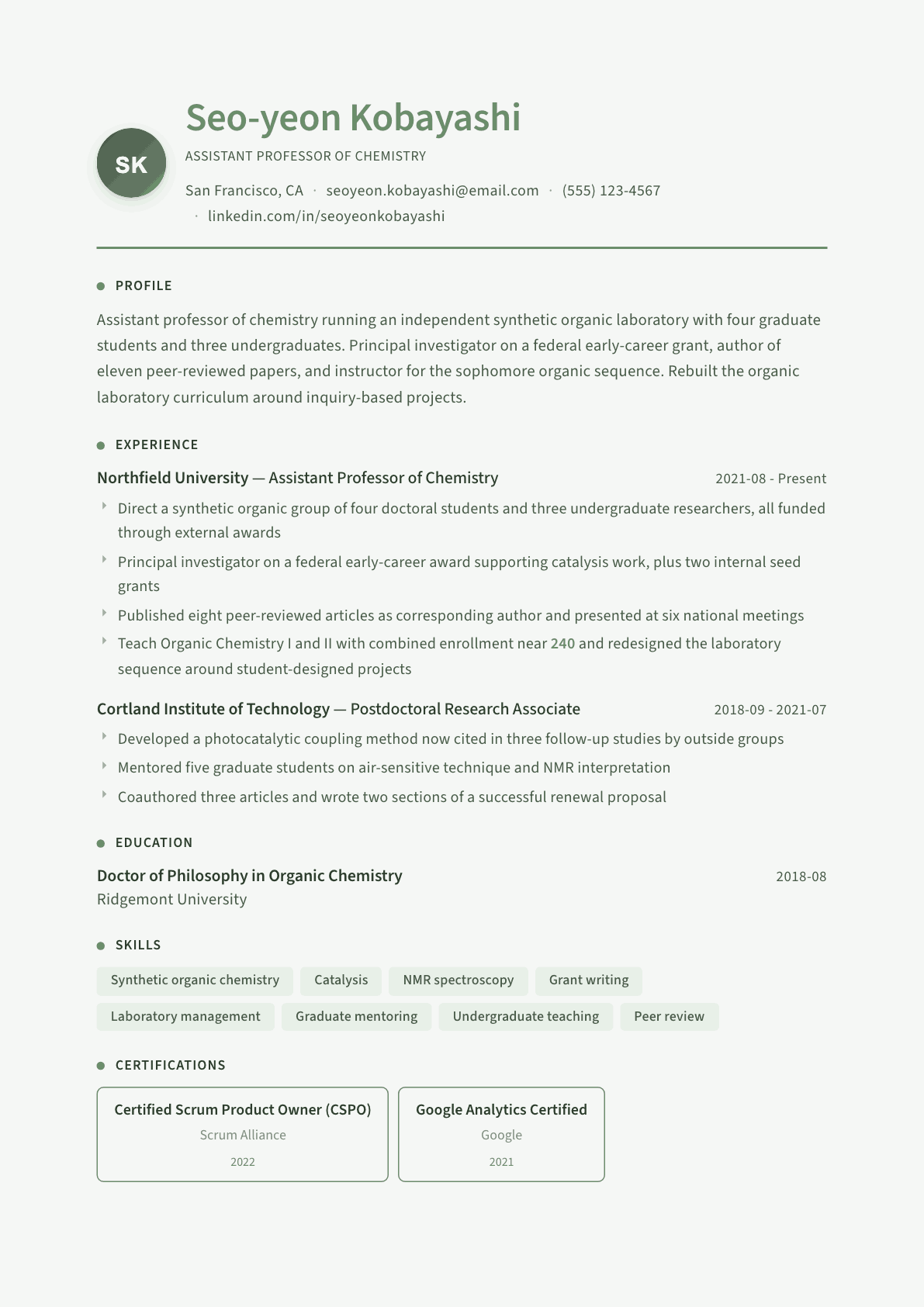
Example Assistant Professor summary
Assistant professor of chemistry with an independent synthetic laboratory, seven students under supervision, and a federal early-career award funding catalysis research. Author of eleven peer-reviewed papers, most as corresponding author, and instructor for the organic sequence enrolling more than two hundred students a year. Rebuilt the organic laboratory around inquiry projects. Seeking a tenure-track appointment at a doctoral research institution.
Skills to list on a Assistant Professor resume
- Independent research program
- Grant writing and administration
- Peer-reviewed publishing
- Laboratory management
- Graduate student mentoring
- Undergraduate research supervision
- Course design
- Lecture and laboratory instruction
- Research ethics compliance
- Conference presentation
- Journal peer review
- Departmental service
- Curriculum revision
- Scientific writing
- Collaborative research
What actually gets this resume read
- Open with a research statement in two lines: the question your laboratory or project asks and the method that makes it yours.
- Separate publications where you are corresponding or first author, since that is how a tenure committee reads productivity.
- List grants by agency, role and purpose, and include proposals under review if the search allows it.
- Show mentoring by number and level: doctoral students, masters students, undergraduate researchers and their placements after graduating.
- Give teaching as a course list with enrollments, and add one line about a curricular change you made rather than only what you delivered.
- Keep service specific to the field: journal reviewing, panel service, conference organizing and departmental committees each read differently.
How to write a assistant professor resume
An assistant professor file is evaluated by a committee of people who will live with the decision for six years. They are asking whether your research program can survive on its own, whether you can teach the courses the department needs, and whether you will be a colleague worth having in a small department during a tenure case.
The document that carries that argument is a curriculum vitae, not a resume, and it is read alongside a research statement, a teaching statement and letters. The curriculum vitae is where claims get checked. Publications, funding, mentoring and service either support the narrative in your statements or quietly contradict it.
This guide covers how to structure an assistant professor curriculum vitae, how to present authorship and funding without overstating either, three summaries from a first-time applicant to a professor approaching tenure, before-and-after bullets, and the questions candidates ask during a market season.
Structure: appointments, research, funding, teaching, service
Open with education and appointments, then publications, then funding, then presentations, then teaching, mentoring and service. Research-intensive committees read in roughly that order and stop reading if the first two sections do not hold up.
At a teaching-focused institution, move teaching and mentoring above publications and add a curricular development subsection. The same content, reordered, tells a completely different story about what you want the job to be.
- Header: name, department, institution, professional email, and a scholarly identifier if your field uses one.
- Keep one citation style throughout and never mix formats between sections.
- Add a short research areas line under the header so a committee member outside your subfield can place you.
Publications: authorship position is the argument
Group peer-reviewed articles, book chapters, conference proceedings, preprints and manuscripts under review separately. Within each group, mark your name and note first, corresponding or senior authorship according to the conventions of the discipline. In laboratory sciences, the corresponding author line is what proves the work came from your group rather than a collaborator.
Note trainee coauthors. Committees look for undergraduate and graduate students appearing on your papers, because that is the clearest evidence that a research program is producing people as well as results.
Do not inflate. Preprints listed as articles, submitted work listed as accepted, or a conference abstract dressed as a proceeding will be caught by a reviewer in your field and will color everything else in the file.
Funding: role, agency, purpose, period
List each award with the agency, the title, your role, and the period. Say principal investigator, co-investigator or senior personnel plainly. Include internal seed grants, equipment awards and instrumentation grants, because a startup-funded assistant professor who has already converted internal money into external money is exactly what a committee wants to see.
Include proposals under review as a separate labeled group if the search permits it. Momentum matters at this stage, and an active submission pipeline answers the question about whether the program will be funded through the tenure clock.
- Give the purpose of each award rather than the budget figure.
- Note whether the award supported students, instrumentation or fieldwork.
- Mention any award you wrote sections of as a postdoctoral researcher, with your role stated.
Teaching and mentoring: courses, enrollments, and what you changed
List courses by title, level and enrollment, and mark whether you were instructor of record. Add a separate line for any course you created or substantially redesigned, because curricular contribution is scored in tenure files and rarely appears clearly on a market curriculum vitae.
Mentoring gets its own section: doctoral students by name and stage, masters students, undergraduate researchers, and postdoctoral scientists if you have supervised any. Where students have moved on to graduate programs or positions, note it briefly. Placement is the evidence a committee trusts most.
Service and the language reviewers scan for
Field service reads as standing: journal reviewing, editorial roles, grant panel service, conference session organizing, and society committees. Institutional service reads as citizenship: curriculum committees, admissions, safety, seminar organizing and outreach. Keep both, keep them short, and put dates on them.
The recurring language across faculty advertisements is consistent: independent research program, extramural funding, peer-reviewed publication, graduate and undergraduate mentoring, curriculum development, interdisciplinary collaboration, and broader impacts. Use those exact phrases in the statements and let the curriculum vitae supply the evidence line by line.
Assistant Professor resume summary examples
First-time applicant
Postdoctoral chemist applying for tenure-track positions with a developing program in photocatalytic coupling. Author of eleven papers, three as first author, and coauthor of a successful renewal proposal. Mentored five graduate students on air-sensitive technique and taught one upper-division section as instructor of record.
Third year on the tenure clock
Assistant professor of chemistry directing an independent synthetic group of four doctoral students and three undergraduates. Principal investigator on a federal early-career award plus two internal seed grants, with eight papers published as corresponding author since starting the appointment.
Approaching tenure
Assistant professor approaching tenure review with a funded catalysis program, seventeen peer-reviewed papers, and two doctoral students placed into industry research roles. Rebuilt the organic laboratory sequence around student-designed projects and chairs the departmental graduate admissions committee.
Work experience bullets: before and after
Before: Run a research lab with several students.
After: Direct a synthetic organic group of four doctoral students and three undergraduate researchers, all supported through externally funded awards.
Group composition and the funding source together prove independence rather than describing a room with people in it.
Before: Received a grant to support my research.
After: Serve as principal investigator on a federal early-career award supporting catalysis work, with two internal seed grants funding preliminary studies.
Naming the role and the award type separates funded independence from participation in someone else's project.
Before: Published papers in chemistry journals.
After: Published eight peer-reviewed articles as corresponding author since starting the appointment, six with student coauthors from the group.
Corresponding authorship and student coauthors are the two signals a tenure committee reads first.
Before: Teach organic chemistry.
After: Teach Organic Chemistry I and II with combined annual enrollment near 240, and redesigned the laboratory sequence around student-designed synthesis projects.
Enrollment plus a curricular change converts a teaching line into a documented contribution.
Before: Mentor students in the lab.
After: Mentored seven researchers through independent projects, with two doctoral students defending and moving into industry research positions.
Outcomes for the people you trained are the evidence committees weigh most heavily in mentoring claims.
Hard skills
- Independent research program design
- Grant writing and administration
- Peer-reviewed publishing
- Laboratory and project management
- Graduate student supervision
- Undergraduate research mentoring
- Course and curriculum design
- Lecture and laboratory instruction
- Research compliance and safety protocols
- Conference presentation
- Journal peer review
- Data management planning
- Scientific writing
- Collaborative and interdisciplinary research
Soft skills
- Long-term planning under a tenure clock
- Recruiting and retaining students
- Constructive supervision
- Departmental collegiality
- Persuasive scientific communication
- Negotiation with collaborators
Mistakes that cost assistant professor candidates the interview
- Listing manuscripts in preparation among accepted publications, which a reviewer in the field will catch immediately.
- Leaving authorship position unmarked, so a committee outside the subfield cannot tell whose project it was.
- Omitting internal seed grants and instrumentation awards that demonstrate momentum before the first external award lands.
- Giving a course list with no enrollments, no levels and no indication of who was instructor of record.
- Burying mentoring in a paragraph when student placements are among the strongest arguments in a tenure file.
- Writing a research statement that promises a program the curriculum vitae shows no funding or publication support for.
Assistant Professor resume questions
Should I use a resume or a curriculum vitae for a tenure-track application?
A curriculum vitae, without exception. Faculty searches expect the full scholarly record with every publication, grant, course and service item listed. A two-page resume reads as unfamiliarity with academic hiring and rarely survives the first cut.
How do I show independence from my postdoctoral advisor?
Through funding, authorship and direction. Corresponding-author papers from your own group, an award where you are principal investigator, and a research direction that is visibly distinct from your training laboratory all make the case without stating it.
Do proposals under review belong on the curriculum vitae?
Yes, in a separate labeled group listing the agency, the title and your role. It shows an active pipeline, which matters when a committee is projecting whether your program will be funded across the tenure clock.
How much teaching detail should a research-intensive application include?
Enough to show competence and readiness for the departmental load. Course titles, levels, enrollments and one curricular contribution are sufficient. The teaching statement carries the philosophy, so the curriculum vitae only needs to supply the record.
What service is worth listing before tenure?
Journal reviewing, panel service, conference organizing and one or two departmental committees. Keep the list short, because a pre-tenure file overloaded with service can raise a question about protected research time rather than impress.