Postdoctoral Researcher Resume Examples: free ATS score
Write a Postdoctoral Researcher Resume for Academic and Industry Roles
By Mustafa Tarabya, founder of CVBooster · Published · Updated
Postdoctoral researcher resume example with project, technique and funding language, publication handling, keywords and a full writing guide.
Sample resumes for a postdoctoral researcher
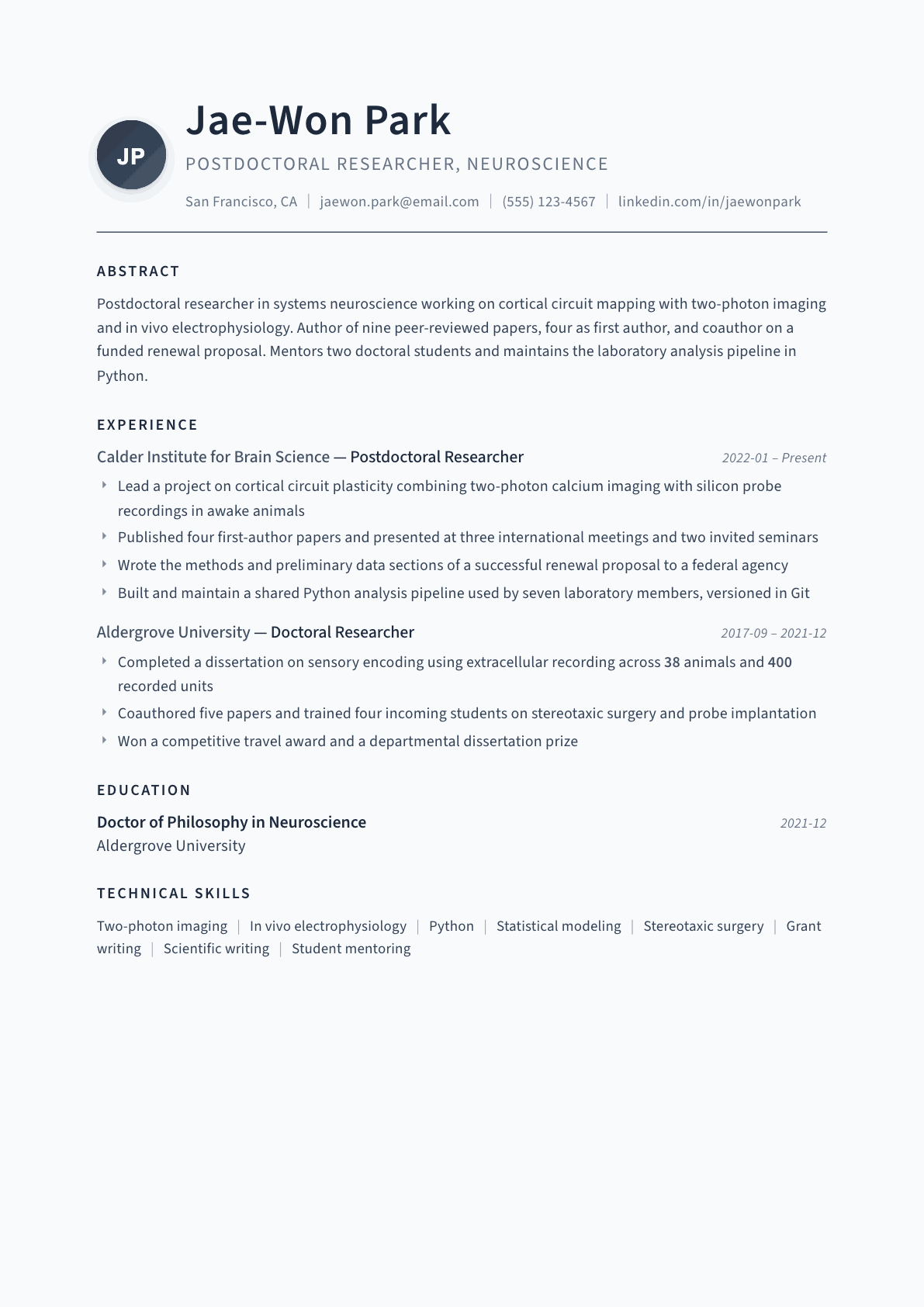
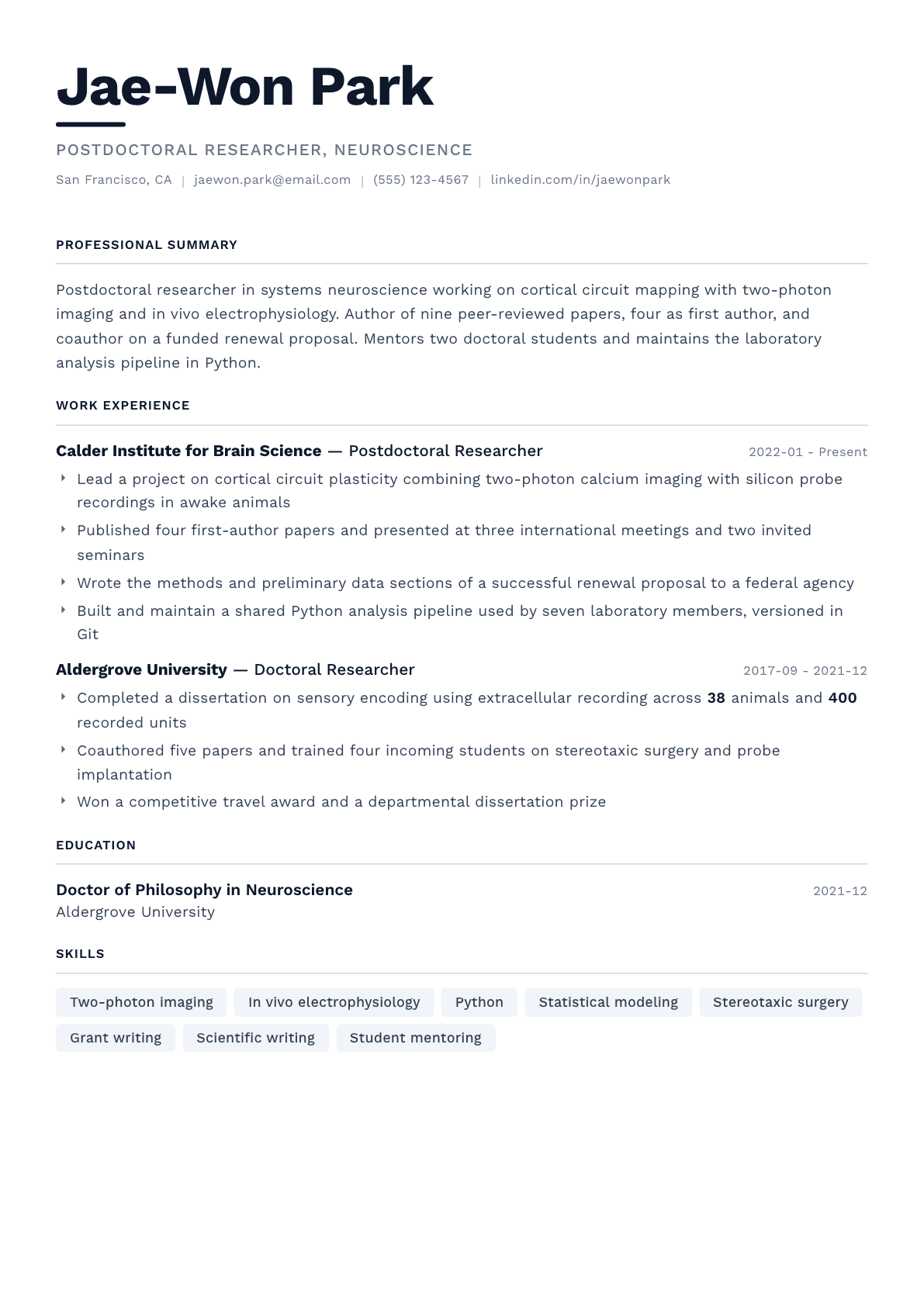
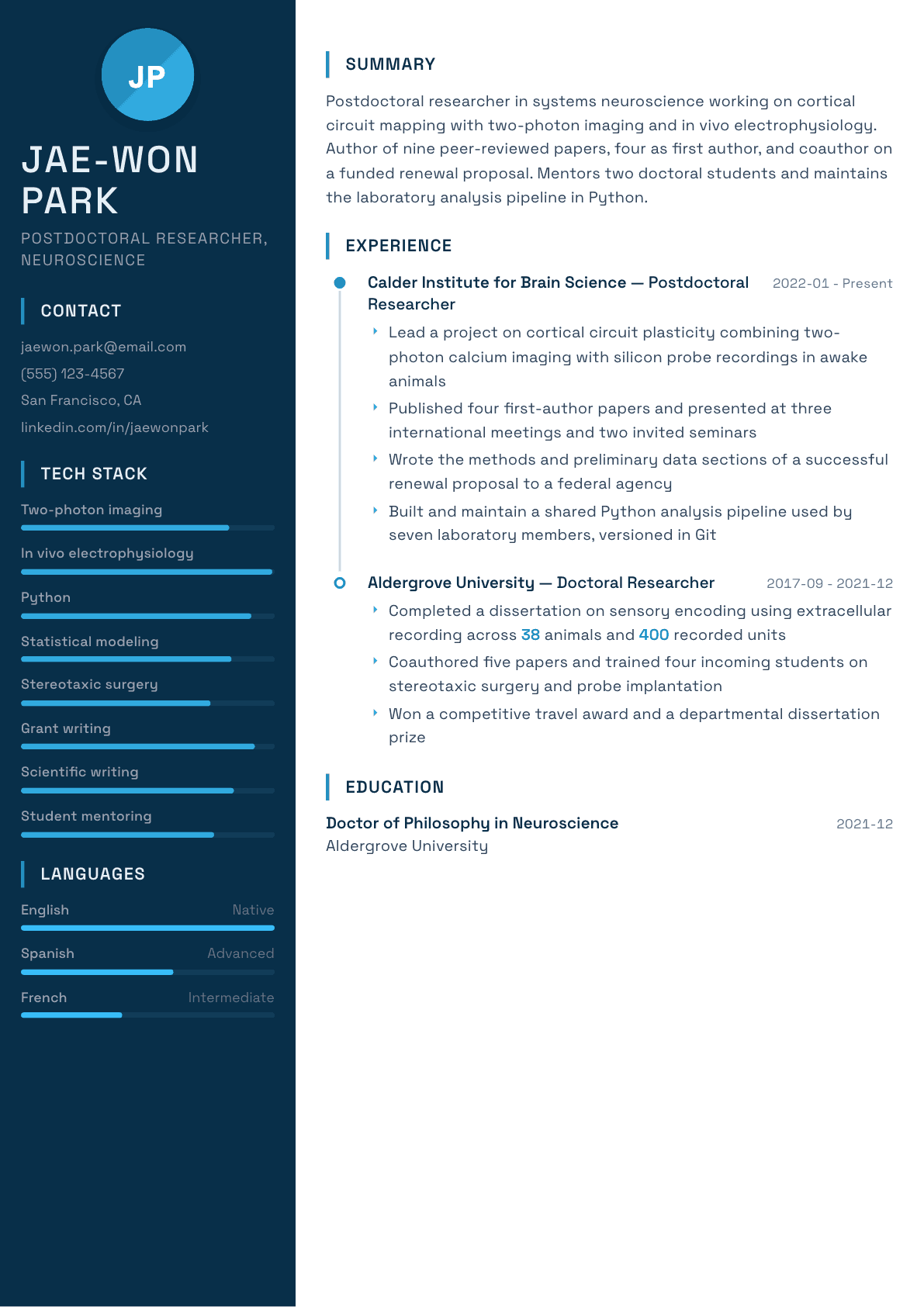
The same postdoctoral researcher content laid out in three CVBooster templates, so you can see what the finished document looks like before you write a word.
Example Postdoctoral Researcher summary
Postdoctoral researcher in systems neuroscience combining two-photon imaging with in vivo electrophysiology to map cortical circuits. Author of nine peer-reviewed papers, four as first author, and contributor to a funded federal renewal proposal. Maintains a shared Python analysis pipeline used across the laboratory and mentors two doctoral students. Seeking a tenure-track faculty position or a senior scientist role in industry research.
Skills to list on a Postdoctoral Researcher resume
- Experimental design
- Data analysis
- Python
- R
- Statistical modeling
- Scientific writing
- Grant proposal writing
- Peer-reviewed publishing
- Conference presentation
- Laboratory technique development
- Student mentoring
- Version control with Git
- Reproducible analysis pipelines
- Literature review
- Research compliance protocols
What actually gets this resume read
- Write the document twice: a curriculum vitae for faculty searches and a two-page resume for industry, with the projects reframed as capability.
- Lead each position with the research question and the technique, because reviewers scan for method fit before they read anything else.
- Mark first and corresponding authorship clearly, and put preprints and manuscripts under review in their own labeled group.
- Name the funding you contributed to and the sections you wrote, since postdoctoral candidates are judged on emerging grant independence.
- List computational tooling separately from bench technique, as many postings now screen on Python, R or specific analysis frameworks.
- Show mentoring and laboratory infrastructure work, because independence is proven by what runs without the principal investigator present.
How to write a postdoctoral researcher resume
A postdoctoral researcher is in a strange position on paper: too experienced to be judged as a student, not yet holding the independence markers a faculty search wants. The file has to close that gap by showing that projects run under your direction, that funding proposals carry your writing, and that other people in the laboratory depend on infrastructure you built.
The second complication is audience. Postdoctoral researchers apply to faculty searches, to research institutes, and to industry teams, and those three readers want different documents. A curriculum vitae for the first, and a two-page resume framed around capability for the last two.
This guide covers both versions, how to present authorship and funding contribution honestly, three summaries from a first-year postdoctoral appointment to a senior one, before-and-after bullets, and the questions researchers ask when the appointment is ending and the next move is unclear.
Two documents from one record
The curriculum vitae lists education, appointments, publications, funding, presentations, teaching, mentoring and service in full, in your field citation style. Nothing is compressed and nothing is left out.
The industry resume is two pages. Each position opens with the research question and the method, then bullets that read as delivered capability: a pipeline built, an assay validated, a model deployed, a dataset assembled, a technique transferred to another group. Publications become a count with two representative citations near the end.
- Faculty and fellowship applications: curriculum vitae, no length limit.
- Industry, government laboratory and nonprofit research: two-page resume.
- Keep a master record so both versions stay synchronized after every paper.
Position entries: question, method, result, in that order
Reviewers scan for method fit before anything else. Open each appointment with the research question and the core techniques, then let the bullets carry the results. A neuroscientist who leads with cortical circuit plasticity, two-photon calcium imaging and silicon probe recordings has already answered the first three questions a hiring committee would ask.
Say which parts of the project were yours. Designed the study, built the rig, wrote the analysis, collected the data, or inherited an existing pipeline are all defensible, and being precise about it reads as maturity rather than modesty.
Publications and funding: contribution over volume
Group first-author work separately, mark corresponding authorship, and put preprints and manuscripts under review in their own labeled section. A short paper record with three strong first-author papers usually beats a long list where you are the fifth of nine authors, provided the grouping makes that visible.
Funding is where postdoctoral files most often undersell. Fellowships you won, proposals you contributed to and the sections you wrote all count. Saying that you wrote the methods and preliminary data sections of a successful renewal is credible and specific in a way that a vague claim of grant experience never is.
Give purpose rather than budget figures. What the money bought, whose salary it covered and how long it ran tell a committee more about research management than a dollar amount ever would.
Independence: infrastructure, mentoring and collaboration
Independence is proved by what continues without the principal investigator in the room. A shared analysis pipeline maintained in version control, a technique you established and transferred to two other groups, a collaboration you initiated with another department, or a protocol adopted across the laboratory are all direct evidence.
Mentoring belongs in the same argument. Name the students you trained, what you trained them on, and where they went. A postdoctoral researcher who has taught four people stereotaxic surgery and probe implantation has already done a supervisory job that a faculty appointment will demand from week one.
- List technical infrastructure you own by name and by user count.
- Note invited talks separately from contributed conference presentations.
- Include peer reviewing, since it is often the first professional service a postdoc holds.
Translating for industry
Industry teams read for delivery. Convert each academic accomplishment into what it produced: a reproducible workflow, a validated method, a documented dataset, a model with measured performance, a tool other teams use. Keep the science, drop the field-specific shorthand that only your subfield decodes.
Name the computational stack separately, because many research postings screen on it directly: Python, R, version control, containerization, workflow managers, statistical frameworks and cloud compute. A researcher who writes maintained code with tests is unusual and should say so.
Postdoctoral Researcher resume summary examples
First-year postdoc
Postdoctoral researcher in systems neuroscience beginning a project on cortical circuit plasticity using two-photon calcium imaging in awake animals. Author of five papers from doctoral work, one as first author, and experienced in stereotaxic surgery, probe implantation and extracellular recording analysis.
Third year
Postdoctoral researcher combining two-photon imaging with silicon probe recordings to map cortical circuits. Four first-author papers, three international presentations, and authorship of the methods and preliminary data sections of a funded federal renewal. Maintains the shared Python analysis pipeline used by seven laboratory members.
Senior postdoc on the market
Senior postdoctoral researcher with nine peer-reviewed papers, an independent line of work on circuit plasticity, and a fellowship supporting the final two years. Mentors two doctoral students, reviews for three journals, and has transferred an imaging protocol to two collaborating laboratories.
Work experience bullets: before and after
Before: Worked on a project about brain circuits.
After: Led a project on cortical circuit plasticity combining two-photon calcium imaging with silicon probe recordings in awake behaving animals.
The question and the two techniques let a reviewer judge method fit in a single line.
Before: Published several papers during the postdoc.
After: Published four first-author papers and presented the work at three international meetings and two invited departmental seminars.
First authorship and the invited talks are the two markers that signal an emerging independent reputation.
Before: Helped write a grant proposal.
After: Wrote the methods and preliminary data sections of a successful federal renewal proposal, including all figures from my own recordings.
Naming the sections you wrote turns a shared credit into a specific, checkable contribution.
Before: Wrote analysis code for the lab.
After: Built and maintain a shared Python analysis pipeline used by seven laboratory members, versioned in Git with regression tests and written documentation.
User count, version control and tests distinguish maintained infrastructure from personal scripts.
Before: Trained students in the lab.
After: Trained four incoming graduate students on stereotaxic surgery, probe implantation and spike sorting, with two now running the technique independently.
Naming the techniques and the outcome shows supervision capability rather than incidental help.
Hard skills
- Experimental design
- Quantitative data analysis
- Python
- R
- Statistical modeling
- Version control with Git
- Reproducible analysis pipelines
- Scientific writing
- Grant proposal development
- Peer-reviewed publishing
- Conference presentation
- Laboratory technique development
- Research compliance protocols
- Literature synthesis
Soft skills
- Project ownership
- Mentoring junior researchers
- Cross-laboratory collaboration
- Written communication for mixed audiences
- Troubleshooting under uncertainty
- Time management across parallel projects
Mistakes that cost postdoctoral researcher candidates the interview
- Sending a full curriculum vitae to an industry research team that asked for a two-page resume.
- Leaving authorship position unmarked so a reader cannot separate your projects from your collaborations.
- Describing a project without naming the technique, which is the first thing a reviewer screens on.
- Understating grant contribution by omitting the sections you wrote and the figures you supplied.
- Treating code as invisible work when maintained pipelines are among the strongest independence signals available.
- Listing every conference poster equally instead of separating invited talks from contributed presentations.
Postdoctoral Researcher resume questions
How do I show independence while still working in someone else's laboratory?
Point at what runs on your authority. A project you designed, infrastructure other members depend on, a collaboration you initiated, students you trained, and proposal sections you authored all demonstrate independence without claiming a title you do not hold.
Should I list manuscripts under review?
Yes, in a clearly labeled separate group with the status stated. Never place them among published articles. If a manuscript has been under review for an unusually long time, be ready to explain the situation in an interview.
How do I write a postdoctoral resume for industry?
Two pages, capability first. Open each position with the question and the method, then write bullets as delivered outcomes: pipelines, validated assays, documented datasets, models with measured performance. Compress publications to a count and two representative citations.
Does teaching experience help a postdoctoral applicant?
It helps for faculty searches, especially at institutions with a teaching load. List courses, guest lectures and any formal training in course design. For industry applications, reframe it as technical training delivery and audience-appropriate communication.
How long can a postdoctoral appointment run before it hurts?
There is no fixed limit, but a long appointment needs a visible trajectory. Show a growing first-author record, a fellowship or proposal contribution, and expanding mentoring so the file reads as building independence rather than staying in place.