College Professor Resume Examples: the lines they read
Build a College Professor CV That Earns Tenure
By Mustafa Tarabya, founder of CVBooster · Published · Updated
College Professor resume examples with expert tips, ATS keywords, and professional templates. See exactly what a winning associate professor resume looks like.
Sample resumes for a college professor
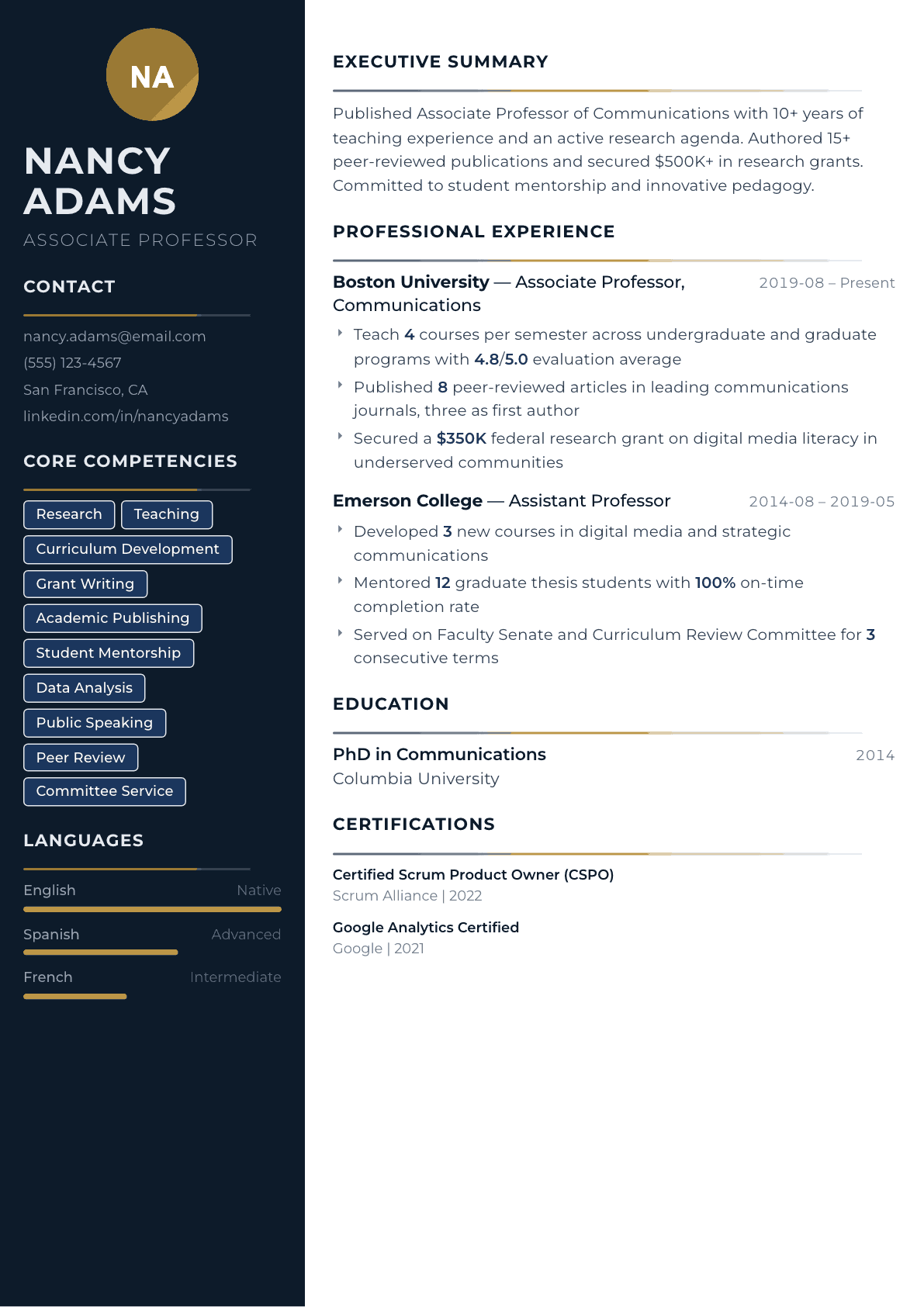
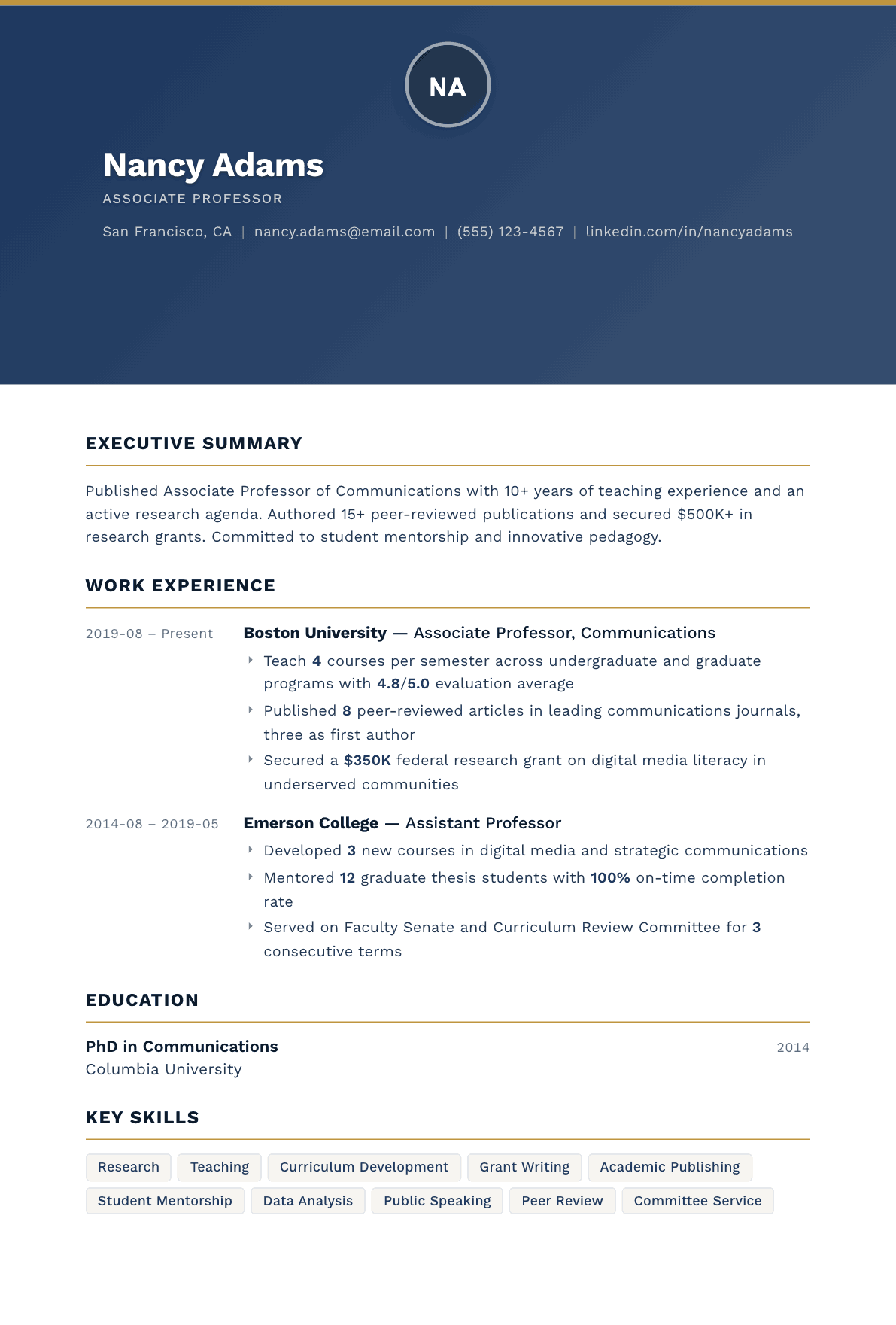
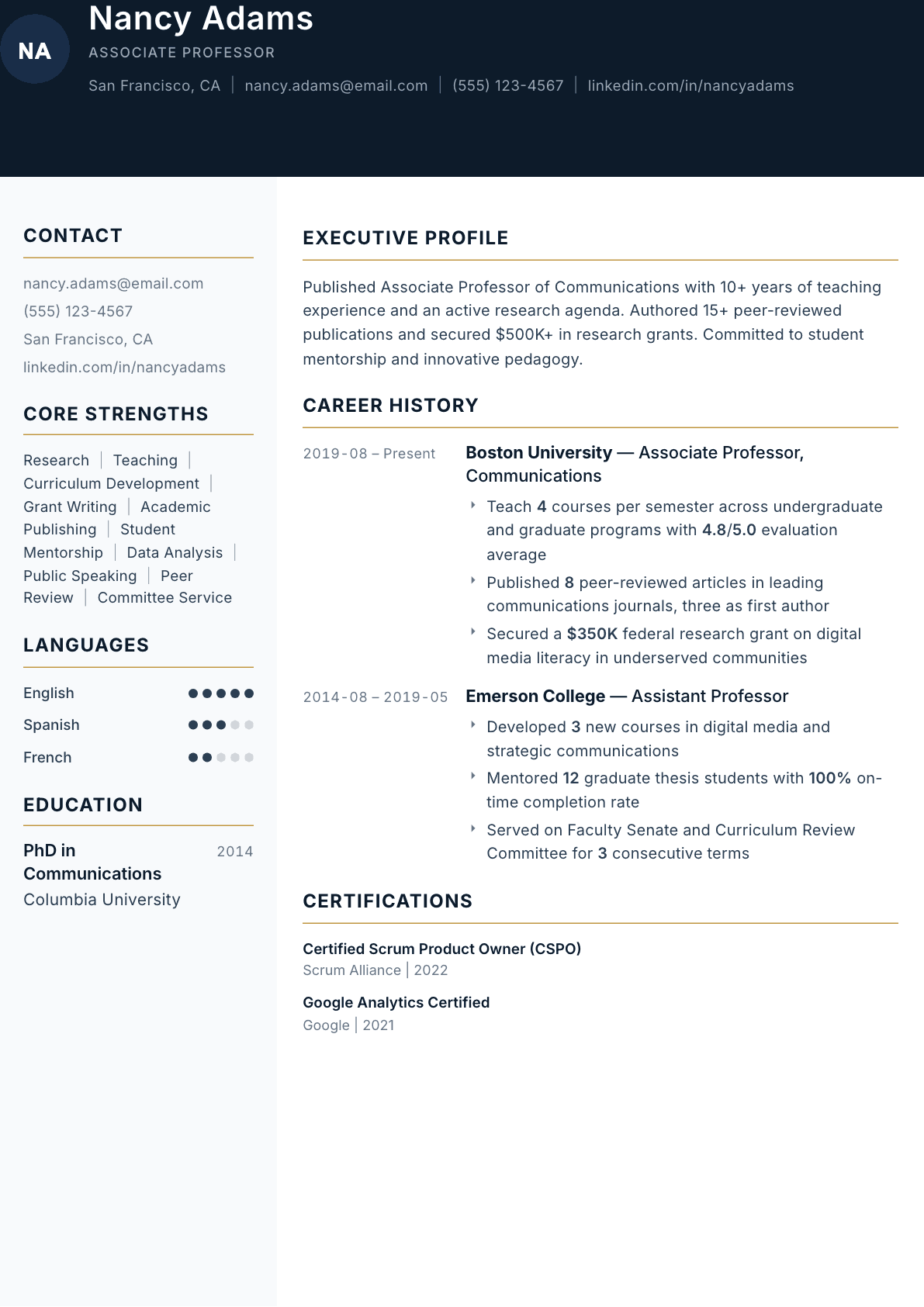
The same college professor content laid out in three CVBooster templates, so you can see what the finished document looks like before you write a word.
Example College Professor summary
Associate professor of communications, tenure track since 2014, teaching four courses a semester at a 4.8 evaluation average across undergraduate and graduate programs. Fifteen peer-reviewed articles, $500K in grant funding, twelve graduate theses supervised to on-time completion, and three new courses built from scratch.
Skills to list on a College Professor resume
- Research
- Teaching
- Curriculum Development
- Grant Writing
- Academic Publishing
- Student Mentorship
- Data Analysis
- Public Speaking
- Peer Review
- Committee Service
What actually gets this resume read
- Lead with your research focus, publications, and grant funding.
- Include teaching evaluations and courses developed.
- List all peer-reviewed publications in proper academic format.
- Highlight student mentorship and committee service.
- Show conference presentations and invited talks.
How to write a college professor resume
A faculty application is read by a search committee of your future colleagues, not by a recruiter. They are scoring against a rubric drawn straight from the advertisement, and the first pass is fast: does this person have the degree in hand or a defensible defense date, does the research fit the line we advertised, can they teach the courses we need covered next fall, and will they still be productive in six years when tenure is decided.
The document itself is different from every other resume. Academic hiring runs on a curriculum vitae, which is comprehensive and grows without limit, while a two-page resume is what you use for a teaching-focused college that asks for one, for administrative posts, or for industry. Sending a trimmed resume to a research university search reads as though you have nothing to list, and sending a twenty-page vitae to a community college teaching post reads as a poor fit.
This guide covers what belongs on a faculty vitae and in what order, how to write publications and grants so a committee can weigh them, what a teaching-focused college wants that a research university does not, and the questions candidates ask when moving between institution types or coming in from industry.
Choose the document: vitae for faculty, resume when the posting asks
For tenure-track and postdoctoral positions, send a curriculum vitae with no page limit and no summary paragraph. It is a record, not a pitch, and the persuading is done in the cover letter, the research statement and the teaching statement that accompany it.
Send a two-page resume only when the posting says resume, which usually means a teaching-focused institution, an administrative role, an adjunct pool with a fast hiring process, or a move to industry. In that case, keep a short profile, a selected publications section rather than a complete one, and lead with courses taught and enrollment.
- Vitae order: education, appointments, publications, grants, presentations, teaching, advising, service, professional memberships.
- Teaching-focused applications move teaching and courses taught above publications.
- Include a defense date and committee status if the doctorate is not yet conferred, because the committee will look for it.
Research record: publications and grants a committee can weigh
Use the citation style of your discipline and use it consistently, since the committee reads in that style all day. Separate peer-reviewed journal articles, book chapters, books, edited volumes, conference proceedings, and manuscripts under review or in preparation. Never blur those categories, because a reviewer who finds an under-review paper listed among published work stops trusting the rest of the page.
Make your own contribution legible. Bold or otherwise mark your name in author lists, note corresponding authorship, and in fields where author order carries meaning, say so. If your discipline weighs venue heavily, include the journal and, where it is conventional in your field, acceptance information for the conference.
Grants belong in their own section with the funder, the role, the period and the award status. Give the role precisely: principal investigator, co-principal investigator, senior personnel or named contributor. Include internal awards, seed funding and unsuccessful applications that reached a scored review only where your field treats that as meaningful.
Teaching: courses, level, enrollment, and evidence of quality
List courses by title and number with the level, the enrollment and whether you were instructor of record or a teaching assistant. A committee filling a service course wants to know if you have taught a section of two hundred, and a small college wants to know if you can carry four preparations a term.
Add evidence, not adjectives. Student evaluation summaries where your institution reports them, peer teaching observations, courses you designed from nothing, curriculum revisions, online and hybrid course development, and any teaching award or certificate in college teaching. Mentoring counts as teaching: undergraduate researchers supervised, thesis and dissertation committees, and where those students went next.
For a teaching-focused institution, put this section above research and expand it. For a research university, keep it accurate and compact, then let the teaching statement carry the philosophy.
Service, and the parts of the job that get you tenured
Service is scored more heavily than early career candidates expect, because departments are choosing a colleague who will sit on committees for decades. List department, college and university committees with your role and years, then disciplinary service: journal reviewing with the journal names, editorial board positions, conference organizing, program committee work, and society office.
Add outreach and public engagement where your field values it, along with mentoring programs, recruitment work and community partnerships. Keep the entries factual with dates rather than describing them.
Fit signals a search committee reads between the lines
Committees hire for a specific line, so make the fit unmistakable in the first page. If the advertisement names a subfield, that subfield should appear in your appointments, your recent publications and the courses you say you can teach. A vitae that could have been sent to any department in the discipline is usually read as a broadcast application.
Signal the trajectory as well as the record. Work under review, funded projects still running, data collection in progress and an articulated next project all tell a committee that productivity will continue after the move, which is the real question behind every tenure-track hire.
College Professor resume summary examples
Job market candidate
Doctoral candidate in sociology defending in May, with three peer-reviewed articles and a dissertation on labor migration in mid-size cities. Instructor of record for four sections of introductory sociology and research methods, and recipient of a graduate teaching award. Seeking a tenure-track appointment.
Assistant professor going up for tenure
Assistant professor of communications with eleven peer-reviewed articles, a university press book manuscript under contract, and a federally funded three-year grant as principal investigator. Teaches five distinct courses including two she designed, and chairs two doctoral committees.
Tenured professor
Tenured associate professor and department chair with a sustained publication record, continuous external funding across nine years, and 14 doctoral students supervised to completion. Serves on two editorial boards, chaired the university curriculum committee, and led a departmental program review.
Work experience bullets: before and after
Before: Published several articles in academic journals.
After: Published nine peer-reviewed articles as first or corresponding author, including three in the flagship journal of the subfield, with two additional manuscripts under review.
Count, authorship position, venue quality and pipeline let a committee weigh the record instead of guessing at it.
Before: Taught undergraduate courses in the department.
After: Served as instructor of record for six courses across four preparations, including a 220-student introductory lecture and a capstone seminar redesigned around a semester-long field project.
Course count, enrollment scale and the redesign show teaching capacity rather than teaching presence.
Before: Received grant funding for research.
After: Held a three-year federal award as principal investigator supporting two graduate assistantships and a national survey, with a no-cost extension approved and a renewal application submitted.
Role, duration, what the money supported and current status are what a committee checks on any funding line.
Before: Mentored graduate students.
After: Chaired four completed dissertations and served on eleven committees, with three advisees placed in tenure-track positions and two in government research posts.
Placement outcomes are the accepted evidence of mentoring, and committee counts show sustained departmental contribution.
Before: Active in service to the department and the profession.
After: Chaired the departmental graduate admissions committee for three cycles, reviewed for four journals in the field, and organized a two-day preconference workshop for the national association.
Named roles, cycles and venues turn service from a claim into a verifiable record.
Hard skills
- Peer-reviewed publishing
- Grant writing and proposal development
- Research design and methodology
- Quantitative and qualitative data analysis
- Institutional review board protocols
- Course design and syllabus development
- Learning management system instruction
- Online and hybrid course development
- Dissertation and thesis supervision
- Laboratory or research group management
- Conference presentation and organization
- Journal and proposal peer review
- Assessment and program review
- Academic advising
Soft skills
- Lecturing to large sections
- Mentoring across career stages
- Collaboration across disciplines
- Persistence through revise and resubmit
- Committee negotiation
- Communicating research to nonspecialists
Mistakes that cost college professor candidates the interview
- Sending a two-page resume to a tenure-track search that expects a full curriculum vitae, or the reverse at a teaching college.
- Mixing published, accepted, under review and in preparation work into one list, which makes a committee doubt the whole record.
- Listing courses without level, enrollment or whether you were instructor of record.
- Writing a broadcast vitae that never names the subfield in the advertisement, so the committee cannot see the fit.
- Treating service as an afterthought when departments are hiring a colleague who will sit on committees for years.
- Omitting the defense date when the doctorate is not yet conferred, which raises a question you could have answered in four words.
- Padding presentations with every departmental talk so that invited and national presentations lose their weight.
College Professor resume questions
Should a college professor use a resume or a curriculum vitae?
Use a curriculum vitae for tenure-track, postdoctoral and research positions, with no page limit. Use a two-page resume only when the posting explicitly asks for one, which typically means an administrative role, an adjunct pool, or a move out of academia.
How long should an academic vitae be?
As long as the record requires. A job market candidate might have four to six pages and a senior professor thirty or more. Length is never the problem, but disorganization is, so keep clear section headings and a consistent citation style throughout.
Where do I list papers that are under review?
In a clearly separate subsection labeled under review or in preparation, placed after published work, with the venue only if it has been submitted there. Never fold them into the published list, because a committee that catches it will discount everything else on the page.
How do I apply for a teaching-focused position from a research university?
Move teaching above research and expand it: courses taught with enrollments, courses designed, evaluation summaries, curriculum work and undergraduate mentoring. Then trim publications to a selected list, and address in the cover letter why a heavier teaching load is what you want.
Can I move into a professorship from industry?
It is common in professional fields such as engineering, business, nursing, law and computing, usually through clinical, teaching or professor of practice titles. Lead with practitioner depth, industry projects, any adjunct teaching, and professional credentials rather than trying to compete on publication count.