Researcher Resume Examples: free ATS score and gap list
Build a Researcher Resume That Survives the First Screen
By Mustafa Tarabya, founder of CVBooster · Published · Updated
A researcher resume guide with sample entries, method and publication keywords, and section order for academic, industry and policy research jobs.
Sample resumes for a researcher
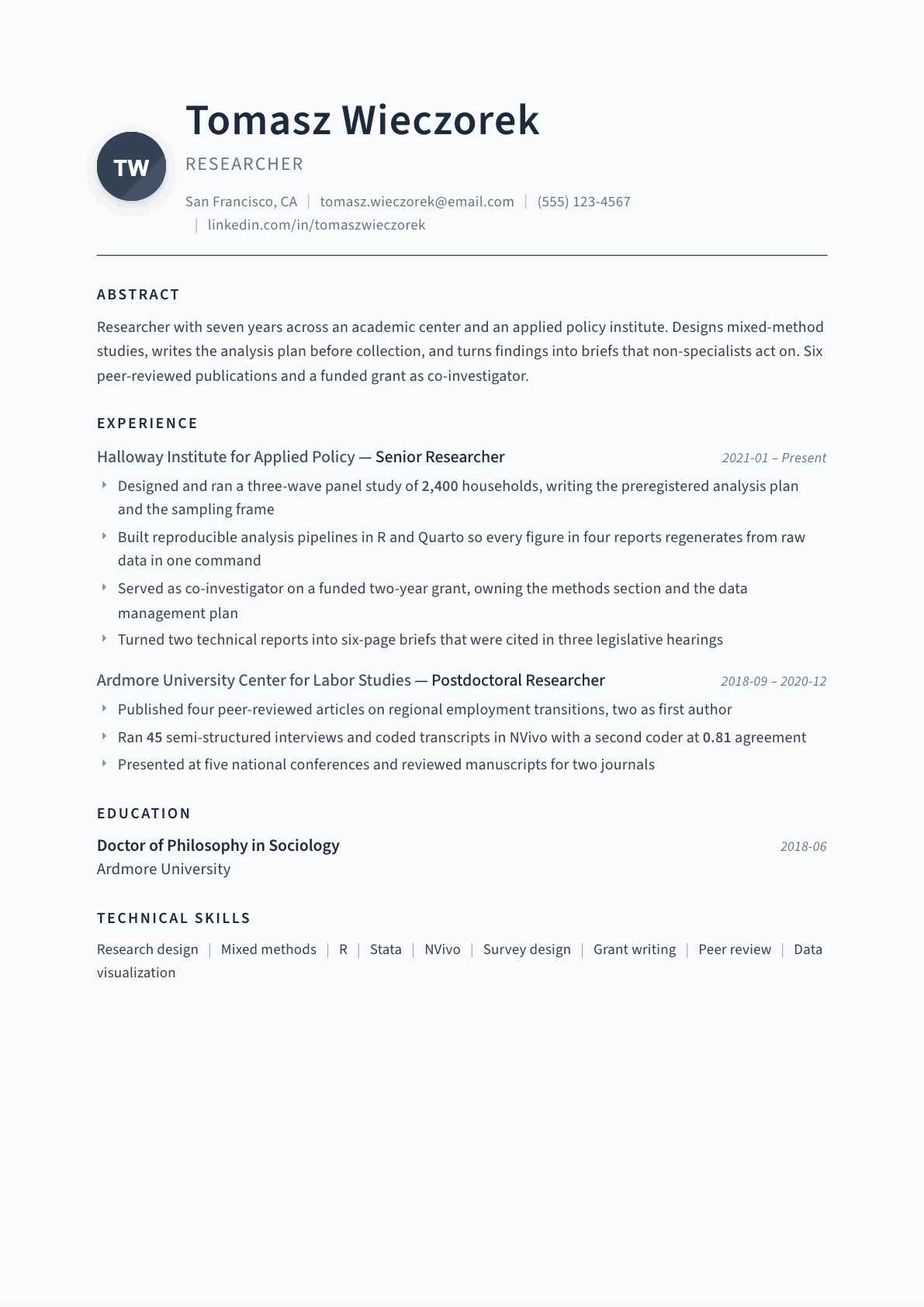
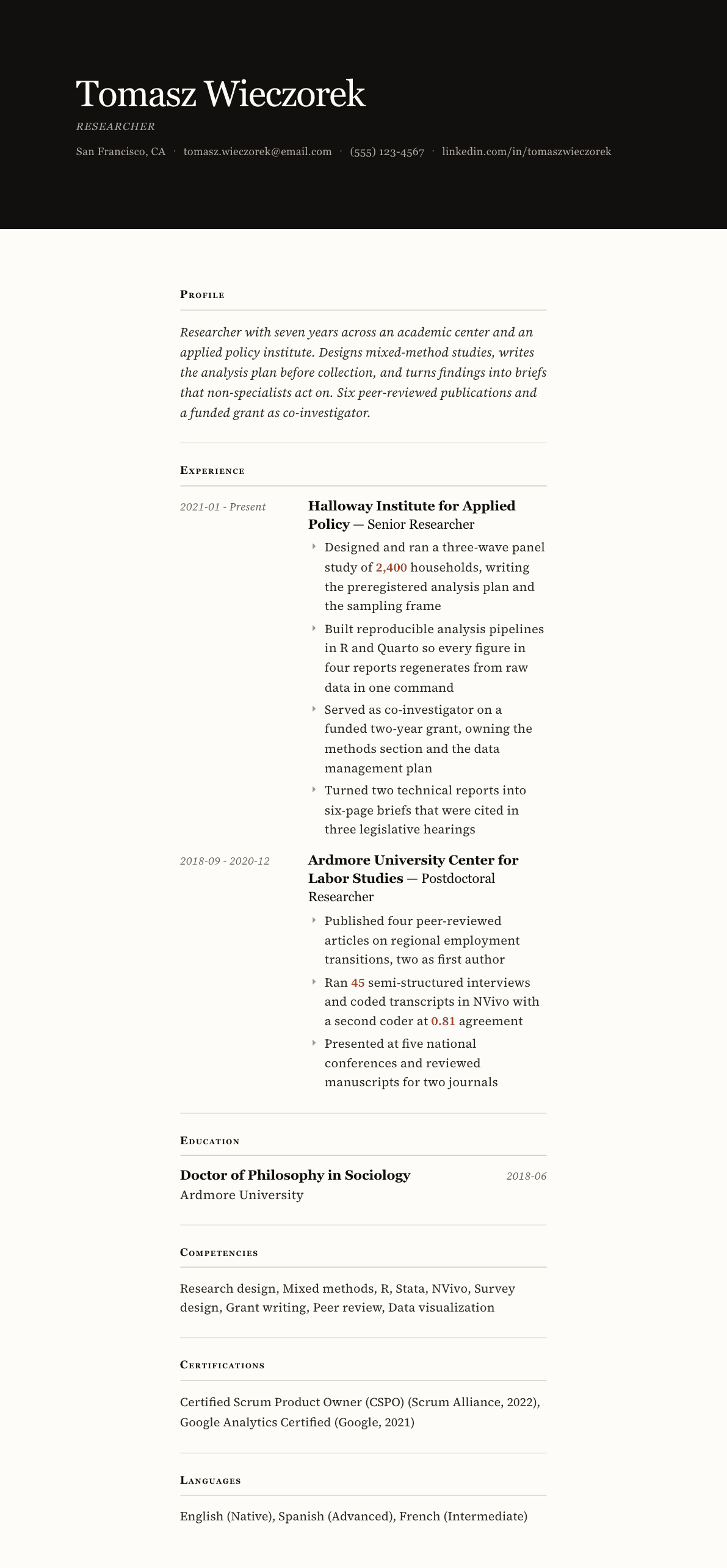
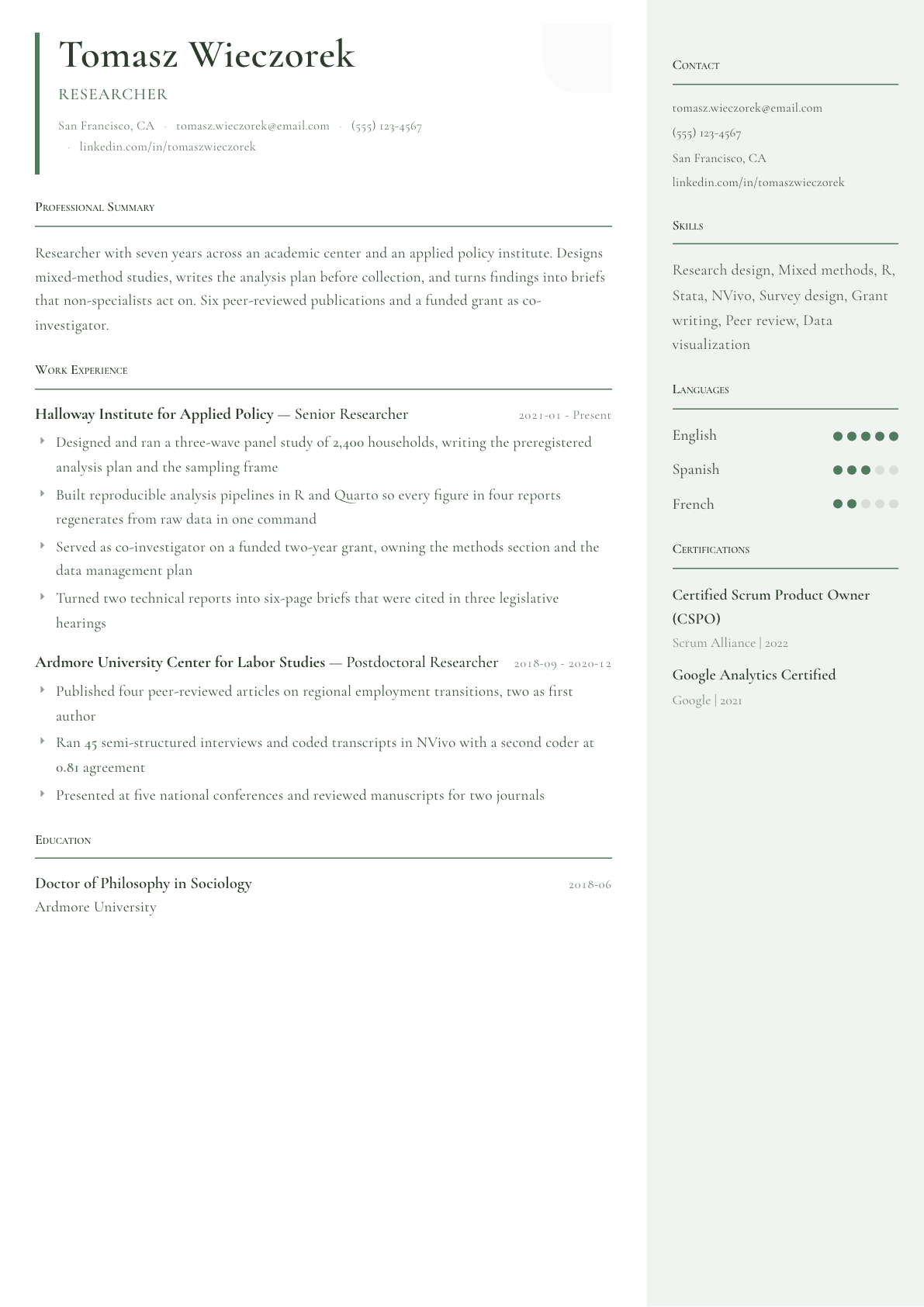
The same researcher content laid out in three CVBooster templates, so you can see what the finished document looks like before you write a word.
Example Researcher summary
Researcher with seven years designing and running mixed-method studies in academic and policy settings. Owns the study design, the sampling frame and the analysis plan, and works in R and Stata with reproducible pipelines. Six peer-reviewed publications, co-investigator on a funded grant, and a record of turning technical findings into briefs that decision makers actually read and use.
Skills to list on a Researcher resume
- Research design
- Quantitative methods
- Qualitative methods
- Survey design
- R
- Stata
- Python
- NVivo
- Regression analysis
- Literature synthesis
- Grant writing
- Peer review
- Data management plans
- Technical writing
- Conference presentation
- Preregistration
What actually gets this resume read
- Open with the question you study and the method you own, because a hiring committee sorts researchers by both at once.
- Give each project the design, the sample, the method and the output rather than a general statement about interests.
- Separate peer-reviewed publications from reports, preprints and conference papers so no reader has to guess the status.
- Name grants with the funder, the role you held and the period, and leave the award amount off a resume.
- Show reproducibility work such as version control, preregistration, code repositories and data management plans.
- For industry research roles, cut the full publication list to five selected items and add a business impact line.
How to write a researcher resume
Researcher is a title that covers very different jobs. A university center, a think tank, a market intelligence team and a corporate user research group all use the word, and all of them screen for the same first thing: can you take an unclear question, turn it into a design that produces a defensible answer, and explain the answer to someone who will not read your appendix.
That is why a researcher resume built as a chronology of employers underperforms. The unit a reader cares about is the project. Each one has a question, a design, a sample, a method, an analysis and an output, and a resume that surfaces those five things per project can be evaluated in under a minute.
This guide covers project-first structure, how to present publications for academic versus applied employers, how to describe grants without listing amounts, and the reproducibility signals that increasingly decide who gets the interview.
Decide first which document the employer wants
An academic search committee expects a full CV with every publication, presentation, grant, course and service line. An applied employer expects two pages at most, five selected outputs and a line on business or policy impact for each project. Sending the wrong one is the most common reason a strong researcher is passed over.
When you are unsure, look at whether the posting names a hiring manager and a team, or a search committee and a department. Team language means resume, committee language means CV. If the ad asks for a job talk, it is a CV.
- Applied version: summary, selected projects, methods and tools, selected publications, education.
- Academic version: education, appointments, publications, grants, presentations, teaching, service.
- Keep both files current so you are never rewriting under a deadline.
Projects: question, design, sample, method, output
Write each significant project as a compact block rather than scattering it across duty bullets. Start with the question in plain language, then the design, then who or what the sample was, then the analytic approach, then what came out and who used it. That order matches how a reviewer evaluates work, so nothing has to be reconstructed.
Be exact about your role. Principal investigator, co-investigator, analyst, field lead and project manager mean different things to a hiring committee and to a funder. If you inherited a study midway, say so. A researcher who reports scope honestly is the one a director trusts with the next study.
- Name the design: randomized experiment, quasi-experimental evaluation, cohort study, ethnography, discourse analysis, mixed-method sequential design.
- Give the sample with its unit: respondents, households, firms, transcripts, documents, sites.
- End with the output the reader can verify: peer-reviewed article, technical report, dashboard, policy brief, dataset release.
Methods and tools: claim only what you can defend
A methods section should read like an inventory a reader could quiz you on. Separate quantitative techniques from qualitative ones, and list the software next to the technique it belongs with. Multilevel modeling in R is a claim. Advanced statistics is not, and it invites a first interview question you will not enjoy.
Add the infrastructure skills that used to be invisible and are now screened for: version control, preregistration, reproducible reports, data management plans, code and data archiving, and documentation standards. Applied teams especially care whether your analysis survives your departure.
Grants and funding: role, funder, period, no amounts
List each award with the funder, your role, the title and the period. Leave the dollar figure off a resume, because the number invites comparison against fields with different funding norms and adds nothing to the evaluation of your work. In a full academic CV, follow whatever your discipline expects.
If you have written sections rather than led proposals, say which sections. Owning the methods and data management sections of a funded application is a real and marketable contribution, and it is the usual on-ramp to co-investigator status.
Communication: the part applied employers weigh most
Show that findings left your desk in more than one form. A researcher who has written a technical report, a short brief and a slide walkthrough of the same study is more valuable than one who has only produced manuscripts, because applied work dies when it cannot be translated.
Name the audiences: legislative staff, clinicians, product teams, a school board, an executive committee. The audience tells a reader more about your communication range than any adjective you could pick.
Researcher resume summary examples
Newly doctorate
Quantitative researcher completing a doctorate in economics, with three years running panel analyses on administrative labor data covering 40K workers. Two peer-reviewed articles and a job market paper on regional wage adjustment. Works in Stata and R with fully reproducible pipelines.
Five years applied
Applied researcher with five years at a policy institute designing survey and evaluation studies for state agency clients. Has led three multi-wave studies from sampling frame through final brief, and works in R, Qualtrics and NVivo. Comfortable presenting findings to non-technical committees.
Principal researcher
Principal researcher directing a four-person team across evaluation and survey portfolios. Principal investigator on two funded studies, author of eleven peer-reviewed articles, and reviewer for three journals. Sets methodological standards, mentors early-career staff and owns client relationships from scoping through final presentation.
Work experience bullets: before and after
Before: Conducted research on employment outcomes.
After: Designed a three-wave panel study of 2,400 households on employment transitions, writing the sampling frame, the preregistered analysis plan and the attrition weighting approach.
The design, sample and the specific artifacts you produced let a reviewer judge methodological depth immediately.
Before: Analyzed survey data using statistical methods.
After: Estimated multilevel models on 12 waves of survey data in R, testing sensitivity to three missingness assumptions before reporting the preferred specification.
Naming the model class and the robustness work signals rigor rather than a generic analysis claim.
Before: Wrote reports for stakeholders.
After: Turned two technical reports into six-page briefs for legislative staff, each with one chart per finding, and presented them at three committee hearings.
The format, the audience and the venue prove translation ability, which applied employers weigh heavily.
Before: Worked on a grant application.
After: Wrote the methods and data management sections of a funded two-year proposal and joined the award as co-investigator responsible for the analysis workstream.
Specifying the sections written and the resulting role makes the contribution verifiable rather than implied.
Before: Made sure the analysis was reproducible.
After: Built a Quarto and Git pipeline so every table and figure in four public reports regenerates from raw data with a single command, documented for external replication.
Concrete tooling and an external replication claim turn a buzzword into an auditable practice.
Hard skills
- Research design
- Survey sampling and weighting
- Regression and multilevel modeling
- Causal inference methods
- Qualitative coding and thematic analysis
- R
- Stata
- Python
- NVivo
- Systematic literature synthesis
- Preregistration
- Data management planning
- Technical report writing
- Peer review
Soft skills
- Framing an unclear question
- Translating findings for non-specialists
- Defending method choices under challenge
- Mentoring junior analysts
- Managing timelines across collaborators
- Saying what the data cannot answer
Certifications worth listing
- Human Subjects Research (CITI Program) (Collaborative Institutional Training Initiative)
- Responsible Conduct of Research (RCR) (Collaborative Institutional Training Initiative)
- Professional Researcher Certification (PRC) (Insights Association)
Mistakes that cost researcher candidates the interview
- Sending an academic CV to an applied team, or a two-page resume to a search committee, without checking which was wanted.
- Describing projects as duties, so a reviewer cannot find the design, the sample or the output.
- Claiming broad method mastery that collapses under the first technical question in an interview.
- Putting award amounts on a resume, which invites cross-field comparisons that never help you.
- Listing every publication for an industry role instead of five selected pieces with a relevance line.
- Ignoring reproducibility signals, which applied and academic employers now screen for equally.
Researcher resume questions
How many publications should an industry researcher list?
Five at most, chosen for relevance to the posting rather than prestige. Add one line under each explaining the method or the applied question it answered, since a hiring manager outside your field cannot read a journal name and infer the contribution.
Should I include my dissertation on a researcher resume?
Yes, but as a project block rather than a title alone. Give the question, the design, the sample and the finding in three lines. A committee will recognize the work, and an applied employer finally has something concrete to evaluate.
How do I show research impact without inventing numbers?
Point to verifiable traces: a report cited in a hearing, a metric a client adopted, a tool still in use, a dataset released publicly, a policy document that references your work. Impact evidence is about the trail, not about invented percentages.
Is a researcher resume different from a data analyst resume?
Yes. An analyst resume leads with pipelines, dashboards and business questions answered on a short cycle. A researcher resume leads with study design, causal or interpretive claims, and the defensibility of the method behind a longer running question.
What if most of my projects are confidential?
Describe the design, the method, the sample size and your role while replacing the client with a sector description such as a state health agency or a national retailer. Reviewers understand confidentiality, and the methodological detail is what they are assessing anyway.