Intake Coordinator Resume Examples: the lines they read
Write an Intake Coordinator Resume That Shows Clean Referral Work
By Mustafa Tarabya, founder of CVBooster · Published · Updated
Intake coordinator resume examples with referral, verification and authorization keywords, and a guide to writing bullets a clinical manager trusts.
Sample resumes for a intake coordinator
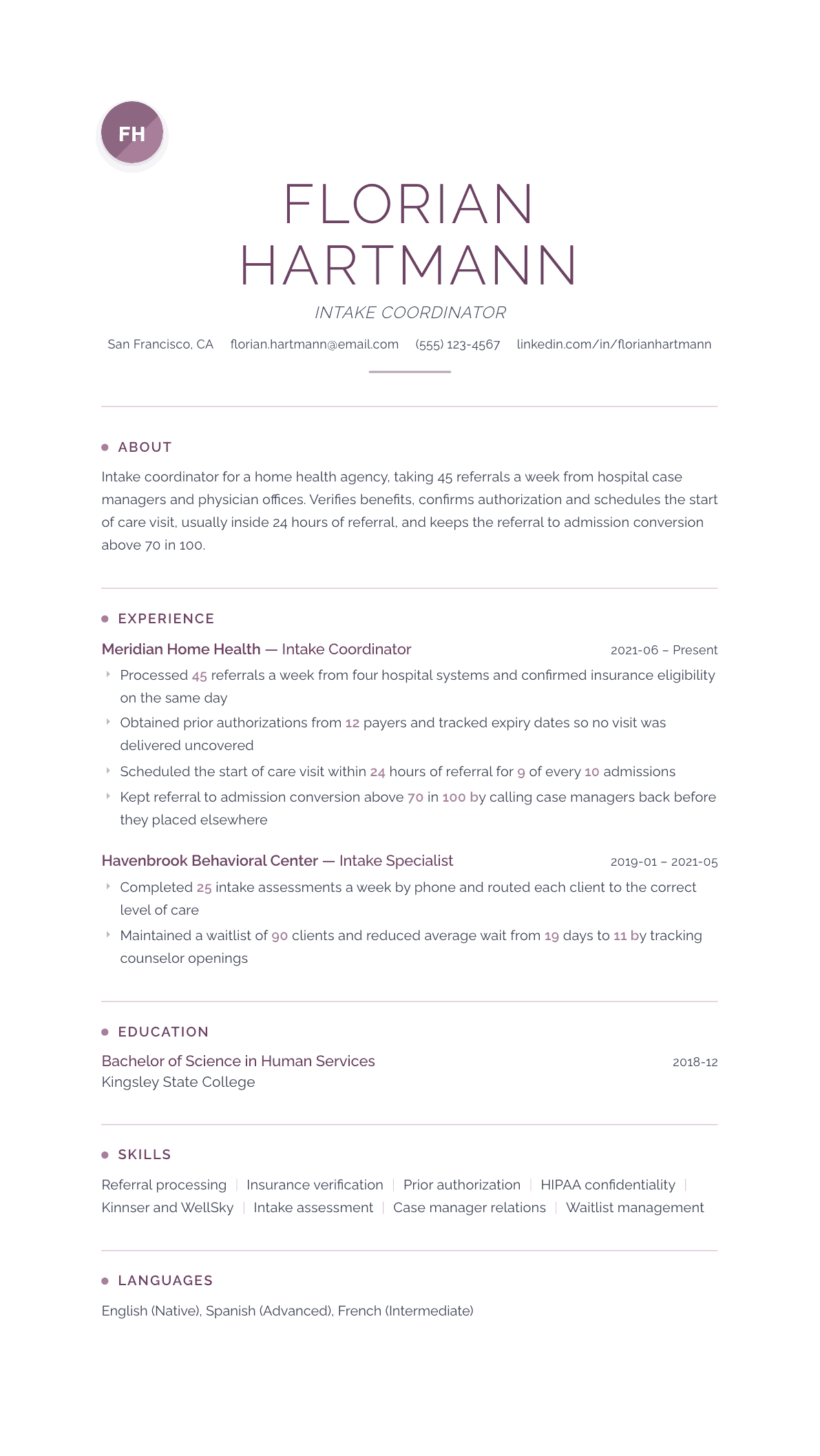
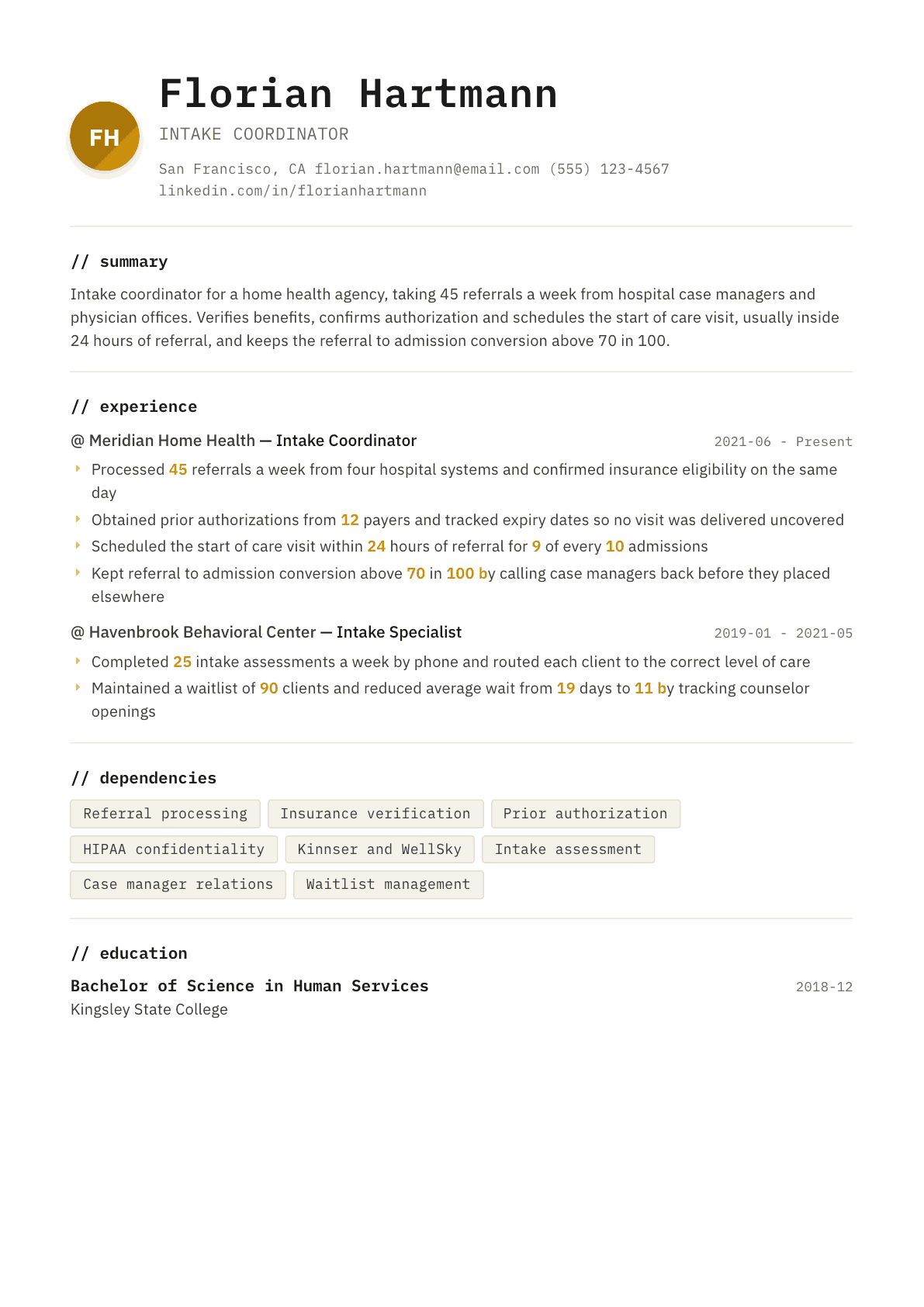
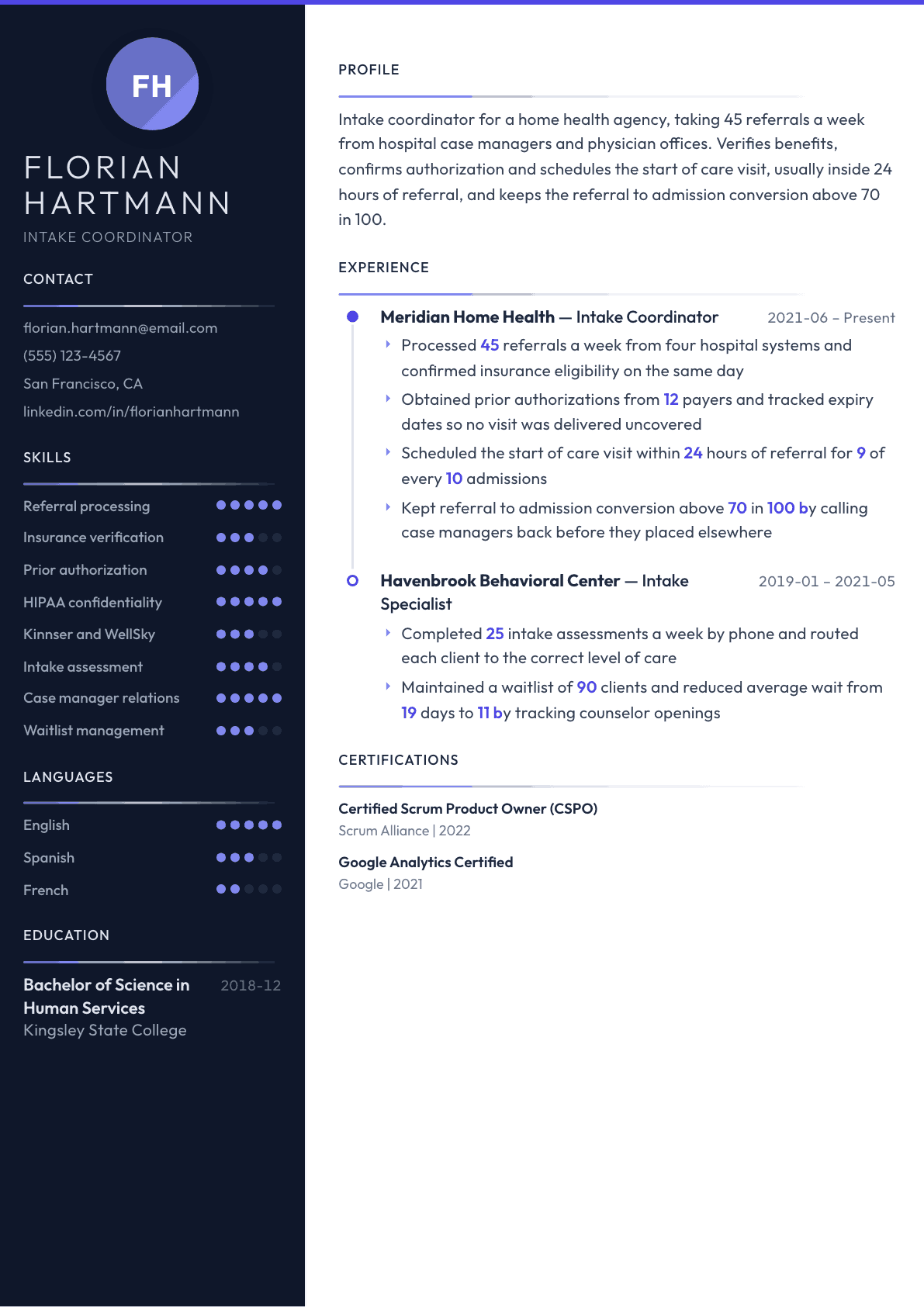
The same intake coordinator content laid out in three CVBooster templates, so you can see what the finished document looks like before you write a word.
Example Intake Coordinator summary
Intake coordinator with five years in home health and behavioral health, handling 45 referrals a week from four hospital systems. Verifies benefits, secures prior authorization from 12 payers and schedules start of care within 24 hours for nine of every ten admissions. Holds referral to admission conversion above 70 in 100. Seeking an intake seat with a growing agency network.
Skills to list on a Intake Coordinator resume
- Referral intake
- Insurance verification
- Prior authorization
- Benefits eligibility checks
- Intake assessment
- HIPAA confidentiality
- WellSky
- Epic
- Level of care determination
- Waitlist and pending log management
- Case manager communication
- Documentation accuracy
- Multi line phone handling
- Medicaid and Medicare basics
What actually gets this resume read
- Give the referral volume per week and the referral sources, since hospital and physician pipelines are managed differently.
- Show the speed from referral to start of care, because that number is what keeps referral sources sending patients.
- Name the payers or payer types you verified with and the authorization portals you used to get approvals through.
- Include the conversion rate from referral to admission if you know it, since intake is a revenue seat, not a phone seat.
- Say which electronic record you documented in, such as WellSky, Kinnser, Epic or a behavioral health platform.
- Note the confidentiality training you carry, because intake handles diagnoses and financial detail on first contact.
How to write a intake coordinator resume
Intake is a revenue seat that looks like a phone seat, and the resumes that get interviews are the ones that understand the difference. When a hospital case manager calls with a discharge, the referral goes to whichever agency answers, verifies benefits and confirms a start of care date first. An intake coordinator who is slow loses the patient to the agency down the road, and the manager reading your resume knows that better than anyone.
So the screening questions are narrow. How many referrals a week did you handle, from which sources, how fast did you convert a referral into a scheduled visit, and what share of referrals actually became admissions. A resume that lists answering calls, verifying insurance and scheduling visits answers none of them.
This guide walks through the section order a clinical intake manager expects, summaries for three stages of an intake career, before and after bullets from referral, authorization and start of care work, and the questions coordinators ask when moving between home health, behavioral health and hospital based intake.
Format: one page, referral numbers above the fold
One page, reverse chronological, single column. Intake managers hire quickly because the seat is rarely vacant by choice, and the page needs to be readable in the two minutes between calls. Numbers in the summary, numbers in the first bullet of the current job.
Keep the privacy training and the electronic record you document in visible near the top. Intake handles a diagnosis and a financial picture inside the first phone call, so a hiring manager wants confidence on confidentiality before she gets to conversion rates.
- Header: name, city and state, phone, email, and the clinical record system you know best.
- Section order: summary, systems and skills, experience, certifications, education.
- Each job header: setting, referral sources, and weekly referral or assessment volume.
Summary: referral volume, sources, speed, conversion
Four facts. Referrals a week, where they came from, how fast the start of care visit was scheduled, and the referral to admission conversion. Hospital case managers, physician offices, skilled nursing facilities and self referrals behave differently, so naming the sources tells the manager which pipeline you can actually work.
If your background is behavioral health rather than home health, or the reverse, say so and name the transferable part. Level of care determination, waitlist management and benefit verification carry across; the payer rules and the documentation platform do not carry across automatically.
Experience: referral in, authorization cleared, visit scheduled
Follow the referral through the job. First bullet: volume and sources, with same day eligibility verification if you did it. Second: authorization work, naming how many payers you dealt with and how you tracked expiry dates so no visit was delivered uncovered. That expiry tracking is a detail only someone who has done the job would write.
Third: speed to start of care. Scheduling the first visit within a day of referral is the promise that keeps case managers calling you back, so give the number and the share of admissions that met it. Fourth: conversion, and how you protected it. Calling a case manager back before she placed the patient elsewhere is the actual mechanism, and naming it is more convincing than the rate alone.
In behavioral health intake, replace the authorization bullet with the assessment: assessments completed a week, how you routed each client to the correct level of care, and how the waitlist was managed against counselor openings.
Systems and skills: platforms, payers, privacy
Name the documentation platform, the payer portals you used to obtain authorization, and the eligibility checking method. Intake managers plan training around exactly these, and the resume that names them is easier to hire than the resume that says electronic medical records.
Add the payer landscape you know. Medicaid, Medicare and commercial plans each carry different eligibility and authorization mechanics, and a coordinator who has worked a managed Medicaid population is a specific and valuable thing to be.
- Platforms: WellSky, Kinnser, Epic, or the behavioral health record you documented assessments in.
- Payer work: eligibility verification, prior authorization, benefit interpretation, authorization expiry tracking.
- Practice: level of care determination, waitlist and pending log management, case manager follow up, privacy handling under HIPAA.
Certifications and education: what a clinical manager values
A bachelor degree in human services, social work or a health field is common but not universal, and strong intake coordinators come from patient access and medical office backgrounds too. List the degree plainly and let the referral numbers do the persuading.
Patient access and revenue cycle credentials are the ones that fit this seat, because they certify exactly the eligibility, authorization and registration knowledge intake depends on. List only what you hold, with the issuing body spelled out.
Intake Coordinator resume summary examples
New to intake
Medical office assistant moving into intake after two years verifying eligibility and scheduling new patient visits for a primary care group. Comfortable with commercial and Medicaid eligibility checks, trained on privacy handling, and looking for a home health intake seat with a defined referral pipeline.
Agency intake coordinator
Intake coordinator for a home health agency taking 45 referrals a week from four hospital systems and physician offices. Verifies benefits the same day, obtains authorization from twelve payers, and schedules start of care within 24 hours for nine of every ten admissions. Referral to admission conversion above 70 in 100.
Intake lead
Intake lead across home health and behavioral health programs, supervising three coordinators and owning the pending log, the authorization tracker and the relationships with hospital discharge planners. Cut average behavioral health wait from 19 days to 11 by matching the waitlist against counselor openings weekly.
Work experience bullets: before and after
Before: Took referrals from hospitals and doctors.
After: Processed 45 referrals a week from four hospital systems and a physician referral network, confirming insurance eligibility on the same day the referral arrived.
Volume, named source types and same day verification show a working pipeline rather than an inbox.
Before: Obtained insurance authorizations.
After: Obtained prior authorization from twelve payers and tracked every expiry date in a pending log so no visit was delivered outside an active authorization.
Tracking expiry is the control that prevents unpaid visits, and only someone who has done the job writes it.
Before: Scheduled patients to start services quickly.
After: Scheduled the start of care visit within 24 hours of referral for nine of every ten admissions, coordinating clinician availability against the geographic district of the patient.
The speed figure plus the constraint you solved for shows how the promise was actually kept.
Before: Worked to increase admissions.
After: Held referral to admission conversion above 70 in 100 by calling case managers back with a confirmed clinician and date before they placed the patient with another agency.
It names the competitive mechanism behind the rate, which is what an intake manager wants to hear described.
Before: Managed the client waitlist.
After: Maintained a waitlist of 90 clients against weekly counselor openings and reduced the average wait from 19 days to 11 by rerouting clients to the correct level of care sooner.
The before and after with the clinical routing behind it turns list keeping into measurable access improvement.
Hard skills
- Referral intake and triage
- Insurance eligibility verification
- Prior authorization
- Authorization expiry tracking
- Intake assessment by phone
- Level of care determination
- WellSky
- Epic
- Waitlist and pending log management
- HIPAA privacy handling
- Medicaid and Medicare basics
- Referral source reporting
Soft skills
- Speed without cutting corners
- Calm intake calls with distressed families
- Relationship building with case managers
- Judgment on incomplete information
- Handoff clarity to clinicians
- Persistence with payer phone queues
Certifications worth listing
- Certified Healthcare Access Associate (CHAA) (National Association of Healthcare Access Management)
- Certified Revenue Cycle Representative (CRCR) (Healthcare Financial Management Association)
- Certified Medical Administrative Assistant (CMAA) (National Healthcareer Association)
Mistakes that cost intake coordinator candidates the interview
- Describing intake as answering phones and verifying insurance, which hides that the seat drives admissions and revenue.
- Giving no weekly referral volume, so a manager cannot tell whether you handled a trickle or a full pipeline.
- Leaving out speed to start of care, the single number that decides whether referral sources keep calling.
- Naming no payers or portals, when authorization mechanics are most of the difficulty in the role.
- Omitting privacy training on a resume for a seat that takes diagnoses and financial detail on first contact.
- Failing to name the documentation platform, which forces the manager to assume a long training period.
Intake Coordinator resume questions
How is an intake coordinator different from a scheduler?
A scheduler fills a calendar that already exists. Intake decides whether a referral can be accepted at all: eligibility, authorization, clinical fit and level of care come first, and only then does a visit get scheduled. Frame the resume around that decision.
What conversion rate should I put on my resume?
Only the one your agency actually reported. Referral to admission conversion is tracked in most home health and behavioral health agencies, so ask before you leave. If it was never measured, describe the follow up routine you used to protect referrals instead.
Does behavioral health intake experience transfer to home health?
Largely yes. Assessment by phone, level of care routing, waitlist management and benefit verification all carry across. What you will need to learn is the visit authorization cycle and the clinician scheduling constraint, so acknowledge that directly rather than glossing it.
Do I need a clinical license for an intake role?
Usually not. Most intake coordinator postings ask for administrative or human services experience and route clinical judgment to a nurse or supervisor. Some behavioral health assessment roles do require a license, so read whether the posting says assessment or screening.
How do I show I built referral relationships?
Name the sources, the call cadence you kept with each discharge planner, and any change in referral volume from a specific hospital. Relationship claims are cheap, but a named account with a rising referral count is evidence a manager can verify.
Related resume examples
- Medical Receptionist Resume example
- Admissions Coordinator Resume example
- Scheduling Coordinator Resume example
- Medical Office Manager Resume example
- Medical Front Desk Resume example
- Medical Administrative Assistant Resume example