Adjunct Professor Resume Examples: the lines they read
Build an Adjunct Professor Resume That Wins the Next Course Assignment
By Mustafa Tarabya, founder of CVBooster · Published · Updated
Adjunct professor resume example with course lists, multi-campus teaching bullets, online delivery keywords and a section by section guide.
Sample resumes for a adjunct professor
The same adjunct professor content laid out in three CVBooster templates, so you can see what the finished document looks like before you write a word.
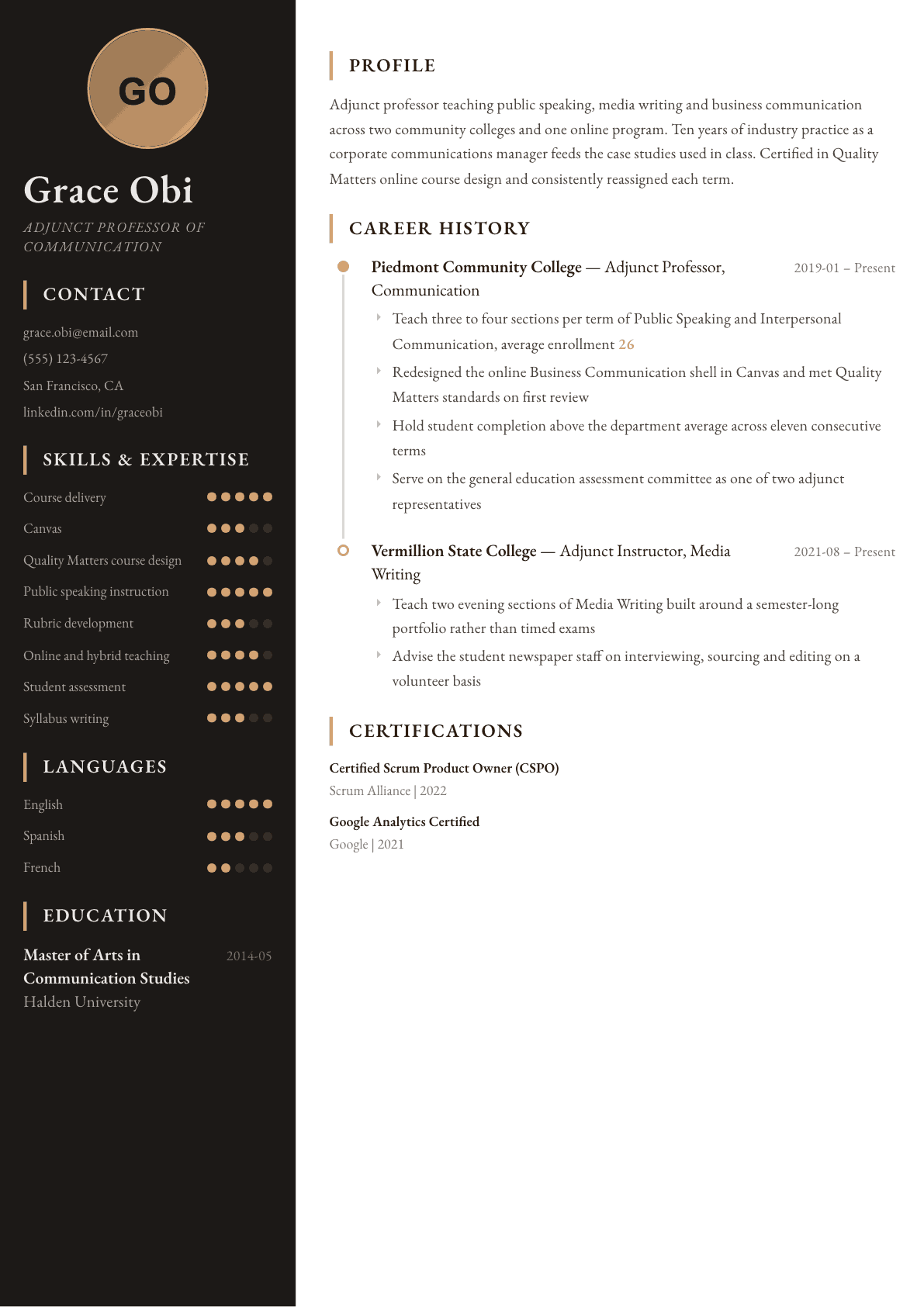
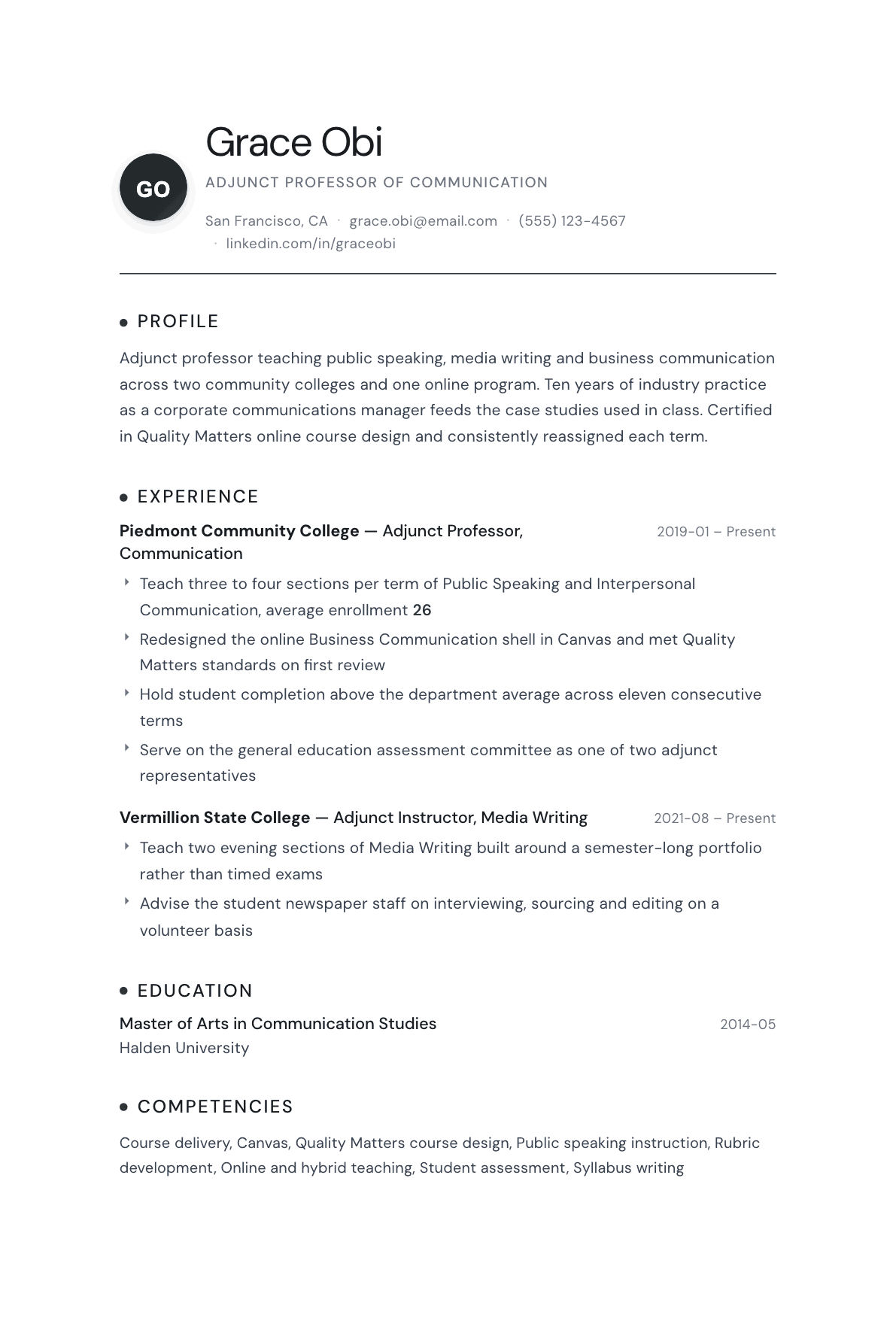
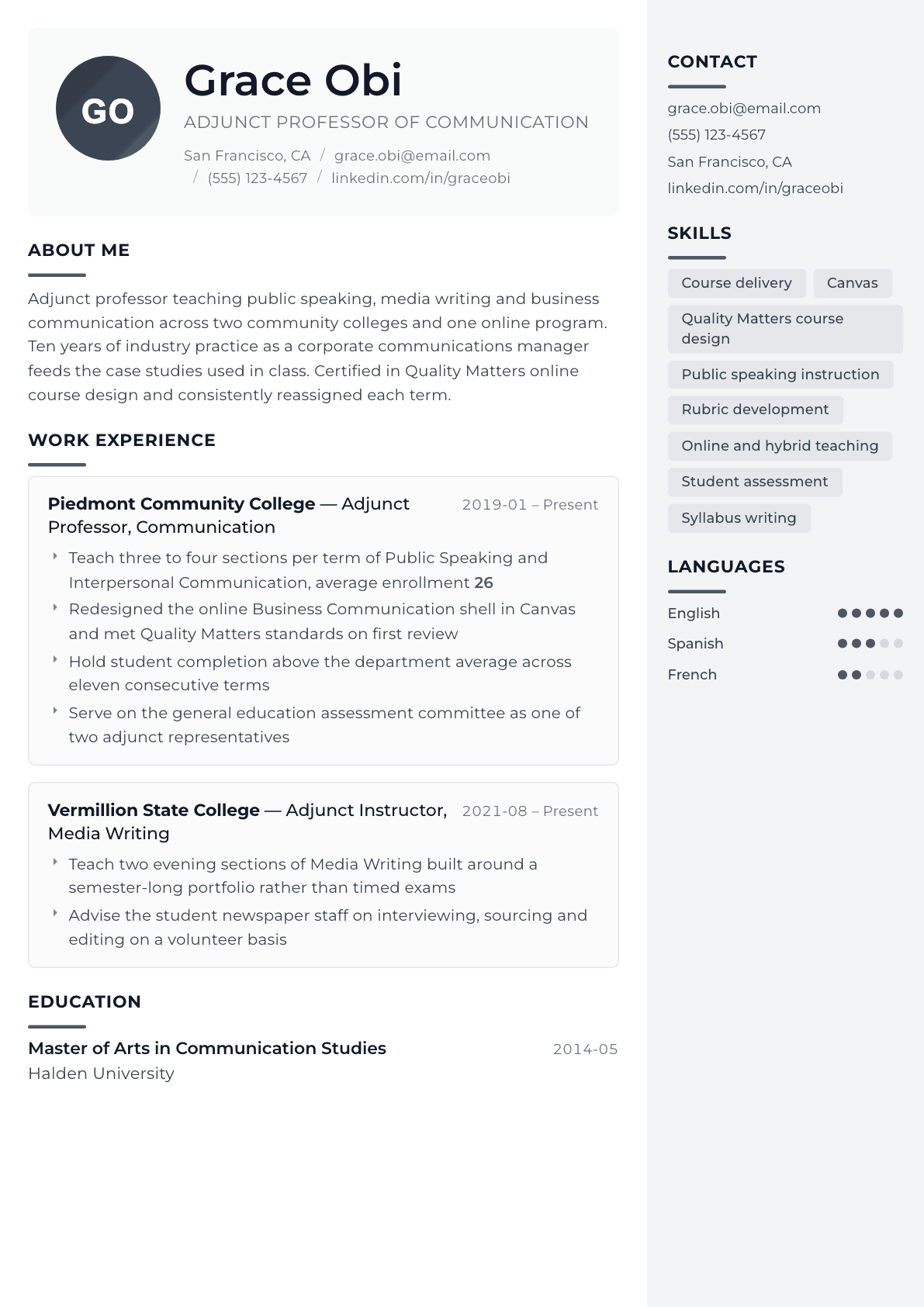
Example Adjunct Professor summary
Adjunct professor of communication teaching public speaking, media writing and business communication at two colleges and one online program. Ten years of corporate communications practice supplies the case material for every course. Redesigned an online course shell that met Quality Matters standards on first review, and has been reappointed for eleven consecutive terms. Seeking additional sections or a full-time instructional appointment.
Skills to list on a Adjunct Professor resume
- College teaching
- Syllabus development
- Course shell design
- Canvas
- Blackboard
- Online and hybrid instruction
- Rubric and assessment design
- Student learning outcomes
- Quality Matters standards
- Discussion facilitation
- Academic advising of students
- Curriculum alignment
- Grading and feedback
- Public speaking instruction
What actually gets this resume read
- List the courses you have taught by catalog title and number, because department chairs match your list against the sections they need covered.
- State the modality of every course: face to face, hybrid, synchronous online or asynchronous, since staffing decisions often start there.
- Name your learning management system, and say if you built the course shell rather than inheriting it from a full-time colleague.
- Show that you were reappointed, because continuity across terms is the strongest signal an adjunct file can carry.
- Keep industry experience visible if you teach an applied subject, as many programs hire adjuncts specifically for current practitioner knowledge.
- Add student success evidence you can source, such as completion rates against the department average or a teaching award.
How to write a adjunct professor resume
An adjunct professor resume is read fast, usually by a department chair who has three uncovered sections and four weeks before the term begins. She is not building a scholarly profile of you. She is matching your course list against her schedule grid and checking whether you can be placed without a supervision problem.
That reality should shape the whole document. Lead with the catalog courses you have taught, the modality of each, the learning management system you work in, and evidence that you were reappointed. Research belongs on the page if you have it, but it is not what decides an adjunct assignment at most institutions.
This guide covers the layout chairs prefer, how to present a multi-campus teaching load without looking scattered, three summaries from a first appointment to a long-serving adjunct, before-and-after bullets, and the questions adjuncts ask when they want more sections or a full-time line.
Format: two pages, course inventory near the top
Two pages is normal because adjuncts accumulate courses across institutions. Reverse chronological by institution, and inside each institution list the courses rather than writing a paragraph about your philosophy. A chair should be able to run a finger down the page and find the course she needs covered.
Directly under the summary, put a courses taught block: catalog title, course number if you know it, level and modality. That block is the single most useful thing on an adjunct resume and almost nobody includes it.
- Header: name, credentials, city and state, phone, email, and your availability if you teach evenings or online only.
- Sections in this order: summary, courses taught, teaching experience, education, professional practice, professional development.
- Note graduate credit hours in the teaching discipline, which accreditors require chairs to document.
Summary: subject, institutions, modality, reappointment
Three lines. Name the subject area, how many institutions you currently teach for, the modalities you deliver, and how long you have been reappointed. Continuity is the strongest signal an adjunct file carries, because it tells a chair that other chairs kept choosing you.
If you teach an applied subject, add your industry practice here. Programs hire adjuncts in accounting, communication, nursing, information technology and criminal justice specifically for current practitioner knowledge, and that becomes an advantage rather than a distraction.
Teaching experience: what you built, not what you covered
Under each institution, spend the bullets on things a full-time colleague would notice. A course shell you designed rather than inherited. A rubric set you wrote. An assessment aligned to program learning outcomes. A textbook adoption you evaluated. Completion rates you held above the department average.
Give the load in each term: how many sections, average enrollment, and whether the sections were face to face, hybrid, synchronous online or asynchronous. Modality is an operational fact for a chair building a schedule, and it is frequently missing from adjunct resumes.
Include the invisible work that adjuncts do without a contract line: advising students during office hours, serving on an assessment committee, mentoring a student organization, or covering a colleague mid-term. It shows you behave like faculty rather than a contractor.
Online teaching: name the standard you meet
Online sections are where adjunct demand concentrates, and quality review is now formal at many institutions. Name your learning management system, say whether you built the shell, and cite any course design standard you have met, such as a Quality Matters review or an internal peer review process.
Add accessibility work explicitly. Captioned media, screen-reader compatible documents, alternative text on images and accessible assessment design are increasingly written into online teaching contracts, and an adjunct who can speak to them is easier to place.
- State whether courses were synchronous, asynchronous or hybrid.
- Mention proctoring, discussion moderation and response-time commitments you held.
- List online teaching certificates by the issuing institution or body.
Keywords adjunct postings repeat
The vocabulary is stable across postings: syllabus development, student learning outcomes, formative and summative assessment, rubric design, active learning, universal design for learning, academic integrity, office hours, course shell, and the specific learning management system.
Add the credential language accreditors force chairs to check: the graduate degree in the discipline, the number of graduate credit hours in the teaching field, and any professional license that qualifies you to teach an applied course. Putting it on the page saves the chair an email and moves your file forward.
Adjunct Professor resume summary examples
First appointment
Communication professional with a masters in communication studies and ten years of corporate practice, seeking adjunct sections in public speaking and business communication. Completed a college teaching certificate, guest lectured six times in an undergraduate media course, and built a Canvas practice shell during training.
Several terms in
Adjunct professor of communication teaching three to four sections a term across two colleges, in face-to-face and asynchronous online formats. Redesigned the online business communication shell to meet Quality Matters standards on first review and holds completion above the department average.
Long-serving adjunct
Adjunct professor with eleven consecutive terms of reappointment across two colleges and one online program, teaching seven distinct catalog courses. Serves as an adjunct representative on the general education assessment committee and mentors new part-time faculty through their first semester.
Work experience bullets: before and after
Before: Taught communication courses at a community college.
After: Taught three to four sections per term of Public Speaking and Interpersonal Communication, average enrollment 26, across day and evening schedules.
Course titles, section counts and enrollment tell a chair exactly where you fit on the schedule grid.
Before: Used the online learning platform.
After: Redesigned the asynchronous Business Communication shell in Canvas with captioned media and aligned rubrics, meeting Quality Matters standards on first review.
Building the shell to a named standard is a different skill from delivering a course somebody else built.
Before: Students did well in my classes.
After: Held course completion above the department average across eleven consecutive terms while teaching the highest-enrollment sections in the sequence.
A comparison against the department average is a claim the chair can check in her own data.
Before: Helped out with department work.
After: Served as one of two adjunct representatives on the general education assessment committee, reviewing artifacts and scoring against the communication outcome rubric.
A named committee seat with the actual task shows faculty citizenship rather than vague willingness.
Before: Have industry experience I bring to class.
After: Drew on ten years as a corporate communications manager to build a crisis messaging case study now used in all sections of the course.
Industry background becomes teaching value only when it produces material other instructors adopt.
Hard skills
- Syllabus development
- Course shell design
- Canvas
- Blackboard
- Asynchronous and hybrid instruction
- Rubric and assessment design
- Student learning outcomes alignment
- Quality Matters standards
- Accessible course materials
- Academic integrity procedures
- Discussion facilitation
- Grading and formative feedback
- Textbook and open resource evaluation
- Public speaking instruction
Soft skills
- Reliability across terms
- Adaptability to short-notice assignments
- Student rapport in large sections
- Clear written feedback
- Collegial communication with chairs
- Time management across campuses
Certifications worth listing
- Quality Matters Applying the QM Rubric (Quality Matters)
- Quality Matters Peer Reviewer Certification (Quality Matters)
- ACUE Certificate in Effective College Instruction (Association of College and University Educators)
Mistakes that cost adjunct professor candidates the interview
- Omitting the course list, which forces a chair to guess whether you can cover the section she needs filled.
- Leaving modality off every entry when online and hybrid availability is often the deciding factor.
- Writing a teaching philosophy paragraph on the resume instead of putting it in the separate document that asks for it.
- Hiding a long run of reappointments, which is the clearest evidence a part-time file can offer.
- Failing to state graduate credit hours in the teaching discipline, which accreditation rules require the chair to document.
- Presenting multiple institutions as a scattered list rather than as a consistent multi-campus teaching load.
Adjunct Professor resume questions
How do I get more sections from the same department?
Make yourself easy to schedule and easy to justify. Keep your course list current, state your availability by day and modality, and document assessment or committee contributions so the chair can defend giving you the better sections.
Should an adjunct resume include research?
Include it in a compact section if you have peer-reviewed work, because it strengthens a case for a full-time line later. Keep it below teaching, since adjunct assignments are decided on course coverage rather than scholarly output.
How many graduate credit hours do I need to teach a subject?
Regional accreditors generally expect a graduate degree in the field or a graduate degree plus a set number of graduate hours in the teaching discipline. Put your hours on the resume so the chair can verify eligibility immediately.
Does teaching at several colleges look bad?
Not if you present it as one coherent teaching load rather than three unrelated jobs. Group by institution, keep the course lists tight, and show that reappointments overlapped, which demonstrates reliability rather than instability.
How do I move from adjunct to full-time faculty?
Build the parts of the file a full-time search scores: curriculum development, assessment leadership, committee service, mentoring, and any scholarship of teaching. Then apply with a resume reordered to put those contributions above the section counts.