Apprentice Resume Examples: free ATS score and gap list
Write an Apprentice Resume That Wins the Indenture Slot
By Mustafa Tarabya, founder of CVBooster · Published · Updated
Apprentice resume example, keyword list and writing guide covering on-the-job hours, classroom instruction, tools owned and safety cards.
Sample resumes for a apprentice
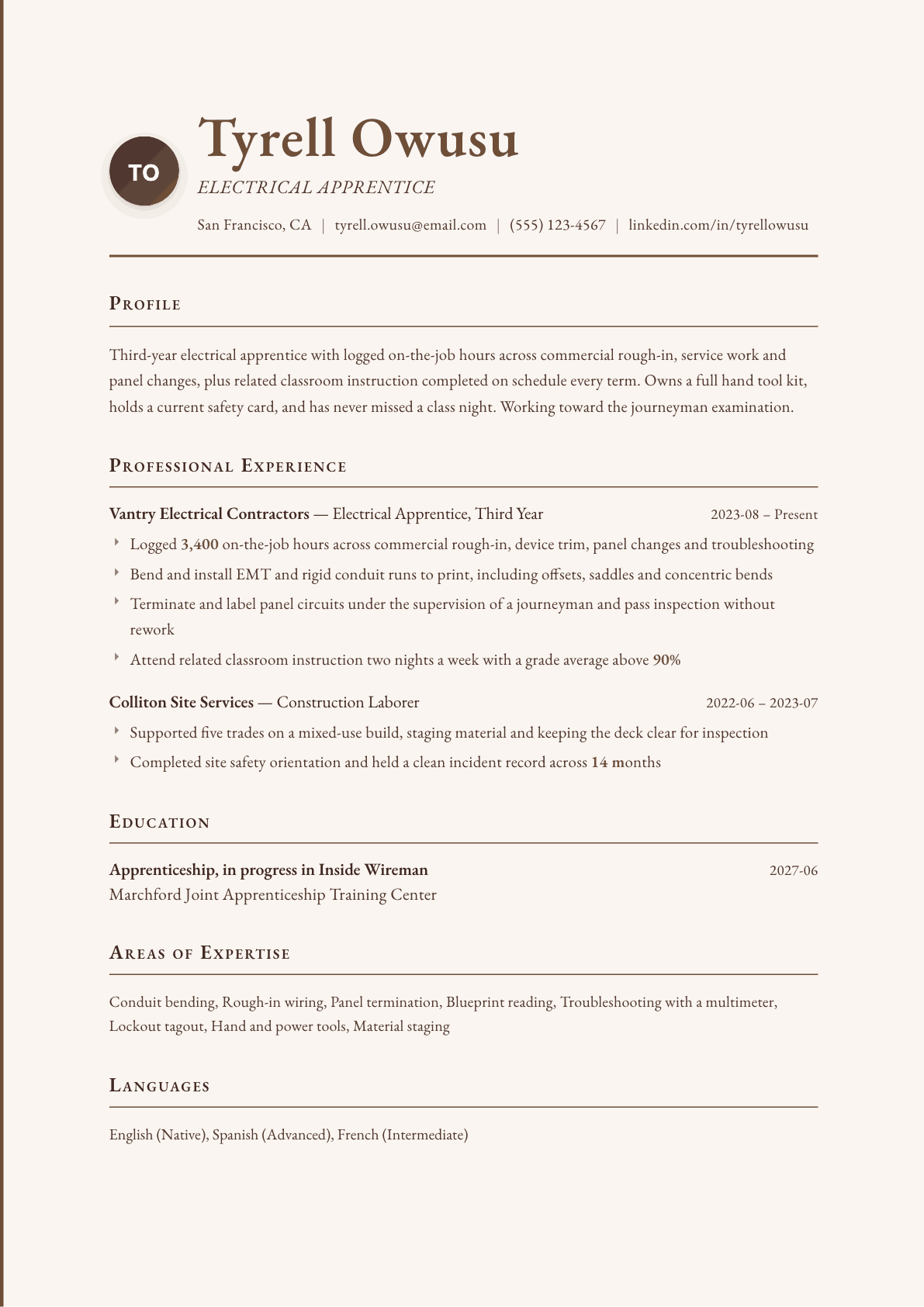
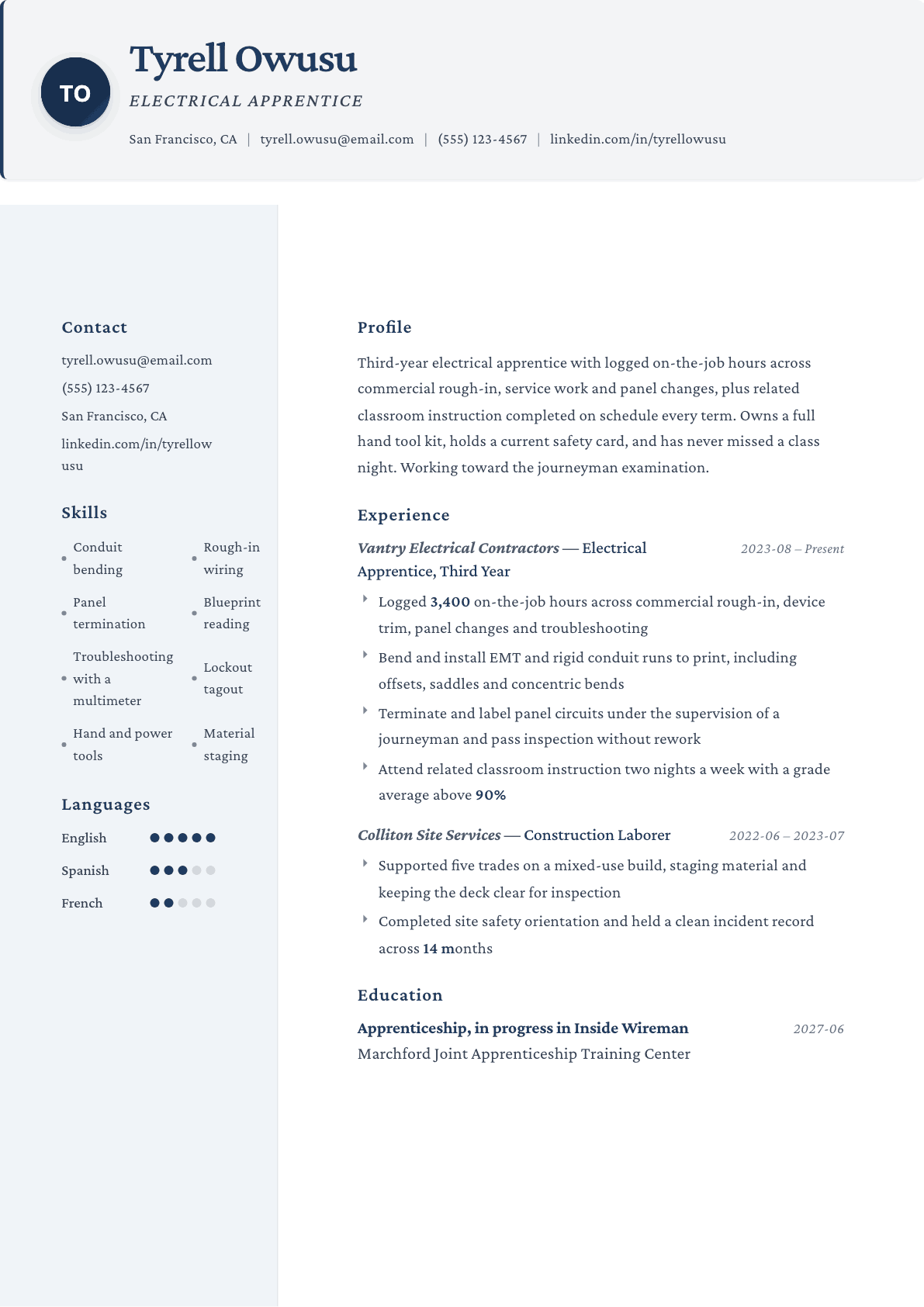
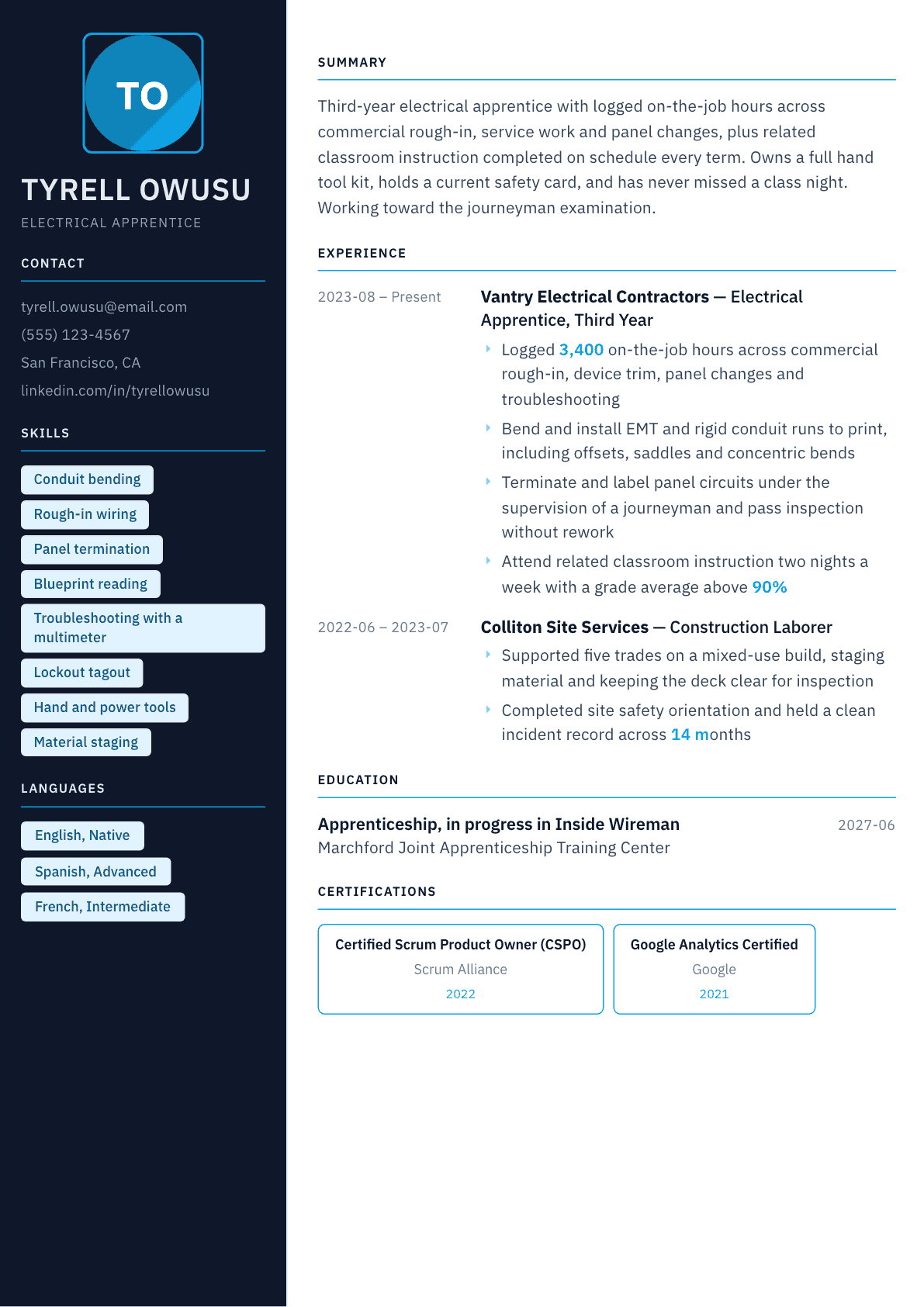
The same apprentice content laid out in three CVBooster templates, so you can see what the finished document looks like before you write a word.
Example Apprentice summary
Third-year electrical apprentice with 3,400 logged on-the-job hours across commercial rough-in, device trim, panel changes and troubleshooting, and related classroom instruction completed every term with a grade average above 90%. Bends EMT to print, terminates panels under journeyman supervision, and holds a current safety card. Owns a full hand tool kit and is working toward the journeyman examination.
Skills to list on a Apprentice resume
- On-the-job hour logging
- Related classroom instruction
- Conduit bending and layout
- Blueprint and print reading
- Rough-in and device trim
- Circuit troubleshooting
- Lockout tagout procedures
- Ladder and lift safety
- Hand and power tool operation
- Material takeoff support
- Jobsite housekeeping
- Measurement and layout math
- Journeyman supervision protocol
What actually gets this resume read
- Put your logged on-the-job hours and your current apprenticeship year at the very top of the page.
- List the related classroom instruction separately with the terms completed and the school that delivers it.
- Name the tasks you can perform unsupervised and the ones you perform under a journeyman, honestly.
- Own your tool list, because a foreman wants to know what shows up in your bag on day one.
- Show attendance and reliability with concrete numbers, the trait a contractor screens for first in apprentices.
- Put every safety card with its issue date, since expired cards keep candidates off a site entirely.
How to write a apprentice resume
An apprenticeship resume is read by a foreman or a training coordinator, not by a recruiter, and that changes everything about what belongs on it. The foreman has a crew waiting and a schedule to hold. He wants to know what year you are in, how many hours you have logged, what you can do without a journeyman standing over you, whether you own tools, and whether you turn up. Everything else on the page is decoration.
The applications that fail do so for predictable reasons. They omit the hour count, which is the single number that defines an apprentice's standing. They claim skills at a level the candidate has not reached, which a foreman discovers on the first bend or the first termination. Or they read like a college resume, full of soft phrasing and empty of the concrete tasks a crew performs on a Tuesday morning.
This guide covers how to present on-the-job hours and related classroom instruction, how to describe skills honestly by supervision level, what a tool list signals, and how a first-year applicant with no trade hours at all builds a page worth reading.
Lead with your year, your hours and your classroom standing
The first three lines under your name should say what year of the apprenticeship you are in, how many on-the-job hours you have logged, and that your related classroom instruction is current. Those three facts place you exactly on the ladder, and a training coordinator can decide in ten seconds whether you fit the opening.
Break the hours down by type of work if your records allow: rough-in, trim, service, troubleshooting, or for other trades the equivalent categories. A candidate with a heavily commercial hour profile is a different hire from one whose hours are almost all residential, and stating the split saves the coordinator a phone call.
For someone applying to an apprenticeship rather than continuing one, the same top block carries the entrance requirements instead: the algebra or math course completed, the aptitude test taken, the driver license held, and the physical readiness the trade demands.
- Apprenticeship year and program name, with the training center or sponsoring employer.
- Logged on-the-job hours, split by category where the record supports it.
- Related classroom instruction: terms completed, subjects covered, current standing.
- Safety cards and site credentials with their issue dates.
- License and transportation status, since crews start at a yard or a site, not an office.
Describe skills by supervision level, honestly
Write two categories: what you perform independently and what you perform under a journeyman. This is the most useful thing an apprentice can put on a page, and almost nobody does it. It shows you understand where you are in the trade, it protects the foreman from putting you on a task you are not ready for, and it makes the independent list credible because you did not claim everything.
Be specific about the operations. Bending offsets, saddles and concentric bends to print is a real description. Familiar with conduit is not. Pulling and dressing wire in a panel, terminating and labeling circuits, mounting devices, setting boxes to finish depth: these are the verbs a foreman uses when he assigns work, and a resume that uses them reads as written by someone who has been on a deck.
Never inflate. An apprentice who claims service troubleshooting and then cannot read a meter has burned the reputation of the person who referred him, and trades are small enough that the story travels.
Attendance, safety and the traits a contractor screens for first
Foremen lose more apprentices to attendance than to ability. Put the reliability evidence on the page in numbers: class nights attended without absence, months on site with no missed shifts, an on-time record from a previous job. It feels like a small thing to write and it is one of the strongest signals you can send.
Safety comes next. List every card with the date it was issued, because an expired card keeps you off the site entirely and a coordinator will check before anything else. Then show safety as practice rather than paperwork: lockout tagout procedures followed, ladder and lift rules observed, a clean incident record across a stated period.
Housekeeping belongs here too. An apprentice who keeps the deck clear, stages material ahead of the crew and has the right fitting in hand before it is asked for becomes indispensable long before his hands catch up with the journeymen.
- Attendance record at both work and related classroom instruction, stated in numbers.
- Safety cards and site orientations with issue dates.
- Incident and injury record over a named period.
- Housekeeping and material staging habits, described as tasks you own.
- Any first aid credential, which is often worth more on a small crew than on a large one.
Tools, prints and the math nobody asks about until you cannot do it
List the tools you own. A foreman is calculating what he has to lend you on day one and what he does not, and a candidate who arrives with a complete hand tool kit, the right meter and personal protective equipment is cheaper and less trouble than one who does not. Keep the list to what you actually own and can carry in.
Print reading deserves its own line. Say which drawing types you work from: floor plans, one-line diagrams, panel schedules, riser diagrams, mechanical drawings for the trade you are in. An apprentice who can find the circuit on a panel schedule without being walked through it saves the journeyman an hour a day.
Layout math is the quiet differentiator. Fraction arithmetic, the triangle rules used for offsets, conduit fill and simple load calculations. A short line naming the calculations you perform on your own converts a vague claim of being good with numbers into something a foreman can test in thirty seconds.
Applying for a first apprenticeship with no trade hours
The page still works, it just draws on different material. Physical work of any kind counts: landscaping, warehouse, moving, farm work, kitchen shifts. Say the hours, the weights and the conditions, because stamina and showing up in bad weather are genuinely predictive. Any hands-on schooling counts too, including shop classes, an automotive elective or a pre-apprenticeship course.
Then show intent. A candidate who has already taken the entrance math course, bought a basic tool kit, sat the aptitude test and toured the training center is telling a coordinator that the interest predates the application. That is the difference between someone chasing a trade and someone applying to every posting on a board.
Apprentice resume summary examples
Applying for a first-year slot
Apprenticeship candidate with 14 months of construction labor across a mixed-use build, supporting five trades and holding a clean incident record. Completed the entrance algebra requirement and a 10-hour construction safety course in 2025. Owns a basic hand tool kit and holds a full driver license.
Third-year apprentice
Third-year electrical apprentice with 3,400 logged on-the-job hours across commercial rough-in, device trim, panel changes and troubleshooting. Bends EMT to print including offsets and saddles, terminates panels under journeyman supervision, and holds a grade average above 90% across every classroom term.
Final year, approaching the exam
Fifth-year apprentice with 8,000 on-the-job hours, running a two-person rough-in team on residential floors and taking off material for the foreman. Sitting the journeyman examination this year. Holds current safety and first aid cards and has led toolbox talks on ladder and lift use.
Work experience bullets: before and after
Before: Worked as an apprentice electrician for three years.
After: Logged 3,400 on-the-job hours as a third-year apprentice across commercial rough-in, device trim, panel changes and service troubleshooting under a licensed journeyman.
Hours and a work-type split place you precisely on the ladder where a year count leaves it to guesswork.
Before: Familiar with conduit and wiring.
After: Bend and install EMT and rigid conduit to print, including offsets, saddles and concentric bends, and pull and dress wire into panels for termination.
Naming the actual bends and operations is the difference between a claim and a description a foreman trusts.
Before: Attended trade school classes.
After: Attend related classroom instruction two nights a week across every term with no absences, holding a grade average above 90% in code, theory and print reading.
Attendance plus subject areas shows both the knowledge and the reliability a coordinator screens for.
Before: Good with safety.
After: Follow lockout tagout on every energized panel, hold a current 10-hour construction safety card issued in 2025, and closed 14 months on site with no recordable incident.
A named procedure, a dated card and an incident record replace an adjective with three checkable facts.
Before: Helped the journeyman with whatever was needed.
After: Staged material and fittings ahead of the crew each morning, kept the deck clear for inspection, and pulled takeoffs from the panel schedule for the next floor.
Concrete support tasks show an apprentice who saves the crew time rather than one who waits to be told.
Hard skills
- On-the-job hour logging and records
- Related classroom instruction subjects
- Conduit bending and layout
- Rough-in and device trim
- Panel termination and labeling
- Print and schematic reading
- Multimeter troubleshooting
- Lockout tagout procedures
- Ladder, scaffold and lift safety
- Hand and power tool operation
- Material takeoff and staging
- Layout math and fraction arithmetic
- Jobsite housekeeping
Soft skills
- Taking correction from a journeyman without argument
- Turning up early and ready in bad weather
- Asking before guessing on an unfamiliar task
- Physical stamina across a full shift
- Watching the crew and anticipating the next fitting
Certifications worth listing
- OSHA 10-Hour Construction Safety (OSHA Outreach Training Program)
- NCCER Core Curriculum (National Center for Construction Education and Research)
- Adult First Aid, CPR and AED (American Red Cross)
Mistakes that cost apprentice candidates the interview
- Leaving off the logged hour count, the one number that tells a coordinator where you stand in the program.
- Claiming tasks you only perform under supervision, which unravels the first time you are handed the work.
- Writing a college-style page of soft phrasing instead of the operations a crew actually performs.
- Omitting the tool list, so a foreman has to assume he is lending you everything on day one.
- Listing safety cards without issue dates when an expired card keeps you off the site entirely.
- Ignoring attendance, the trait contractors lose more apprentices to than any skill gap.
- Applying for a first-year slot with no evidence of physical work, entrance math or a tool purchase.
Apprentice resume questions
What goes at the top of an apprentice resume?
Your apprenticeship year, your logged on-the-job hours and the standing of your related classroom instruction. Those three facts place you on the ladder immediately, and everything else on the page is read in light of them.
How do I write about skills I can only do with a journeyman watching?
Split the list in two: tasks you perform independently and tasks you perform under supervision. The honesty makes the independent list believable, and it stops a foreman assigning you work that is a year ahead of your hands.
Do I need to list the tools I own?
Yes. A foreman is working out what he has to lend you before you can be useful. A complete hand tool kit, a meter and your own protective equipment make you cheaper to start, and the list takes two lines.
What can I put on the page if I have never worked in a trade?
Physical work of any kind with the hours, weights and conditions stated, plus shop or automotive classes, the entrance math requirement, an aptitude test result and any safety card. Evidence of preparation matters as much as evidence of experience.
Should I mention that I am working toward the journeyman examination?
Yes, with your expected date. It tells the employer how long you remain at apprentice cost and when your value changes, which is part of how a contractor plans a crew and a wage schedule.