Trade School Graduate Resume Examples: read this first
Turn Trade School Hours Into a Resume Shops Take Seriously
By Mustafa Tarabya, founder of CVBooster · Published · Updated
Trade school graduate resume example with shop hours, tool lists, safety cards and a guide to landing a first skilled trade job.
Sample resumes for a trade school graduate
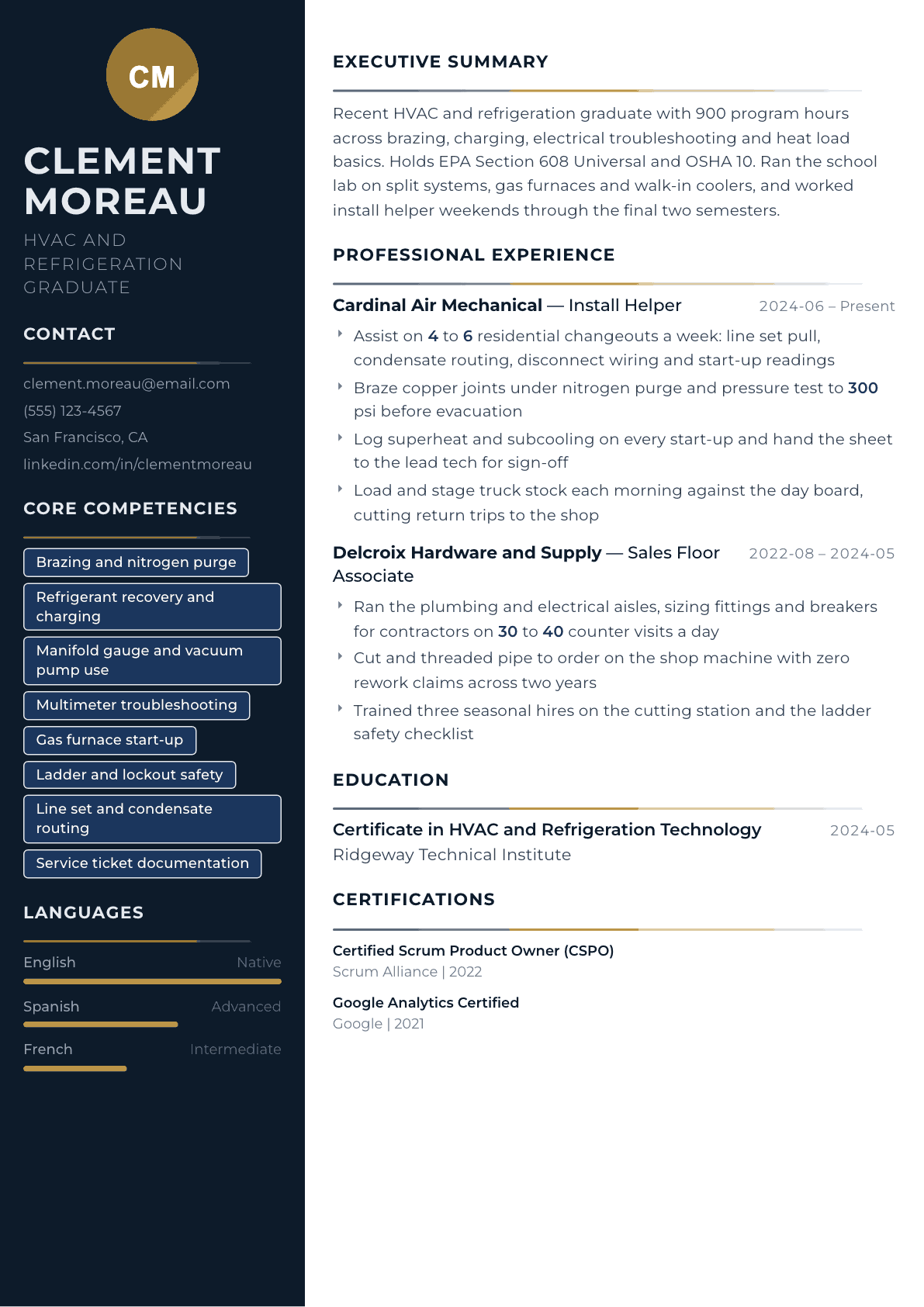
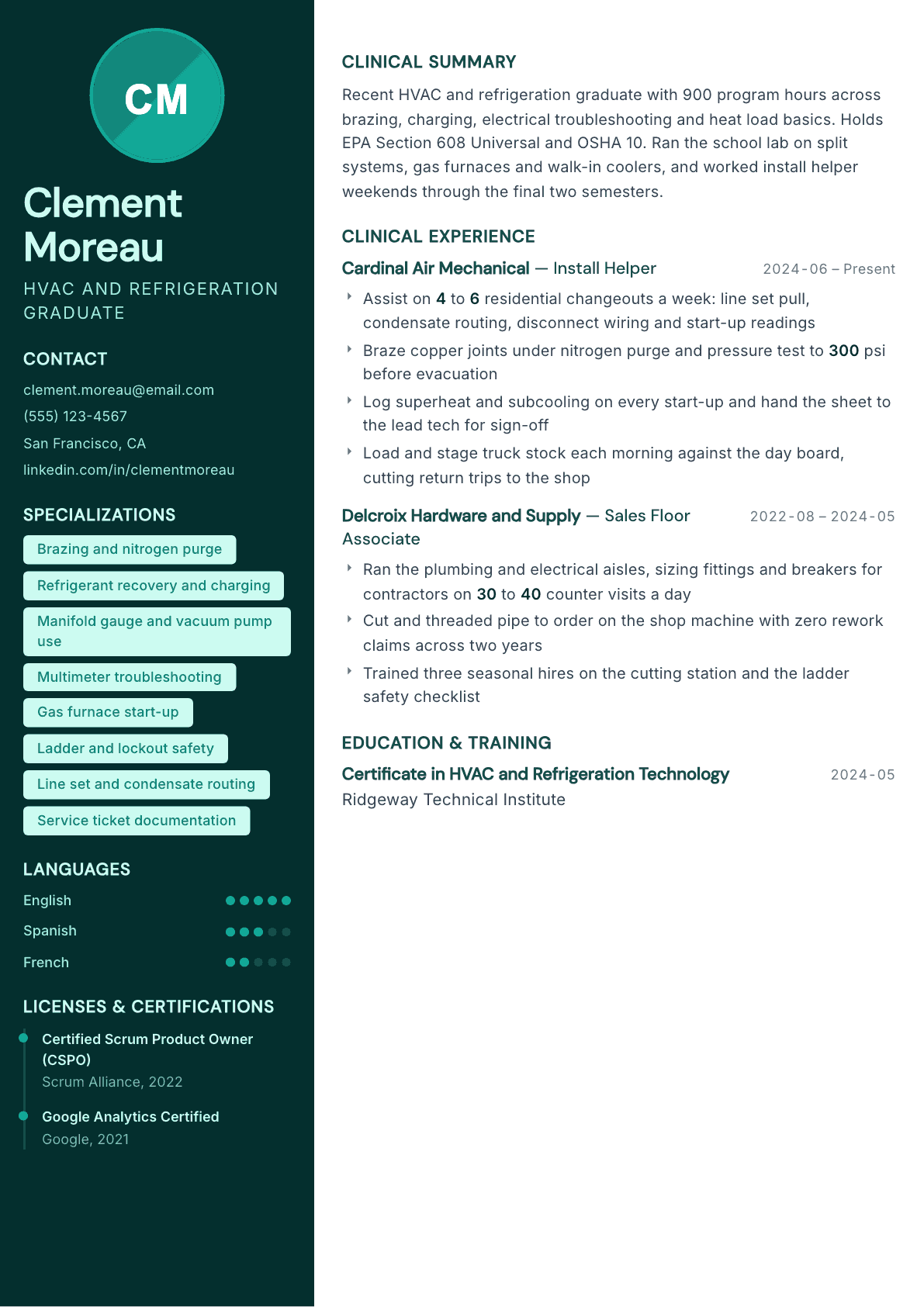
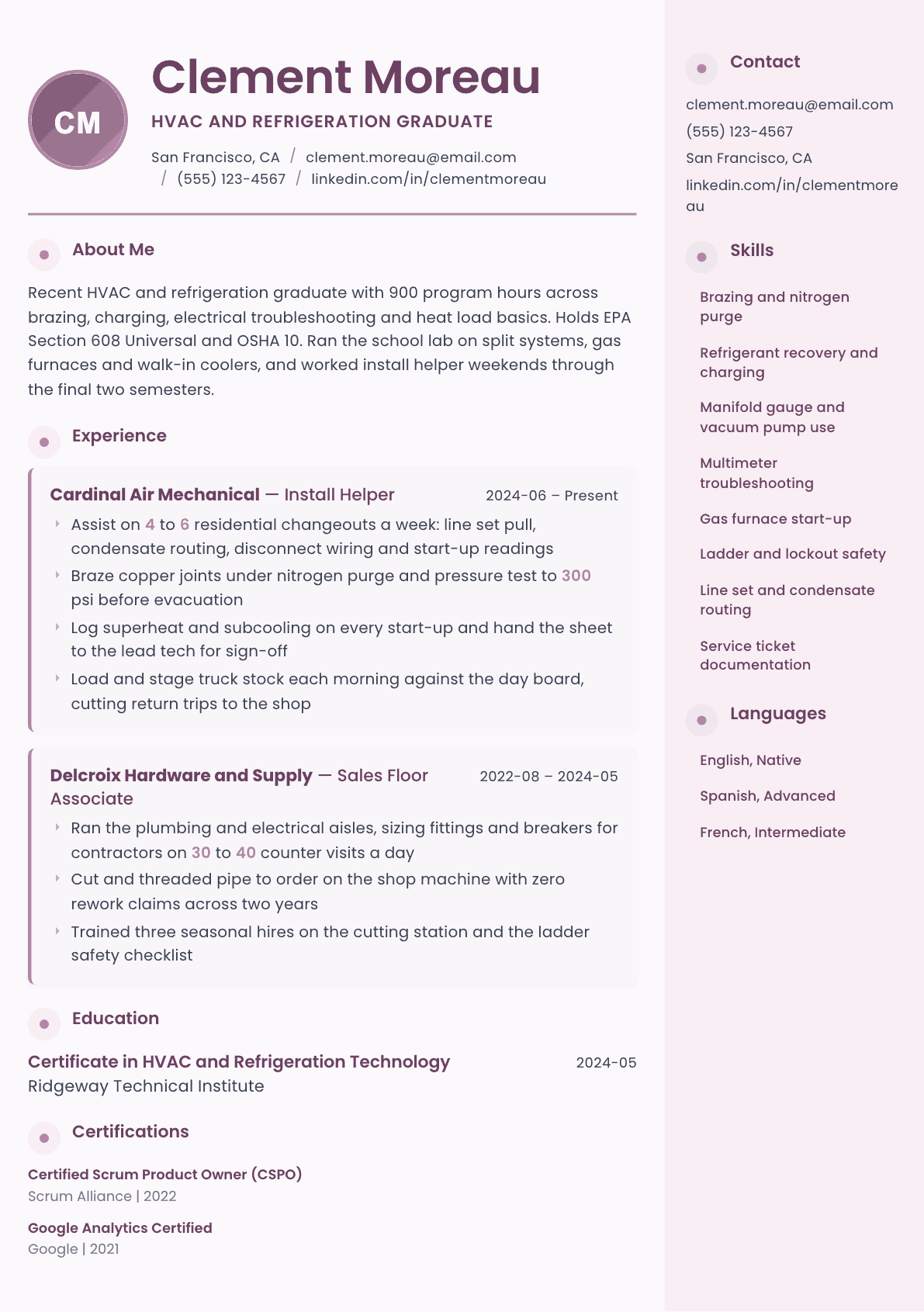
The same trade school graduate content laid out in three CVBooster templates, so you can see what the finished document looks like before you write a word.
Example Trade School Graduate summary
Trade school graduate with 900 documented lab hours in HVAC and refrigeration, holding EPA Section 608 Universal and OSHA 10, plus two years of weekend install help on residential changeouts. Brazes under nitrogen, pulls a vacuum to spec and records superheat and subcooling on every start-up. Owns a full hand tool set, drives clean, and wants a service apprentice seat with a shop that runs its own training ladder.
Skills to list on a Trade School Graduate resume
- Program lab hours
- Hand and power tool proficiency
- Blueprint and schematic reading
- Measurement and layout
- Torque and fastening standards
- Electrical troubleshooting
- Brazing and soldering
- Lockout and tagout
- Personal protective equipment discipline
- Job site cleanup and material staging
- Work order documentation
- Ladder and fall protection
- Tool inventory and maintenance
- Customer facing conduct on site
What actually gets this resume read
- Put your program hours and the machines or systems you ran on them above any unrelated part time work.
- List every safety card and technician card by its real name, because a foreman checks those before he checks grades.
- Name the tools you own, since a shop that does not have to buy you a torch set can start you sooner.
- Describe your capstone or lab project like a job: the system, the fault you found, and how you proved the fix.
- Say plainly whether you have a valid driver license and a clean record, because service trucks decide half of these hires.
- Add the instructor or shop lead who will pick up the phone, since trade hiring still runs on a two minute reference call.
How to write a trade school graduate resume
The person reading a trade school graduate resume is usually a service manager or a shop foreman who is short one body and has a truck sitting idle. He is not grading your education. He is working out how many weeks of babysitting you cost him before you can be sent to a call alone, and whether you will still be there in six months when that investment starts paying him back.
That means the two things he hunts for are hours and cards. Hours means the bench, bay or lab time your program put behind you, broken down by the systems you actually touched. Cards means the safety and technician credentials you already hold, because each one you are missing is a class he has to schedule and pay for. A resume that leads with a school name and a graduation month answers neither question.
This guide covers how to lay the page out, how to write a program you have just finished as if it were work experience, how to describe a capstone the way a foreman would describe a service call, and how to handle the awkward parts: no paid trade history, a patchy job record, and the license exam you have not sat yet.
Format: cards at the top, hours next, unrelated jobs last
One page, and put the credential block above the education block. A foreman scanning ten of these will read the first third of the page and decide. If your safety card and your technician card are down near the bottom next to a hobby line, you have buried the only part he can act on today.
Order the page as credentials, then program and lab hours, then trade related work of any kind including unpaid help, then other employment. Keep the other employment: two years of never missing a shift at a warehouse is a real signal to a shop that has been burned by no shows. Just do not let it take more room than the trade content.
- Credentials block: each card by its full name, the issuing body, and the month it expires if it expires.
- Program block: total lab or shop hours, then a breakdown by system, machine or process rather than by course number.
- Tools line: what you own outright, since a shop that does not have to outfit you can start you a week earlier.
- Logistics line: driver license class, clean record, ability to lift and work at height, and whether you have your own transportation.
Write the program like a job, not like a transcript
A course list tells a foreman nothing. Rewrite the program as work performed. Instead of naming a residential wiring course, say you pulled and terminated circuits on training walls, set panels, and tested with a meter until the instructor signed off. The verbs and the equipment are what carry across to a job site.
Give quantities wherever the program gave you any. Number of welds run and the positions they were run in. Number of vehicles through your bay. Number of joints brazed, panels set, or systems commissioned. Trade instructors keep these counts because accreditation makes them, so ask for yours before you leave. A graduate who can say how many times he has done a thing sounds like somebody who has done it.
Say who checked your work. A line noting that every lab job was inspected against a sign off sheet before it counted tells a foreman you are used to being corrected, which is most of what a first year looks like.
The capstone is your best bullet, so write it like a service call
Most programs end with a project or a diagnostic practical. That is the closest thing you have to a real job, so give it four lines in the format a technician uses: the system, the symptom, what you measured, what you found, and how you proved the repair held. A foreman reads that sequence every day on service tickets and will recognize the thinking immediately.
Resist the urge to describe the capstone as a team achievement. Name your part of it. If three of you built a mock system, say which sections you ran and which readings you took. Vague group credit reads as a person who stood near the work.
- Symptom first, in the words a customer would use, then the measurements you took to narrow it.
- The instrument you used for each reading, since the tool list proves the method.
- The fault you landed on, and one line on the wrong answer you ruled out along the way.
- The verification step: pressure held, voltage in range, cycle completed, no repeat fault on retest.
Cards, licenses, and the exam you have not taken yet
List only the credentials you hold in hand, with the body that issued them spelled out. A card that is genuinely pending gets one honest line saying the exam date is booked. Never write that you are certified when you mean you finished the coursework. Trade licensing is checkable in a public database in most states, and a foreman who catches that will not call back.
If your trade runs an apprenticeship ladder, say where you sit on it and how many on the job hours you have logged toward the next step. A shop that sponsors apprentices needs to know whether hiring you starts a clock at zero or at halfway, and that single number can move you ahead of a graduate who left it off.
Keywords a trade posting actually uses
Trade job adverts are short and repetitive. They ask for a valid driver license, a clean motor vehicle record, a safety card, the ability to lift a stated weight, comfort on ladders or in crawl spaces, and a willingness to be on call. Answer each of those in plain words on the page rather than assuming they are obvious. Half the applicants do not, and the ones who do get screened in faster.
Then mirror the equipment vocabulary. Manifold gauges, torque wrench, oscilloscope, megger, plasma cutter, conduit bender, scan tool: whichever family belongs to your trade, name the specific instruments you have used unsupervised. That list is the fastest proof of real bench time that a resume can carry.
Trade School Graduate resume summary examples
Straight out of the program
Automotive technology graduate with 1080 shop hours across brakes, suspension, drivability diagnostics and electrical, holding two ASE entry-level certifications and a clean driving record. Ran 60 vehicles through the student bay under instructor sign-off. Owns a full metric hand tool set and a scan tool.
Graduate with a year on the truck
Trade school graduate with one year as an install helper on residential HVAC changeouts, backed by 900 program hours in refrigeration and controls. Holds EPA Section 608 Universal and OSHA 10. Brazes under nitrogen, pulls vacuum to spec, and records superheat and subcooling on every start-up.
Graduate finishing an apprenticeship
Electrical graduate with 3200 logged on-the-job hours toward a journeyman card, plus 600 classroom hours in code and theory. Runs residential rough-in and service changes unsupervised, bends and sets conduit to print, and has trained four first-year apprentices on panel labeling and lockout.
Work experience bullets: before and after
Before: Completed HVAC training program at a technical school.
After: Completed 900 lab hours across split systems, gas furnaces and walk-in refrigeration, with every job inspected against an instructor sign-off sheet before it counted toward hours.
The hour count, the systems and the sign-off tell a foreman what you touched and who checked it.
Before: Learned to weld in school.
After: Ran roughly 400 practice welds in flat, horizontal and vertical positions on carbon steel plate and pipe, passing a 6G bend test on the second attempt in the final term.
Positions and a named test turn a claim of welding into a skill level a shop can price.
Before: Did a final project on a heating system.
After: Diagnosed a no-heat call on a mock furnace: traced a 24 volt control fault to a failed limit switch with a multimeter, replaced it, and ran three full cycles to confirm ignition and blower handoff.
Written as a service call, it shows diagnostic sequence rather than time spent near a project.
Before: Have good safety habits.
After: Holds OSHA 10 for construction, ran the lab lockout board for two terms, and finished the program with no tool or ladder incidents logged against the bench.
A card, a duty and a clean record are three checkable facts where a habit claim is none.
Before: Worked part time while going to school.
After: Held a 25-hour warehouse shift through both program years with no missed starts, working 5 am openings around a full daytime lab schedule.
Reliability under a hard schedule is exactly what a shop worries about with a first-year hire.
Hard skills
- Blueprint and schematic reading
- Precision measurement and layout
- Multimeter and test instrument use
- Hand and power tool operation
- Brazing, soldering or welding by trade
- Torque and fastening specification
- Lockout and tagout procedure
- Fall protection and ladder safety
- Material estimating and staging
- Work order and service ticket writing
- Equipment start-up and commissioning checks
- Tool inventory and calibration care
Soft skills
- Taking correction on the first pass without argument
- Asking before guessing on an unfamiliar system
- Punctuality on early start times
- Customer conduct inside an occupied home
- Keeping a work area a second technician can walk into
Certifications worth listing
- OSHA 10-Hour Construction Outreach Training (Occupational Safety and Health Administration)
- NCCER Core Craft Skills Credential (National Center for Construction Education and Research)
- Section 608 Technician Certification (United States Environmental Protection Agency)
- Entry-Level Technician Certification (National Institute for Automotive Service Excellence)
- Certified Welder (American Welding Society)
Mistakes that cost trade school graduate candidates the interview
- Listing course titles and grades instead of the hours, machines and processes those courses put in your hands.
- Burying the safety and technician cards below education, where the foreman scanning the top third never reaches them.
- Writing that you are certified when the exam is only booked, on credentials that a public license lookup will check.
- Describing the capstone as a team effort without naming which sections and readings were yours.
- Dropping every non-trade job off the page and losing the only proof you show up on time for two years running.
- Leaving out the driver license, the lifting ability and the transportation, which are screening questions in almost every trade posting.
- Claiming tools you do not own, which is discovered on day one when the truck is loaded.
Trade School Graduate resume questions
How do I write a trade resume with no paid experience in the trade?
Treat the program as the experience section. Give total shop hours, break them out by system or process, name the instruments you used unsupervised, and add the capstone written as a diagnostic sequence. Then keep your unrelated jobs underneath as evidence of attendance and reliability.
Should a trade school graduate resume be one page or two?
One page, without exception at this stage. A foreman is comparing a stack of graduates on hours, cards and whether you drive. Everything that matters fits on one page, and a second page usually means course descriptions have been pasted in to fill space.
Do employers care about my grade point average from a technical program?
Rarely. Attendance and lab hours carry far more weight, because shops have learned that the graduate who never missed a session is the one who shows up to a 6 am job. Include a class rank or a perfect attendance record if you have one, and skip the rest.
How should I list a license exam I have not sat yet?
Give it one line stating the credential, the issuing body and the booked exam date, kept visually separate from the credentials you hold. Never fold it in with the real cards. Being upfront about a pending exam costs you nothing, while an overstated one ends the process.
Is it worth listing the tools I own?
Yes, and it is one of the most underused lines on these resumes. A shop that has to outfit a new hire absorbs a real cost and a delay before you can be useful. Give the categories honestly, note whether you have a rolling box, and never list something you plan to buy later.