Trainee Resume Examples: free score, then the gap list
Write a Trainee Resume That Survives a Graduate Program Screen
By Mustafa Tarabya, founder of CVBooster · Published · Updated
Trainee resume example, keyword list and writing guide covering rotation programs, assessment centers, cohort selection and early career evidence.
Sample resumes for a trainee
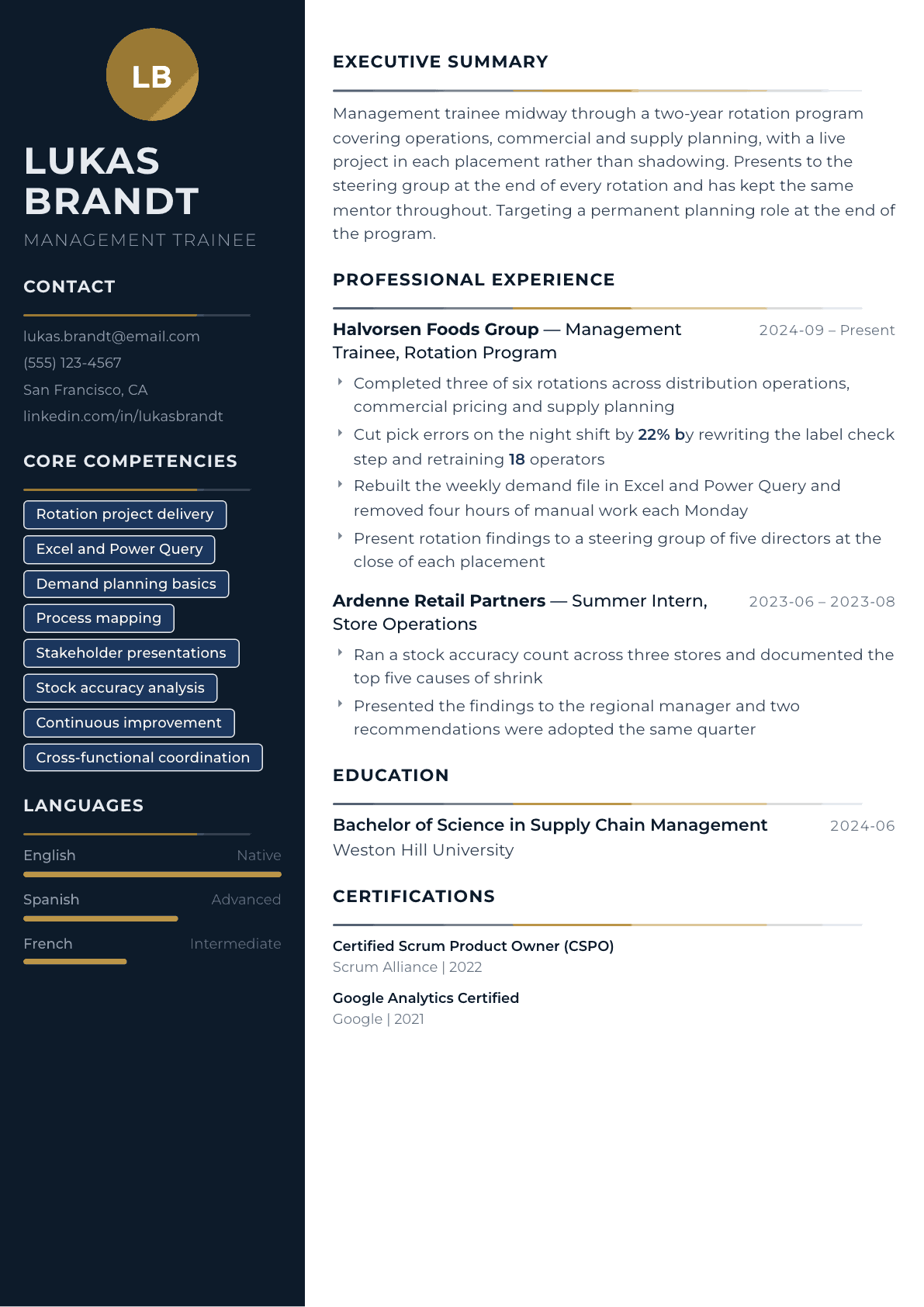
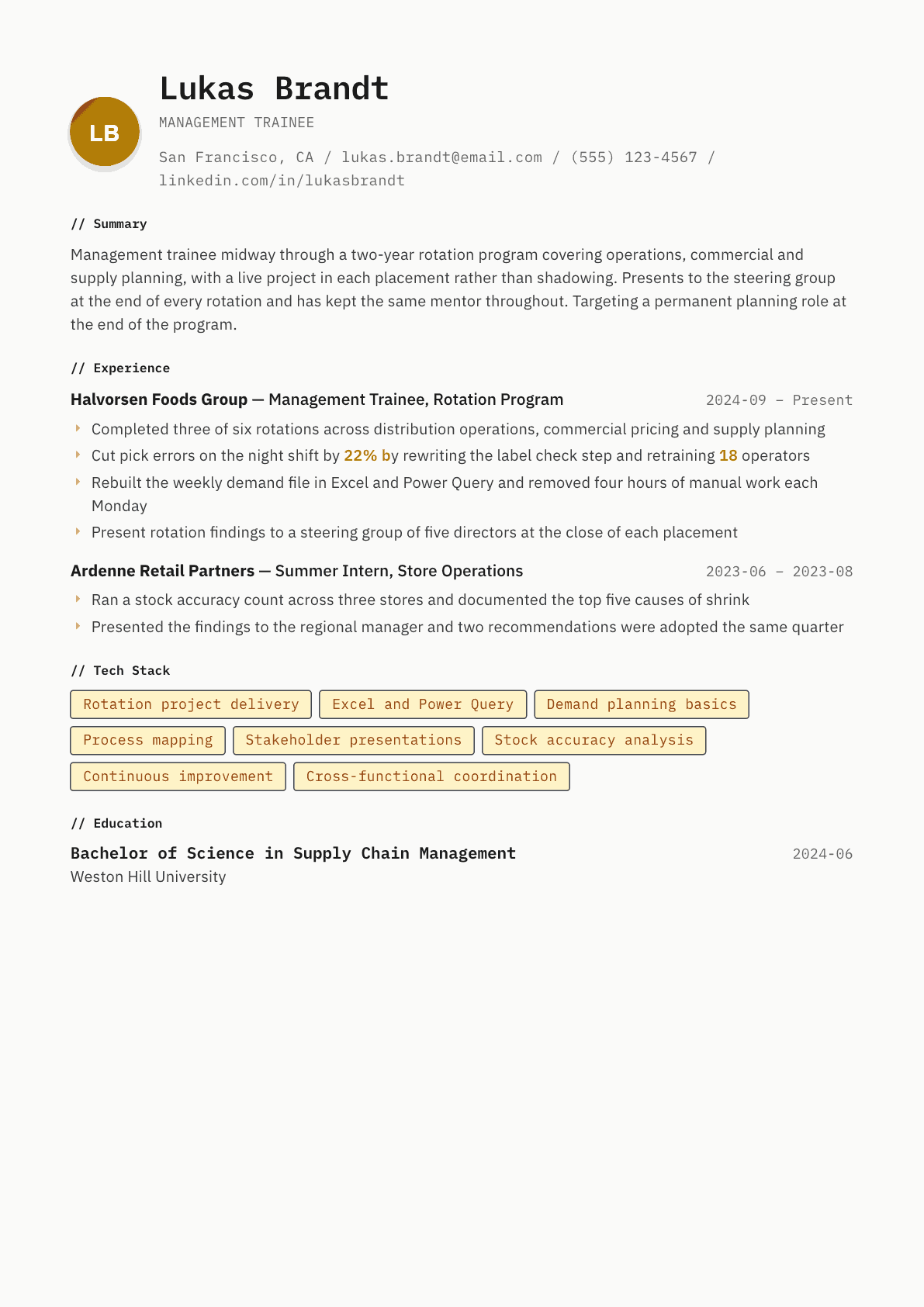
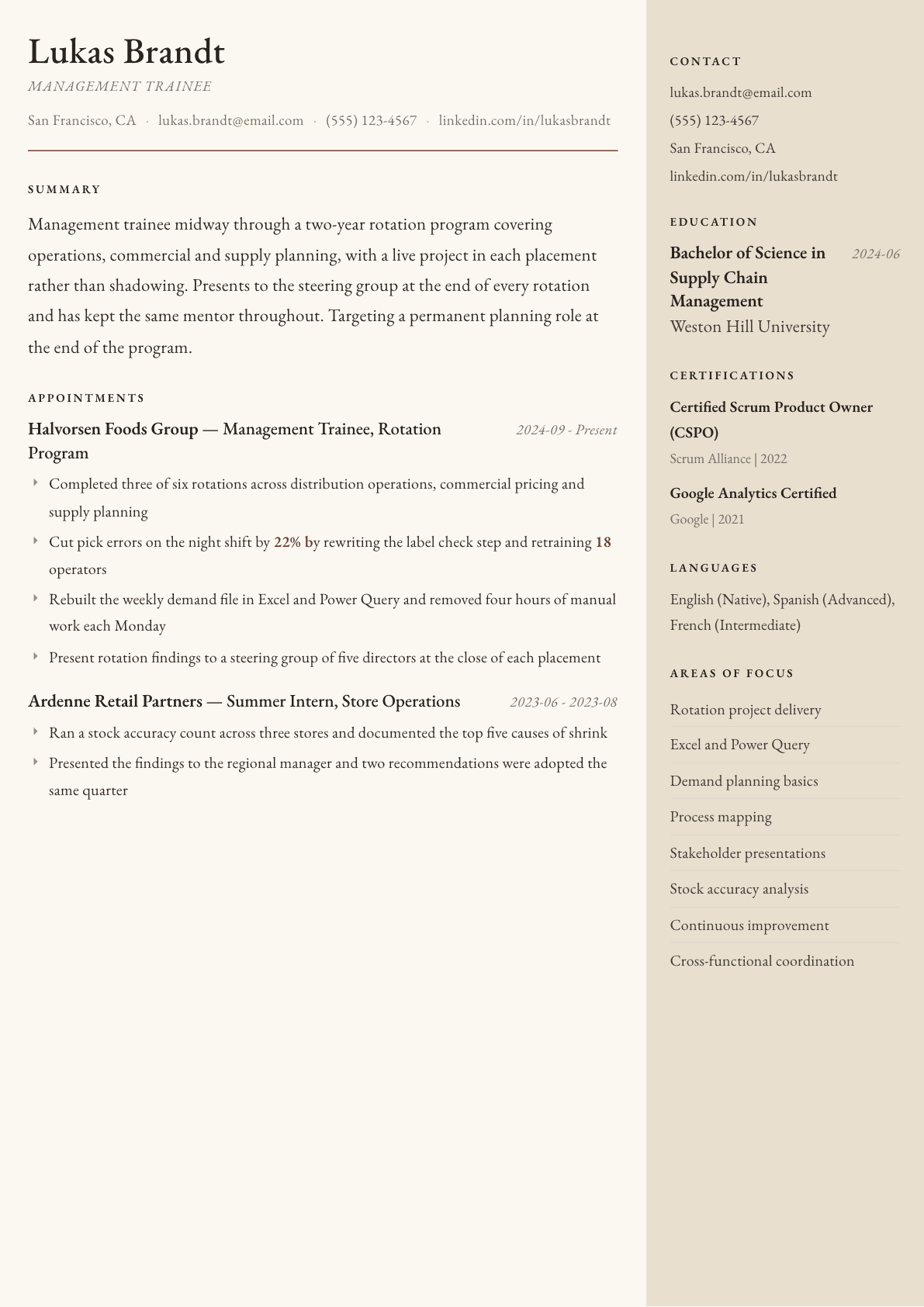
The same trainee content laid out in three CVBooster templates, so you can see what the finished document looks like before you write a word.
Example Trainee summary
Management trainee three rotations into a two-year program spanning distribution operations, commercial pricing and supply planning, with a delivered project in each placement. Reduced night shift pick errors by 22% through a rewritten label check and operator retraining, and automated the weekly demand file. Presents to a director steering group each rotation. Targeting a permanent supply planning position.
Skills to list on a Trainee resume
- Rotation program delivery
- Structured problem solving
- Process mapping
- Data analysis in Excel
- Stakeholder presentation
- Project scoping
- Continuous improvement methods
- Cross-functional coordination
- Report writing
- Time management across placements
- Assessment center exercises
- Mentor and feedback cycles
What actually gets this resume read
- Name the program, its length and every rotation with the function and duration of each placement.
- Give each rotation a deliverable, not a description, because programs are judged on what trainees shipped out.
- Show the assessment stages you have already passed if you are applying to another program mid-track.
- Put academic evidence near the top while your work history is short, including your degree class and dissertation.
- Add the mentoring and steering group exposure, which proves you can hold a room above your grade.
- Say which permanent function you want after the program so the recruiter can picture the landing seat.
How to write a trainee resume
Trainee programs are the most heavily contested entry route into large employers, and they are screened differently from ordinary vacancies. There is no line manager with an urgent seat to fill. There is a program team selecting a cohort against a scorecard, usually running an online assessment, a video interview and an assessment center before a human reads much of anything. The resume's job in that pipeline is narrow: get you past the first cut and give the assessors something to probe later.
That means the page has to do two unusual things. It has to make a short history look deliberate rather than thin, and it has to show potential in the specific form these programs measure: analytical work, ownership of something small, and the ability to stand in front of people more senior than you and hold the room. Programs are not buying competence yet. They are buying trajectory.
This guide covers laying out rotations if you are already in a program, building the page if you are applying to one, what a rotation bullet should contain, how to reference assessment stages, and how to position yourself for the permanent seat at the end rather than drifting into whichever function has a vacancy.
If you are in a program: name it, then give each rotation a deliverable
Treat the program as the employer entry and the rotations as sub-entries. Name the program, its total length, and how many placements it contains, then list each rotation with the function, the duration and what you delivered. A reader who sees three of six rotations completed understands both your progress and your remaining commitment without asking.
The deliverable is the whole point. Rotations are short, so a trainee who describes a placement as gaining exposure to supply planning has told the reader that nothing happened. A trainee who rebuilt the weekly demand file and removed four hours of manual work every Monday has a result that survives the rotation ending. Write every placement to that standard, and if one placement genuinely produced nothing, give it a single line and spend the space on the ones that did.
- Program name, sponsoring employer, total duration and number of rotations.
- Each rotation as a sub-entry: function, dates, and the project you owned.
- The deliverable and its measurable effect, not the learning objective.
- Presentation and steering group exposure, with the seniority of the audience.
- The permanent function you are targeting when the program ends.
If you are applying to one: build the case from academics and evidence of ownership
With little work history, academics carry more weight here than in almost any other application. Put the degree, the classification or grade average, the modules that map to the function, and the dissertation or capstone with its question and method. Program screeners often filter on a grade threshold, so burying it below three internships is a self-inflicted wound.
Then find the ownership evidence. Assessors look for a candidate who took responsibility for something end to end, and it does not have to be corporate. A society treasury, a sports team you captained, a summer internship project you presented to a regional manager, a part-time job where you were trusted with the close. What matters is that you decided something, carried it, and can describe what went wrong in the middle.
Where you have already passed stages of another program's selection process, say so. Reaching a final assessment center is a credential in itself, and a program team reads it as evidence that another respected process rated you highly.
The rotation bullet: what assessors are actually testing
Program scorecards tend to circle the same competencies: analysis, commercial awareness, influencing without authority, resilience and learning speed. Write bullets that hit those deliberately. An analysis bullet names the data, the tool and the conclusion. An influencing bullet names people you had no power over and what they agreed to do. A resilience bullet names a setback and what you changed after it.
Quantify at trainee scale and do not inflate. Retraining eighteen operators on a label check step is a genuine, verifiable result. Claiming to have transformed a distribution network is not, and an assessment center interview is specifically designed to take that claim apart question by question.
Keep the language plain. Programs recruit from a pool that has all read the same advice, so a page written in ordinary sentences about real work stands out against a stack of competency vocabulary.
- Analysis: the data set, the tool, the finding and what changed because of it.
- Influence: who you needed, what they agreed to, and how you got there without authority.
- Delivery: the deadline, the constraint and whether it held.
- Setback: what failed and the specific change you made afterward.
- Audience: who you presented to and how senior they were.
Placing yourself for the permanent role, not just the program
Trainees who end programs badly are usually the ones who never said what they wanted. Rotations end, a seat opens somewhere, and the trainee who has been visibly interested in supply planning for two years gets the planning seat while the neutral one gets whatever is left. Put the target function in the summary and keep it consistent across the page.
Support it with the pattern of your placements and your projects. Choosing the analytics work in a commercial rotation, taking the forecasting piece in an operations rotation, and asking for the planning placement rather than accepting the allocation all tell a coherent story that a hiring conversation can build on.
Mentors matter here too. Programs pair trainees with a mentor for a reason, and a candidate who has held the same mentor throughout and can name what came out of that relationship reads as someone who uses the structure rather than tolerating it.
Trainee resume summary examples
Applying to a graduate program
Supply chain graduate with a first-class degree and a summer internship in store operations, where a stock accuracy count across three sites produced two recommendations adopted the same quarter. Treasurer of a 90-member university society for two years. Applying to a management trainee program in retail operations.
Halfway through the rotations
Management trainee three rotations into a two-year program across distribution operations, commercial pricing and supply planning, with a delivered project in each placement. Cut night shift pick errors by 22% through a rewritten label check and retraining 18 operators. Targeting a permanent supply planning role.
Final rotation, moving to a permanent seat
Final-year trainee completing a two-year program with six placements across operations, finance and commercial, presenting to a director steering group at each close. Automated the weekly demand file and removed 4 hours of manual work per cycle. Moving into a demand planner position at the end of the program.
Work experience bullets: before and after
Before: Completed a rotation in distribution operations.
After: Spent 4 months in distribution operations and cut night shift pick errors by 22% by rewriting the label check step and retraining 18 operators on the new sequence.
A duration plus a delivered result turns a placement into evidence that outlasted the rotation itself.
Before: Gained exposure to demand planning processes.
After: Rebuilt the weekly demand file in Excel and Power Query, removing 4 hours of manual consolidation every Monday and handing the model to the planning team.
Exposure describes attendance, while a rebuilt file with a time saving describes work someone else now relies on.
Before: Presented my project at the end of the rotation.
After: Presented rotation findings to a steering group of 5 directors at each placement close, with two pricing recommendations approved for the following quarter.
The seniority of the audience and the decisions taken are what an assessor is trying to measure.
Before: Worked with different teams across the business.
After: Persuaded two shift supervisors and the training coordinator to pilot the revised label check on one line before rollout, with no formal authority over any of them.
Naming the people and the agreement is how influencing without authority becomes visible on a page.
Before: Was treasurer of a university society.
After: Ran the accounts of a 90-member society for two academic years, moving the membership process online and closing both years with an audited balance and no outstanding claims.
Membership size, a change made and a clean close convert a title into evidence of end-to-end ownership.
Hard skills
- Rotation project delivery
- Structured problem solving
- Data analysis in Excel and Power Query
- Process mapping and improvement
- Business case preparation
- Stakeholder presentation
- Report writing for senior audiences
- Project scoping and planning
- Continuous improvement methods
- Cross-functional coordination
- Assessment center exercises
- Time management across placements
Soft skills
- Influencing people who do not report to you
- Starting again in a new function every few months
- Asking useful questions in the first week
- Taking feedback from a mentor and acting on it
- Holding a room of people more senior than you
Mistakes that cost trainee candidates the interview
- Describing rotations as exposure or learning objectives instead of naming what you delivered in each one.
- Leaving the degree classification off the page when program screeners often filter on exactly that threshold.
- Claiming transformation at a scale an assessment center interview will dismantle in three questions.
- Listing all six rotations at equal length when only three of them produced anything worth reading.
- Writing in competency vocabulary that every other applicant to the same program has also copied.
- Never naming the permanent function you want, which leaves the end-of-program seat to chance.
- Omitting society, sports or part-time roles that carry the only end-to-end ownership evidence you have.
Trainee resume questions
How do I put a rotation program on a resume?
Make the program the employer entry with its total length and number of placements, then list each rotation as a sub-entry with the function, the dates and the project you delivered. That structure shows progress and commitment at a glance.
What do I write about a rotation where I did not deliver anything?
Give it one line naming the function and the dates, and spend the space on the placements that produced results. A short honest line reads better than a paragraph describing meetings you attended.
How important are grades for a trainee program application?
More important than for most jobs, because many programs filter on a grade threshold before a human reads the page. Put the classification or average near the top with the modules and the dissertation that connect to the function.
Should I mention that I reached the assessment center for another program?
Yes. Reaching a final stage is evidence that a rigorous process rated you highly, and program teams read it that way. State the employer, the stage reached and the year without dwelling on the outcome.
How do I secure a good permanent role at the end of the program?
Decide the target function early, say it in your summary, and build a consistent pattern of placements and projects around it. Trainees who stay neutral to the end tend to receive whichever seat happens to be open.