Intern Resume Examples: what a hiring manager reads first
Build an Intern Resume That Launches Your Career
By Mustafa Tarabya, founder of CVBooster · Published · Updated
Create an impressive intern resume with CVBooster, even with limited experience. Highlight coursework, projects, and transferable skills that make recruiters take notice.
Sample resumes for a intern
The same intern content laid out in three CVBooster templates, so you can see what the finished document looks like before you write a word.
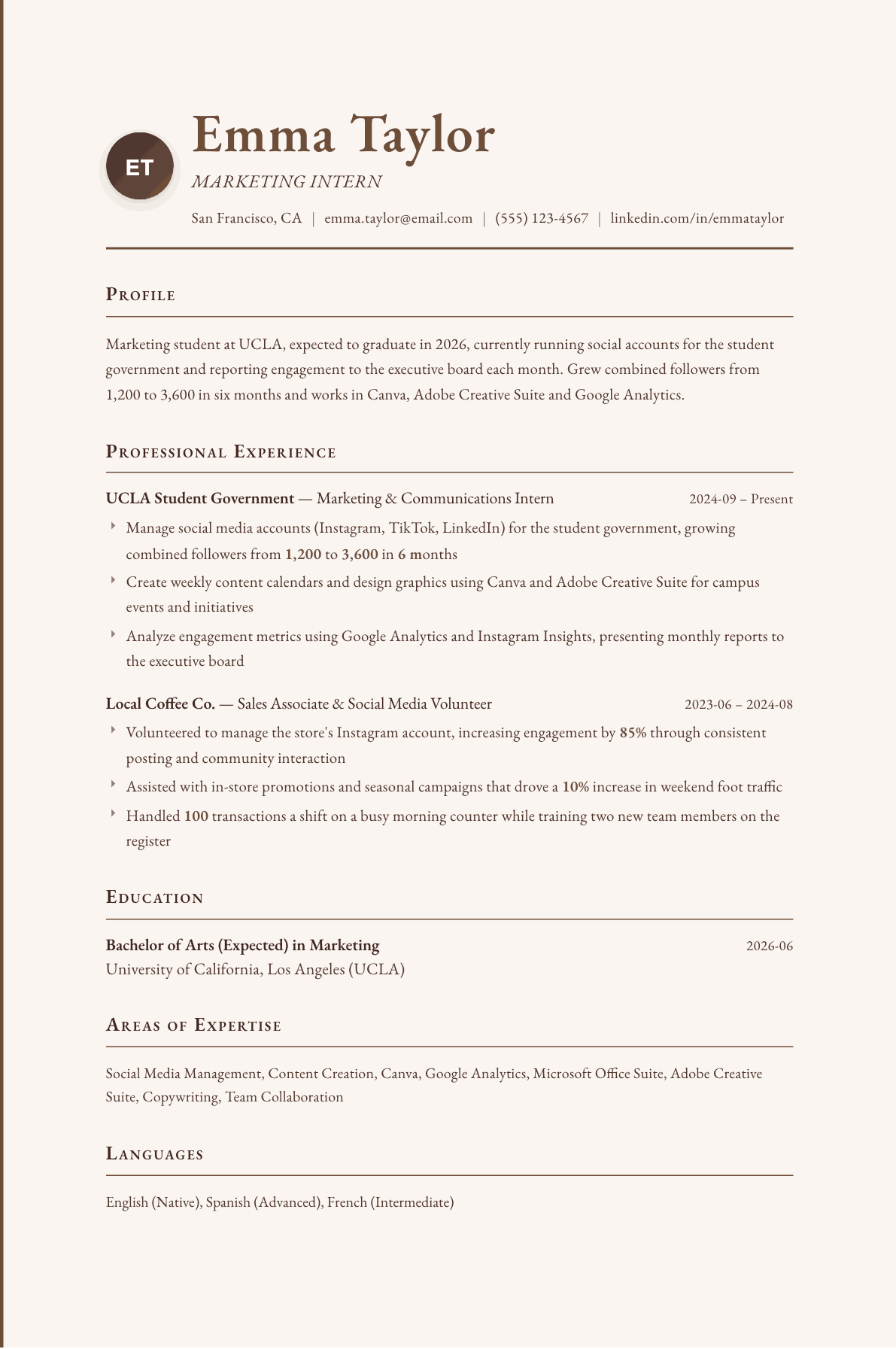
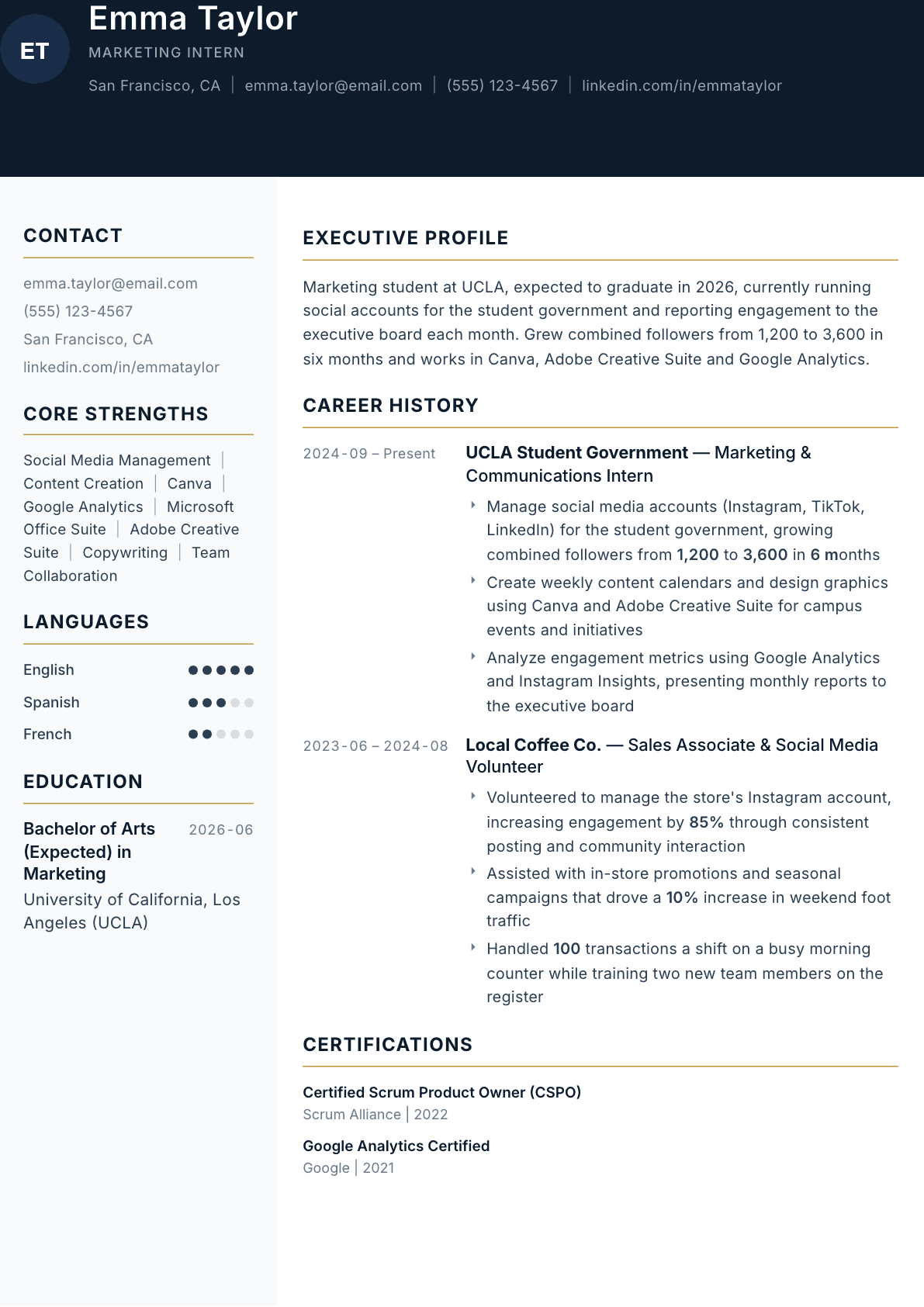
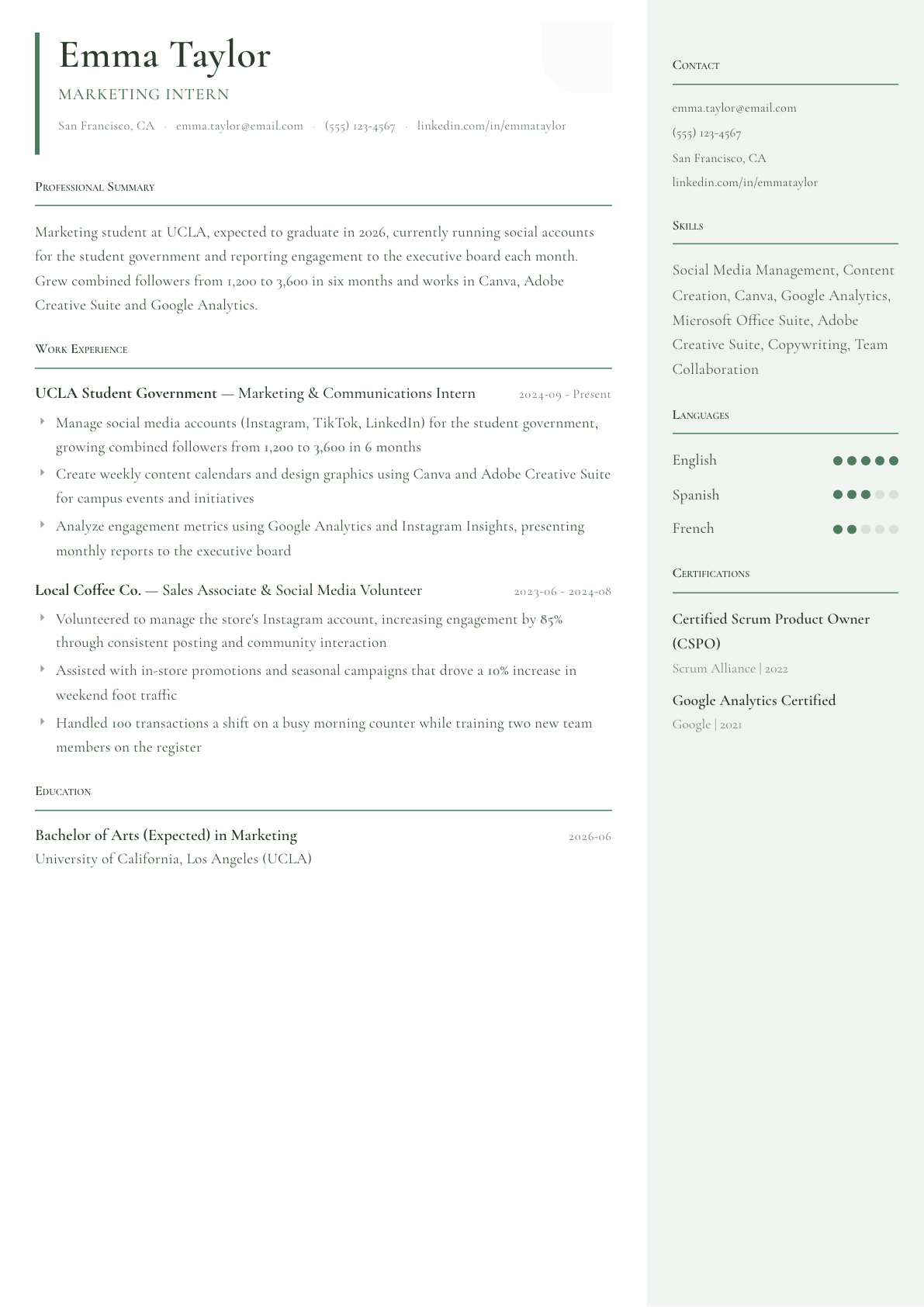
Example Intern summary
Marketing student at UCLA graduating in 2026, with two years of campus social media work and a retail job alongside classes. Tripled a student government following in six months, builds weekly content calendars in Canva, and reports engagement from Google Analytics and Instagram Insights. Looking for a summer marketing internship in social or content.
Skills to list on a Intern resume
- Social Media Management
- Content Creation
- Canva
- Adobe Creative Suite
- Google Analytics
- Microsoft Office Suite
- Copywriting
- Team Collaboration
- Time Management
- Research & Analysis
- Presentation Skills
- Customer Service
What actually gets this resume read
- Lead with education, including relevant coursework, GPA (if 3.5+), academic honors, and expected graduation date.
- Treat campus activities, volunteer work, and personal projects as legitimate experience. Format them like professional roles.
- Quantify everything you can: social media followers gained, events organized, funds raised, or people served.
- Highlight transferable skills from any work experience: customer service, teamwork, time management, and communication.
- Include technical skills and tools even if self-taught: Google Analytics, Canva, Excel, Python, or any relevant software.
- Keep it to one page. Recruiters expect concise resumes from early-career candidates and appreciate clean formatting.
How to write a intern resume
Internship hiring runs on a calendar, and the resume has to fit it. Large employers open summer programs many months ahead, screen in waves, and fill cohorts before some applicants have even started looking. The document that wins a spot is one that a university recruiter can process in a few seconds: eligible graduation window, a major that maps to the team, evidence you have used the tools, and something you built that was not assigned to you.
The second reader is the team that will host you. A manager taking an intern is spending real supervision time for twelve weeks and wants the shortest possible ramp. That is why tool names, coursework depth and project detail matter more on an internship resume than titles do. Nobody expects you to have held a job in the field. They expect proof that you can be useful by week three.
This guide covers the layout that survives a campus application portal, how to write projects and coursework so a hosting manager can judge them, what to say about work authorization and program eligibility, three summaries for a first internship through a returning intern, before-and-after bullets, and the questions applicants ask during recruiting season.
Format: single page, single column, parser safe
Campus applications almost always route through a portal that extracts your text before a human sees it. Use one column, standard section headings the parser recognizes, no text boxes, no icons in place of words, and no tables. Save and submit as a PDF unless the portal asks for something else, and name the file with your own name rather than a version number.
Keep it to a page and place education at the top with the expected graduation date, the degree and the major. Internship eligibility is defined by that date, so any ambiguity there is a rejection you never hear about.
- Header: name, city and state, phone, email, and a link to a code repository or portfolio when the field expects one.
- Sections in this order: summary, education, projects or experience depending on which is stronger, leadership, skills.
- State work authorization plainly when the program asks, since many internships cannot sponsor.
- Match the wording of the program title you are applying to so a keyword filter finds it.
Summary: target program, major, tools, and one thing you made
Two or three lines aimed at the specific program. Name the field, the degree in progress, the graduation term, the two or three tools you are strongest in, and one concrete thing you built or ran. A recruiter reading fifty files an hour keeps the ones where the first two lines answer whether you fit the team.
Skip the objective that says you are seeking an opportunity to learn and grow. Every applicant is, so the sentence carries no information and costs you the best real estate on the page. Replace it with what you can already do.
Projects and experience: give the reader something to interview you about
For a first internship, projects usually carry the page. Write each with a short problem statement, the approach, the tools and the outcome, and be specific about scale: how many records you cleaned, how many users tried it, how long the build took, what broke and how you fixed it. Managers pick interns whose projects give them a question to open the interview with.
Any prior experience goes in a parallel section formatted the same way: a previous internship, a research position, freelance work, a campus job, a family business, or military service. Where the work was unrelated to the target field, keep it short and lead the bullets with the transferable part, such as handling customers, managing a schedule, tracking money or training a colleague.
If you are applying to return to a program or moving from one internship to another, lead with what you owned end to end. The strongest line on a second-internship resume is a piece of work that outlived your last term: a script the team still runs, a process document still in use, a report the client kept requesting.
- Technical projects: the problem, the stack, your specific contribution, the size of the data or user base, and where the code lives.
- Business and marketing projects: the client or campus audience, the deliverable, the metric watched, and what the recommendation was.
- Research: the lab or faculty area, the method you ran, the sample size, and any poster, paper or presentation.
- Prior internships: the team, the manager expectations, the deliverable handed over, and whether you were asked back.
Leadership, coursework and the eligibility details recruiters check
Student organizations, competition teams, hackathons, tutoring and volunteer work belong in a leadership section with the position, the size of the group and what you were accountable for. Hosting managers read these to predict how you behave in a team meeting, which is most of what an internship is.
Relevant coursework earns four to six named courses when they map to the role, and it should read as evidence of what you can already do rather than as a transcript. Add the term you took them if you want to signal recency.
Eligibility items go where the recruiter can find them quickly: expected graduation, degree level, work authorization status if the posting asks, willingness to relocate, and availability window in weeks. Programs are scheduled tightly and a mismatch found late costs both sides a round of interviews.
Skills: name the tools, and only the ones you can defend
Group the skills section by type: programming languages, software and platforms, analytical methods, and languages spoken with an honest level. Take the vocabulary straight from the posting, because the filter is looking for exact tool names rather than descriptions of them.
Rate nothing on a five-point scale, and drop anything you cannot survive two follow-up questions about. Interns are frequently asked to open a tool during an interview, and the fastest way out of a pipeline is a listed skill that evaporates under a simple question.
Intern resume summary examples
First internship
Computer science sophomore graduating in June with coursework in data structures and databases, comfortable in Python and SQL. Built a course scheduling tool used by 40 classmates and maintains a small repository of practice projects. Seeking a summer software engineering internship with a mentored onboarding program.
Second internship
Marketing junior returning for a second internship after a ten-week agency term managing content calendars for three accounts and lifting engagement 28%. Runs social media for a student government reaching 3,600 followers. Fluent in Google Analytics, Canva and Meta Ads Manager, available for twelve weeks from June.
Pre-graduation internship
Finance senior graduating in December, returning from a summer analyst internship where a valuation model built during the term was adopted by the coverage team. Bloomberg Market Concepts certified, strong in Excel modeling and Python for data cleaning. Seeking a fall internship convertible to a full-time analyst role.
Work experience bullets: before and after
Before: Helped the team with data entry and reports.
After: Cleaned and merged 3,000 records from two mismatched exports, then automated the weekly report in a Python script the team continued running after the internship ended.
The record count and the fact that the work outlasted your term prove real contribution rather than busywork.
Before: Built a website as a personal project.
After: Built and deployed a course review site for my department using React and a small Postgres database, handling roughly 400 visits in the first exam period.
The stack, the deployment and the traffic give a manager something concrete to ask about in the interview.
Before: Attended a hackathon with a team.
After: Competed in a 36-hour hackathon on a four-person team, owning the API layer for a campus lost-and-found app and placing third of 22 teams.
Naming your component and the placement separates you from teammates who list the same event.
Before: Worked part-time at a coffee shop while studying.
After: Worked 18 hours a week through three semesters at a coffee shop, opening the store alone twice a week and reconciling the morning till before service.
Opening alone and handling money translate directly into the reliability a hosting manager needs.
Before: Know Excel, Python and SQL.
After: Used SQL joins and window functions to pull two years of campus dining transactions, then modeled the demand curve in Excel to recommend two new service hours.
Showing the tools inside a question you answered is far more credible than naming them in a row.
Hard skills
- Python
- SQL queries and joins
- Excel modeling and pivot tables
- Data cleaning and validation
- Git and version control
- Tableau or Power BI dashboards
- Google Analytics
- PowerPoint deck building
- Technical writing and documentation
- Survey and user research basics
- Jira and task tracking
- API basics
Soft skills
- Asking clarifying questions early
- Receiving feedback
- Managing a twelve-week deadline
- Speaking up in team meetings
- Note taking and follow-through
- Working without close supervision
Certifications worth listing
- Microsoft Office Specialist: Excel Expert (Microsoft)
- Google Ads Search Certification (Google)
- Tableau Desktop Specialist (Salesforce)
- Salesforce Certified Associate (Salesforce)
- Microsoft Certified: Azure Fundamentals (Microsoft)
- Meta Certified Digital Marketing Associate (Meta)
Mistakes that cost intern candidates the interview
- Applying late in the cycle for programs that fill their cohort months before the term begins.
- Opening with an objective about gaining experience, which describes every applicant in the queue.
- Submitting a designed template with sidebars that a campus portal parser scrambles before a human reads it.
- Listing tools you cannot answer a follow-up question about, which ends the interview early.
- Describing a team project without saying which part you owned.
- Hiding the expected graduation date, which is the field the eligibility filter runs on.
- Ignoring unrelated part-time work that shows you can hold a schedule and be trusted alone.
Intern resume questions
How do I write an internship resume with no work experience at all?
Put education first, then a projects section written like jobs: problem, approach, tools, scale and outcome. Add coursework that maps to the role and any club, volunteer or tutoring position where you were accountable to other people for something specific.
When should I apply for a summer internship?
Start early, because many large programs open applications many months before the term and close them once a cohort fills. Track the postings you care about, apply as they open, and keep a smaller list of later-cycle employers as a second wave.
Should I list my GPA on an internship resume?
List it when it is roughly 3.0 or above and write the scale, since several industries screen on it during campus recruiting. If it is lower, leave it out and put the weight into projects, tools and any prior internship or research work.
What is the difference between an internship resume and a full-time resume?
An internship resume is judged on potential and ramp speed, so projects, coursework and tools carry it. A full-time resume is judged on delivered results, so outcomes and ownership carry it. The intern version also has to state graduation date and availability window explicitly.
Do I need a cover letter for an internship application?
Send one whenever the portal has a field for it, kept to three short paragraphs: why this team, what you have already built that relates, and your availability window. Many recruiters skip it, but the ones who read it use it to break ties between similar resumes.