Volunteer Resume Examples: free ATS score and gap list
Volunteer Resume: Unpaid Work Written Up for a Paid Job
By Mustafa Tarabya, founder of CVBooster · Published · Updated
A resume for volunteering, written out: availability, relevant experience, checks and references, plus how to show volunteering work on a resume for a paid job.
Sample resumes for a volunteer
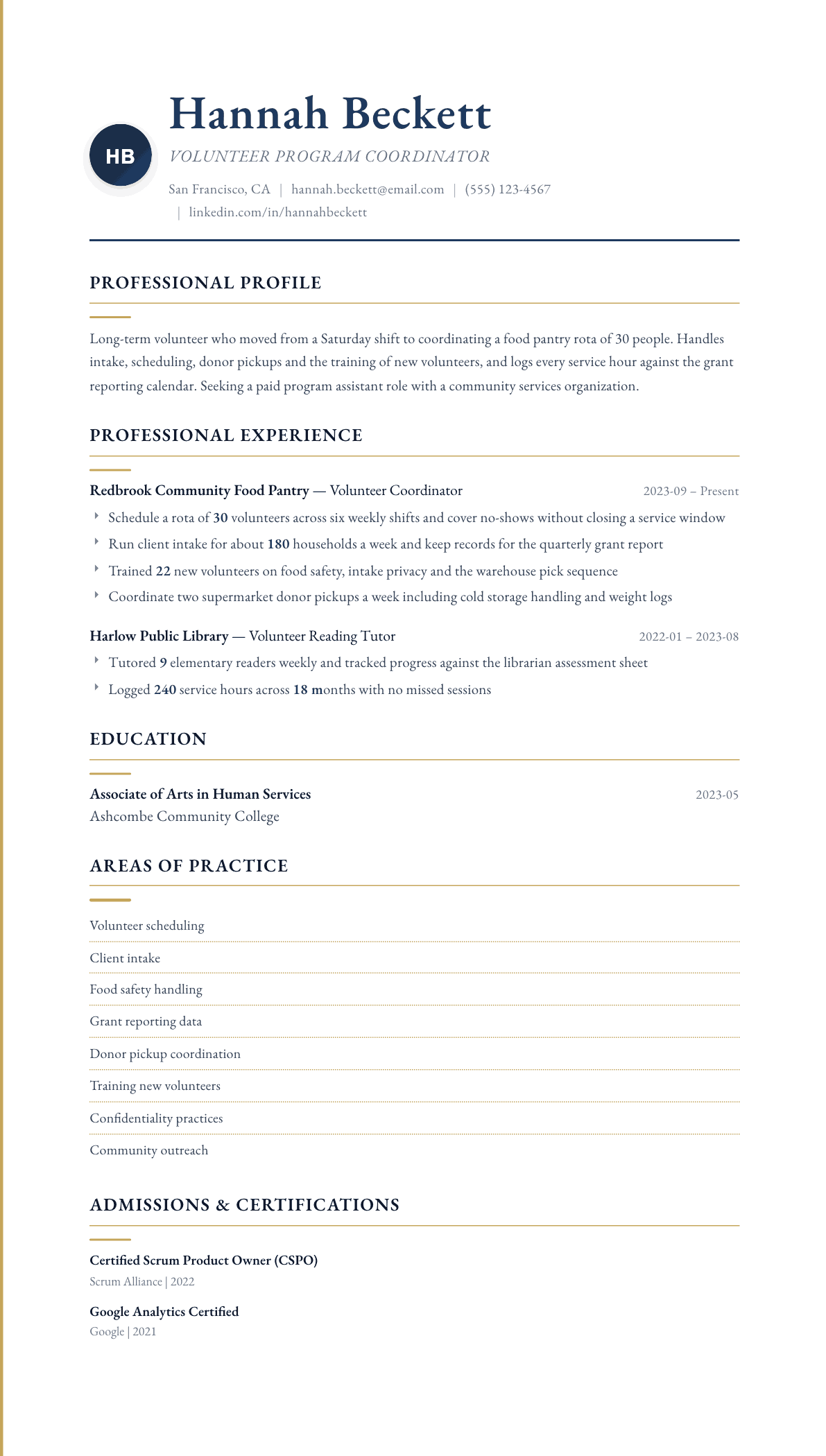
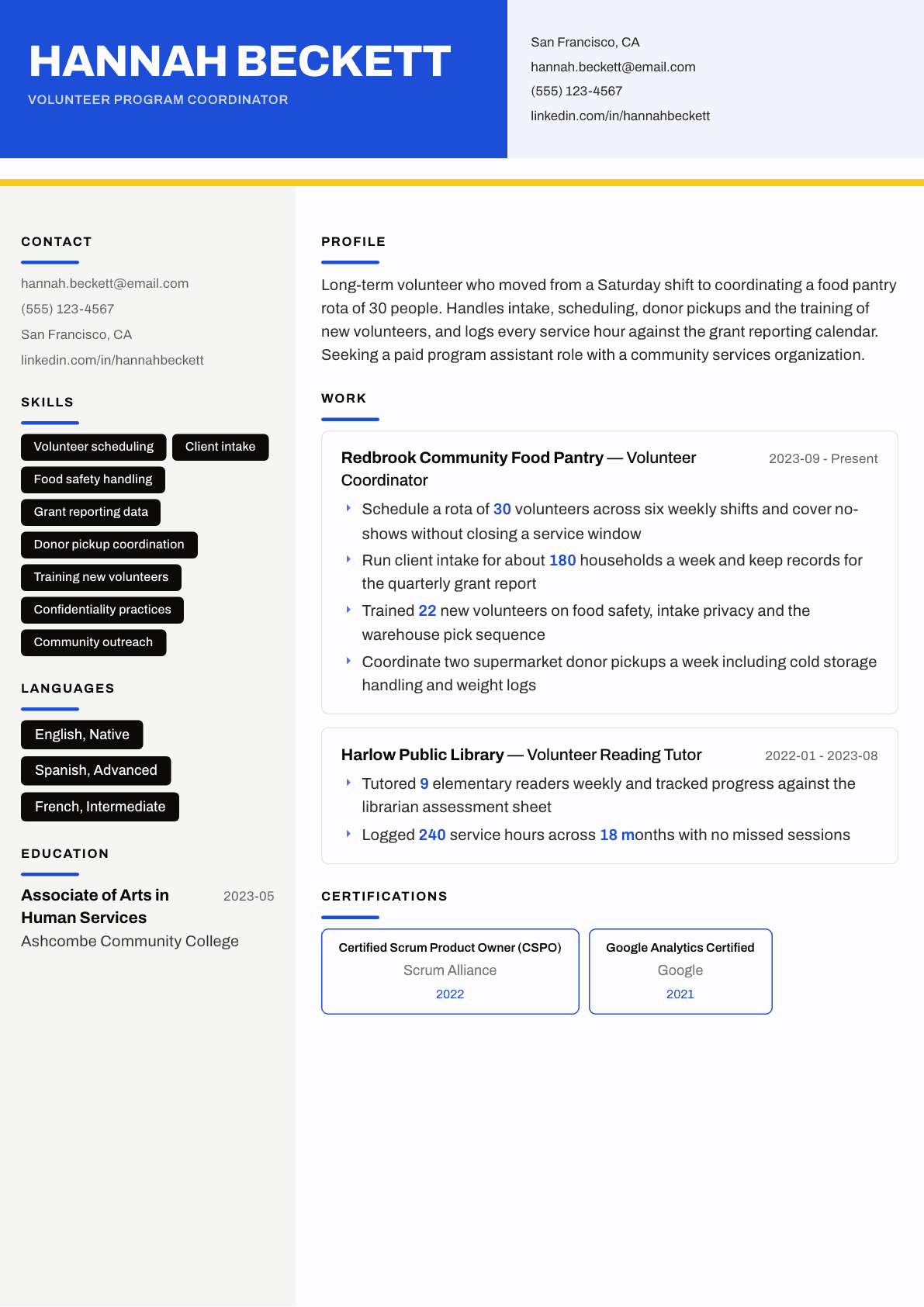
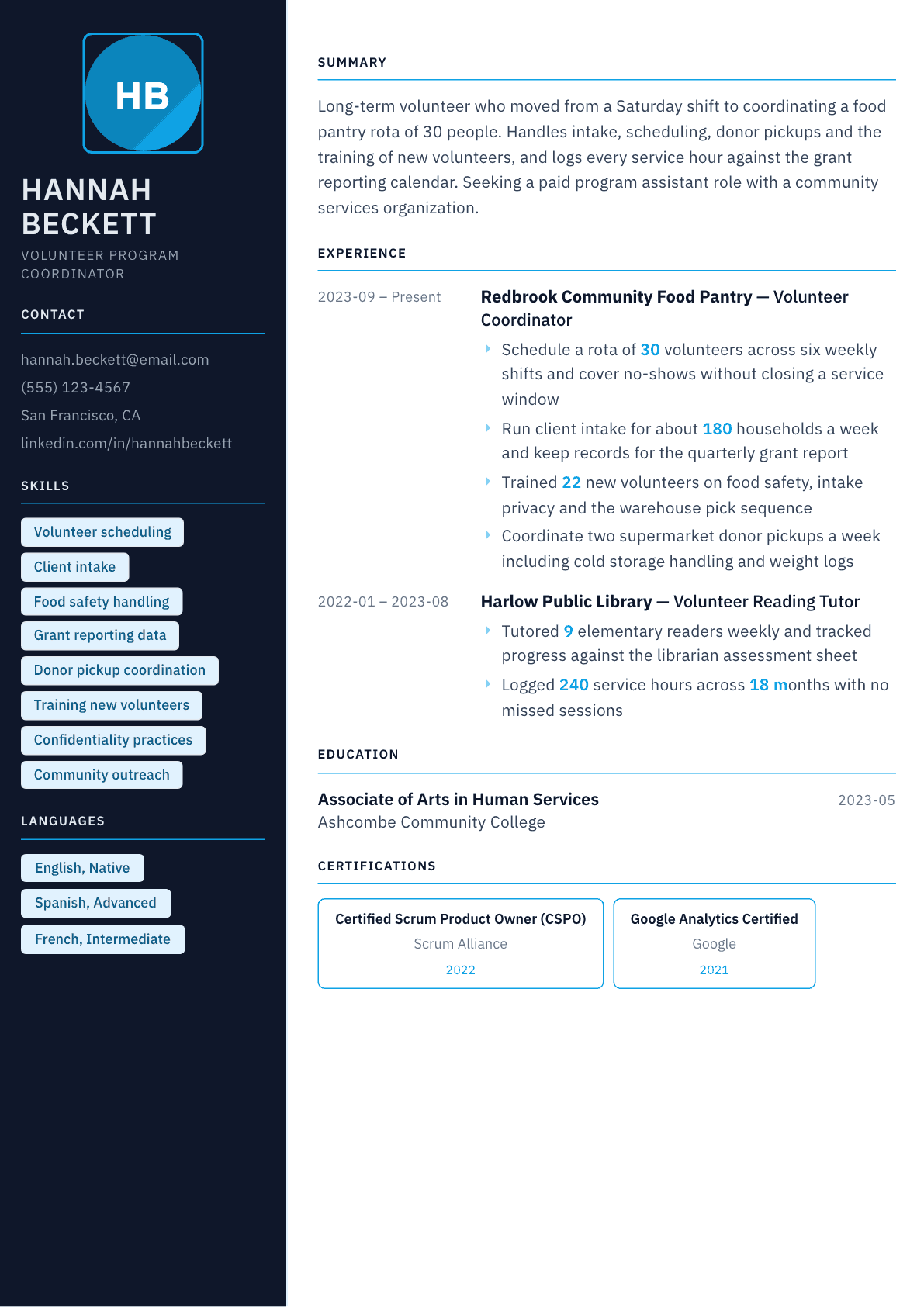
The same volunteer content laid out in three CVBooster templates, so you can see what the finished document looks like before you write a word.
Example Volunteer summary
Community volunteer who grew from a weekend shift into coordinating a food pantry rota of 30 people across six weekly service windows. Runs client intake for roughly 180 households a week, trains new volunteers on food safety and privacy, and keeps the service records the quarterly grant report depends on. Seeking a paid program assistant role in community services.
Skills to list on a Volunteer resume
- Volunteer rota scheduling
- Client intake and records
- Service hour tracking
- Event staffing
- Donor and in-kind coordination
- Peer training
- Confidentiality and safeguarding
- Community outreach
- Fundraising support
- Inventory and stock rotation
- Grant reporting inputs
- Conflict de-escalation
What actually gets this resume read
- Put substantial volunteer roles in the main experience section, not in a footnote at the bottom.
- Give each role a title, an organization, a date range and the hours per week you actually served.
- Quantify service the way the nonprofit does: households served, hours logged, volunteers trained, events staffed.
- Separate one-day service events from sustained roles so the commitment level is obvious at a glance.
- Name your supervisor role holder as a reference, since nonprofit coordinators answer reference calls readily.
- Translate the work into the language of the paid job you want before you send the resume anywhere.
How to write a volunteer resume
Unpaid service is the most undersold material on a resume. A person who has coordinated a rota of thirty people, run intake for a hundred and eighty households a week and kept the records a grant report depends on will describe it as helping out at the pantry, drop it into a two-line section at the bottom, and then wonder why the application for a program assistant job goes unanswered. The work was real. The description was not.
A hiring manager treats volunteer experience exactly like paid experience under one condition: it has to be presented with the same furniture. A title, an organization, a date range, hours per week and outcomes. Without those, it reads as an interest. With them, it reads as a job that happened to be unpaid, and the reader stops caring about the difference. That is what separates a resume that mentions volunteerism from one that uses it.
This guide covers how to show volunteer work on a resume, when it belongs in the main experience section rather than a separate block, how to quantify service the way nonprofits already measure it, how to separate a sustained role from a one-day event, and how to convert a volunteer record into a first paid position in community services, education or health support. Applying in Canada, the UK or Ireland, where many postings ask for a CV, the same rules cover volunteer experience in a CV: the entry keeps its shape, only the document name changes.
How to show volunteer work on a resume: decide where it goes
There are only two correct placements. If the unpaid role is the strongest evidence you have for the job you want, put it in the main experience section in date order alongside any paid work, with the word volunteer in the title so nothing is misrepresented. If it is supporting evidence for a different career, put it in a clearly headed section below experience.
Either way, the entry looks the same: title, organization, city and province or state, months and years, hours per week, then two or three bullets. Use the same reverse chronological layout for paid and unpaid work, so a volunteer entry is indistinguishable in shape from a job entry; only the word volunteer in the title tells them apart.
The wrong answer is a bare list of organization names under interests. That placement tells the reader the work was minor, and they will accept your assessment. Choose the section that matches how much of your case rests on it, then give the entry the same depth as any job.
- Title, organization, city, and a date range with months for anything longer than a season.
- Hours per week or per month, since commitment level is the first thing a reader estimates.
- Whether the role was assigned or elected, and who you reported to.
- Outcomes in the units the organization itself reports: people served, hours, events, funds raised.
- A separate short list for one-day events, kept apart from sustained roles.
Quantify service the way the organization already counts it
Nonprofits run on numbers because their funders demand them, so the measures already exist. Households or clients served in a period, volunteer hours logged, volunteers recruited and trained, meals distributed, tutoring sessions delivered, events staffed, donated goods processed by weight. Ask the coordinator for the figures before you write, since most organizations can pull them from the same system that feeds their annual report.
Frame the numbers around your own contribution rather than the whole organization. Saying the food bank served a large area is background. Saying you scheduled a rota of thirty across six weekly windows and covered no-shows without closing a service window is your work, and it is the version that transfers.
Where confidentiality applies, describe the population without identifying anyone: households in a catchment area, students in an after-school program, patients on a hospital ward. That is the same discretion the paid version of the job requires, and demonstrating it is itself a qualification.
Volunteer work experience on a resume: sustained roles versus one-day service
Both belong on a resume, but they prove different things and mixing them dilutes both. A two-year role as a treasurer or a rota coordinator proves reliability and capability. A charity run you marshaled once proves civic engagement. Group them separately so the reader can see at a glance which is which.
Sustained roles get full bullets. One-day and short-term events get a single combined line naming the events and the total days. A page that gives four bullets to a weekend beach cleanup and one line to a two-year committee position tells a recruiter that you cannot judge relative importance, which is a worse signal than the thin experience itself.
How to write volunteer experience on a resume for a paid job
To write volunteer experience on a resume, work in three steps. First, list what you actually did on a typical shift. Second, rewrite each item in the language of the job you want, using the pairs below. Third, add the number the organization already tracks: households, hours, volunteers trained or events staffed. The two entries at the end of this section show the result.
Volunteer language and employment language are different dialects. Client intake at a pantry is registration, eligibility screening and confidential record keeping. Running a rota is scheduling and workforce coverage. Handling donated stock is receiving, inspection, rotation and inventory. Reading with children is structured tutoring against an assessment sheet. Write the second version.
Then choose which parts to lead with. The same pantry role supports an application for an administrative coordinator seat, a warehouse assistant seat and a caseworker seat, but the three resumes should open with different bullets. Reordering is not exaggeration, it is the ordinary work of tailoring.
Include the compliance layer. Background checks, safeguarding or child protection training, food handler certification, confidentiality agreements and any orientation you completed all transfer directly, and they tell an employer that onboarding you will be short.
Volunteer work on a resume sample, the one-day events line: Event Volunteer, Riverside Charity Run and Harvest Food Drive, four days in total over two seasons: registration desk, route marshal, donation sorting.
- Scheduling and coverage instead of organizing the rota.
- Intake, eligibility screening and record keeping instead of signing people in.
- Receiving, rotation and inventory control instead of sorting donations.
- Structured tutoring against an assessment framework instead of reading with kids.
- Training delivery and onboarding instead of showing new volunteers around.
- Volunteer job resume entry in the main experience section: Intake Volunteer, Eastside Community Food Bank, Hamilton, ON, two years and current, 6 hours a week. Screens about 40 households a shift for eligibility, enters records in the client database and trains new intake volunteers.
- The same role in a separate Volunteer Experience section, when it supports a different career: Intake Volunteer, Eastside Community Food Bank, two years, current: client intake, confidential records, volunteer training.
References, hours and the paperwork that makes it verifiable
Volunteer coordinators make excellent references and are usually glad to be asked, because a volunteer moving into paid work is a success story for the organization. Ask before you apply, give them the posting, and list them with the relationship stated so nobody has to guess.
Where a formal record exists, use it. Many organizations issue service hour statements, student service programs certify hours, and some run recognition awards with verifiable criteria. A recorded hour total carries the same weight as a payslip in this context: it converts a claim into a fact.
Resume for volunteering: a complete example
A resume for volunteering is one page built around availability, relevant experience and the checks the organization will run. Coordinators want to know when you can come, what you have done that fits the role, and whether you can pass a vulnerable sector or background check. The volunteering work resume below is for an adult applying to a hospital visitor desk program, written as it would sit on the page.
Profile: Priya Raman, Volunteer. Retired bank branch supervisor applying for a weekday hospital wayfinding and visitor desk role. Available Tuesday and Thursday mornings, calm with visitors who are anxious or lost, and ready to complete a vulnerable sector check and the hospital orientation.
- Availability: Tuesday and Thursday, 8 a.m. to noon, for at least one year.
- Volunteer, Community Food Bank, three years: sorts donations and runs the Saturday intake table, greeting about 60 households a shift and checking registrations.
- Volunteer Reader, public library literacy program, two years: reads weekly with two adult learners and logs each session for the coordinator.
- Earlier career, Branch Supervisor, regional bank, 22 years: handled customer complaints at the counter, trained new tellers and opened and closed the branch.
- Skills: greeting and directing visitors, staying calm with upset people, cash handling, basic computer use, English and Tamil.
- Checks and training: current first aid and CPR, vulnerable sector check on request, food safety course.
- References: food bank volunteer coordinator and library literacy coordinator, contact details on request.
Volunteer resume summary examples
Student with a service record
Human services student with 240 logged volunteer hours across an after-school reading program and a weekend food pantry shift. Tutored 9 elementary readers weekly against a librarian assessment sheet and completed food handler training. Seeking a first paid role as a program aide in community services.
Long-serving volunteer coordinator
Community volunteer who grew from a weekend shift into coordinating a food pantry rota of 30 people across six weekly service windows. Runs client intake for roughly 180 households a week, trains new volunteers on food safety and privacy, and maintains the records behind the quarterly grant report.
Board and program leadership
Nonprofit board member and program volunteer of 8 years, chairing a fundraising committee that ran 4 annual events and serving as treasurer through two audit cycles. Recruited and inducted 60 volunteers across the program. Moving into a paid operations role in the charitable sector.
Work experience bullets: before and after
Before: Volunteered at a local food bank.
After: Coordinated a rota of 30 volunteers across six weekly service windows at a community food pantry, covering short-notice absences without closing a session.
A rota size, a schedule and a coverage outcome describe a scheduling job rather than an act of goodwill.
Before: Helped people who came in for food.
After: Ran client intake for about 180 households a week, checking eligibility, recording confidential details and producing the weekly counts used in the quarterly grant report.
Naming intake, eligibility and reporting maps unpaid service onto administrative work an employer recognizes.
Before: Trained new volunteers.
After: Trained 22 new volunteers on food safety, intake privacy and the warehouse pick sequence, and rewrote the one-page induction sheet they now work from.
A trainee count plus a lasting artifact turns informal showing around into documented training delivery.
Before: Did some reading with kids at the library.
After: Tutored 9 elementary readers weekly for 18 months, tracking each child against the librarian's assessment sheet and logging 240 service hours with no missed sessions.
Frequency, duration, assessment and an attendance record make the tutoring measurable and verifiable.
Before: Collected food donations from supermarkets.
After: Coordinated two supermarket donor pickups a week including cold storage handling, weight logging and rotation of perishable stock into the same-day distribution line.
The cold chain, the weights and the rotation describe inventory handling that transfers to a warehouse role.
Hard skills
- Volunteer rota scheduling
- Client intake and eligibility screening
- Confidential record keeping
- Service hour tracking and reporting
- Food safety and handling
- Inventory receiving and stock rotation
- Event staffing and logistics
- Donor and in-kind coordination
- Peer training and induction
- Fundraising support
- Grant reporting inputs
- Safeguarding procedures
Soft skills
- Treating people in hardship without visible judgment
- Holding a commitment nobody is paying you to keep
- Directing peers who are also unpaid
- Discretion with sensitive personal details
- Staying steady when demand exceeds supply
Certifications worth listing
- Adult and Pediatric First Aid, CPR and AED (American Red Cross)
- ServSafe Food Handler (National Restaurant Association)
Mistakes that cost volunteer candidates the interview
- Burying a substantial unpaid role under interests, which invites the reader to treat it as a hobby.
- Writing helped out or assisted with instead of the function performed, such as scheduling or intake.
- Giving a one-day charity event the same space as a two-year committee position.
- Claiming the organization's total impact as though it were your personal contribution.
- Leaving out hours per week, the number that separates a serious commitment from an occasional appearance.
- Keeping the nonprofit vocabulary when applying to a commercial employer who does not speak it.
- Never asking the coordinator for the service statistics the organization already reports to its funders.
Volunteer resume questions
Should volunteer work go in the main experience section?
Yes when it is your strongest evidence for the job you want, listed in date order with volunteer in the title. Put it in a separate headed section when it supports a different career, and never leave it under interests.
How do I put volunteer work on a resume for a job?
Give it a title, the organization, city, dates and hours per week, then two or three bullets in employment language, such as intake, scheduling or inventory. List it under experience when it fits the job, or in a Volunteer Experience section when it does not. Group one-off events into one line.
How do I write a resume for volunteering?
Keep it to one page and open with your availability and the role you want. List the paid and unpaid experience that fits that role, the checks you can pass such as a background or vulnerable sector check, any first aid training, and two references. Coordinators read for reliability more than polish.
How do I describe volunteer work without breaching client confidentiality?
Describe the population and the volume rather than any individual: households in a catchment area, students in an after-school program, patients on a ward. Handling the description carefully is itself evidence that you can be trusted with records.
How do I put volunteering experience in a CV?
The same way as on a resume: title, organization, town, dates and hours per week, then two or three bullets in the language of the job. In a Canadian or UK CV, a Volunteering Experience section sits after work experience unless the unpaid role is your strongest evidence, in which case it joins the main history.