Architect Resume Examples: free ATS score and gap list
Craft an Architect Resume That Earns the Interview
By Mustafa Tarabya, founder of CVBooster · Published · Updated
Architect resume examples with project types, license and registration guidance, software keywords and a full writing guide.
Sample resumes for a architect
The same architect content laid out in three CVBooster templates, so you can see what the finished document looks like before you write a word.
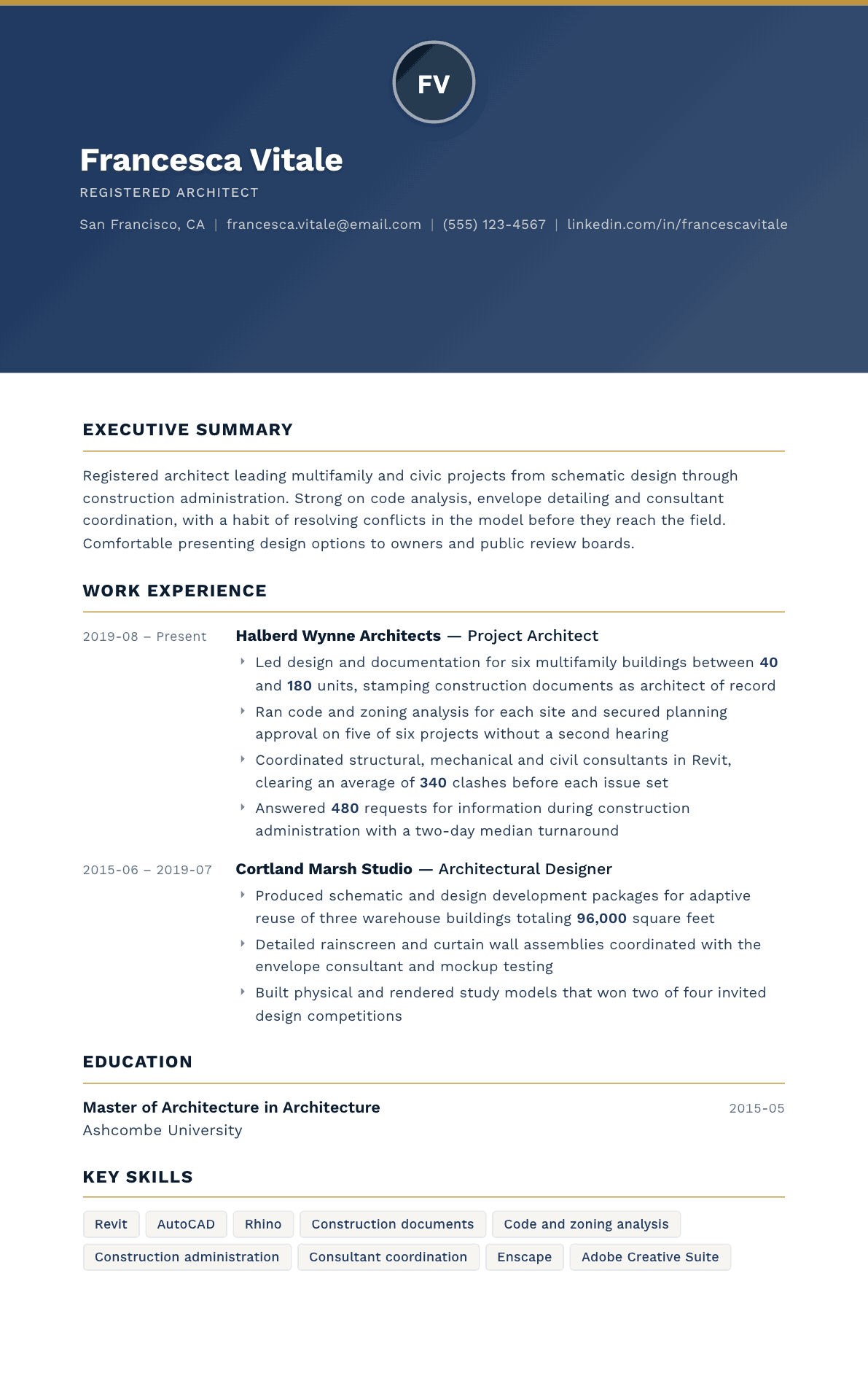
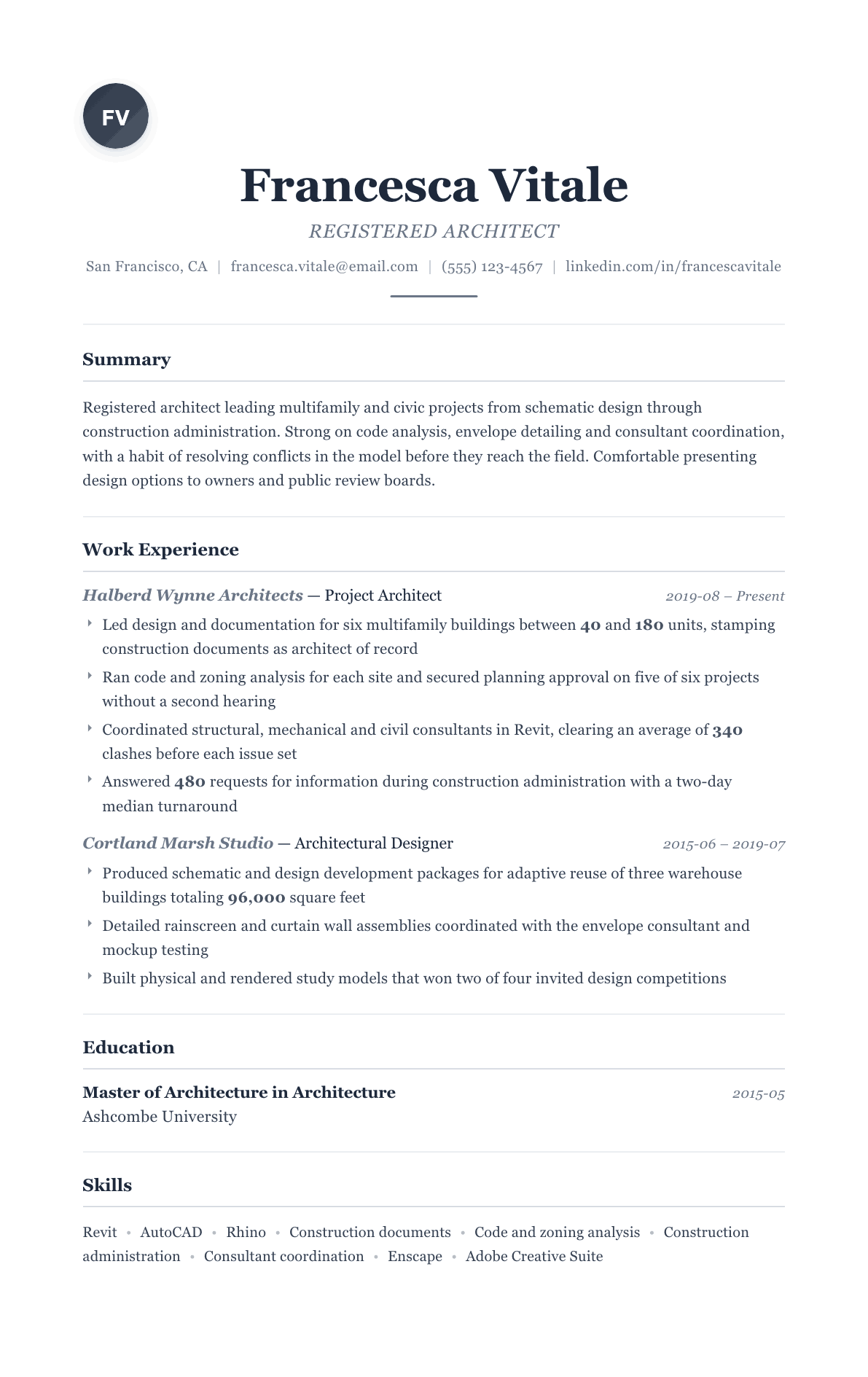
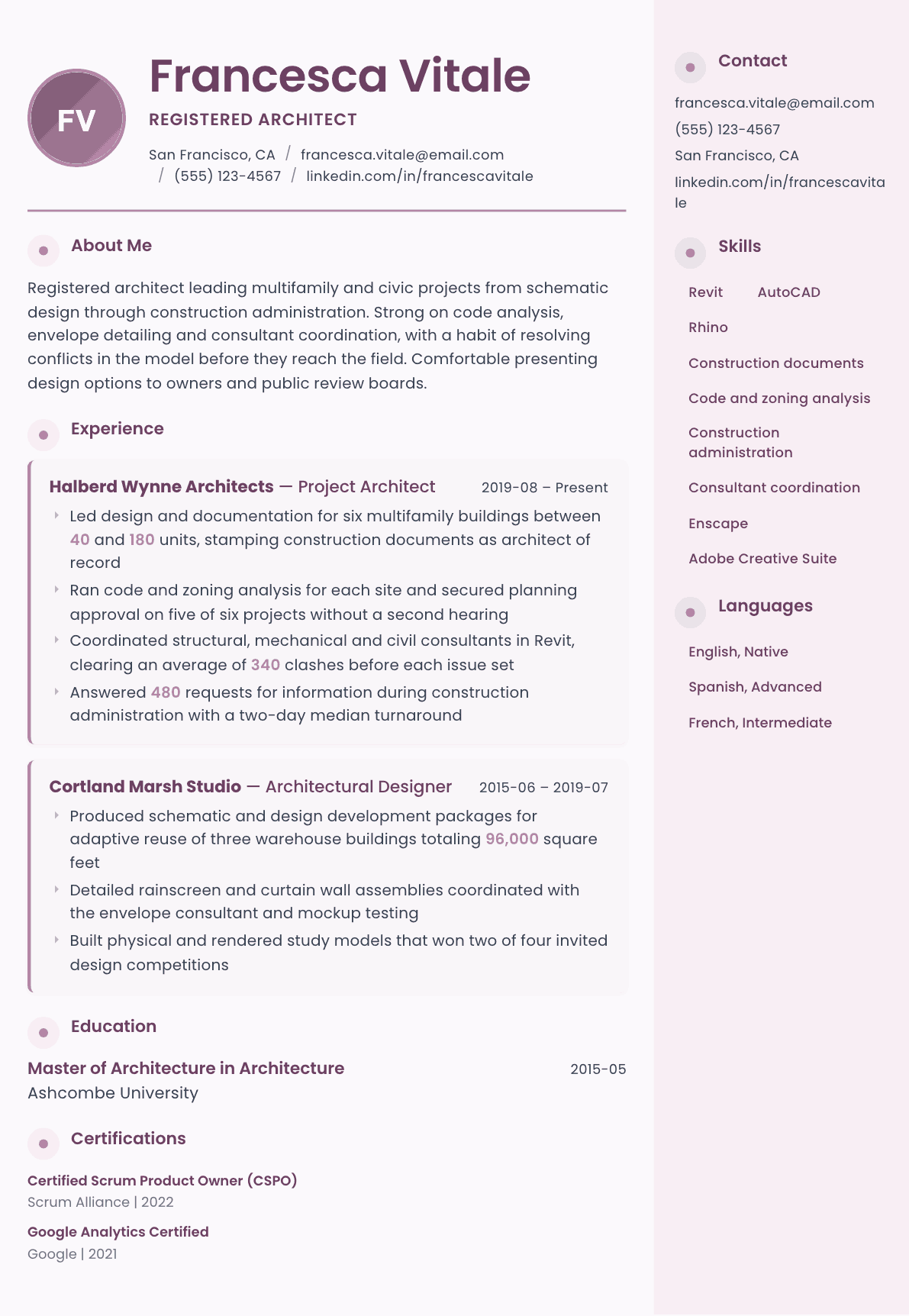
Example Architect summary
Registered architect with ten years on multifamily and civic work, licensed in two states and NCARB certified. Leads projects from schematic design through construction administration, stamps construction documents, and coordinates structural, mechanical and civil consultants in Revit. Recently secured planning approval for five of six multifamily buildings without a second public hearing, and answered field questions with a two-day median turnaround.
Skills to list on a Architect resume
- Revit
- AutoCAD
- Rhino and Grasshopper
- SketchUp
- Construction documentation
- Building code analysis
- Zoning and entitlement
- Construction administration
- Envelope detailing
- Consultant coordination
- Design development
- Specification writing
- Client presentations
- Enscape rendering
- Adobe InDesign
- Sustainable design
What actually gets this resume read
- State your registration clearly: the jurisdiction, the year of licensure, and whether you hold NCARB certification for reciprocity.
- Organize experience by project rather than by task, giving each one a building type, size, budget band and your exact role.
- Say which phases you owned, because a firm hiring for construction administration will not read a portfolio of competition renderings.
- Put Revit and your visualization tools in a skills block, and note whether you have authored families and templates.
- Link a portfolio and keep the resume itself clean, since most firms read the resume through an applicant tracking system first.
- Name the codes and standards you work with, such as the International Building Code and accessibility standards, in plain terms.
How to write a architect resume
An architect resume is read for two things at once: whether you are registered, and whether you have carried a project through the phases the firm is hiring for. A studio staffing up for construction administration will pass over a beautiful page of competition renderings, and a design driven office will pass over a page of nothing but submittal logs.
So the page has to declare its phase coverage early. Registration and jurisdiction in the header, then projects described by building type, size, budget band, delivery method and the phases you personally owned. Firms hire against a gap in their bench, and your resume is only useful if a principal can match it to that gap in the first fifteen seconds.
This guide covers the format, the summary, how to write project experience that survives a principal reading it, where registration and continuing education belong, the software block, and the questions architects ask when they update the page after a few years of heads down work.
Format: one page of resume, with the portfolio doing the visual work
Keep the resume typographically quiet. The portfolio is where design ability is judged, and a resume that tries to be a portfolio usually loses the dates and the license number to the tracking system. One page under about twelve years, two after that, with a portfolio link in the header rather than at the bottom.
Order matters. Registration and education sit high because they are screening facts, but experience should still occupy most of the page. A studio that reads three hundred applications for one project architect opening is scanning for phase coverage, not for a design philosophy statement.
- Header: name, credentials, city, phone, email, portfolio link, registration jurisdictions.
- Sections: summary, experience by project, registration and credentials, software and technical skills, education, awards or publications.
- Keep any portfolio attachment small enough to pass an email size limit, and repeat the link inside the file.
Summary: registration, building types, and the phases you own
Four lines. Name your registration and jurisdictions, the building types you have delivered, and the phases you have run without supervision. A reader who learns in one sentence that you stamp construction documents for multifamily work and run construction administration has everything needed to route the resume to the right team.
If you are changing building types, name the transferable technical ground rather than hoping it is obvious. Envelope detailing, egress planning, accessibility compliance and consultant coordination travel between sectors; specific program knowledge does not, and pretending otherwise reads as unfamiliarity with the work.
Experience: describe projects, not job duties
Give each project a scope line: building type, unit count or square footage, construction budget band, delivery method, and your role. Architect of record, project architect, job captain and designer mean different things, and a principal will read the wrong assumption into a vague title.
Then bullets that show technical ownership. Code and zoning analysis you performed and the approval that followed. Assemblies you detailed and how they were tested or mocked up. Consultant coordination measured in clashes resolved before an issue set. Requests for information answered during construction and the turnaround you held. Those are the facts a firm uses to predict how you will behave on a live job.
Cut anything that describes the profession rather than your work. Collaborated with the design team and produced drawings appear on every resume in the pile and prove nothing about you.
Registration, continuing education and professional standing
List each jurisdiction where you are registered, the license number if you are comfortable publishing it, and whether you hold an NCARB Certificate for reciprocity. Add professional membership such as the American Institute of Architects and any sustainability credential you actually maintain, such as LEED accreditation from the Green Business Certification Institute.
If you are not yet registered, say exactly where you are: an accredited professional degree, the number of AXP hours logged, and which divisions of the Architect Registration Examination you have passed. Firms track this closely because it affects who can stamp work and what they can bill.
Software and technical skills, sorted by how you actually use them
Separate authoring tools from visualization and documentation tools. Revit and AutoCAD sit in the first group, and it is worth noting whether you author families, build templates and manage worksets rather than only drawing in someone else model. Rhino and Grasshopper belong in the first group too if you use them for real geometry rather than concept images.
Then list visualization such as Enscape or Lumion, the Adobe applications you lay out books in, and the specification system you have written in. A firm about to hand you a live project wants to know how much of its process you already know.
- Authoring: Revit, AutoCAD, Rhino, Grasshopper, SketchUp.
- Visualization: Enscape, Lumion, V-Ray, physical model making.
- Documentation: Bluebeam, Adobe InDesign, specification writing, Autodesk Construction Cloud.
Keywords the screening pass is looking for
Architecture postings reuse a narrow set of terms: schematic design, design development, construction documents, construction administration, code analysis, zoning, entitlement, consultant coordination, submittals, requests for information, and the building type itself. Mirror the posting once in your skills block and once inside a project bullet where it is backed by a fact. A dense keyword paragraph gets caught the moment a human opens the file.
Architect resume summary examples
Newly registered
Newly registered architect with four years in practice on education and civic projects. Completed AXP and passed all divisions of the registration exam last spring. Produces construction documents, runs code and accessibility analysis, and has answered field questions on two occupied renovation projects.
Project architect
Project architect registered in two states with ten years on multifamily and civic work. Leads projects from schematic design through construction administration, stamps construction documents as architect of record, and secured planning approval for five of six buildings without a second public hearing.
Studio leader
Registered architect and studio leader with nineteen years across healthcare and higher education. Runs a nine person team on projects up to 80 million dollars, sets envelope and accessibility standards for the office, and has taken four campus buildings from feasibility study through occupancy.
Work experience bullets: before and after
Before: Worked on multifamily projects from start to finish.
After: Led six multifamily buildings between 40 and 180 units from schematic design through occupancy, stamping the construction documents as architect of record.
Unit counts and the stamping role tell a principal exactly what scale of responsibility you have carried.
Before: Coordinated with engineering consultants.
After: Coordinated structural, mechanical and civil models in Revit, clearing about 340 clashes before each issue set and holding a weekly consultant call.
A clash count and a recurring meeting turn coordination into a process the reader can picture.
Before: Handled code review for projects.
After: Performed code and zoning analysis for each site, including occupancy separation, egress and accessible route, and secured planning approval on five of six projects at first hearing.
Naming the code topics and the approval result shows judgment rather than a completed checklist.
Before: Answered contractor questions during construction.
After: Responded to 480 requests for information during construction administration with a two day median turnaround and issued 22 supplemental instruction sheets.
Turnaround time is the metric a construction team uses to rate an architect, so state it directly.
Before: Detailed the building envelope.
After: Detailed rainscreen and curtain wall assemblies with the envelope consultant and revised the parapet condition after mockup water testing.
A specific assembly and a test result prove technical depth that the word detailed alone cannot.
Hard skills
- Construction documentation
- Building code analysis
- Zoning and entitlement review
- Construction administration
- Envelope and assembly detailing
- Accessibility compliance
- Consultant coordination
- Specification writing
- Revit family and template authoring
- AutoCAD
- Rhino and Grasshopper
- Enscape visualization
- Bluebeam markup
- Feasibility and test fit studies
Soft skills
- Client presentation
- Public hearing communication
- Design critique and mentoring
- Negotiating scope with consultants
- Decision making under budget pressure
- Written correspondence discipline
Certifications worth listing
- NCARB Certificate (National Council of Architectural Registration Boards)
- LEED Accredited Professional (Green Business Certification Institute)
- WELL Accredited Professional (International WELL Building Institute)
- Certified Passive House Consultant (Passive House Institute)
Mistakes that cost architect candidates the interview
- Turning the resume into a portfolio spread so the tracking system loses the dates, the firms and the registration line.
- Listing firm names with no project scope, which leaves a principal unable to tell a tenant fit out from a hospital tower.
- Claiming full project leadership on work where you drew sheets, a claim that collapses in the first technical interview.
- Omitting construction administration experience because it feels less glamorous than design, when it is often what the opening needs.
- Leaving registration status vague, so a firm assumes you cannot stamp and routes the resume to a junior opening.
- Naming software without saying how deeply you use it, which reads the same as a candidate who opened Revit twice.
Architect resume questions
How long should an architect resume be?
One page for roughly the first decade, two pages once you have a project list worth reading. Beyond two pages a principal starts skimming, and the projects you most want read are usually the ones that get skipped.
Where do I put my portfolio on an architect resume?
A link in the header next to your contact details, and a short sample of five to eight pages if you are attaching one. Keep the full book separate and send it when asked, because large attachments are frequently blocked before a human sees them.
Should I list projects or employers first?
Employers stay as the structure, but the first line under each one should be the project scope. Firms are read for their reputation, projects are read for your capability, and a reader needs both to place you correctly.
How do I show registration if I am licensed in one state and applying in another?
State your current registration, then note whether you hold an NCARB Certificate, which is the route most reciprocity applications take. If you have already applied to the second board, say that as well so the firm can plan around the timing.
What belongs in the education section for an experienced architect?
The accredited professional degree, the institution and the year, plus any second degree relevant to the work. Drop coursework, honors and student activities once you have several years in practice, and use the space for projects instead.
Related resume examples
- Construction Manager Resume example
- Architectural Drafter Resume example
- Architectural Designer Resume example
- BIM Manager Resume example
- Interior Architect Resume example
- Architecture Intern Resume example