BIM Manager Resume Examples: free ATS score and gap list
Write a BIM Manager Resume That Proves Model Control
By Mustafa Tarabya, founder of CVBooster · Published · Updated
BIM manager resume examples covering standards, execution plans, clash coordination and the software keywords construction firms screen for.
Sample resumes for a bim manager
The same bim manager content laid out in three CVBooster templates, so you can see what the finished document looks like before you write a word.
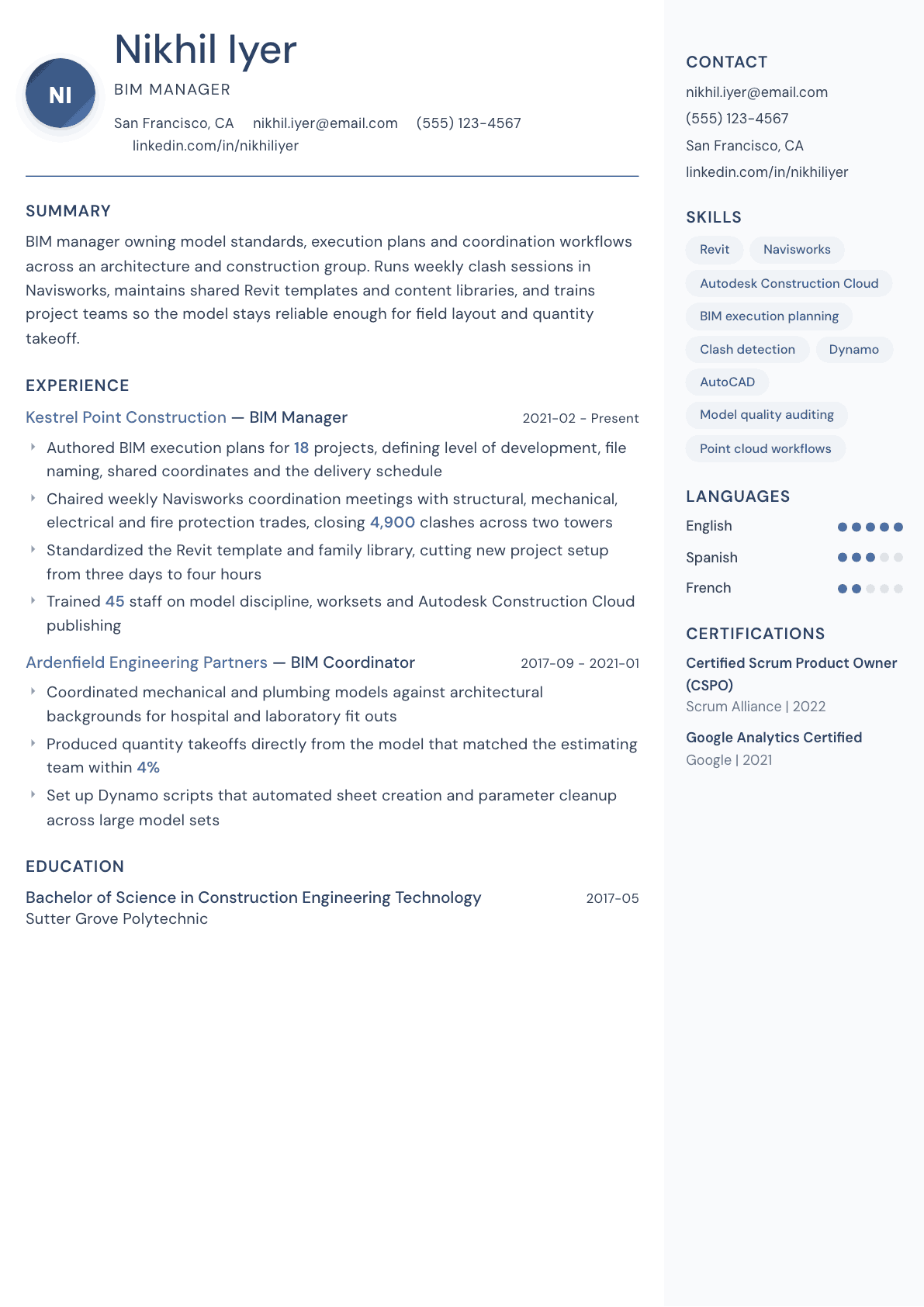
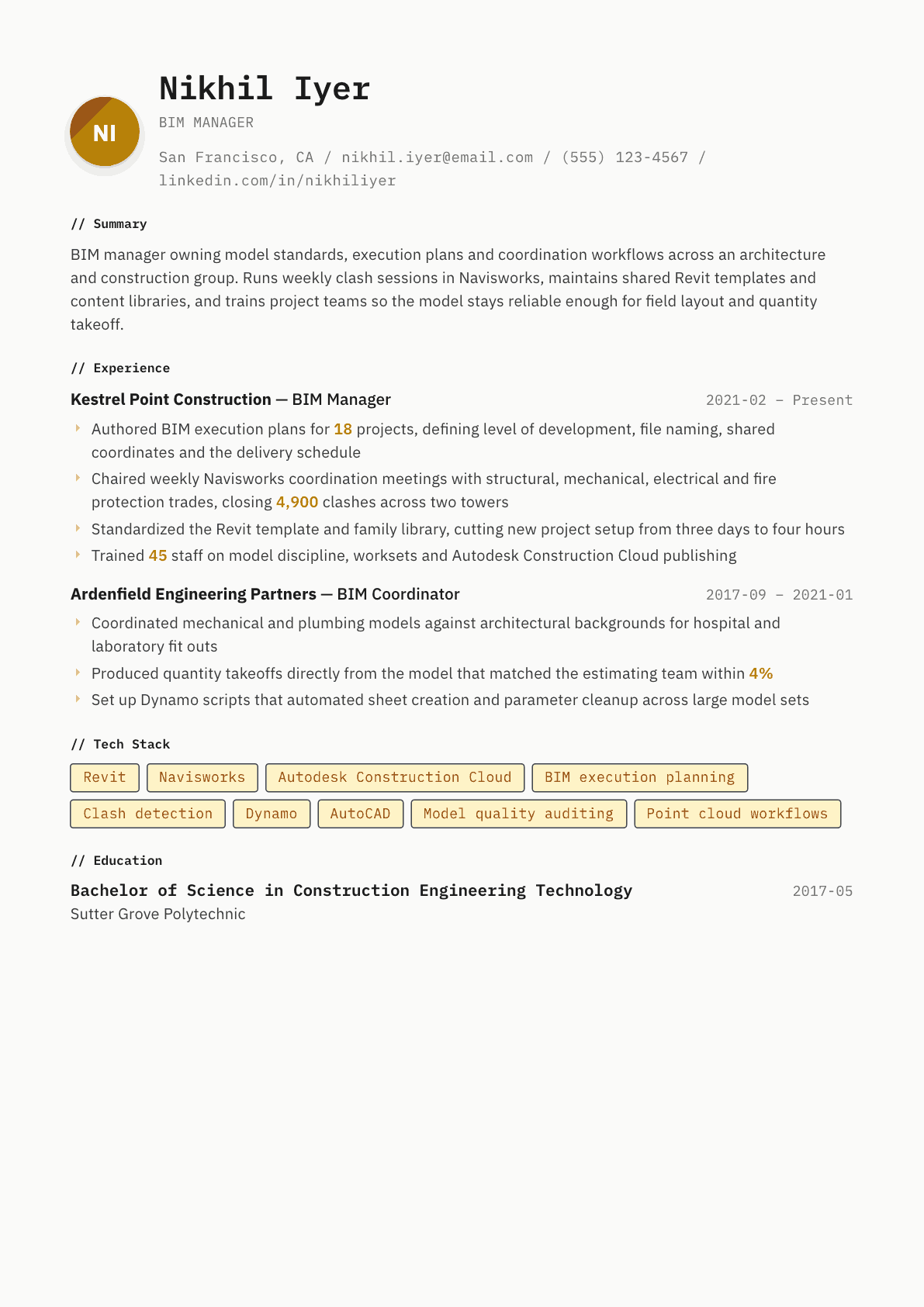
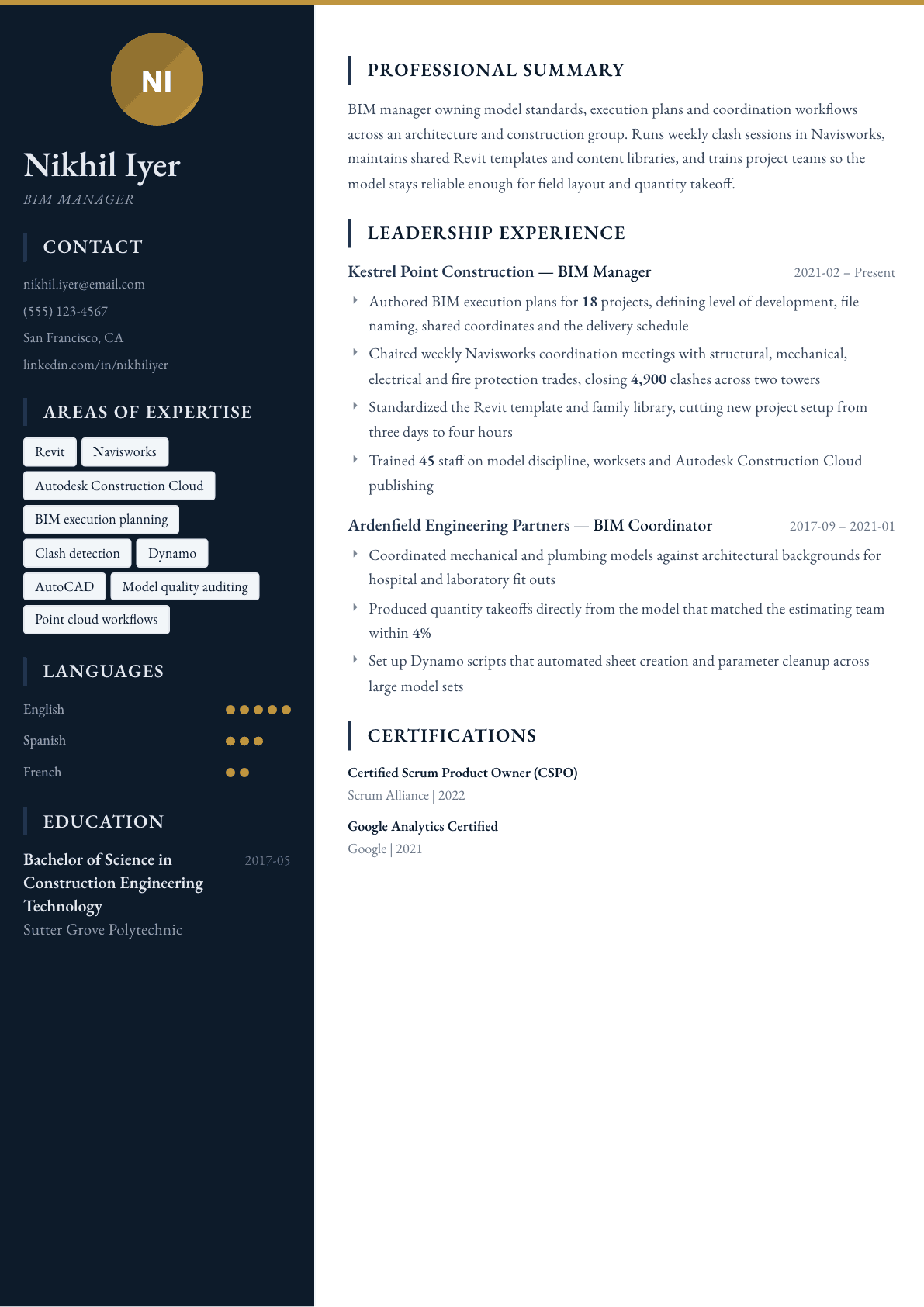
Example BIM Manager summary
BIM manager with eight years across engineering and construction, owning standards, execution plans and coordination for up to eighteen concurrent projects. Chairs weekly Navisworks sessions with all trades, administers Autodesk Construction Cloud, and writes Dynamo automation that cut project setup from three days to four hours. Trained forty five staff on worksets, model discipline and publishing so field teams can trust the model.
Skills to list on a BIM Manager resume
- Revit
- Navisworks Manage
- Autodesk Construction Cloud
- BIM execution plan authoring
- Clash detection and resolution
- Model quality auditing
- Dynamo scripting
- AutoCAD
- Civil 3D
- Point cloud and scan to BIM
- Shared coordinates setup
- Family and template authoring
- Quantity takeoff from model
- Team training and standards
- ISO 19650 workflows
What actually gets this resume read
- Open with the scope you own: standards, execution plans, coordination meetings, training, and the number of concurrent projects.
- Quantify coordination work with clash counts closed, disciplines managed and how often the model went out for field use.
- Show the standards you write and enforce, including level of development definitions, naming conventions and shared coordinates.
- List automation you have built in Dynamo or scripting, since that is the difference between a coordinator and a manager.
- Name the common data environment you administer, such as Autodesk Construction Cloud or BIM 360, and who you gave access to.
- Include training numbers, because firms hire BIM managers to raise a whole team rather than to model faster themselves.
How to write a bim manager resume
A BIM manager is hired to make a model trustworthy enough that other people bet money on it. Field crews lay out from it, estimators pull quantities from it, and trade contractors fabricate from it. So the resume is not a software list. It is evidence that you set standards, enforced them across teams who did not want to be enforced upon, and kept the model reliable while projects moved.
That distinction is what separates this title from coordinator work. A coordinator runs clash tests. A BIM manager writes the execution plan that decides how the model is built, who owns which file, what level of development each element reaches at each milestone, and what happens when a consultant misses a publish deadline.
This guide covers how to format the page, what the summary has to establish in three lines, how to write experience that shows governance rather than modeling hours, which credentials are real, and the questions that come up when a modeler tries to move up into the manager seat.
Format: scope of ownership before software
Two pages is normal once you have run standards across an office. Put a short scope statement under the header naming what you own: standards, execution plans, coordination, training, common data environment administration, and the number of concurrent projects. That line does more screening work than the whole skills section.
Keep the layout single column and plain. Firms in design and construction run applications through tracking systems that will scramble a two column file, and losing the project list is worse than looking conservative.
- Header: name, city, phone, email, and a one line scope statement.
- Sections: summary, experience, standards and process authored, software and platforms, certifications, education.
- A short list of the standards documents you have written belongs on the page, not only in an interview.
Summary: teams supported, projects running, disciplines coordinated
Three or four lines covering the size of the operation you support, the concurrent project count, the disciplines you coordinate, and the platform you administer. A BIM manager who supports forty five staff across eighteen live projects is a different hire from one supporting a six person studio, and the reader needs to place you fast.
Add the outcome you are proudest of in measurable terms: setup time cut, clash counts closed before issue, or a model that went out for field layout. Managers are hired to remove friction, so lead with the friction you removed.
Experience: governance, coordination, automation, training
Split each role mentally into four buckets and make sure every bucket gets a bullet. Governance is the execution plan, the naming convention, the level of development matrix and the shared coordinates setup. Coordination is the meeting cadence, the disciplines in the room, the clash counts closed and how issues were tracked to resolution.
Automation is where a manager separates from a senior modeler. Dynamo scripts, parameter cleanup routines, automated sheet creation and model health audits are all worth naming individually, along with what each one saved the team.
Training is the fourth and it is the one candidates skip. Say how many people you trained, on what, and whether you wrote the material. A firm hiring a BIM manager is buying capability across a whole team, not one very fast modeler.
Standards and documents you have authored
List the actual documents. A BIM execution plan, a modeling standards manual, a level of development matrix, a family creation guide, a model health checklist, an onboarding pack for new staff. Naming them proves the governance claim in a way that no adjective can.
If you work to a published framework such as the ISO 19650 series for information management, say so and say how far you implemented it. Partial adoption is normal and stating it honestly is better than implying a full rollout you cannot describe.
- BIM execution plan covering level of development, naming, coordinates and delivery milestones.
- Model health audit routine with a defined frequency and a published result.
- Family and template library with a documented request and approval process.
Platforms, and how deeply you administer them
Say whether you administer the common data environment or simply use it. Setting up Autodesk Construction Cloud or BIM 360 projects, managing permissions, running the publish schedule and onboarding external consultants is administration. Uploading a model is not, and interviewers can tell the difference in one question.
Then cover authoring and coordination software with the same honesty: Revit, Navisworks Manage, Civil 3D, point cloud registration tools and whatever fabrication platform your trades use. If you support mechanical or structural detailing teams, name their software, because supporting a discipline you cannot open is a known failure mode.
BIM Manager resume summary examples
Moving up from coordinator
BIM coordinator moving into management, with four years coordinating mechanical and plumbing models against architectural backgrounds on hospital and laboratory fit outs. Runs weekly clash sessions, produces model based quantity takeoffs, and has written the modeling standards used by a six person team.
Eight years, office wide
BIM manager owning standards, execution plans and coordination for up to eighteen concurrent projects. Chairs weekly Navisworks sessions with structural, mechanical, electrical and fire protection trades, administers Autodesk Construction Cloud, and cut new project setup from three days to four hours with a rebuilt template.
Director of virtual construction
Virtual design and construction leader with fourteen years across contracting and engineering, managing a five person BIM team on projects up to 400 million dollars. Sets information management policy to the ISO 19650 series, owns the automation roadmap, and reports model readiness to project executives each month.
Work experience bullets: before and after
Before: Wrote BIM execution plans for projects.
After: Authored BIM execution plans for 18 projects defining level of development by milestone, file naming, shared coordinates and the consultant publish schedule.
Listing what the plan actually governs shows you write standards rather than fill in a template.
Before: Ran clash detection meetings.
After: Chaired weekly Navisworks coordination sessions with structural, mechanical, electrical and fire protection trades, closing about 4,900 clashes across two towers.
Naming the disciplines in the room and the volume closed makes the coordination scope concrete.
Before: Improved the office Revit template.
After: Rebuilt the Revit template and family library with an approval process, cutting new project setup from three days to four hours.
A before and after time with a governance mechanism behind it proves a lasting change.
Before: Trained staff on BIM tools.
After: Trained 45 staff on worksets, model discipline and Autodesk Construction Cloud publishing, writing the onboarding material still used for new hires.
Headcount plus authored material shows the training scaled beyond you standing at a screen.
Before: Used Dynamo to automate tasks.
After: Built Dynamo routines for sheet creation and parameter cleanup across large model sets, removing a recurring manual step from every issue cycle.
Saying which step disappeared turns automation into a measurable operational gain.
Hard skills
- BIM execution plan authoring
- Revit template and family standards
- Navisworks Manage clash workflows
- Autodesk Construction Cloud administration
- Level of development matrices
- Shared coordinates and project setup
- Model health auditing
- Dynamo scripting
- Civil 3D
- Point cloud registration and scan to model
- Model based quantity takeoff
- ISO 19650 information management
- Field layout point export
- Team training and documentation
Soft skills
- Enforcing standards across teams
- Chairing coordination meetings
- Explaining model limits to executives
- Consultant negotiation
- Patience during rollout resistance
- Written process documentation
Certifications worth listing
- Autodesk Certified Professional: Revit for Architectural Design (Autodesk)
- Autodesk Certified Professional: Civil 3D for Infrastructure Design (Autodesk)
- Certified Virtual Design and Construction Professional (Stanford Center for Integrated Facility Engineering)
- BuildingSMART Professional Certification, Foundation (buildingSMART International)
Mistakes that cost bim manager candidates the interview
- Writing the resume as a modeling history so the reader hires you as a senior modeler at a modeler salary.
- Listing platforms without saying whether you administer them or only publish into them.
- Reporting clash counts with no mention of how issues were tracked to resolution or who owned them.
- Leaving training and adoption off the page, when raising a whole team is the reason the role exists.
- Claiming full ISO 19650 implementation without being able to describe the information delivery cycle in an interview.
- Skipping the standards documents you authored, which are the clearest single proof of governance ownership.
BIM Manager resume questions
What separates a BIM manager resume from a BIM coordinator resume?
Ownership. A coordinator runs clash tests and fixes models. A manager writes the standards, sets the execution plan, administers the platform and trains the team. Show governance and adoption on the page or the resume reads as coordination with a better title.
Do I need a degree to be a BIM manager?
Not always. Many managers come up through drafting and detailing with a technical associate degree or trade background. What the posting screens for is standards authorship, coordination scope and platform administration, all of which can be evidenced without a four year degree.
How do I show automation work without a programming background?
Describe the routine and what it removed. Dynamo graphs, Revit schedules used as checking tools, and shared parameter cleanup all count. Say how often the manual step used to happen and what the routine now handles unattended.
Should I mention ISO 19650 if my office only partly uses it?
Yes, but scope the claim. Say which parts you implemented, such as naming conventions and the common data environment structure, and which parts remain aspirational. Honest partial adoption is credible; an unqualified claim collapses under a single follow up question.
How do I prove the model was actually used in the field?
Point to downstream deliverables. Layout points exported to a total station, spool drawings issued to a fabrication shop, quantity takeoffs the estimating team accepted, or as built updates after installation. Field use is the strongest evidence a model was trusted.
Related resume examples
- Architect Resume example
- Construction Manager Resume example
- BIM Modeler Resume example
- Construction Project Manager Resume example
- Site Engineer Resume example
- Interior Architect Resume example