Architectural Designer Resume Examples: read this first
Write an Architectural Designer Resume Studios Actually Read
By Mustafa Tarabya, founder of CVBooster · Published · Updated
Architectural designer resume examples covering project phases, modeling software, portfolio strategy and the keywords design studios search.
Sample resumes for a architectural designer
The same architectural designer content laid out in three CVBooster templates, so you can see what the finished document looks like before you write a word.
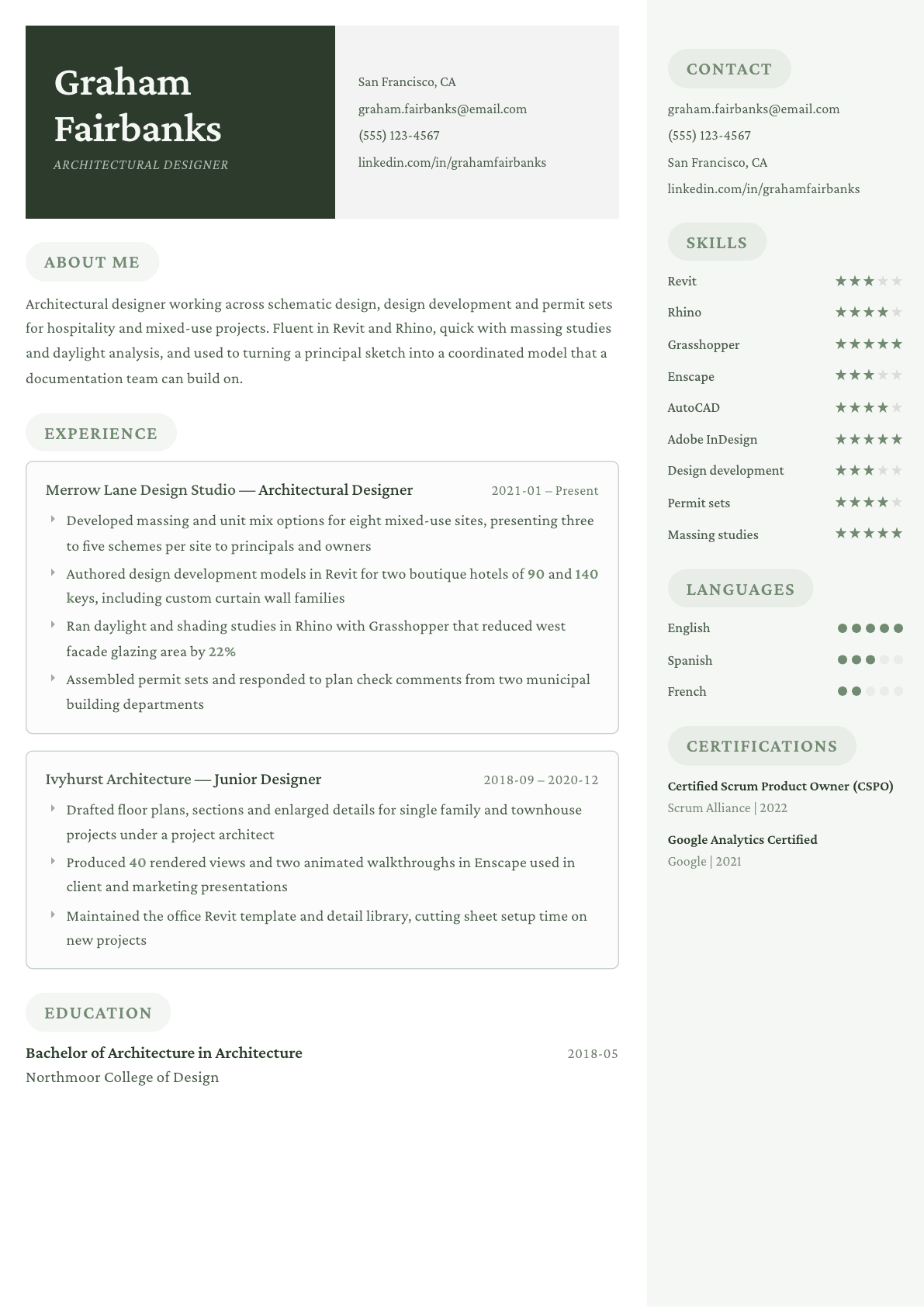
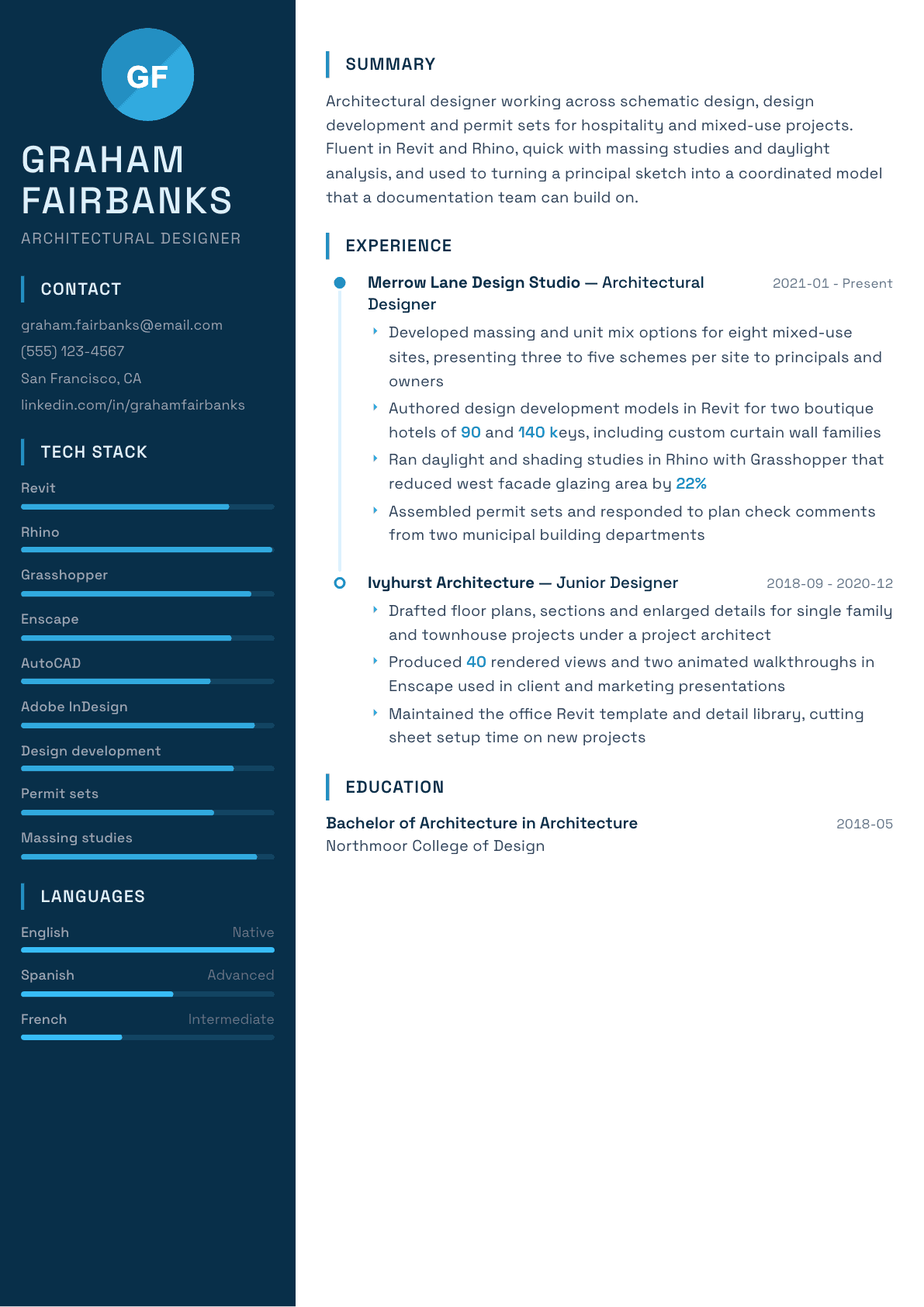
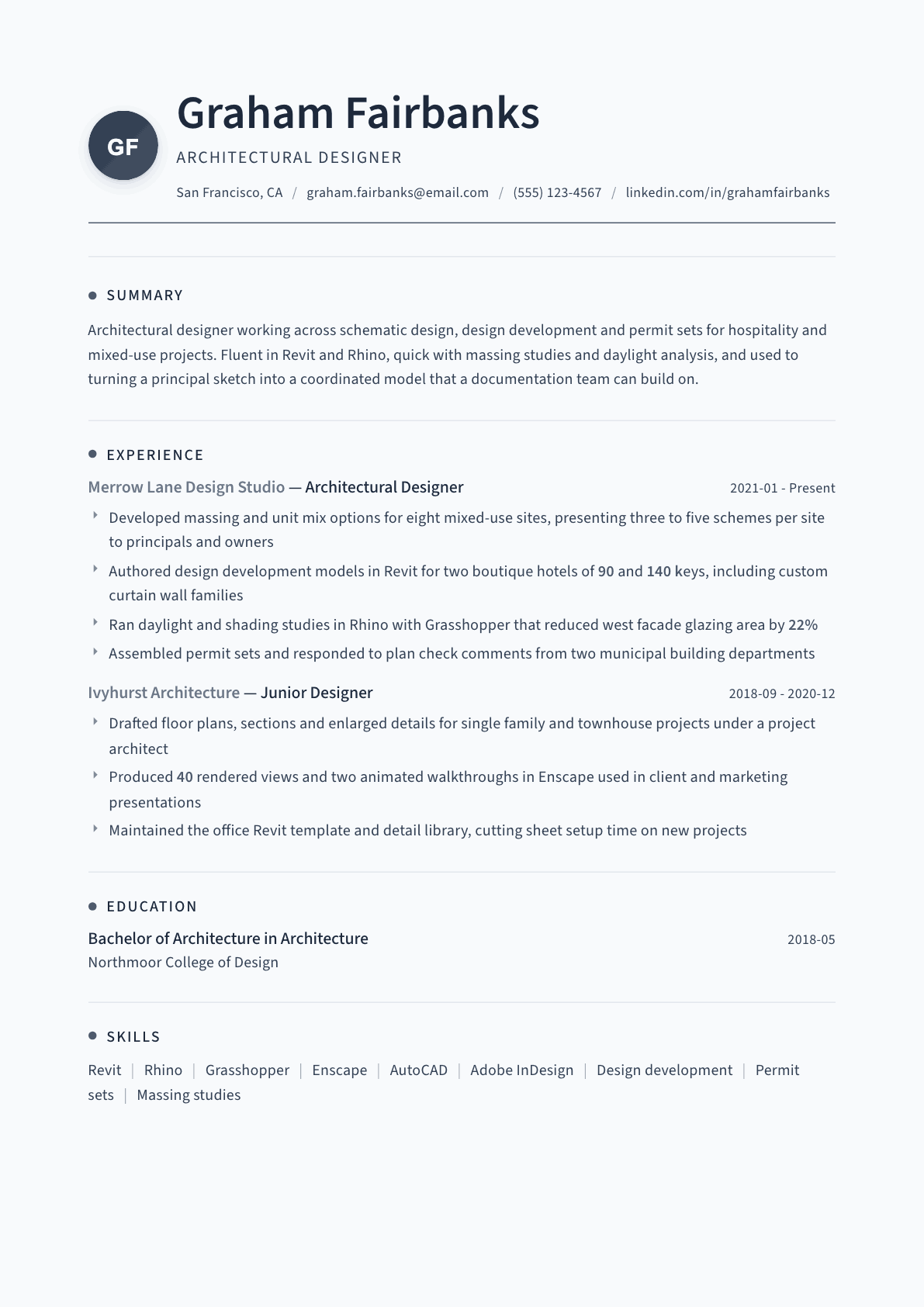
Example Architectural Designer summary
Architectural designer with five years across hospitality and mixed-use work, covering schematic design through permit documentation. Builds coordinated Revit models with custom curtain wall families, runs daylight studies in Grasshopper, and produces the rendered views that carry client presentations. Logged AXP hours toward licensure and answered plan check comments from two municipal building departments without a resubmittal.
Skills to list on a Architectural Designer resume
- Revit
- Rhino
- Grasshopper
- AutoCAD
- SketchUp
- Enscape
- Lumion
- Adobe InDesign
- Schematic design
- Design development
- Permit documentation
- Massing and site studies
- Daylight analysis
- Detail drafting
- Client presentation graphics
What actually gets this resume read
- Lead with the phases you have actually worked in, since studios hire designers for schematic work and permit sets differently.
- Name every modeling and visualization tool with the depth you have, such as Revit families, Grasshopper definitions or Enscape animation.
- Describe projects by building type, size and your contribution, not by the firm name alone that a reader may not know.
- Put your portfolio link near your contact details and keep the file itself small enough for an email attachment.
- Show evidence you can work under a project architect: coordination, plan check responses, and redline turnaround.
- If you are pursuing licensure, state your AXP hours logged and which divisions of the exam you have passed.
How to write a architectural designer resume
Architectural designer is the widest title in a studio. It covers someone a year out of school pushing massing options and someone with eight years who runs permit sets and only lacks the stamp. A resume that does not settle which of those you are will be read as the junior one, because that is the safer assumption for the person doing the screening.
Settle it with phases and deliverables. Say which packages you have authored end to end, which you have contributed sheets to, and which you have never touched. Then show the modeling depth behind it, because in most studios the designer who can build a clean Revit model with working families is the one who gets pulled onto the live project.
This guide walks through the format, the summary, the project experience, the software block that decides half the screening, licensure progress, and the questions designers ask when they are trying to move from concept work into documentation.
Format: one page, portfolio linked, phases visible
Keep the resume to one page and let the portfolio carry the imagery. Use a single column so a tracking system reads the dates in order, and place the portfolio link in the header beside your email where nobody has to hunt for it.
Under each project, the phase you worked in is the load bearing fact. A studio hiring for permit documentation and a studio hiring for competitions are looking for opposite halves of this job title, and the phase line is what routes your file correctly.
- Header: name, city, phone, email, portfolio link, licensure status in one short phrase.
- Sections: summary, experience by project with phase noted, software, licensure progress, education, awards.
- Sample portfolio of six to ten pages sized for email, with the full book available on request.
Summary: sectors, phases, and the tools you are strongest in
Three or four lines. Name the sectors you have worked in, the phases you can carry, and the two tools you are genuinely fast in. A designer who says she develops hospitality and mixed use projects from massing through permit set in Revit and Rhino has answered the three questions a studio principal asks.
Add licensure progress at the end of the summary rather than hiding it in education. Firms plan staffing around who will be stamping work in two years, and a candidate on that track is worth more to them than one who is not.
Experience: what you authored versus what you assisted on
Each project gets a scope line: building type, size, and the phase you worked in. Then say plainly whether you authored the model, produced the sheets, or supported a project architect. Overstating this is the fastest way to lose an offer, because a technical interview will ask you to walk through a detail you claimed.
Write bullets that show design thinking with a consequence. Options studied and how the preferred scheme was chosen. A daylight or shading study and what it changed about the facade. A unit mix tested against a pro forma. Custom families you built and what they let the team do faster. Those bullets separate a designer from a drafter.
Include plan check and redline work if you have it. Permit responses are unglamorous and every studio needs someone who can handle them, so a candidate who volunteers that experience stands out immediately.
Software: depth, not a list
Every applicant lists Revit. What differentiates is depth: family authoring, phasing and design options, worksets, view templates, and whether you have set up a project from a blank template. Say which of those you have done.
Do the same for Rhino. Modeling geometry is one level, writing a Grasshopper definition that drives a facade panel layout is another, and only one of them is worth interviewing about. For visualization, name the renderer and whether you produce still views, animation or real time walkthroughs.
- Revit: family authoring, design options, phasing, worksets, sheet and view template setup.
- Rhino and Grasshopper: geometry modeling, parametric facade studies, panel layout logic.
- Visualization and graphics: Enscape, Lumion, Adobe InDesign, Illustrator and Photoshop.
Licensure, education and continuing development
State the degree and whether the program is accredited, because that determines your path to registration. Then give AXP hours logged and any Architect Registration Examination divisions passed. If you are not pursuing licensure, say what you are building instead: computational design, envelope specialization, or visualization leadership are all legitimate tracks a studio hires for.
Architectural Designer resume summary examples
One year out of school
Architectural designer one year into practice, working on townhouse and small mixed use projects. Models in Revit, produces presentation graphics in InDesign, and has drafted floor plans, sections and enlarged details under a project architect. Holds an accredited professional degree and has begun logging AXP hours.
Five years in
Architectural designer with five years across hospitality and mixed use work, carrying projects from massing through permit documentation. Authors design development models in Revit including custom curtain wall families, runs daylight studies in Grasshopper, and answers plan check comments from municipal building departments.
Senior designer
Senior architectural designer with nine years leading concept and design development for boutique hotels and adaptive reuse projects. Sets the modeling standard on each job, mentors two junior designers, and has taken three schemes from invited competition through construction documents with a project architect.
Work experience bullets: before and after
Before: Created design options for mixed use projects.
After: Developed massing and unit mix options for eight mixed use sites, presenting three to five schemes per site with area tabulations and yield comparisons.
Counting the schemes and naming the comparison metrics proves the options were tested, not just drawn.
Before: Used Revit on hotel projects.
After: Authored design development models in Revit for two boutique hotels of 90 and 140 keys, including custom curtain wall and guest room families.
Key counts and family authoring turn a software mention into a statement about modeling depth.
Before: Did some environmental analysis.
After: Ran daylight and shading studies in Rhino with Grasshopper that reduced west facade glazing by 22% while holding the required daylight factor.
A result with a constraint attached proves the study changed the design rather than decorating it.
Before: Helped with permit drawings.
After: Assembled permit sets for four projects and cleared plan check comments from two municipal building departments without a resubmittal.
Clearing comments on the first pass is the outcome a studio actually cares about in permitting.
Before: Made renderings for clients.
After: Produced 40 rendered views and two animated walkthroughs in Enscape used in owner presentations and the studio marketing package.
Naming the volume and where the images were used shows the work had a purpose beyond the screen.
Hard skills
- Revit modeling and family authoring
- Rhino and Grasshopper
- AutoCAD
- SketchUp
- Enscape and Lumion rendering
- Schematic design
- Design development packages
- Permit documentation
- Massing and yield studies
- Daylight and shading analysis
- Detail drafting
- Adobe InDesign and Illustrator
- Zoning research
- Presentation graphics
Soft skills
- Taking direction from a project architect
- Presenting options clearly
- Iterating quickly under review
- Coordination with consultants
- Written plan check responses
- Mentoring junior staff
Certifications worth listing
- LEED Green Associate (Green Business Certification Institute)
- Autodesk Certified Professional: Revit for Architectural Design (Autodesk)
- WELL Accredited Professional (International WELL Building Institute)
Mistakes that cost architectural designer candidates the interview
- Leaving the phase off every project, which makes a studio assume you have only ever worked on concept design.
- Claiming to have led documentation you only contributed sheets to, a gap that a technical interview exposes quickly.
- Listing ten pieces of software at the same level so a reader cannot tell which two you are actually fast in.
- Filling the page with imagery and losing the dates, the firm names and the phase information to the tracking system.
- Hiding licensure progress in the education block where a staffing decision maker will not look for it.
- Describing renderings as the deliverable without saying what decision the images supported.
Architectural Designer resume questions
What is the difference between an architectural designer and an architect on a resume?
The title architect is protected in most jurisdictions and requires registration. If you are not registered, use designer and state your licensure progress. Misusing the protected title can get an application rejected outright by a compliance minded firm.
How much Revit detail should I include?
Enough to show depth beyond drawing walls. Mention family authoring, design options, phasing, worksets and template setup if you have done them. A studio deciding between two candidates usually picks the one who can start a project file alone.
Do I still need a portfolio if my resume is strong?
Yes. In architecture the portfolio is the primary evidence and the resume is the index to it. Send a short sample sized for email, keep the full book ready, and make sure the first pages show finished drawings rather than concept collage.
How do I move from concept work into documentation roles?
Lead your resume with any permit set, detail package or plan check work you have, however small. Then name the technical skills that support it: assembly detailing, code research and consultant coordination. Studios promote into documentation from evidence, not from interest.
Should I list competitions on an architectural designer resume?
List them if you placed or if the entry is in your portfolio and shows relevant building types. Give the competition name, your role and the result. An unplaced entry with no images attached takes space that a delivered project deserves.
Related resume examples
- Architect Resume example
- Architectural Drafter Resume example
- Junior Architect Resume example
- Interior Architect Resume example
- Landscape Architect Resume example
- Architecture Intern Resume example