Architecture Intern Resume Examples: what gets the call
An Architecture Intern Resume Built on Studio Work
By Mustafa Tarabya, founder of CVBooster · Published · Updated
Architecture intern resume examples that turn studio projects, software skills and model making into a page a firm will read.
Sample resumes for a architecture intern
The same architecture intern content laid out in three CVBooster templates, so you can see what the finished document looks like before you write a word.
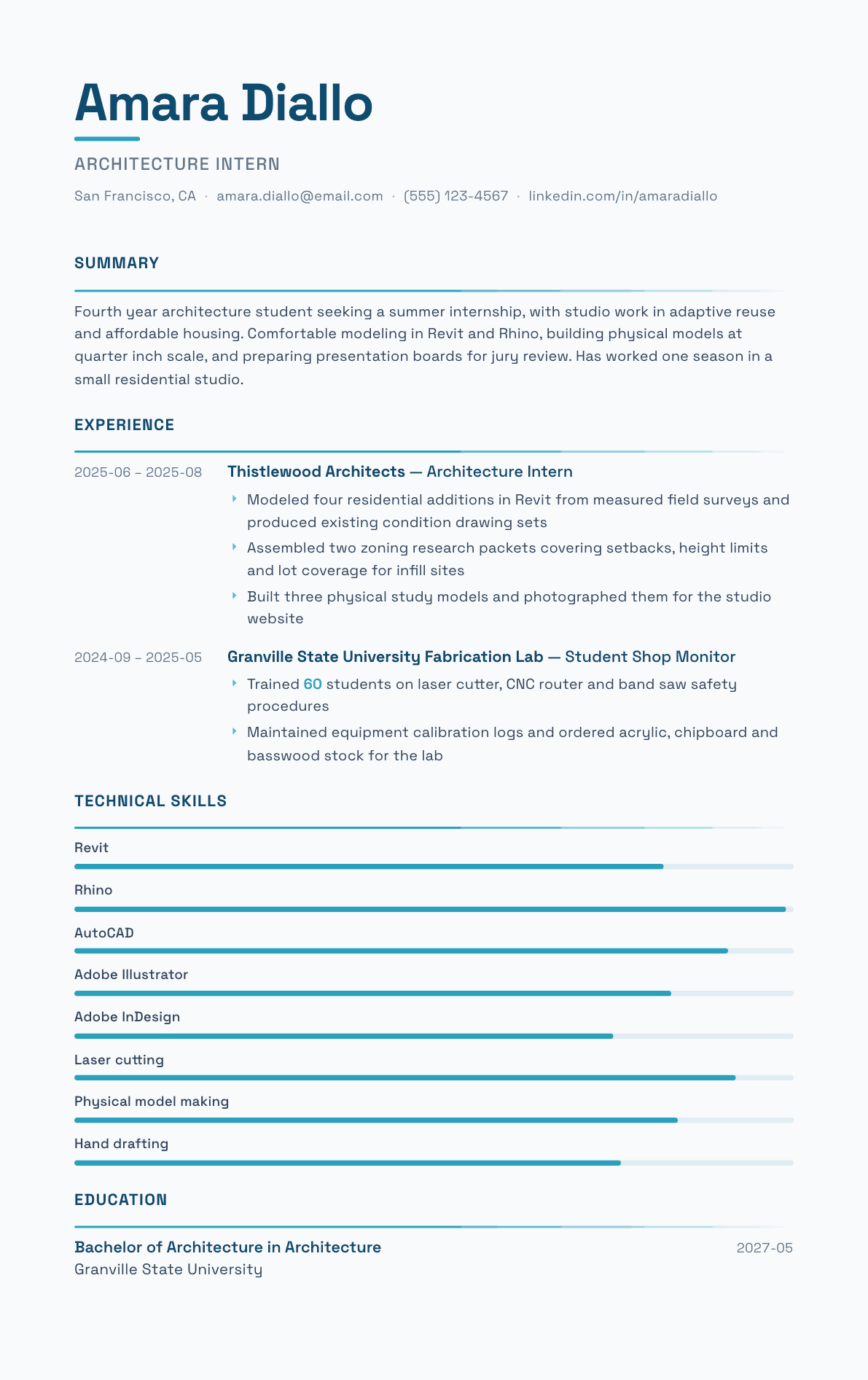
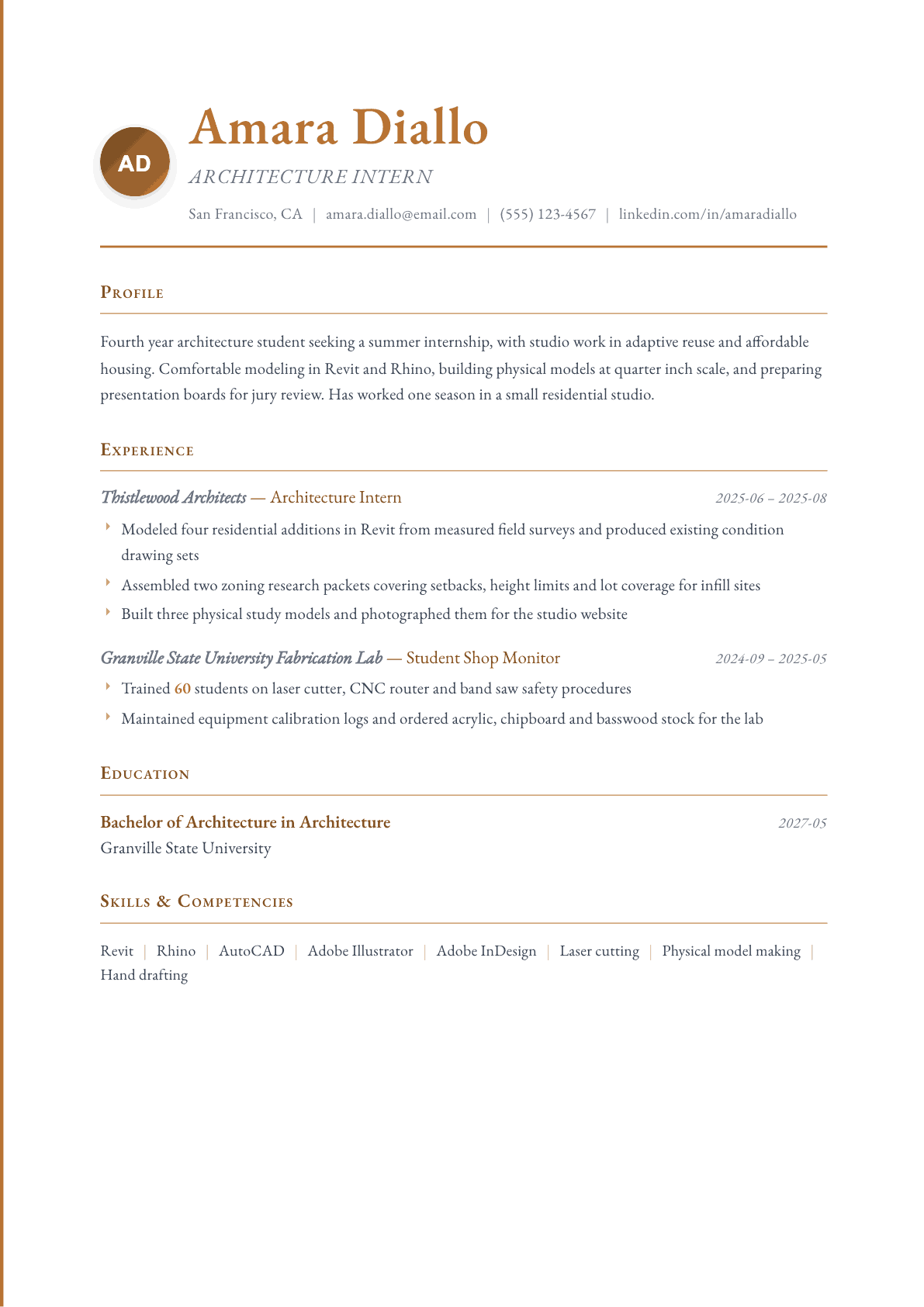
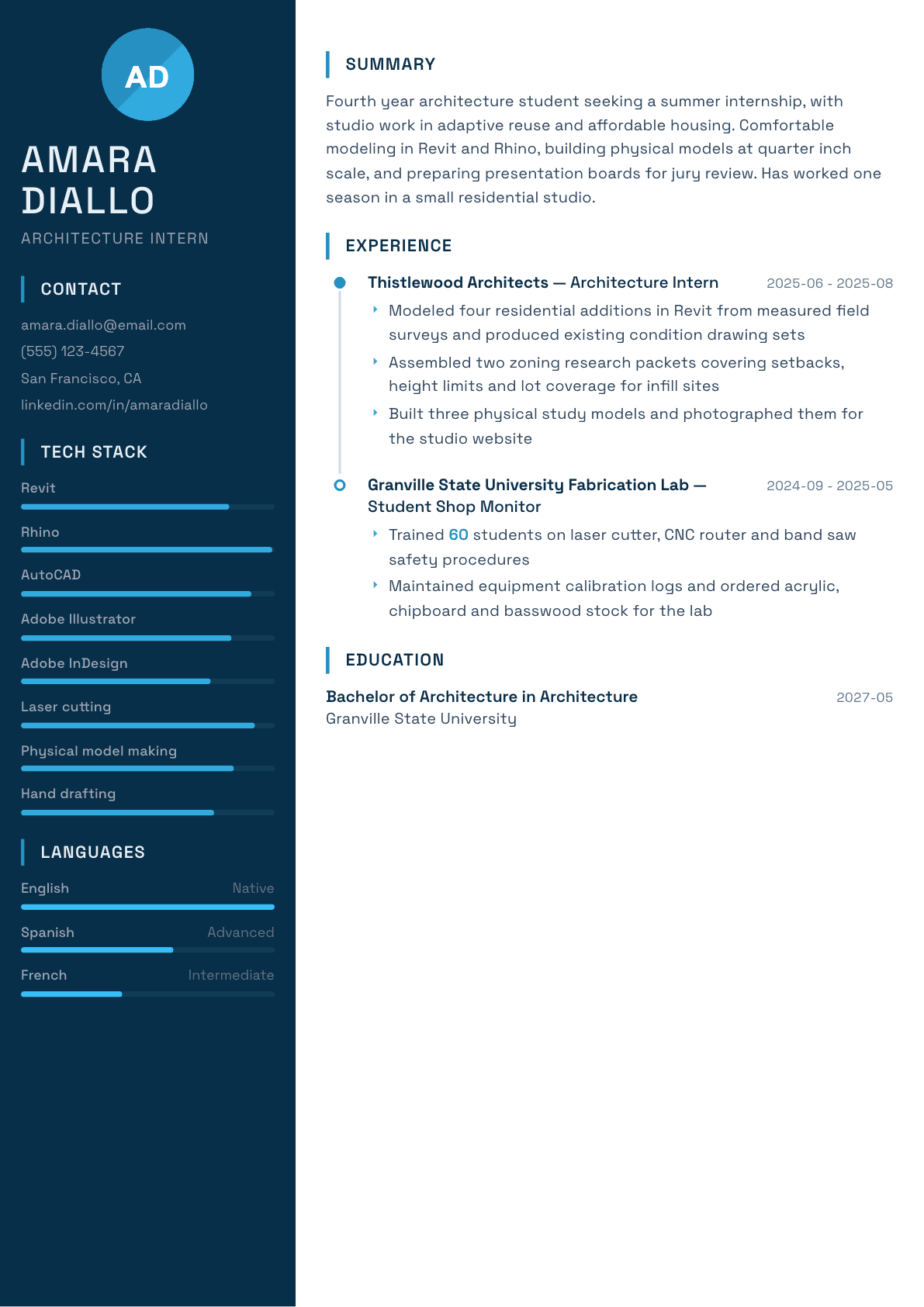
Example Architecture Intern summary
Fourth year architecture student seeking a summer internship in residential or adaptive reuse practice. Models in Revit and Rhino, drafts existing condition sets from field measurements, and builds physical study models in the school fabrication lab where she also trains students on the laser cutter. Completed one studio internship producing zoning research packets and measured drawings for infill sites.
Skills to list on a Architecture Intern resume
- Revit
- Rhino
- AutoCAD
- SketchUp
- Adobe Illustrator
- Adobe InDesign
- Adobe Photoshop
- Enscape
- Laser cutting
- CNC routing
- Physical model making
- Hand drafting and sketching
- Site and zoning research
- Presentation board layout
What actually gets this resume read
- Put education at the top with your expected graduation date, degree type, and whether the program is accredited.
- Treat studio projects as experience: give each one a site, a program, a scale and the software you used.
- List fabrication skills like laser cutting, CNC routing and model shop work, because interns are hired to make things.
- Show software depth honestly, separating tools you use daily from tools you have only touched in one course.
- Add a portfolio link and make sure the first three pages show finished drawings, not only concept collage.
- Include any construction, retail or campus job, since firms read it as evidence you can show up and take direction.
How to write a architecture intern resume
An architecture intern resume is competing against a hundred pages that all say the same thing: a design student who knows Revit and loves making things. The ones that get called have something the others do not, which is usually proof of production. Somebody in that studio has to hand you a task on your second morning, and the resume decides whether that feels safe.
Studio projects count as experience here, but only when they are written like experience. A site, a program, a scale, the software you used and what you produced. Written that way, a housing studio reads as a project. Written as a title and a semester, it reads as a course you attended.
This guide covers how to structure the page while you are still in school, how to turn coursework and shop hours into evidence, what to say about software honestly, and the questions students ask when they send out applications for the first time.
Format: education first, one page, no exceptions
Education goes at the top with the degree type, the institution, the expected graduation date and whether the program is accredited. Accreditation matters because it determines the path to registration, and a firm planning for future staff pays attention to it.
Everything fits on one page. Interns who stretch to two pages are usually padding with coursework lists and software logos. A single dense page with real deliverables outperforms two pages of enthusiasm every time.
- Header: name, city, phone, email, portfolio link, expected graduation date.
- Sections: education, studio and academic projects, work experience, fabrication and technical skills, software, activities.
- Include grade point average only if it is strong and your school reports it.
Studio projects: write them like commissions
Give each studio project a one line brief: the site, the program, the approximate scale and the studio focus. Then two bullets on what you produced. Drawing sets, physical models at a stated scale, structural or environmental studies, and the review outcome if there was one.
Choose two or three projects, not six. The ones to keep are those closest to the work the firm does. A residential studio applying to a housing office beats a speculative pavilion, however good the pavilion looked on the wall.
Fabrication, shop work and the things you can physically do
Interns get hired to make things. Laser cutting, CNC routing, three dimensional printing, band saw and chop saw work, chipboard and basswood modeling, casting and photography of finished models are all listed too rarely and valued more than students expect.
If you have monitored a school shop, trained other students or maintained equipment, that is a genuine work bullet. It shows responsibility, safety awareness and the ability to explain a process to someone else, all of which transfer straight into a studio.
- Digital fabrication: laser cutter, CNC router, three dimensional printer, file preparation for each.
- Hand fabrication: chipboard, basswood, acrylic, casting, finishing and model photography.
- Shop responsibilities: safety training delivered, equipment maintenance, material ordering.
Software: separate daily tools from course exposure
Split the list into two lines: tools you use every week and tools you have used for one project. Overstating here is common and it backfires fast, because an interview will ask you to open a file and show something. Honesty at this stage costs nothing and buys credibility.
Name the parts you know inside each tool. Revit sheets and schedules, Rhino surface modeling, Illustrator diagram work, InDesign board layout. A student who says she lays out boards in InDesign and produces measured drawing sets in Revit is describing two tasks a studio can actually assign.
Non design jobs belong on the page
A construction labor season, a campus job, retail or food service all belong here. Firms read them as proof that you show up, take direction and handle a schedule, which is the main risk with an intern hire. Give each one a line and quantify something: shifts, customers, crew size or hours worked alongside a full course load.
Construction and trade work is worth extra emphasis. Anyone who has framed a wall or poured a slab understands drawings differently, and studios notice that immediately in an intern.
Architecture Intern resume summary examples
Second year student
Second year architecture student seeking a first internship. Comfortable modeling in SketchUp and Rhino, drafting in AutoCAD, and building chipboard study models. Works weekends on a residential framing crew and has read construction drawings on site since high school.
Fourth year, one internship done
Fourth year architecture student with studio work in adaptive reuse and affordable housing. Models in Revit and Rhino, produced existing condition sets from measured field surveys during a studio internship, and monitors the school fabrication lab where she trains students on the laser cutter.
Graduate student before licensure track
Graduate architecture student finishing an accredited professional degree, with two summers of office experience on residential additions and clinic renovations. Produces permit ready drawing sets in Revit, runs zoning research for infill sites, and is ready to begin logging AXP hours after graduation.
Work experience bullets: before and after
Before: Worked on a housing project in studio.
After: Designed a 24 unit infill housing scheme on a quarter acre corner site, producing a full drawing set, a sectional model at quarter inch scale and a daylight study.
A unit count, a site size and named deliverables make a studio project readable as real work.
Before: Interned at an architecture firm last summer.
After: Modeled four residential additions in Revit from measured field surveys and produced the existing condition sets used in permit applications.
Naming the input, the tool and where the output went proves the internship involved deliverables.
Before: Know how to use the laser cutter.
After: Trained 60 students on laser cutter, CNC router and band saw procedures and kept the equipment calibration log for the fabrication lab.
Training others and owning a log turn a machine skill into evidence of responsibility.
Before: Did research for the firm.
After: Assembled two zoning research packets covering setbacks, height limits and lot coverage for infill sites, summarized for the principal in one page each.
The specific research topics and the one page format show the work was usable, not just collected.
Before: Had a summer job in construction.
After: Framed walls and set formwork on a residential crew for two summers, reading structural drawings daily and learning tolerance limits firsthand.
Connecting site work back to drawings explains why the job matters to an architecture employer.
Hard skills
- Revit
- Rhino
- AutoCAD
- SketchUp
- Adobe Illustrator
- Adobe InDesign
- Adobe Photoshop
- Enscape rendering
- Laser cutting and file preparation
- CNC routing
- Physical model making
- Hand drafting and sketching
- Measured field surveys
- Zoning and site research
Soft skills
- Taking direction
- Meeting review deadlines
- Asking clarifying questions
- Presenting work to a jury
- Working late in a team
- Careful note taking
Certifications worth listing
- LEED Green Associate (Green Business Certification Institute)
- OSHA 10-Hour Construction (Occupational Safety and Health Administration)
Mistakes that cost architecture intern candidates the interview
- Listing studio projects by title and semester with no site, program, scale or deliverable attached.
- Claiming advanced skill in eight programs when only two have been used past a single assignment.
- Dropping retail, campus and construction jobs, which are the strongest evidence a student can show of reliability.
- Sending a fifty page portfolio with the application instead of a short sample that opens in a browser.
- Writing a summary full of design philosophy instead of the tasks a studio could assign you next week.
- Leaving the expected graduation date off, which forces a firm to guess whether you are available for a full summer.
Architecture Intern resume questions
Do I include studio projects on an architecture intern resume?
Yes, and they should occupy real space on the page. Write each one with a site, a program, a scale and the deliverables you produced. Two or three well written studio entries beat a list of six project titles nobody can picture.
What if I have no architecture work experience at all?
Then education, studio projects and fabrication skills carry the page, with any other job listed underneath for reliability. Nearly every intern applicant is in the same position, so the difference comes from how concretely you describe what you made.
How do I show software skill honestly without underselling myself?
Split the list into weekly tools and course exposure, then name the specific tasks you can do in the weekly ones. That framing reads as self aware rather than modest, and it survives the moment an interviewer opens a file and asks you to work.
Should I send a portfolio with my internship application?
Send a short sample of six to ten pages sized to pass an email filter, and link the full book. Lead the sample with drawings and models rather than concept collage, because studios are checking whether you can produce, not only imagine.
Is it worth applying to firms that have not posted an internship?
Yes. Many small studios hire when a good application arrives rather than on a schedule. Send the resume, a short sample and two sentences about why that office specifically, then follow up once. Generic mass emails are what get ignored.
Related resume examples
- Junior Architect Resume example
- Architectural Designer Resume example
- Architectural Drafter Resume example
- Architect Resume example
- Landscape Architect Resume example
- BIM Modeler Resume example