History Teacher Resume Examples: the lines they read
Build a History Teacher Resume That Shows Real Instruction
By Mustafa Tarabya, founder of CVBooster · Published · Updated
History teacher resume example with course lists, document-based question units, certification placement and the keywords school hiring teams search.
Sample resumes for a history teacher
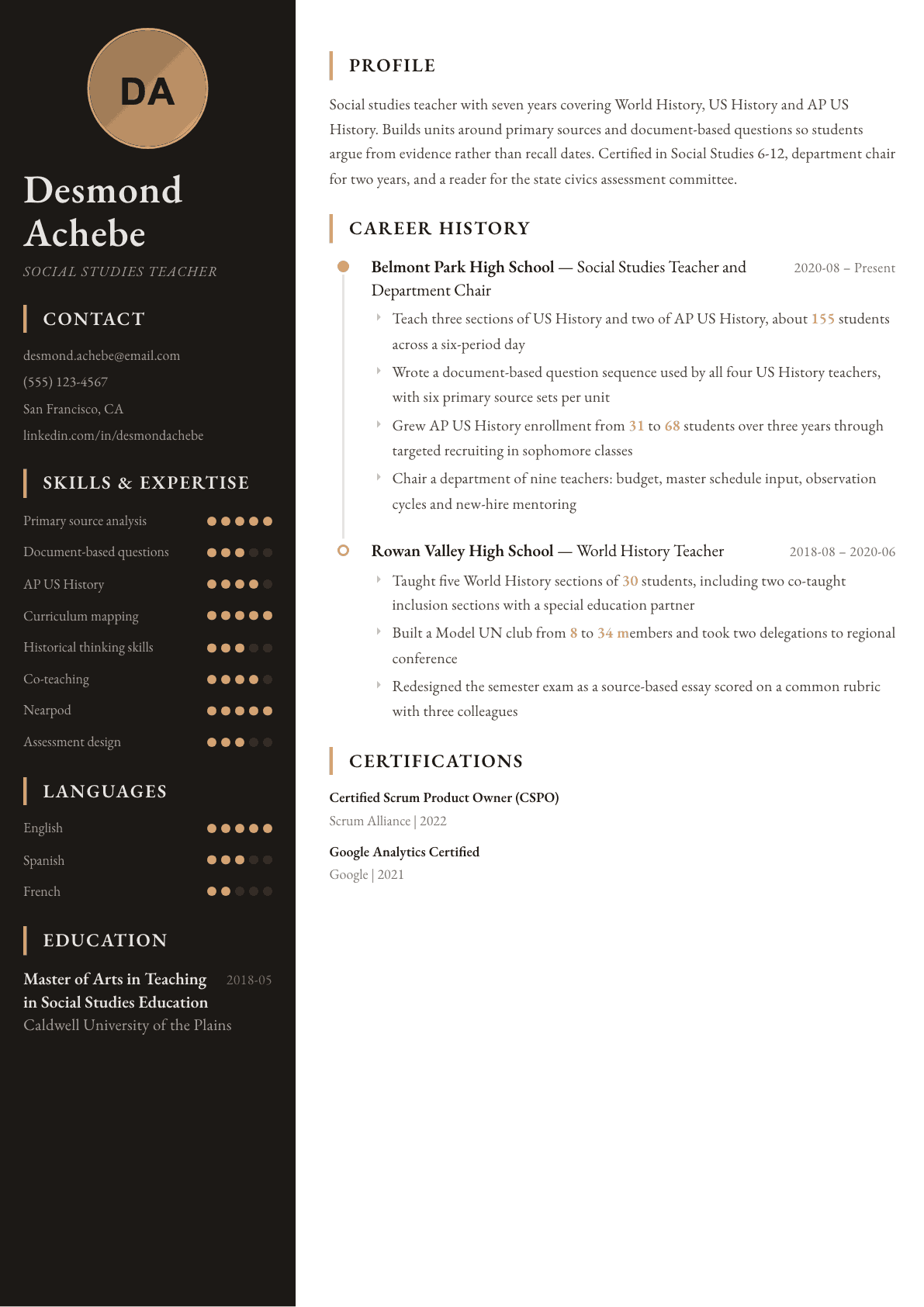
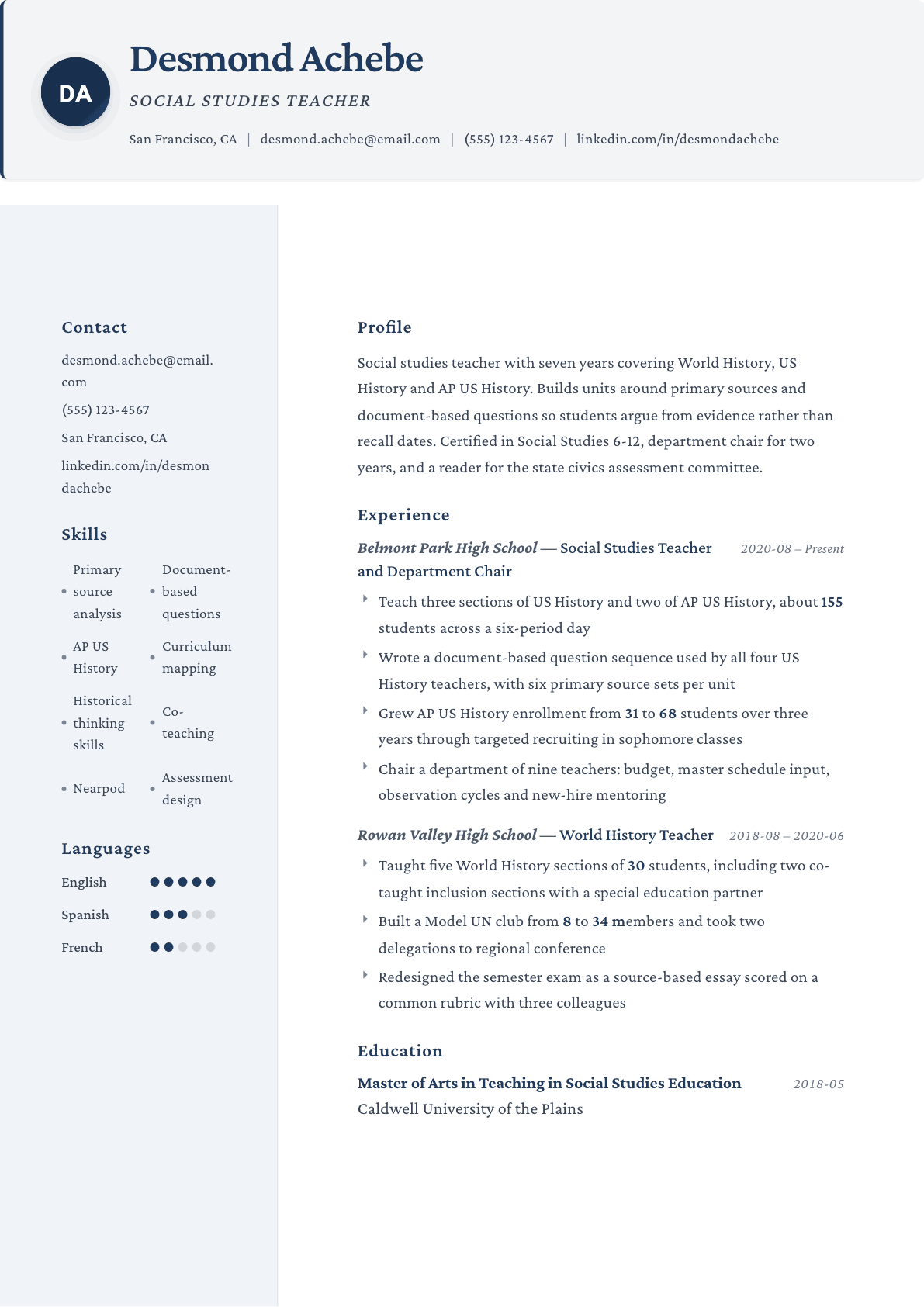
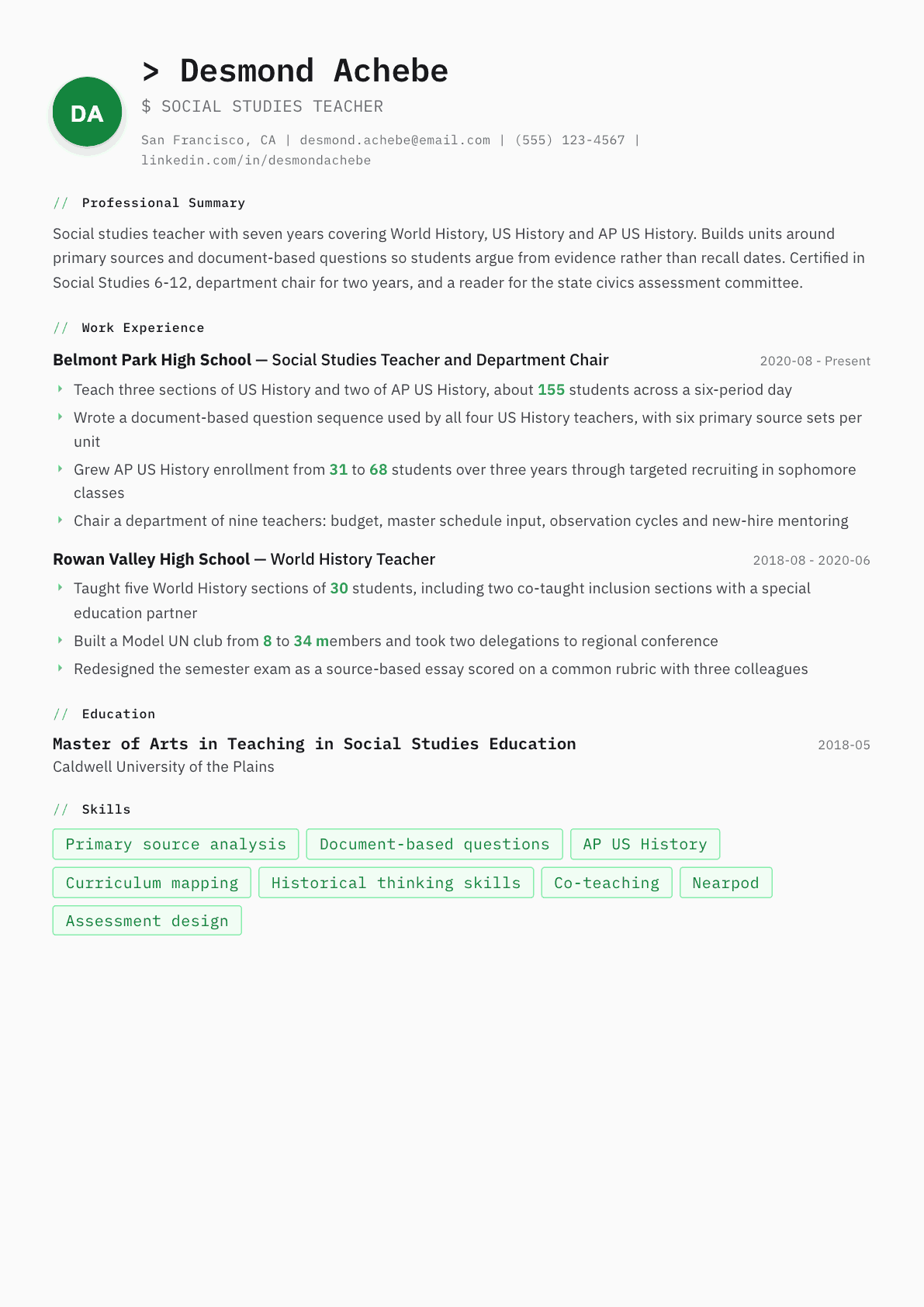
The same history teacher content laid out in three CVBooster templates, so you can see what the finished document looks like before you write a word.
Example History Teacher summary
Social studies teacher with seven years in World History, US History and AP US History, certified 6-12. Built a shared document-based question sequence adopted department wide and grew AP enrollment from 31 to 68 students. Two years as department chair covering observation cycles, budget and new-teacher mentoring. Seeking a high school history position with an AP or dual credit load.
Skills to list on a History Teacher resume
- World History instruction
- US History instruction
- AP US History
- Primary source analysis
- Document-based questions
- Historical thinking skills
- Civics and government instruction
- Curriculum mapping
- Socratic seminar facilitation
- Standards alignment
- Co-teaching
- Nearpod
- Newsela
- Assessment writing
- Department leadership
- National History Day sponsorship
What actually gets this resume read
- Open with the exact courses you are certified and experienced to teach, from World History to AP European History.
- Show how you teach sourcing, context and corroboration instead of claiming you make history engaging for students.
- Give the enrollment numbers of any AP or dual credit section you built, since growth is a hiring argument.
- Name the state social studies standards framework you have written to, because districts screen for that alignment.
- Mention Model UN, debate, National History Day or student government sponsorship in its own short section.
- Keep the technology line concrete: Nearpod, Newsela, DBQ Project materials, and the district learning platform.
How to write a history teacher resume
History postings are among the most oversubscribed in secondary hiring. A single World History vacancy can draw a hundred files, most of them from people who genuinely love the subject and say so on line one. Loving history is the baseline, not the argument. The department chair reading your file wants to know which courses you can pick up, whether you can carry an AP or dual credit section, and whether your students argue from evidence or memorize a timeline.
The strongest history teacher resumes read like a course catalog with proof attached. They list the exact courses taught, the standards framework, the document-based work students produced, and the enrollment or outcome numbers behind any claim.
What follows is the section order a social studies department expects, how to write about sourcing and argumentation without sounding like a methods textbook, summaries for three career stages, before and after bullets, and the questions that come up when the job posting is open for nine days.
Format: a teaching file, not a scholarly CV
A history degree tempts people toward an academic CV with conference lines and a research interests block. Secondary hiring does not read that document. Use a one or two page reverse chronological resume, single column, with certification near the top and courses named in every job entry.
Keep any graduate research to a single line under education unless it produced classroom material. A thesis on Reconstruction matters to a hiring committee only when it became a unit students completed.
- Header: name, city and state, contact, certification area with grade band.
- Order: summary, certification, teaching experience with courses, education, skills, activity sponsorships.
- Graduate work belongs under education, not in a separate research section.
Summary: the courses you can cover tomorrow
Name every course you are experienced and certified to teach in the first two lines: World History, US History, Government, Economics, Geography, Psychology, AP or dual credit variants. Social studies departments are staffing puzzles, and the candidate who solves two gaps at once gets called first.
Then one clause on how you teach. Something like building units around primary sources and document-based questions tells a chair your instructional stance in eight words, which is faster than a paragraph of philosophy.
Experience: sourcing, argument, and the units you wrote
Lead each job with school, title, courses and grade levels. Then show the instructional work that only a history teacher does: primary source sets, document-based question sequences, corroboration and contextualization practice, historical argumentation, simulations, and how you teach students to weigh a biased source rather than discard it.
Attach numbers where they exist and are honest. AP or dual credit enrollment growth, the count of students earning a qualifying exam score across cycles, or a department-wide adoption of material you wrote. Enrollment growth is especially persuasive because it is a problem principals are actively trying to solve.
Skip bullets that describe classroom existence. Delivering lectures, creating PowerPoint presentations and grading tests are not evidence, and they crowd out the sentence that would have gotten you the interview.
Standards, certification and the endorsements that unlock coverage
Give the state, the certification title and the grade band, then the standards framework you have written units to. Districts screen on framework familiarity because a teacher who already knows the state social studies standards is a shorter onboarding.
List secondary endorsements separately. Psychology, economics, geography and gifted endorsements decide who can cover an elective, and a chair building a master schedule reads that block closely.
Skills, keywords and the activities block
Social studies postings repeat a small vocabulary: historical thinking skills, primary and secondary sources, document analysis, civic engagement, inquiry design, differentiated instruction and standards alignment. Use those exact phrases once where they are claimed and once where they are shown.
Give activity sponsorship its own short block. Model United Nations, National History Day, debate, mock trial, student government and quiz bowl are real staffing needs, and many history positions are effectively hired to fill one of them.
- Instructional: document-based questions, source corroboration, historical argumentation, simulations, seminar discussion.
- Tools: Nearpod, Newsela, digital archives, the district learning platform, primary source databases.
- Sponsorships: Model United Nations, National History Day, debate, mock trial, quiz bowl.
History Teacher resume summary examples
First teaching year
Newly certified social studies teacher, grades 6 to 12, with a 15-week placement teaching three World History sections and a semester tutoring for the state civics exam. Built a four-source document analysis routine used daily. Seeking a secondary history position with a World or US History load.
Seven years in
History teacher with seven years covering World History, US History and AP US History. Wrote a document-based question sequence adopted by all four US History teachers and grew AP enrollment from 31 to 68 students in three years. Sponsors Model United Nations. Certified Social Studies 6-12.
Department chair
Social studies chair with thirteen years teaching US History, Government and AP European History, and five years leading a department of nine. Owns the curriculum adoption cycle, observation calendar and new-teacher mentoring. Redesigned the semester exam as a source-based argument scored on a common rubric.
Work experience bullets: before and after
Before: Taught history classes to high school students.
After: Taught three US History and two AP US History sections, about 155 students across a six-period day.
Course names and student load let a chair place you on the master schedule while reading.
Before: Used primary sources in lessons.
After: Wrote a document-based question sequence with six primary source sets per unit, now used by all four US History teachers.
Quantity, structure and adoption turn a common claim into a piece of curriculum you own.
Before: Increased interest in AP classes.
After: Grew AP US History enrollment from 31 to 68 students over three years through recruiting visits to every sophomore class.
The method is named alongside the growth, so the reader knows it can be repeated at their school.
Before: Sponsored the Model UN club.
After: Grew Model United Nations from 8 to 34 members and prepared two delegations for regional conference.
Membership growth and competition preparation show the sponsorship was work, not a title.
Before: Collaborated with the special education department.
After: Co-taught two inclusion sections of World History with a special education partner, sharing planning and modified assessments.
Naming the co-teaching model and what was shared proves the collaboration was structural.
Hard skills
- World History instruction
- US History instruction
- AP US History
- Government and civics instruction
- Primary source analysis
- Document-based question design
- Historical thinking skills
- Curriculum mapping
- Standards alignment
- Assessment writing
- Co-teaching
- Nearpod and Newsela
Soft skills
- Discussion facilitation
- Handling contested topics with balance
- Department collaboration
- Mentoring new teachers
- Student recruiting for advanced courses
- Parent communication
Certifications worth listing
- National Board Certification, Social Studies History (National Board for Professional Teaching Standards)
- AP Course Audit Approval, United States History (College Board)
- Praxis Social Studies: Content Knowledge (Educational Testing Service)
Mistakes that cost history teacher candidates the interview
- Submitting an academic CV with a research interests section instead of a teaching resume with courses and outcomes.
- Writing that you make history come alive, a phrase that appears on most of the files in the stack.
- Leaving out the course list, which forces the chair to guess whether you can hold a Government or Economics section.
- Claiming inquiry-based instruction without a single document set, source routine or unit named anywhere on the page.
- Hiding club sponsorship at the bottom when it is often the reason the vacancy exists.
- Listing endorsements only by acronym, so an HR screener cannot match them to the elective on the schedule.
History Teacher resume questions
Should a history teacher resume include a research or publications section?
Not for secondary hiring. Reduce graduate research to one line under education, and only expand it if the work became classroom material such as a unit, a document set or a professional development session you delivered.
How do I show I can teach an AP or dual credit history course?
Name the closest evidence you hold: honors sections taught, an AP Summer Institute completed, exam reading experience, or a course audit approval on file. Then state that you are seeking an advanced section so the chair reads your file against that vacancy.
What social studies keywords do district screeners search for?
Historical thinking skills, primary and secondary sources, document-based questions, civic engagement, inquiry design, standards alignment, differentiated instruction and the course names themselves. Mirror the posting wording once in skills and once inside an experience bullet.
How much space should club sponsorship get?
A short block of two or three lines with the activity, your role and the scale. Model United Nations, National History Day, debate and mock trial are staffing needs, so a principal reads that block to see whether one hire covers two problems.
Can I apply for a history opening with a general social studies certification?
Yes, and you should state the certification title exactly as your state issues it along with the grade band. HR verifies the certificate, not the subject label on the posting, so matching wording prevents your file from being screened out early.