Assistant Coach Resume Examples: the lines they read
Write an Assistant Coach Resume That Earns the Next Step
By Mustafa Tarabya, founder of CVBooster · Published · Updated
Assistant coach resume example showing position group ownership, scouting work, recruiting support and the specifics that move you toward a head coaching job.
Sample resumes for a assistant coach
The same assistant coach content laid out in three CVBooster templates, so you can see what the finished document looks like before you write a word.
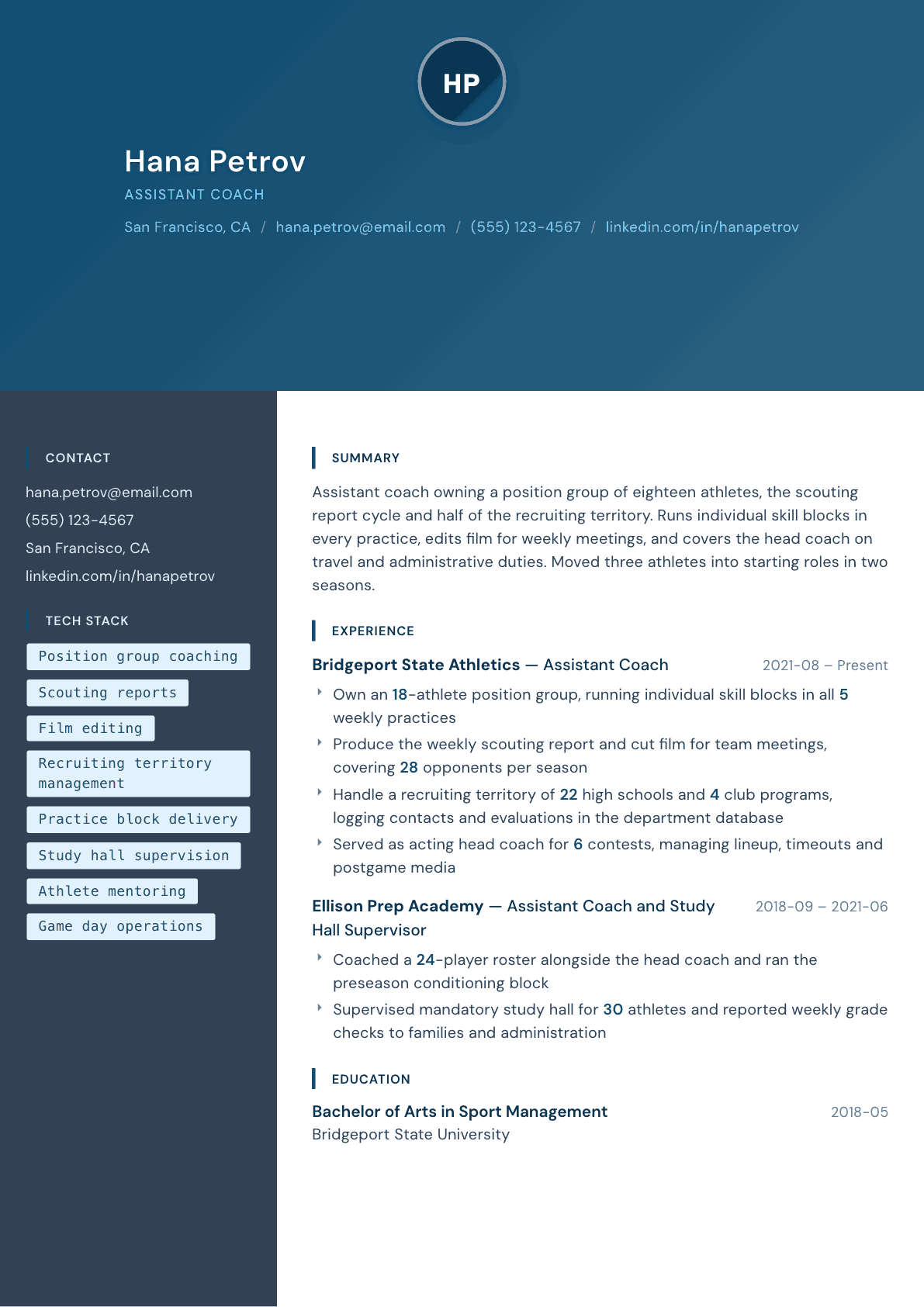
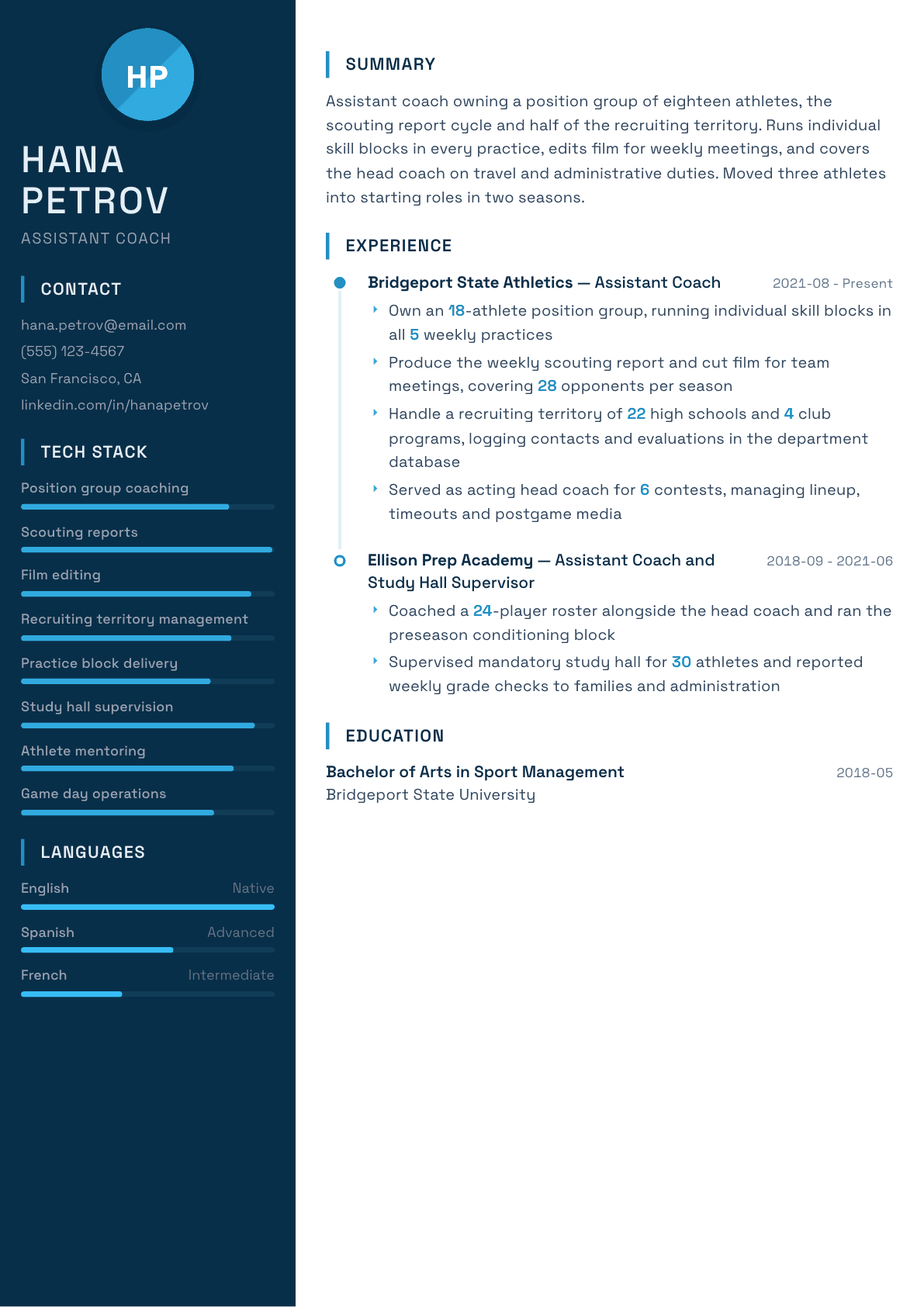
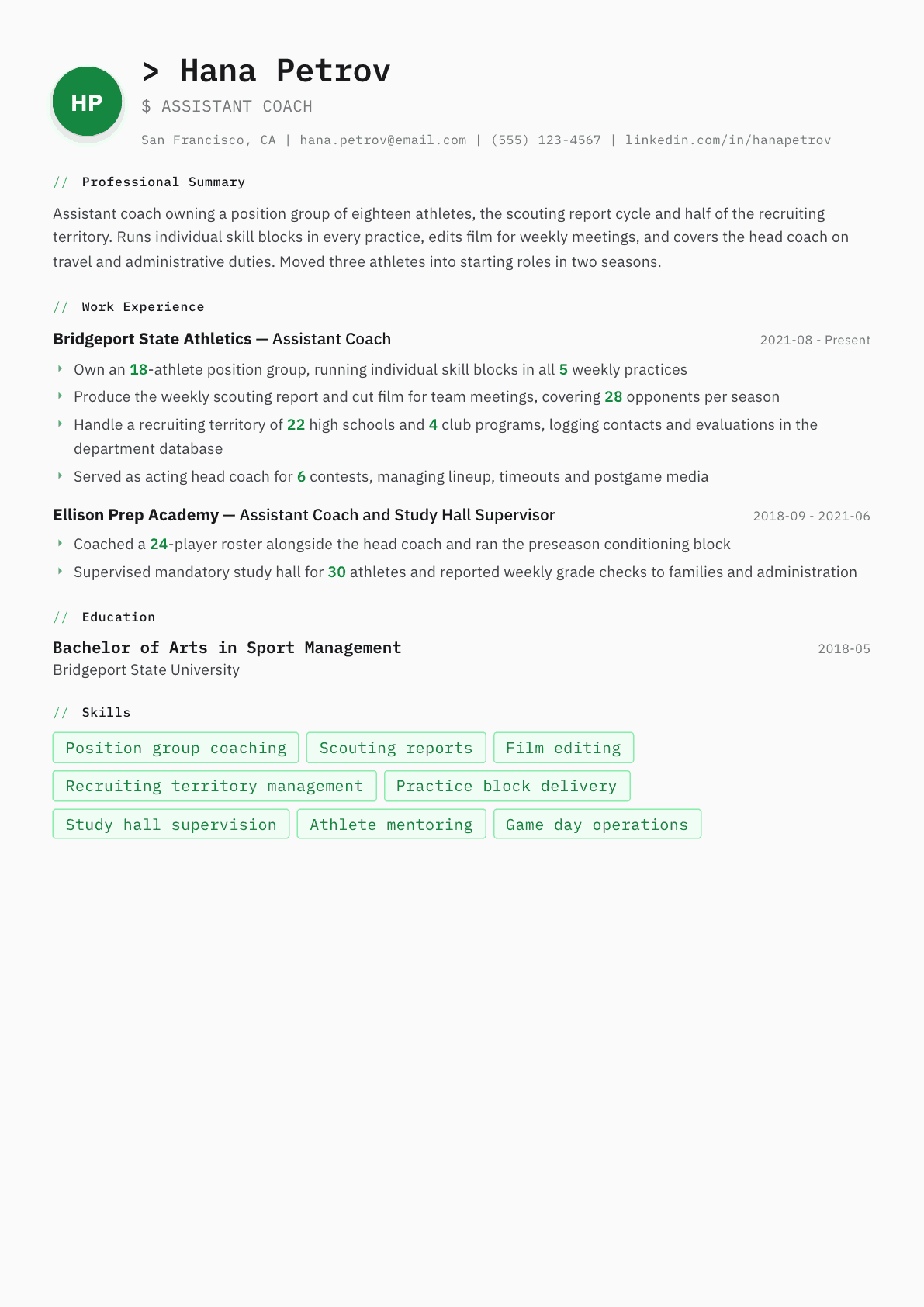
Example Assistant Coach summary
Assistant coach with five seasons of college and preparatory experience, currently owning an eighteen-athlete position group, the weekly scouting cycle and a recruiting territory of twenty-two schools. Cuts film for team meetings, runs individual skill blocks in every practice, and has served as acting head coach for six contests. Seeking an associate head coach role with expanded staff responsibility.
Skills to list on a Assistant Coach resume
- Position group coaching
- Individual skill development
- Scouting reports
- Film breakdown
- Video editing software
- Recruiting territory management
- Practice block delivery
- Game day operations
- Academic support and study hall
- Athlete mentoring
- Equipment and travel logistics
- Opponent tendency analysis
- Camp instruction
- Player evaluation
What actually gets this resume read
- Say exactly what you owned, because an assistant coach resume fails when the reader cannot separate your work from the head coach.
- Name your position group and its size, then show what those athletes did while you coached them.
- Quantify the scouting and film load: opponents covered, clips cut, meetings led, and the software you edit in.
- Give your recruiting territory in schools and club programs, since that is how a department measures assistant contribution.
- List any contests where you acted as head coach, which is the clearest evidence you are ready for the next chair.
- Include academic support duties such as study hall and grade checks, because retention and eligibility often sit with assistants.
How to write a assistant coach resume
The failure mode of an assistant coach resume is invisibility. The candidate lists what the team did, the season went well, the athletes improved, and the reader finishes the page unable to name a single thing that belonged to the applicant rather than to the head coach. Hiring at this level is about carving out ownership and proving it.
A head coach reading applications is filling a gap in the staff. She already has someone who recruits well and someone who runs the defense; she needs the person who can take a position group, produce the scouting report on time every week and be trusted with athletes when she is on the road. Your resume should say which of those gaps you fill.
This guide covers how to write ownership without overstating it, how to quantify film and scouting work, how to present a recruiting territory, and the questions assistants ask when they want the resume to move them toward an associate head coach or head coach chair.
Format: your slice of the staff, stated first
One page early in a career, two once you have several institutions. Reverse-chronological. Under each title, write your assignment in the staff before any bullets: the position group and its size, the phase of play or side of the program you handled, and the administrative area assigned to you. That single line does the work that most assistant resumes never do.
Then be careful with pronouns. Write what you ran, taught, produced or owned. Anything the whole staff did belongs in a shared context line, not in your bullets, because an experienced head coach can spot borrowed credit and it costs you the interview.
- Assignment line: position group and headcount, phase of play, and the administrative area you owned.
- Section order: summary, coaching experience, recruiting, video and scouting, academic support, education, certifications.
- Add any contests where you served as acting head coach, since that is the clearest readiness signal available to you.
Position group work: teach, develop, deploy
Give your group a size and then show the development inside it. Individual skill blocks in every practice, the technique you rebuilt with a specific athlete, the freshman who moved into the rotation, the depth you produced when the starter was unavailable. Athlete outcomes in your group are the assistant coach equivalent of a season record.
Show how your group fits the team plan too. What you install each week, how you adapt your teaching when the game plan changes, how you communicate an athlete readiness assessment to the head coach before a lineup decision. That is the difference between a position teacher and a staff contributor.
Film, scouting and the weekly production cycle
Video work is measurable, so measure it. Opponents covered a season, clips cut per week, the meetings you led from your own material, the tendency reports you produced and the software you edit in. Assistants who are fast and reliable in the video room become indispensable, and the resume should say so with numbers rather than adjectives.
Describe the delivery too. A scouting report is worthless if athletes cannot act on it, so say how you compress it: a one-page tendency sheet, a five-clip walkthrough, a personnel card athletes carry. The translation step is the coaching, not the file.
- Give opponents scouted per season and clips or reports produced per week.
- Name the video and analysis platform you work in, because staffs hire for tool fluency at this level.
- Say who consumed your work: the position group, the whole team, or the head coach for game planning.
Recruiting territory and academic support
Recruiting is where assistants earn their next job. Present your territory as a defined area with volume: high schools and club programs covered, evaluations logged, contacts made, visits hosted and athletes signed from your area. Then note how you tracked it, since a department database and reliable logging habits matter as much as the eye for talent.
Academic support is the other duty assistants absorb. Study hall supervision, grade checks, communication with faculty and families, and the athletes you kept eligible through a difficult term. Retention and eligibility often sit with assistants, and a head coach hires the person who takes it seriously.
Keywords and the readiness signals to include
Postings at this level repeat: position coaching, skill development, film breakdown, scouting reports, recruiting, player evaluation, academic monitoring, practice organization, equipment and travel logistics, and student athlete welfare. Place each inside a bullet where it is demonstrated.
Then add readiness signals for the next chair: contests managed as acting head coach, budget or camp responsibility, staff you supervised such as student assistants and managers, and clinics where you presented. Those lines are what turn an assistant application into an associate head coach conversation.
Assistant Coach resume summary examples
First assistant role
Assistant coach in a first full season, running individual skill blocks for a 12-athlete position group and supervising study hall for 30 athletes. Cuts practice film for weekly meetings, logs recruiting evaluations, and holds current safety and coaching education certification. Seeking a full-time assistant position.
Four seasons on staff
Assistant coach owning an 18-athlete position group, the weekly scouting cycle and a recruiting territory of 22 high schools and 4 club programs. Produces reports on 28 opponents a season, cuts film for team meetings, and has served as acting head coach for 6 contests.
Associate head coach
Associate head coach directing three assistants, the entire scouting operation and the recruiting calendar for a full roster. Manages travel and equipment budgets, runs the summer camp, and has moved two position athletes into all-conference selection over the last three seasons.
Work experience bullets: before and after
Before: Assisted the head coach with practices and games.
After: Owned an 18-athlete position group and ran individual skill blocks in all five weekly practices, installing the weekly plan for the group and reporting readiness before lineup decisions.
Assisting is invisible; owning a group with a headcount and a weekly install is a job a head coach can evaluate.
Before: Broke down film for the coaching staff.
After: Produced the weekly scouting report and cut film for team meetings across 28 opponents a season, delivering each report as a one-page tendency sheet plus a five-clip walkthrough.
Volume and delivery format show a repeatable production cycle instead of general video work.
Before: Helped with recruiting.
After: Covered a recruiting territory of 22 high schools and 4 club programs, logging evaluations and contacts in the department database and hosting visits during every contact period.
A territory with counts and a tracking system reads as recruiting responsibility rather than occasional help.
Before: Filled in for the head coach when needed.
After: Served as acting head coach for 6 contests, managing the lineup, timeout usage, in-contest adjustments and postgame media while the head coach was away recruiting.
It quantifies head coaching duty, which is the strongest readiness signal an assistant can offer.
Before: Monitored athletes academic progress.
After: Supervised mandatory study hall for 30 athletes, ran weekly grade checks with faculty, and reported academic standing to families and administration every Friday.
Naming the headcount, cadence and audience turns academic oversight into a duty you clearly carried.
Hard skills
- Position group coaching
- Individual skill development
- Weekly scouting report production
- Film breakdown and clip editing
- Video analysis software
- Opponent tendency analysis
- Recruiting territory management
- Player evaluation and grading
- Practice block delivery
- Game day operations
- Academic monitoring and study hall
- Equipment and travel logistics
- Camp and clinic instruction
- Depth chart preparation
Soft skills
- Loyalty to a staff plan
- Direct feedback to athletes
- Reliability under deadline
- Mentoring
- Communication with families
- Adaptability across roles
Certifications worth listing
- Accredited Interscholastic Coach (AIC) (National Federation of State High School Associations)
- SafeSport Trained (U.S. Center for SafeSport)
- Adult and Pediatric First Aid, CPR and AED (American Red Cross)
Mistakes that cost assistant coach candidates the interview
- Writing about what the team accomplished instead of what you personally owned inside the staff.
- Never naming a position group or an assigned area, which leaves the reader unable to place you on a staff chart.
- Describing film work without a single count of opponents, clips or meetings led.
- Treating recruiting as a vague duty rather than a defined territory with logged evaluations and hosted visits.
- Leaving out academic support and study hall, which is often the exact duty a head coach needs covered.
- Failing to mention contests run as acting head coach, the one line that proves you are ready for more.
Assistant Coach resume questions
How do I show my own contribution as an assistant coach?
Anchor every bullet to something assigned to you: a position group, the scouting cycle, a recruiting territory, study hall. Use verbs that describe your action rather than the team outcome, and keep shared results in a short context line.
Should an assistant coach list the head coach they worked under?
Name the institution and the program in the entry, and mention the head coach only if the connection is meaningful in your sport and the person is a reference. Never build the entry around someone else name at the expense of your own duties.
How much recruiting detail should I include?
Enough to show a system: territory size in schools and clubs, evaluations logged, visits hosted and athletes signed from your area. Keep individual athlete names out of it and describe the process, since that is what transfers to a new staff.
What makes an assistant coach resume ready for a head coach job?
Evidence of scope beyond a position group: contests managed as acting head coach, staff or student assistants supervised, budget or camp responsibility, and a recruiting operation you ran rather than participated in.
Do volunteer and graduate assistant roles belong on the resume?
Yes, and they should be written as full entries with duties, headcounts and outcomes. Coaching staffs understand that careers begin in unpaid and stipend roles, and the work in them is often broader than a first paid position.
Related resume examples
- Sports Coach Resume example
- Athletic Trainer Resume example
- Head Coach Resume example
- Athletic Coach Resume example
- Soccer Coach Resume example
- Golf Instructor Resume example