Life Coach Certification on a CV: 6 Worked Examples
By Mustafa Tarabya, founder of CVBooster · Published · Updated
8 min read
Write the qualification, the awarding body, the level and the date, then the accreditation separately with its expiry. Life coach certification is not a licence to practise, so the reader judges the body, not the word "certified". The National Careers Service says so outright: "Life coaching is not regulated in the UK, so anyone can work as a life coach if they feel they have the necessary skills and qualities." Below are six complete CV lines, checked in September 2026, for a qualifications block, a skills line, an in-house learning role, a career changer, a course in progress, and a self-employed practice. Written by Mustafa Tarabya, who hired for his own company, read every application himself and now writes CVBooster's guides.
Here is the line. Copy the shape, not the details.
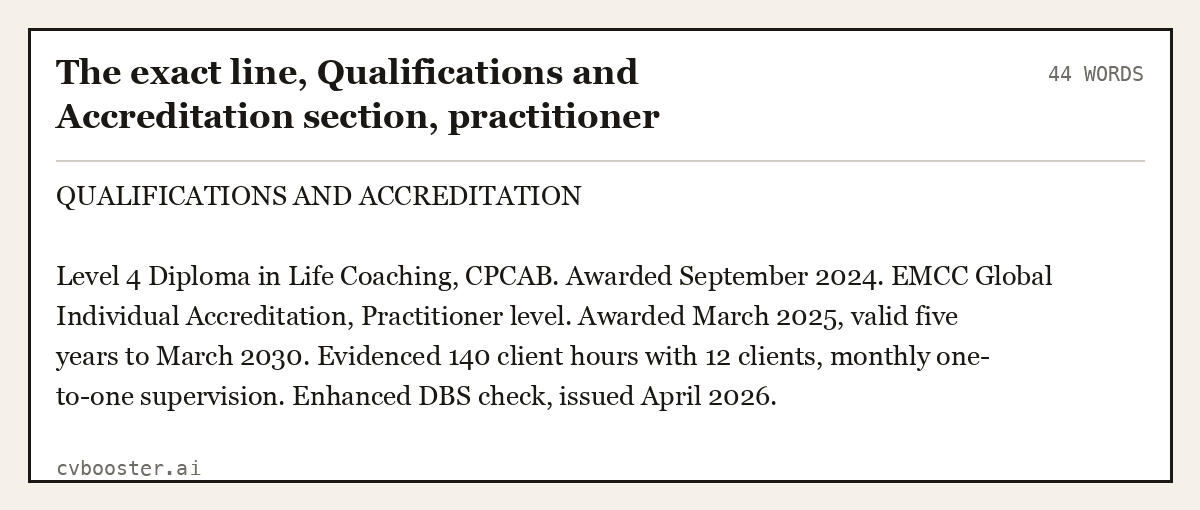
The exact line, Qualifications and Accreditation section, practitioner (44 words)
QUALIFICATIONS AND ACCREDITATION
Level 4 Diploma in Life Coaching, CPCAB. Awarded September 2024. EMCC Global Individual Accreditation, Practitioner level. Awarded March 2025, valid five years to March 2030. Evidenced 140 client hours with 12 clients, monthly one-to-one supervision. Enhanced DBS check, issued April 2026.
Four parts on each line: the award, the body, the level, the date. Client hours belong on the line too, because that is the number an accreditation panel counted.
What "certified" can mean when nobody regulates the job
Three different things get called certification, and they are not equal.
- A regulated qualification from an awarding organisation, delivered by a recognised centre and externally assessed.
- An accreditation from a coaching professional body, based on training, logged client hours and supervision.
- A course completion certificate from a private training company, sometimes described as accredited by a body that accredited nothing but the course.
The National Careers Service life coach profile is blunt about the route: "You could also work towards accreditation from a coaching professional body to improve your job prospects." It names one hard requirement for the work itself: "You'll need to: pass enhanced background checks."
So write which of the three you hold. A reader who has seen twenty coaching CVs can tell them apart.
The qualification names that hold up on a CV
Use the printed title, in full, with the level. CPCAB lists its awards as the Level 3 Certificate in Life Coaching Studies and the Level 4 Diploma in Life Coaching, and says the first "provides a solid foundation in life coaching practice and is also signposted to the relevant National Occupational Standards".
The apprenticeship route has a formal title too. The National Careers Service names it: "You could apply to do a Coaching Professional Level 5 Higher Apprenticeship." Write that, not "coaching apprenticeship".
Never abbreviate to "Level 3 life coaching". The level without the award title reads as a course bought online, which is sometimes exactly what it was.
Where the line goes, section by section
| Your situation | Where to put it | Why |
|---|---|---|
| Self-employed coach applying for contracts | Top block, above experience | It is the buyer's first screening question |
| Applying for an in-house coaching or L&D role | Qualifications section, plus one experience bullet | The employer wants hours and supervision, not the badge |
| Career changer, still in another job | Qualifications section, under a one-line practice summary | It explains a gap in the sector, not in your CV |
| Diploma in progress | Qualifications section, marked in progress with the completion date | Honest, and it answers the screening question |
| Coaching as one part of a wider role | One line at the foot of the skills block | Relevant, not the headline |
Accreditation levels, and the renewal date to put on the line
Accreditation levels are countable, which is why they beat adjectives. EMCC Global publishes the minimum requirements for its four Individual Accreditation levels: Foundation needs "a minimum of one year's experience coaching or mentoring, 50 client hours and five clients", Practitioner covers those who "have been practising for at least three years, with 100 client hours and 10 clients", and Senior Practitioner is "a five-year practice, 250 client hours and 20 clients".
The renewal period is published and short enough to matter: "Your EIA accreditation is valid for five years. Two months before it expires, you will receive a reminder email from us with details of what you need to do."
Put that expiry date on the line. It tells the reader the accreditation is live, which almost no coaching CV bothers to prove.
One more fact worth a clause: EMCC UK states that "Accreditation and membership with EMCC are separate, with separate fees". Membership is not accreditation. Write whichever you hold.
Six worked lines by level and template
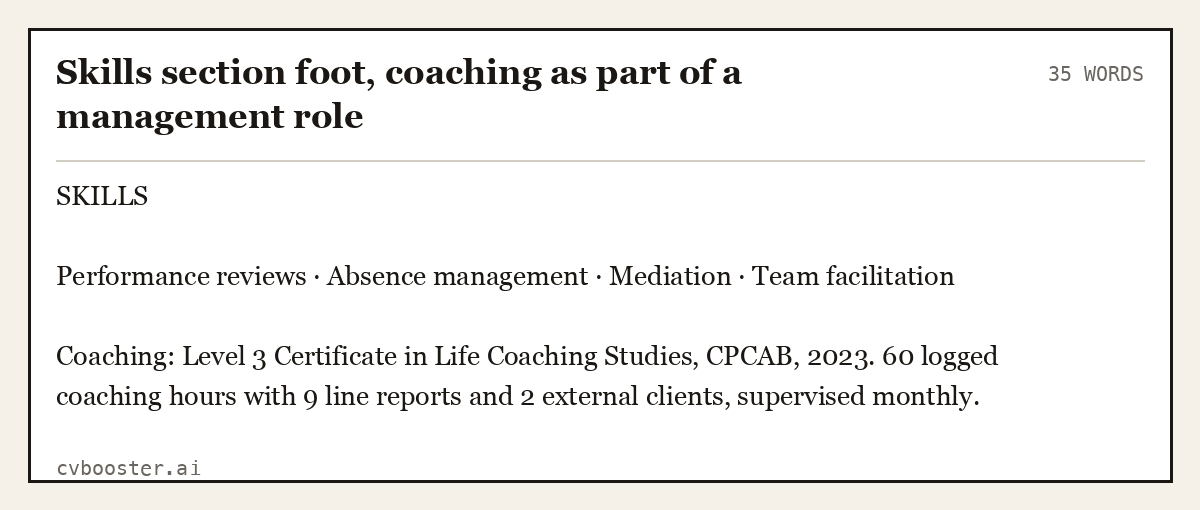
Skills section foot, coaching as part of a management role (35 words)
SKILLS
Performance reviews · Absence management · Mediation · Team facilitation
Coaching: Level 3 Certificate in Life Coaching Studies, CPCAB, 2023. 60 logged coaching hours with 9 line reports and 2 external clients, supervised monthly.
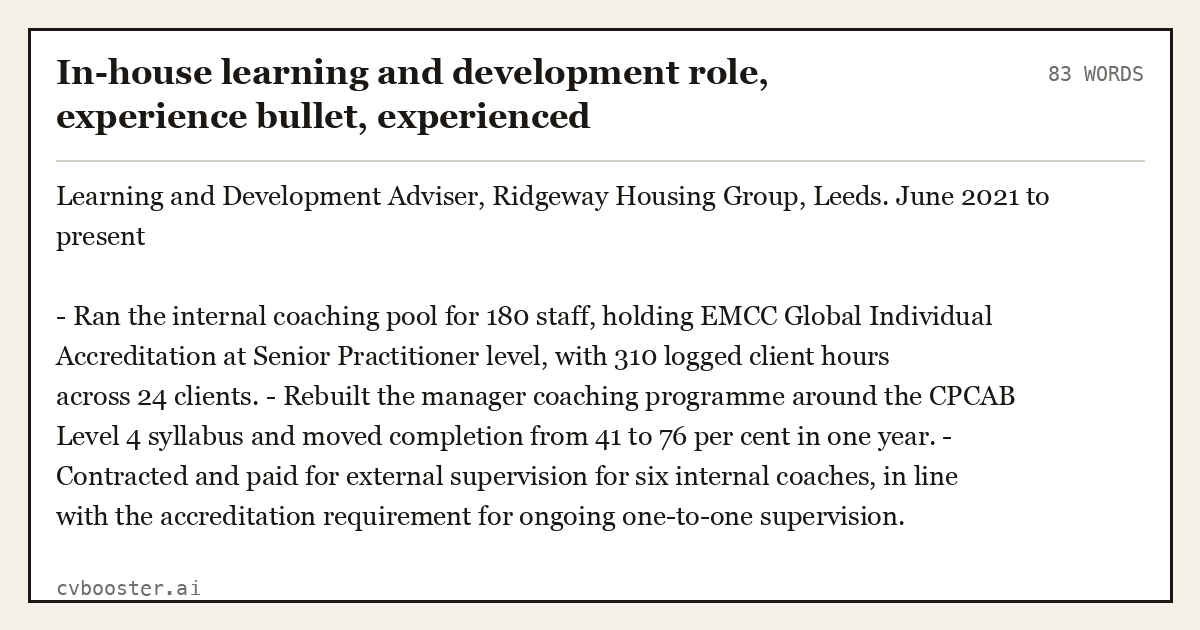
In-house learning and development role, experience bullet, experienced (83 words)
Learning and Development Adviser, Ridgeway Housing Group, Leeds. June 2021 to present
- Ran the internal coaching pool for 180 staff, holding EMCC Global Individual Accreditation at Senior Practitioner level, with 310 logged client hours across 24 clients. - Rebuilt the manager coaching programme around the CPCAB Level 4 syllabus and moved completion from 41 to 76 per cent in one year. - Contracted and paid for external supervision for six internal coaches, in line with the accreditation requirement for ongoing one-to-one supervision.
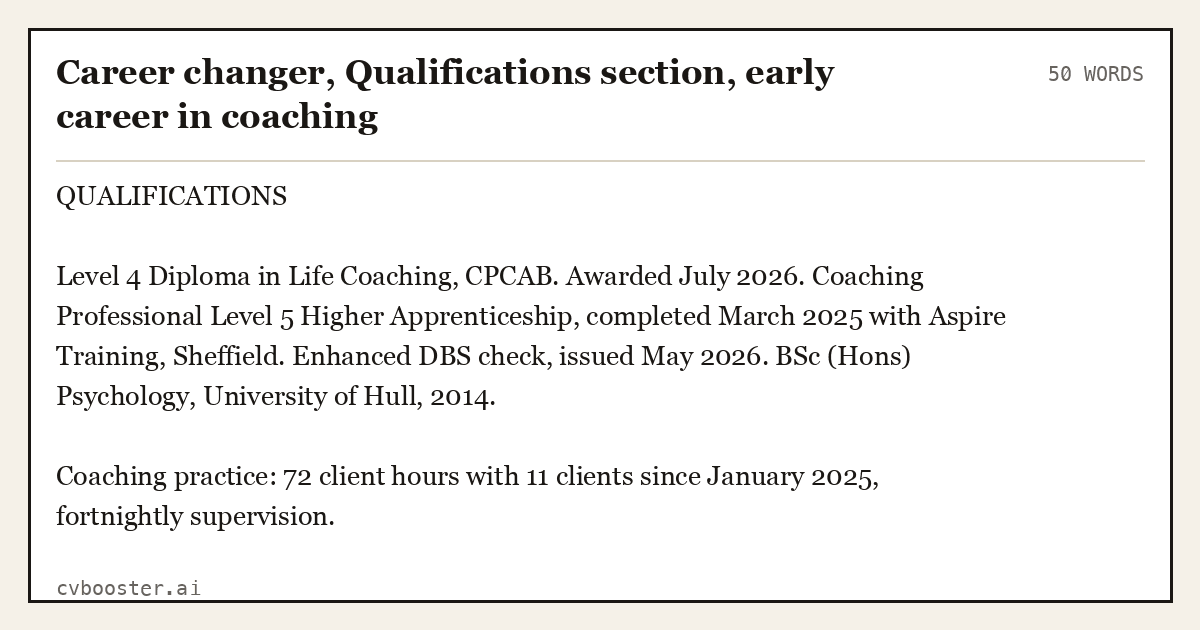
Career changer, Qualifications section, early career in coaching (50 words)
QUALIFICATIONS
Level 4 Diploma in Life Coaching, CPCAB. Awarded July 2026. Coaching Professional Level 5 Higher Apprenticeship, completed March 2025 with Aspire Training, Sheffield. Enhanced DBS check, issued May 2026. BSc (Hons) Psychology, University of Hull, 2014.
Coaching practice: 72 client hours with 11 clients since January 2025, fortnightly supervision.
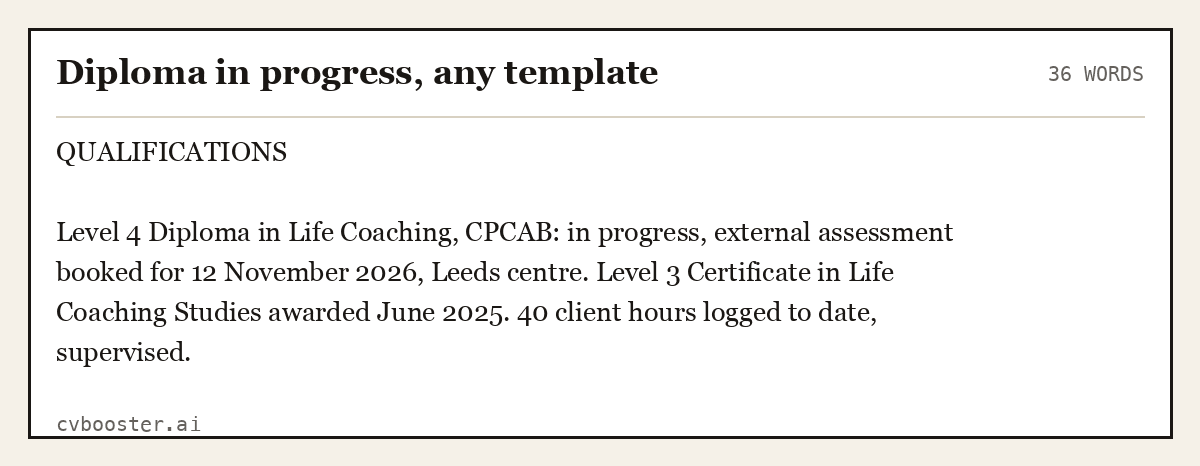
Diploma in progress, any template (36 words)
QUALIFICATIONS
Level 4 Diploma in Life Coaching, CPCAB: in progress, external assessment booked for 12 November 2026, Leeds centre. Level 3 Certificate in Life Coaching Studies awarded June 2025. 40 client hours logged to date, supervised.
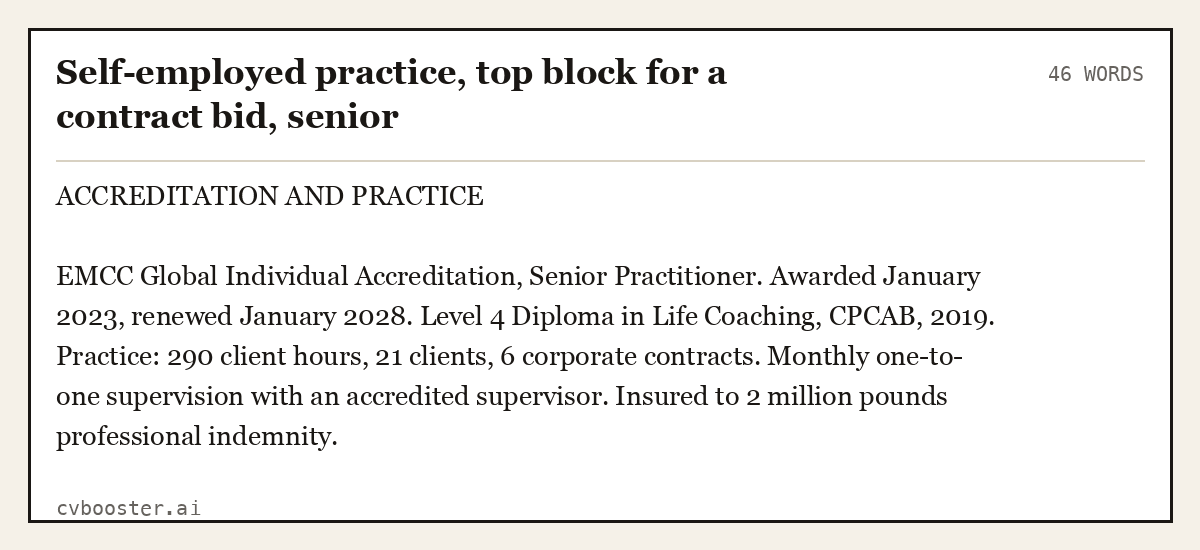
Self-employed practice, top block for a contract bid, senior (46 words)
ACCREDITATION AND PRACTICE
EMCC Global Individual Accreditation, Senior Practitioner. Awarded January 2023, renewed January 2028. Level 4 Diploma in Life Coaching, CPCAB, 2019. Practice: 290 client hours, 21 clients, 6 corporate contracts. Monthly one-to-one supervision with an accredited supervisor. Insured to 2 million pounds professional indemnity.
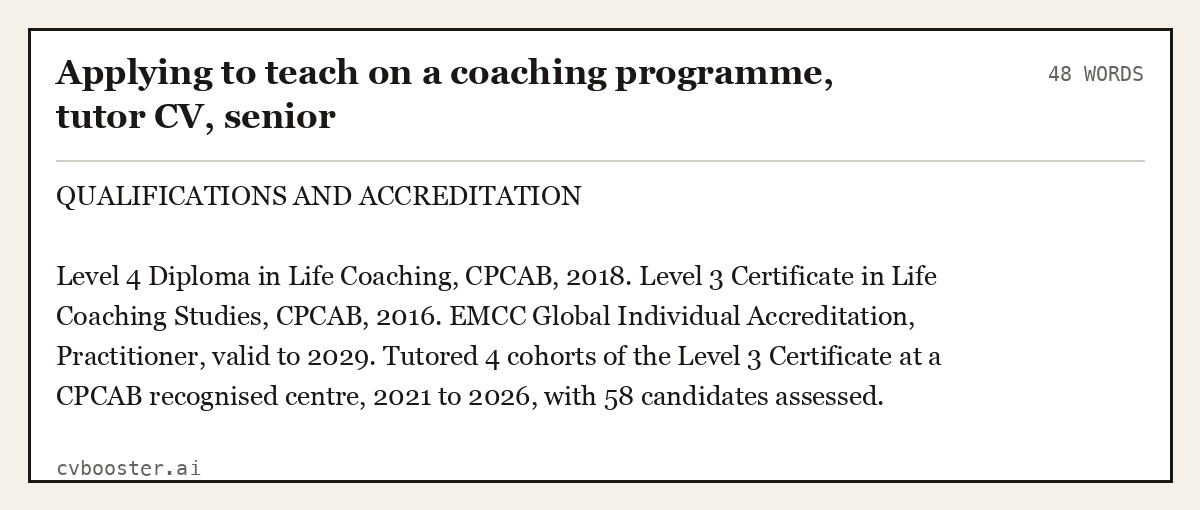
Applying to teach on a coaching programme, tutor CV, senior (48 words)
QUALIFICATIONS AND ACCREDITATION
Level 4 Diploma in Life Coaching, CPCAB, 2018. Level 3 Certificate in Life Coaching Studies, CPCAB, 2016. EMCC Global Individual Accreditation, Practitioner, valid to 2029. Tutored 4 cohorts of the Level 3 Certificate at a CPCAB recognised centre, 2021 to 2026, with 58 candidates assessed.
Notice what changes. The manager keeps it to one skills line with hours attached. The self-employed bid leads with accreditation and insurance, because a buyer checks those first. The tutor CV names the centre, since the centre is what CPCAB recognises.
What we could not verify here
The International Coaching Federation site returned a 403 to our fetch on 12 September 2026, so this page does not quote its credential names, fee or renewal period. If you hold an ICF credential, take the exact designation, the award date and the renewal date from your own certificate and from the ICF account that issued it, and write them in the same four-part shape used above.
Mistakes that lose the client or the job
- Writing "certified life coach" with no body and no level. It is the one phrase every unverified CV uses.
- Calling a course completion certificate an accreditation.
- Naming a membership instead of an accreditation, when the two have separate fees.
- Leaving off client hours. They are the only number in this field that a panel counted.
- Letting an expired accreditation sit undated on the page.
Once the qualifications block is right, work outwards with our guides to the skills section, the professional summary and how to make a CV. Career changers should read the career change CV guide before rewriting the top of the page.
Frequently asked questions
Is life coaching regulated in the UK?
No. The National Careers Service states that life coaching is not regulated in the UK, so anyone can work as a life coach. That is why the awarding body and the accreditation level carry the weight on your CV, and why enhanced background checks are still required for work with vulnerable clients.
What qualifications do you need to be a life coach?
None are legally required, but employers and corporate buyers look for a regulated qualification plus body accreditation. CPCAB awards the Level 3 Certificate in Life Coaching Studies and the Level 4 Diploma in Life Coaching. The Coaching Professional Level 5 Higher Apprenticeship is the paid route into the same work.
Which life coach certification is recognised?
Recognition comes from the awarding organisation or the professional body, not from the training company's own wording. CPCAB qualifications are delivered through recognised centres, and EMCC Global accreditation is assessed against published client-hour minimums. Ask any provider which body awards the certificate and which body accredits the course.
How long does accreditation last?
EMCC Global states that an Individual Accreditation "is valid for five years", with a reminder email two months before expiry. Qualifications such as the CPCAB diploma do not expire, so put the award year on those and the expiry date on the accreditation. That single date shows the reader your practice is current.
How many client hours do you need?
It depends on the level. EMCC Global sets 50 client hours and five clients for Foundation, 100 hours and 10 clients for Practitioner, and 250 hours and 20 clients for Senior Practitioner, each alongside a minimum practice length, continuing professional development and ongoing one-to-one supervision.
More in this series: Certifications on a CV
- Careers With Certification: 7 Jobs and the Resume Line
- Certification for Office Managers: 6 Lines That Get Read
- Certifications for Jobs: 7 With the Exact Resume Line
- Forklift Licence on a CV: the Exact Line and 6 Examples
- How to Add CPR Certification to a Resume: 5 Examples
- How to Put CPR Certification on a Resume: 6 Examples
- Industry Certification on a Resume: 8 Sector Examples
- Licensed Practical Nurse Resume: 6 Examples in Canada
- Server Certification on a Resume: 6 Worked Examples
- Technician Certificate on a Resume: 6 Worked Examples
Related articles
- Forklift Licence on a CV: the Exact Line and 6 Examples
- Certification for Office Managers: 6 Lines That Get Read
- How to Add CPR Certification to a Resume: 5 Examples
- How to Put CPR Certification on a Resume: 6 Examples
More articles
- LinkedIn Profile vs Resume: What Changes
- Making Effective Decisions: 4 Civil Service Examples
- Managing a Quality Service: 4 Worked Examples, EO to G7
Looking for a worked example for your job title? Browse the resume examples by job title.