Head Coach Resume Examples: free ATS score and gap list
Craft a Head Coach Resume That Reads Like Program Leadership
By Mustafa Tarabya, founder of CVBooster · Published · Updated
Head coach resume example covering staff management, budget, recruiting, season results and the leadership keywords hiring committees look for.
Sample resumes for a head coach
The same head coach content laid out in three CVBooster templates, so you can see what the finished document looks like before you write a word.
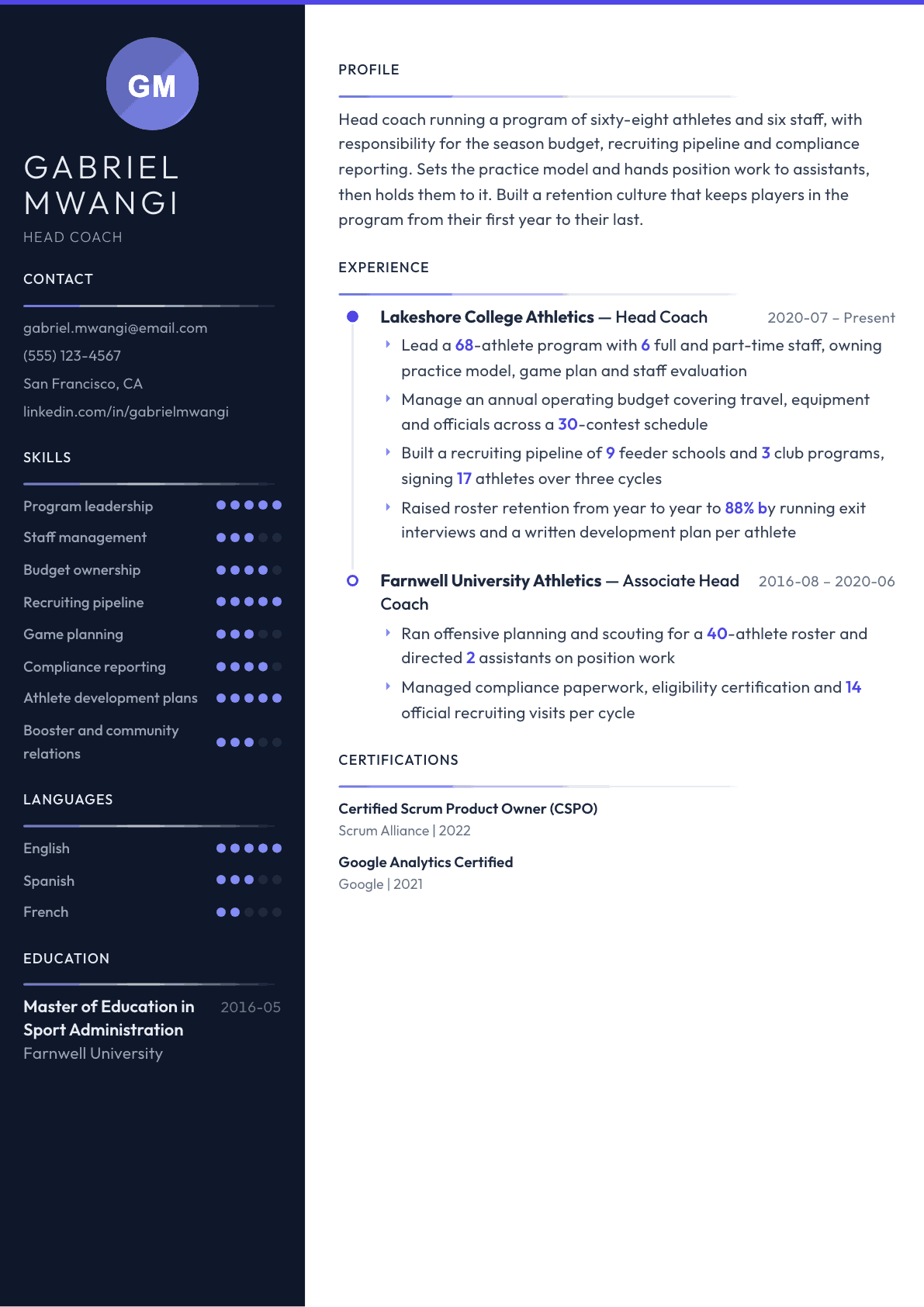
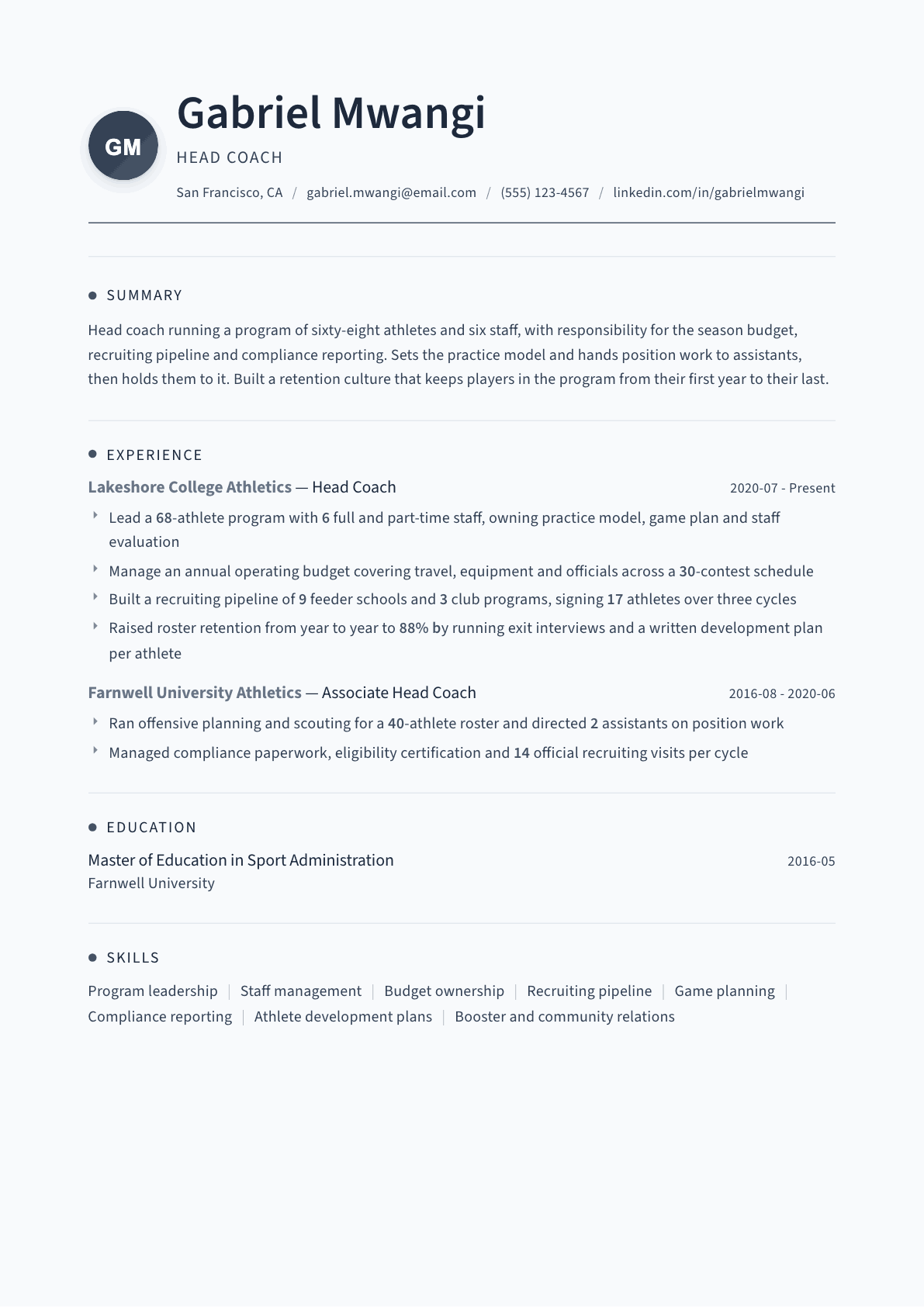
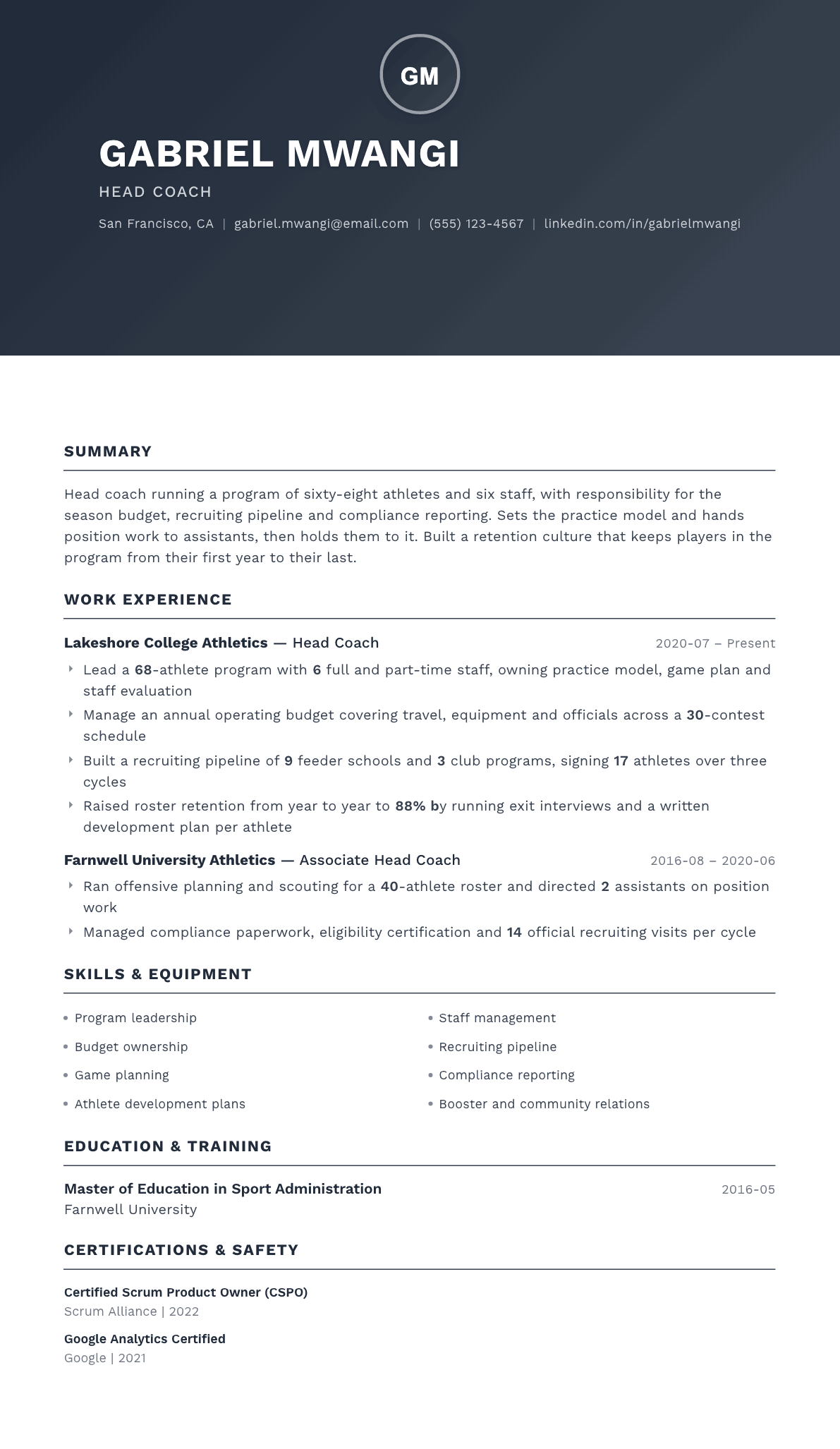
Example Head Coach summary
Head coach responsible for a sixty-eight athlete program, six staff and a full operating budget across a thirty-contest season. Sets the practice model, evaluates assistants, and owns recruiting through nine feeder schools and three club programs. Lifted year-to-year roster retention through written development plans and exit interviews. Seeking a head coaching position at a program investing in staff and facilities.
Skills to list on a Head Coach resume
- Program leadership
- Coaching staff management
- Budget ownership
- Recruiting pipeline
- Game planning
- Scouting and opponent analysis
- Compliance and eligibility
- Athlete development plans
- Retention and exit interviews
- Camp and clinic operations
- Booster relations
- Travel and contest scheduling
- Staff evaluation
- Media and community relations
What actually gets this resume read
- Open with program scope: roster size, staff headcount, budget responsibility and the number of contests per season.
- Split leadership from tactics, because a hiring committee wants to see that you can run staff and not only practices.
- Give recruiting numbers as a pipeline: feeder schools, visits hosted and athletes signed across cycles, not one headline signing.
- Report retention alongside win totals, since keeping athletes in the program is what athletic directors ask about second.
- Name your compliance and safety duties directly, because eligibility certification and safety training are non-negotiable checkpoints.
- Include community-facing work such as camps, booster meetings and alumni events, which often funds the program you would inherit.
How to write a head coach resume
A head coach search is run by a committee, not one person. There is usually an athletic director, a senior administrator, sometimes an alumni or booster representative, and each of them reads for something different: program leadership, compliance risk, fundraising potential and whether athletes will stay. A resume that only demonstrates tactical knowledge satisfies none of them.
The core shift when you write for a head coach job is that you are no longer the person who coaches a position group. You are the person who hires, evaluates and sometimes releases the people who do. You own a budget, a recruiting calendar, a compliance file and the relationship with everyone who funds the program. The page has to show that scope before it shows a philosophy.
What follows covers how to state program scope, how to write staff leadership and recruiting as systems rather than anecdotes, where results belong, and the questions coordinators and associate head coaches ask when they put together their first head coaching application.
Format: program scope before philosophy
Two pages is normal at this level and expected once you have led a program. Reverse-chronological. Under each head coaching title, put a scope line: roster size, coaching and support staff headcount, contests per season, operating budget responsibility and the division or league. A committee sorts by scope, and a candidate who omits it gets sorted downward by default.
Keep any coaching philosophy statement short and put it in the summary or a cover letter. Committees interview philosophy. They screen scope, results and compliance history, and a page of beliefs at the top delays everything they came to find.
- Scope line: roster size, staff headcount, contests per season, budget responsibility, league or division.
- Section order: summary, head coaching experience, assistant and coordinator roles, administrative and compliance duties, education, certifications.
- Keep a short results block with season records, postseason appearances and any team academic recognition.
Staff leadership: the section that separates head coaches
Write hiring and development like a manager. Assistants hired, how you divided responsibility across the staff, what a coaching evaluation looks like in your program, and which of your assistants went on to bigger jobs. That last detail is the strongest evidence a committee can get that you develop people rather than merely direct them.
Add the delegation model. Who owns the scouting cycle, who runs the individual periods, who handles travel and equipment, how you run a staff meeting during a heavy week. A committee is trying to picture your Monday, and a delegation model lets them.
Recruiting and roster construction as a system
Present recruiting as a pipeline with volume at each stage rather than as a list of good athletes you landed. Feeder schools and club programs in your network, evaluations logged, visits hosted, offers made and athletes signed across cycles. Committees want to know the machine works without you personally driving to every gym.
Roster construction is the other half. How you balance classes so graduation does not gut a position, how transfers fit, and how you decide when to develop rather than replace. Then retention: the share of athletes who stay from one year to the next, exit interview practice, and written development plans that give an athlete a reason to stay.
- Give recruiting as a funnel with numbers at more than one stage.
- Name the compliance steps you personally own, including eligibility certification and recruiting rules education for staff.
- Report year-to-year retention alongside signings, because a committee reads them together.
Budget, fundraising and community work
Say what you controlled: travel, equipment, officials, camp revenue, and how you handled a shortfall without cutting the season. Head coaches who can describe a budget conversation are far easier to hand a program to than head coaches who have only requested things from one.
Community and fundraising work belongs next to it. Camps and clinics run, booster meetings, alumni events, youth outreach, media appearances and the season ticket or attendance work you supported. In many programs this activity is what funds the assistants you want to hire.
Results, compliance and the keywords committees use
Keep results factual: season records, postseason appearances, conference finishes, team grade point average and graduation or eligibility outcomes. Academic results carry real weight with administrators, so give them equal billing rather than tucking them at the end.
The vocabulary in these postings is consistent: program leadership, staff management, budget administration, recruiting, compliance, student athlete welfare, retention, community relations and game strategy. Mirror each in a place where the work is demonstrated, and never in a list at the bottom of the page.
Head Coach resume summary examples
First head coaching role
Associate head coach stepping into a first head coaching position after four years running offensive planning, scouting and a recruiting territory for a 40-athlete roster. Directed two assistants, managed compliance paperwork and hosted 14 official visits per cycle. Seeking a program to lead and build.
Head coach, four seasons
Head coach of a 68-athlete program with 6 staff, an annual operating budget and a 30-contest schedule. Built a recruiting pipeline across 9 feeder schools and 3 club programs, signed 17 athletes over three cycles, and raised year-to-year roster retention to 88%.
Veteran program leader
Veteran head coach with twelve seasons leading two programs, including a rebuild from a 12-athlete roster to a full squad with a complete coaching staff. Has developed four assistants into head coaching positions and runs a camp calendar that funds two part-time staff lines.
Work experience bullets: before and after
Before: Served as head coach and led the team.
After: Led a 68-athlete program with 6 full and part-time staff across a 30-contest schedule, owning the practice model, game plan, staff evaluation and the operating budget.
A scope line lets a committee compare you against other head coaching candidates in a single glance.
Before: Hired and managed assistant coaches.
After: Hired 4 assistants, split scouting, individual periods and travel between them, and ran a written midseason evaluation with each one; two later moved into head coaching roles.
Hiring plus a delegation model plus staff outcomes is the clearest proof of leadership a committee can read.
Before: Recruited student athletes for the program.
After: Built a recruiting pipeline across 9 feeder schools and 3 club programs, logged evaluations in the department database, hosted 14 visits a cycle and signed 17 athletes over three cycles.
Numbers at several stages of the funnel show a system rather than a handful of personal relationships.
Before: Improved team retention and culture.
After: Raised year-to-year roster retention to 88% by running exit interviews every spring and writing an individual development plan for each returning athlete.
Culture becomes measurable when it is expressed as retention with the two practices that produced it.
Before: Managed the team budget and fundraising.
After: Administered an annual operating budget covering travel, equipment and officials, and ran a summer camp calendar whose revenue funded two part-time coaching lines.
Naming what the budget covers and what the fundraising paid for shows financial stewardship, not just involvement.
Hard skills
- Program leadership
- Coaching staff hiring and evaluation
- Budget administration
- Recruiting pipeline management
- Roster and class construction
- Game planning and in-contest strategy
- Scouting and opponent analysis
- Compliance and eligibility certification
- Athlete development planning
- Retention and exit interviews
- Camp and clinic operations
- Travel and contest scheduling
- Booster and alumni relations
- Media and public speaking
Soft skills
- Delegation
- Staff development
- Difficult conversations
- Public representation of a program
- Decision making under scrutiny
- Long-horizon planning
Certifications worth listing
- Certified Interscholastic Coach (CIC) (National Federation of State High School Associations)
- SafeSport Trained (U.S. Center for SafeSport)
- Basic Life Support for Healthcare Providers (American Heart Association)
Mistakes that cost head coach candidates the interview
- Opening with a coaching philosophy essay when the committee is screening for scope, results and compliance history.
- Describing the team without ever naming staff headcount, budget responsibility or contests per season.
- Presenting recruiting as a few standout signings instead of a pipeline with volume at each stage.
- Omitting academic results, which administrators on the committee often weigh as heavily as the win column.
- Failing to show what happened to your assistants, which is the clearest available evidence of leadership.
- Treating compliance as assumed, when a clean eligibility and rules record is a deciding factor at every level.
Head Coach resume questions
How long should a head coach resume be?
Two pages is standard and appropriate once you have led a program, with a short results block and a full account of staff, budget and recruiting responsibility. Three pages is acceptable only for long careers with multiple institutions.
Where do season records belong on a head coach resume?
In a compact results block near your head coaching entries, with records, postseason appearances, conference finishes and team academic outcomes together. Keeping them in one place stops the committee from hunting through bullets for the numbers.
How do I apply for a head coaching job from an assistant role?
Show every piece of head coaching work you already do: coordinating a side of the program, directing other assistants, owning a recruiting territory, handling compliance paperwork, and any contests you managed as acting head coach.
Should a head coach resume include fundraising?
Yes, especially at schools where the program budget depends on camps, booster support or community events. Name what you ran, how often, and what the money paid for, since a committee reads that as sustainable program funding.
What do search committees look for beyond winning?
Retention and eligibility, staff development, budget discipline, compliance history and community standing. Winning opens the conversation, but committees hire the candidate who looks least likely to create a problem they will have to manage.
Related resume examples
- Sports Coach Resume example
- Athletic Trainer Resume example
- Assistant Coach Resume example
- Athletic Coach Resume example
- Football Coach Resume example
- Golf Instructor Resume example