Soccer Coach Resume Examples: free ATS score and gap list
Soccer Coach Resume: How Strong Soccer Coaching Resumes Are Built
By Mustafa Tarabya, founder of CVBooster · Published · Updated
Soccer coach resume example with a sample team entry from strong soccer coaching resumes: licenses, session planning, formation language and keywords.
Sample resumes for a soccer coach
The same soccer coach content laid out in three CVBooster templates, so you can see what the finished document looks like before you write a word.
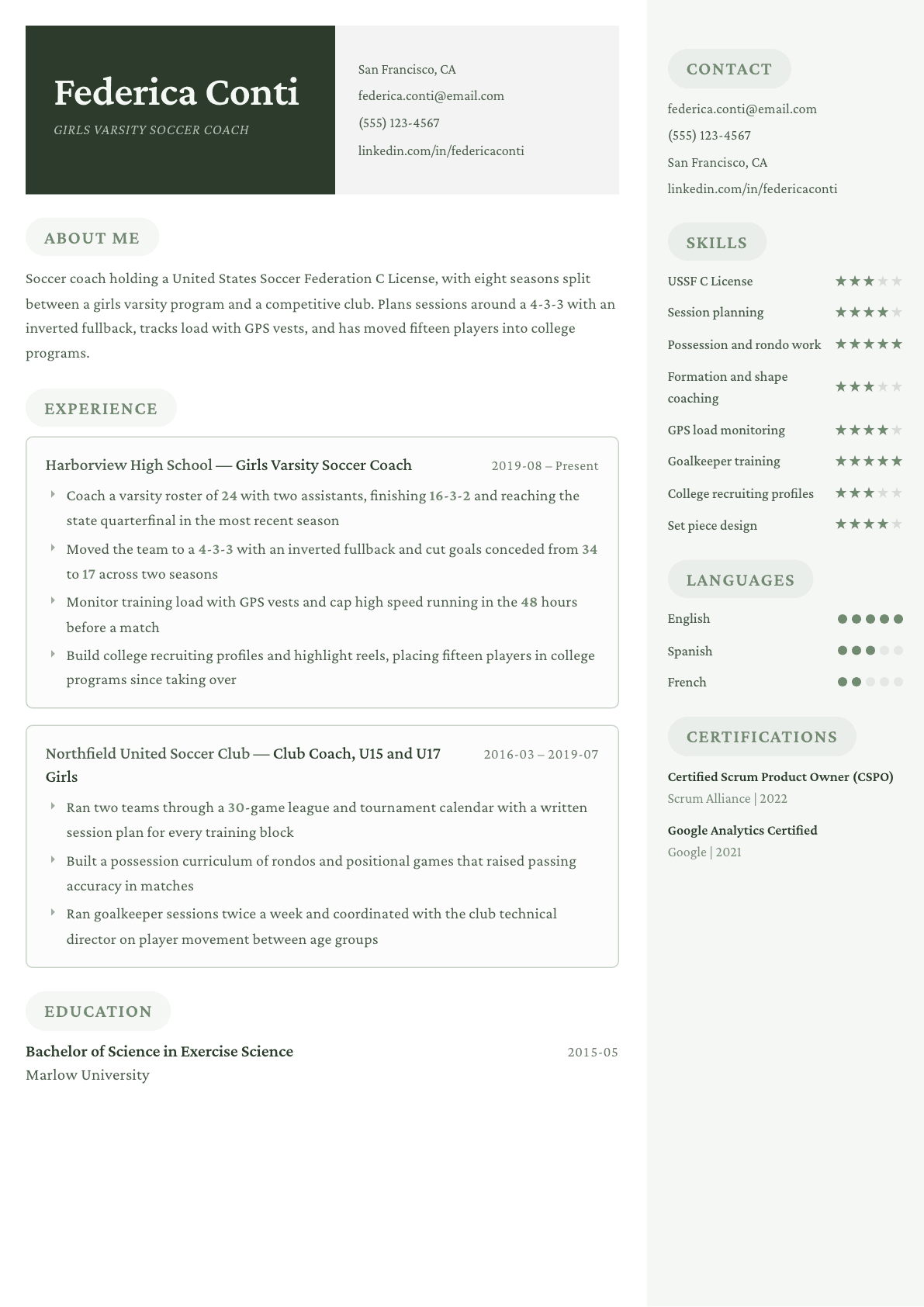
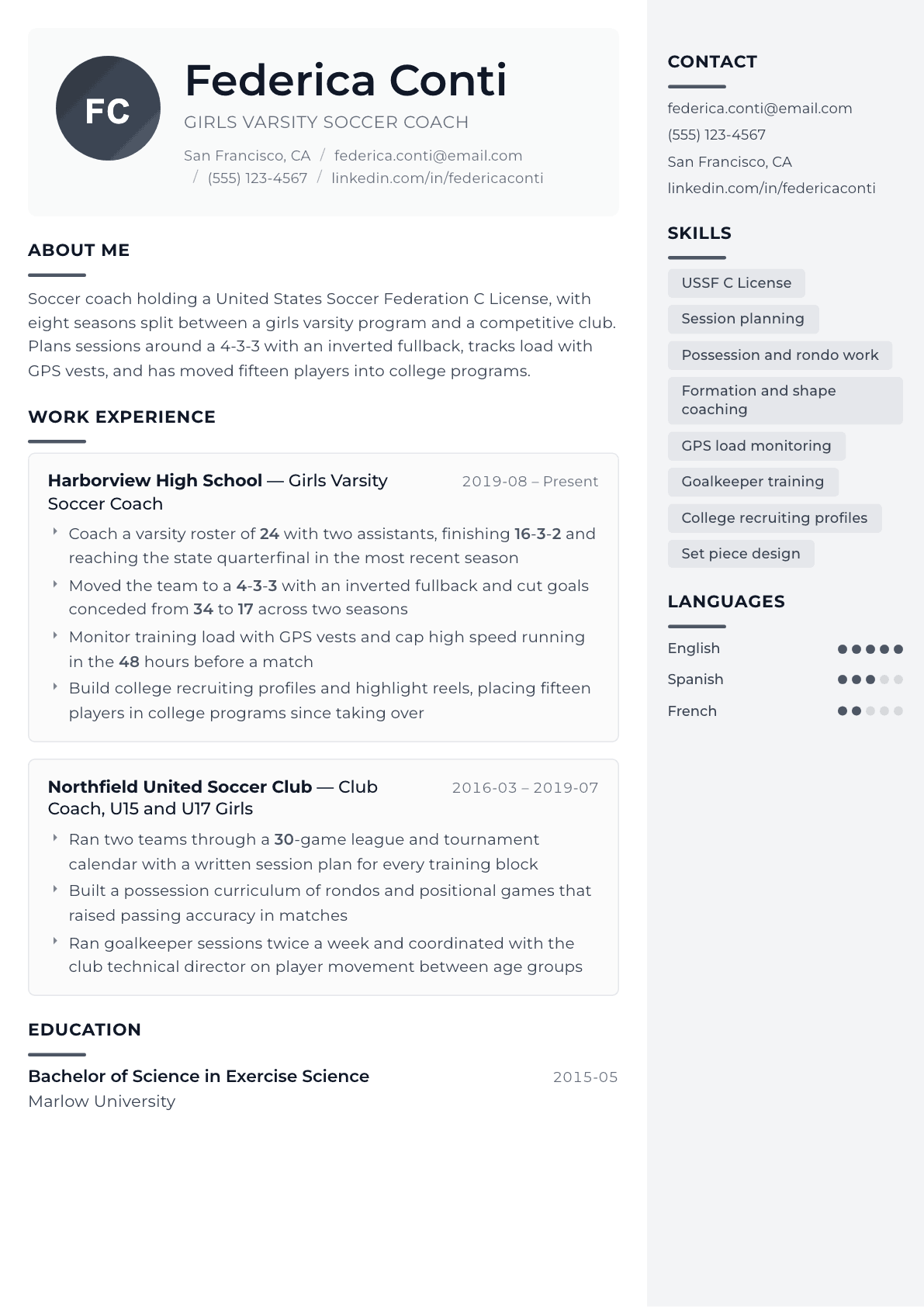
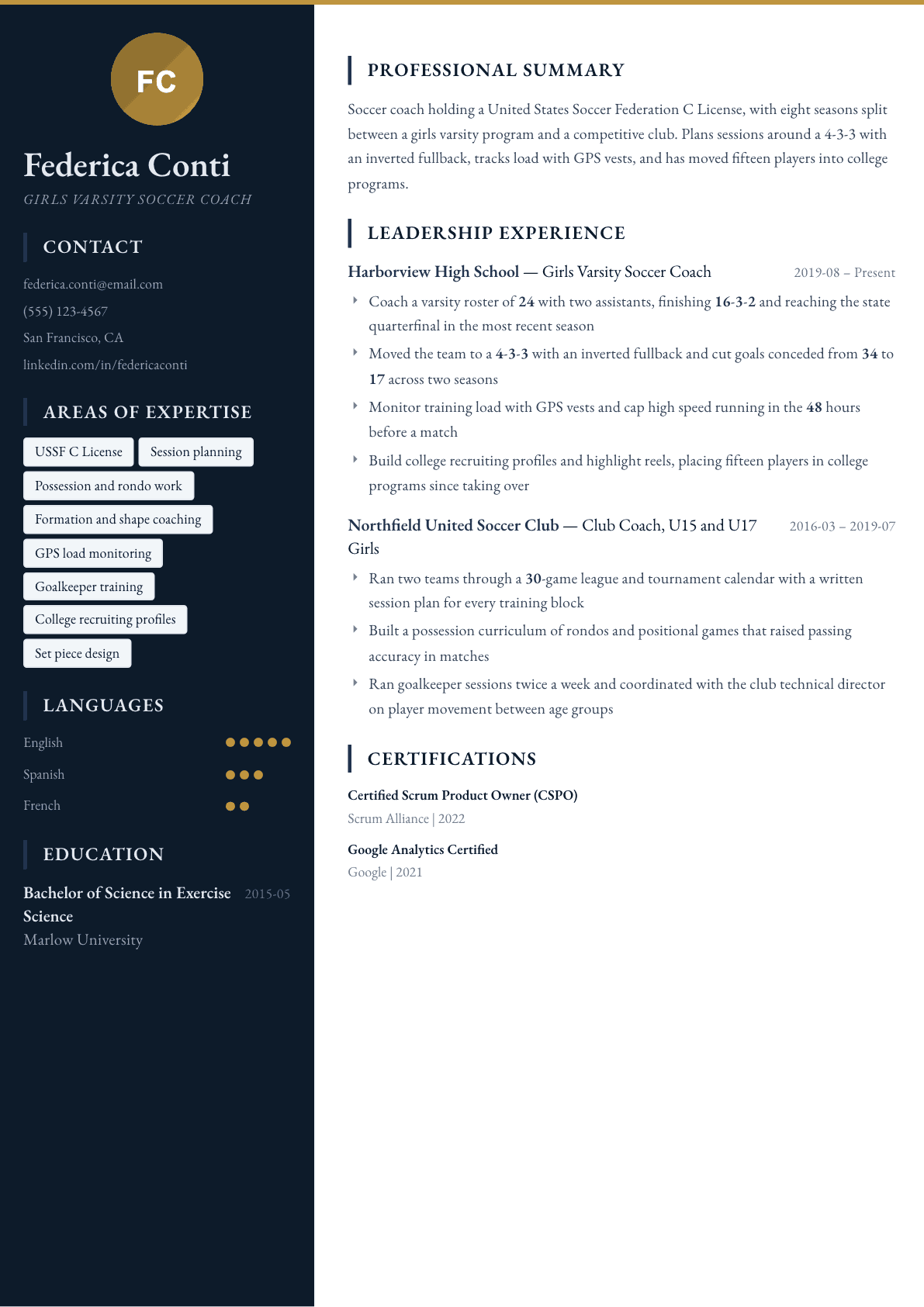
Example Soccer Coach summary
Soccer coach with a United States Soccer Federation C License and eight seasons across high school varsity and competitive club teams. Teaches a 4-3-3 with structured build-up patterns and a defined pressing trigger, plans every session in writing, and monitors training load with GPS vests. Has placed fifteen players into college programs and is looking for a club role with a clear pathway from youth to first team.
Skills to list on a Soccer Coach resume
- Session planning
- Formation and tactical shape
- Pressing and defensive organization
- Possession training
- Set piece design
- Goalkeeper coaching
- Player evaluation
- GPS and load monitoring
- Match analysis
- College recruiting support
- Tournament and travel logistics
- Parent communication
- Youth player pathway planning
- Referee and rules knowledge
What actually gets this resume read
- Put your coaching license and its issuing body in the header area, because clubs filter candidates on the license first.
- Describe the model you teach: formation, pressing trigger, build-up pattern, and what a training session actually looks like.
- Give each team the age group, gender, roster size and competitive level, since a U12 recreational job differs from a college one.
- Attach results to the season: record, goal difference, league finish, and how many players moved up an age group or level.
- Mention load monitoring, hydration rules and return to play work, because parents and directors ask about athlete safety.
- List the languages you coach in when the club serves a mixed community, as it widens the group you can reach.
How to write a soccer coach resume
Soccer hiring runs on licenses. Before a club director reads a word of your experience, she checks which coaching license you hold and who issued it, because the license decides which teams you may be assigned and what the club can tell parents. A resume that buries the license three quarters of the way down loses the reader in the first ten seconds.
After the license comes the model. Clubs and schools are choosing a way of playing, so a soccer coach resume has to name the formation, the build-up pattern, the pressing trigger and what a session actually contains. Writing that you develop players and build character does not distinguish you from any of the other applicants, all of whom wrote the same thing.
This guide covers the order a director reads in, three example summaries for a grassroots coach, a club coach and a technical lead, five rewritten bullets, a complete team entry showing how strong soccer coaching resumes are laid out, and the questions that come up when a coach applies across school, club and academy jobs at the same time.
Format: license block at the top, teams below it
Put a short credentials block immediately under the header: coaching license and issuing federation, safeguarding status, first aid, and any goalkeeping or fitness diploma. Everything else follows in reverse chronological order.
One page is fine for a coach with a handful of seasons. Two pages is normal once you have run multiple age groups, a school team and a club role at the same time, which is common in soccer and worth showing rather than compressing.
- Credentials block: license level and federation, safeguarding, first aid and CPR, any goalkeeper diploma.
- Each team entry: club or school, age group, gender, competitive level, roster size, seasons.
- A results line: league finish, record, cup rounds, players moved up an age group or into a college program.
- Then education, playing background if relevant, and languages you can coach in.
Summary: license, age groups, model of play
Three lines that answer the director's three questions. Which license, which ages and levels you have coached, and how your teams play. Add one distinguishing practice, such as load monitoring or a written session library, so the summary contains something a rival application will not.
A coach moving from recreational into competitive soccer should say so directly and name the transferable work: session planning, curriculum writing, tournament management, player evaluation. Directors are used to that move and respect a candidate who describes it honestly.
Experience: the team, the season, and the football
Open each entry with the team profile, because a U11 recreational side and a U17 elite team share a job title and nothing else. Age group, gender, level, roster size and number of training sessions per week give a director the whole picture in one line.
Then write about the football itself. Formation and the reason you chose it, how you build from the goalkeeper, what triggers the press, how you defend restarts and how you attack them. Set pieces deserve their own bullet, because they decide a large share of youth matches and most applicants ignore them entirely.
Finish each entry with development outcomes: players promoted to a higher team, called into a regional pool, or placed in a college program, plus the record and the league finish. Numbers matter here even in a development-first club, because a director still has to report results to a board.
Soccer coaching resumes that reach the interview give every team the same entry, so a director can compare a school season with a club season at a glance. The sample entry below is invented; keep the order and replace the details with your own.
- Head Coach, U16 Girls Premier team, a competitive youth club, four seasons. Roster of twenty, one assistant coach and a goalkeeper coach, four sessions a week.
- Model of play: 4-3-3 building from the goalkeeper through a back three in possession, a high press triggered by a backward pass, and set pieces rehearsed every Thursday.
- Results: promoted from the second division to the state premier league in season two and finished third in season four.
- Development: six players moved up to the club's top age group team, four called into the regional pool and five committed to college programs.
- Program: wrote the age group session curriculum, ran tryouts and player evaluations twice a season, and managed tournament entries and travel.
Session planning, load and player evaluation
Describe your planning rhythm. A written plan for every session, a curriculum that repeats across a season, a theme carried from Tuesday through Thursday into the weekend match. Say whether you use rondos, positional games or constraint-led design, and how you progress a session from a warm-up into a game realistic finish.
Then cover athlete management. Load monitoring with GPS vests or session rating, high speed running caps before a match, hydration rules, growth-related injury screening in adolescent players, and how you communicate a return to play with the medical staff. Parents ask about all of it and directors need a coach who has answers.
- Session library: themes, progressions, and how a week is built around the match.
- Analysis: what you review after a match and how the clips reach players.
- Load management: what you measure, and the rule that changes because of it.
- Player evaluation: the criteria you score on and how often families see them.
Licenses, safeguarding and administration
List each license with the issuing federation and any diploma or continuing education you have completed. Safeguarding and background screening belong here too, because a club cannot register a coach without them and a director likes to see the box already checked.
Add the administration you handle, which in club soccer is a substantial part of the job: registration, roster cards, tournament entries, travel and hotel blocks, uniform ordering, field and referee scheduling. Coaches who can run those without help save a club real staffing time.
Keywords in soccer job postings
Club and school postings reuse a small set of phrases: player development, curriculum delivery, age appropriate training, technical and tactical instruction, parent communication, tournament management, and the license level required. Mirror the exact words once high on the page and once inside a team entry.
Use the same spellings the posting uses for the sport and the competitions, because tracking systems match strings rather than meaning, and a director searching for a license level will not find a coach who wrote it a different way.
Soccer Coach resume summary examples
Grassroots coach
Grassroots licensed coach with two seasons leading a U10 recreational team and assisting a U13 competitive side. Plans every session in writing around small sided games, runs the club holiday camp and holds safeguarding and first aid certification. Seeking a paid club role with an age group of my own.
Club coach
C licensed soccer coach with six seasons across U15 and U17 girls teams, finishing top three in the state league twice. Teaches a 4-3-3 with defined build-up patterns and a pressing trigger, monitors training load with GPS vests and has moved nine players into college programs.
Technical lead
Technical director candidate with a B License and eleven seasons, currently overseeing eight teams, a written club curriculum and a staff of twelve coaches. Built the goalkeeper pathway, the coach education calendar and the player evaluation framework families receive twice a season.
Work experience bullets: before and after
Before: Coached a youth soccer team and improved their results.
After: Coached a U15 girls team of 22 through a 30-game league and cup season, finishing 16-3-2 after moving to a 4-3-3 with an inverted fullback.
Team profile, fixture volume, record and the tactical change give a director something concrete to judge.
Before: Ran training sessions twice a week.
After: Delivered four sessions a week from a written library of possession, pressing and transition themes, carrying one theme from Tuesday through Thursday into the weekend match.
A planning rhythm and named themes show a curriculum instead of an improvised evening on the field.
Before: Worked on defending as a team.
After: Cut goals conceded from 34 to 17 across two seasons by teaching a mid-block pressing trigger on the backward pass and rehearsing defensive restarts every Thursday.
The result is tied to a specific defensive principle and the session slot where it was trained.
Before: Helped players get recruited.
After: Built recruiting profiles and highlight reels for 15 players, contacted college staffs each fall and prepared families for the identification day calendar.
The recruiting work is described as a process with a count rather than a favor done occasionally.
Before: Kept players fit and healthy.
After: Monitored training load with GPS vests, capped high speed running in the 48 hours before a match and screened adolescent players for growth-related knee pain each month.
Three specific practices replace a general claim about fitness that any coach could make.
Hard skills
- Session design and progression
- Formation and tactical shape coaching
- Build-up and pressing principles
- Set piece design and rehearsal
- Goalkeeper technical training
- Match analysis and clip review
- GPS and training load monitoring
- Player evaluation frameworks
- Curriculum writing across age groups
- Tournament entry and travel planning
- Registration and roster administration
- College recruiting support
Soft skills
- Age appropriate communication
- Parent management
- Coach mentoring
- Match day composure
- Conflict resolution on the sideline
- Cultural and language inclusion
Certifications worth listing
- USSF Grassroots Coaching License (United States Soccer Federation)
- USSF C License (United States Soccer Federation)
- United Soccer Coaches Advanced National Diploma (United Soccer Coaches)
- SafeSport Trained (U.S. Center for SafeSport)
- Adult First Aid, CPR and AED (American Red Cross)
Mistakes that cost soccer coach candidates the interview
- Hiding the coaching license at the bottom of the page when it is the first filter a club applies.
- Describing teams only by age group without the gender, level or roster size.
- Writing that you play attacking soccer without naming a formation or a single principle behind it.
- Skipping set pieces and goalkeeper work, the two areas youth clubs are most often short on.
- Listing tournament attendance instead of what your team did there.
- Leaving out the administrative load you carry, which is a large share of any club coaching job.
- Using one page for eight seasons across school and club, which compresses the most valuable evidence into nothing.
Soccer Coach resume questions
Which coaching license should be on a soccer resume?
The highest one you hold, with the federation that issued it and the year you completed it kept in your records. If you are enrolled in the next level, say so as in progress, because directors plan assignments a season ahead.
Does my playing career help a soccer coaching application?
It helps at the margins. Give it two lines with the level and the years, then spend the page on coaching. Directors hire for session quality and player management, and a strong playing background does not predict either one.
How do I show tactical knowledge without writing an essay?
Pick three things and be exact: the formation, the build-up pattern, and the pressing trigger. Add one line on how you defend and attack set pieces. That gives a technical director enough to open a real conversation in the interview.
What do strong soccer coaching resumes have in common?
They put the license block at the top and give every team the same entry: age group, gender, level, roster and staff, model of play, results and player movement. School and club work sit in two separate blocks so overlapping seasons do not look like an error, and the administration a coach carries is listed rather than assumed.
What results matter most for a youth soccer coach?
Player movement first: promotions to higher teams, regional pool call ups and college placements. League finishes and records still belong on the page, but a development club will weigh where your players ended up more heavily than a trophy.
Related resume examples
- Sports Coach Resume example
- Personal Trainer Resume example
- Athletic Coach Resume example
- Strength and Conditioning Coach Resume example
- Referee Resume example
- Esports Player Resume example