Sports Coach Resume Examples: free ATS score and gap list
Build a Winning Sports Coach Resume
By Mustafa Tarabya, founder of CVBooster · Published · Updated
Craft a compelling sports coach resume that highlights your leadership, player development skills, and competitive results.
Sample resumes for a sports coach
The same sports coach content laid out in three CVBooster templates, so you can see what the finished document looks like before you write a word.
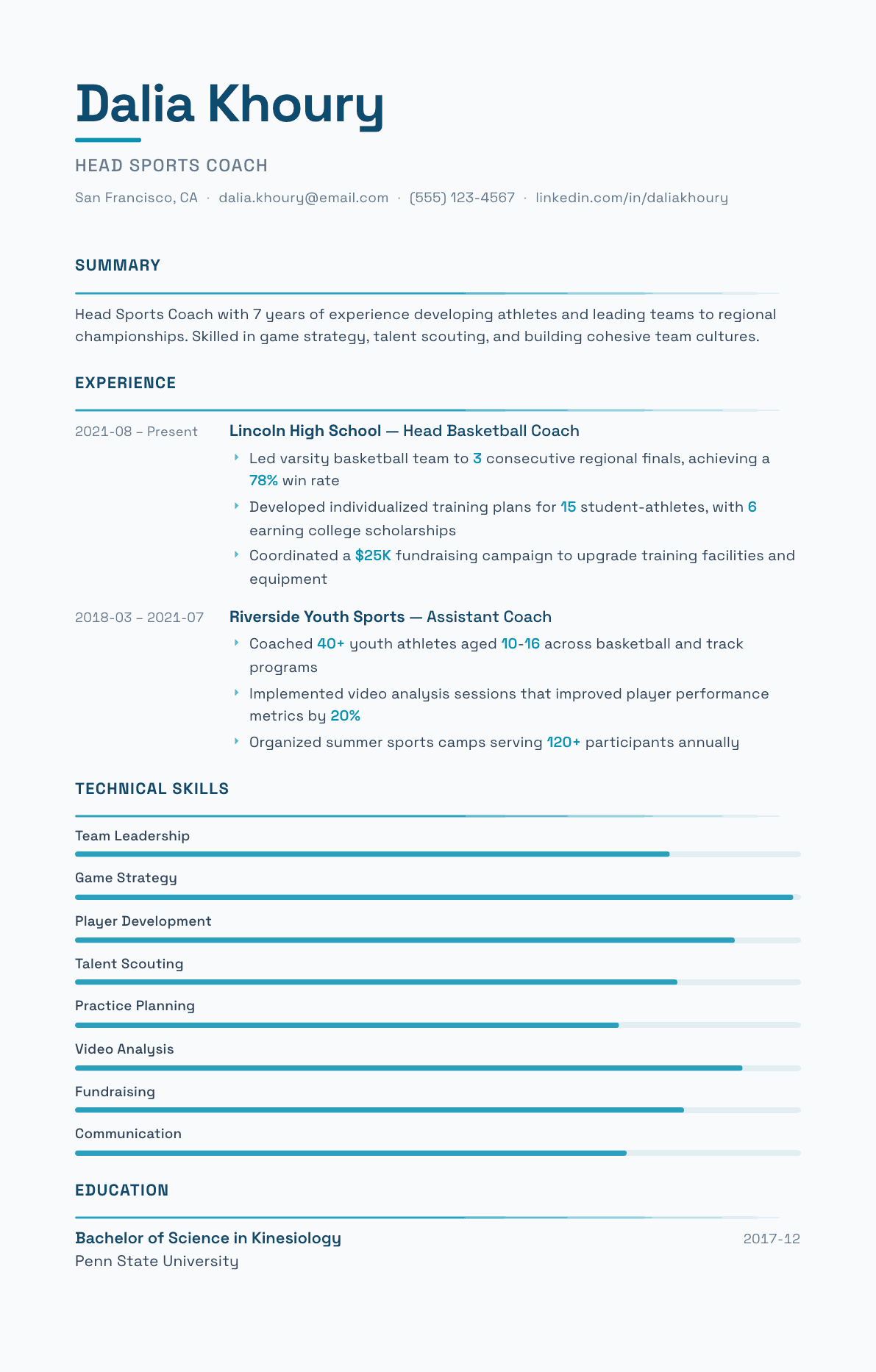
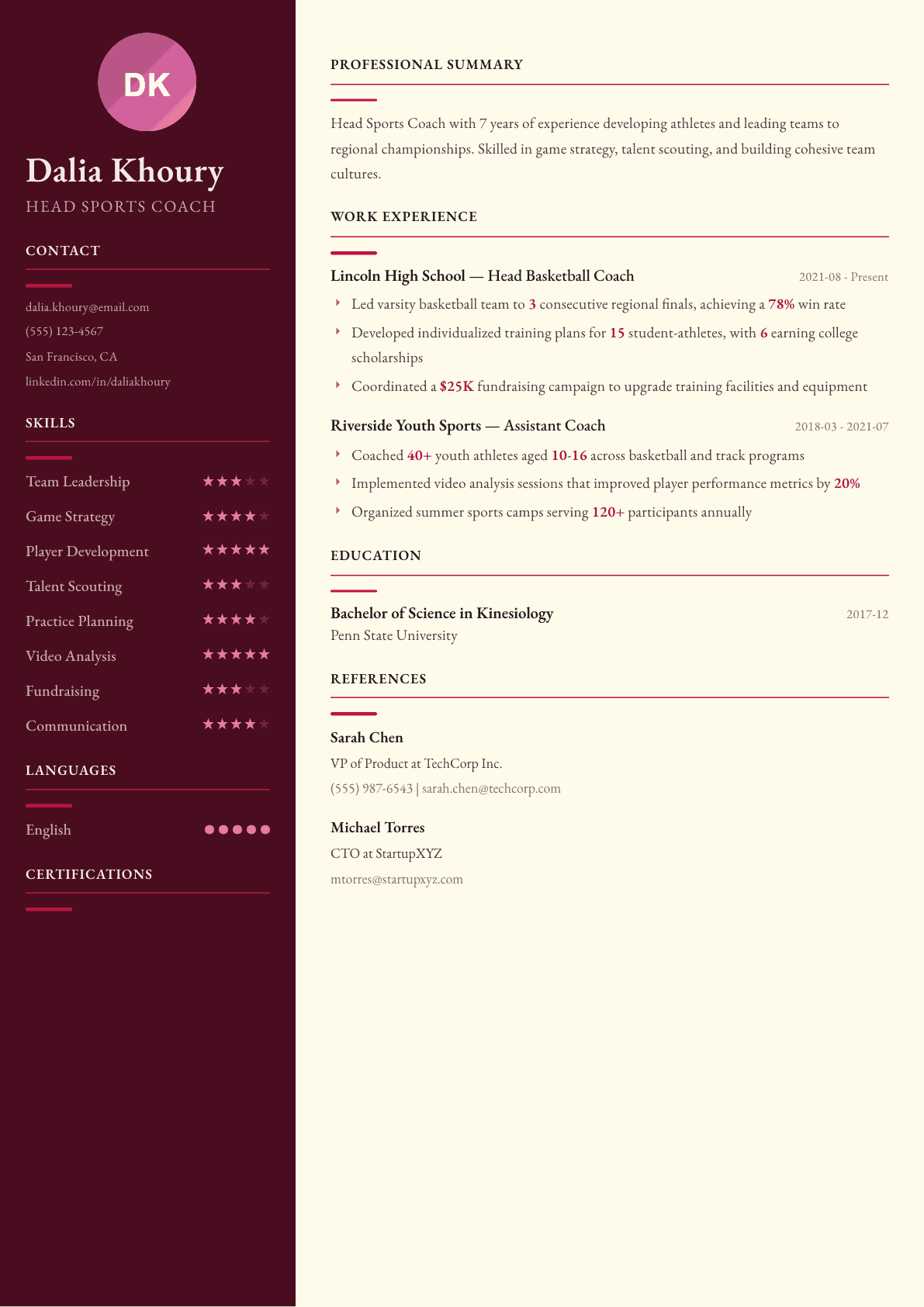
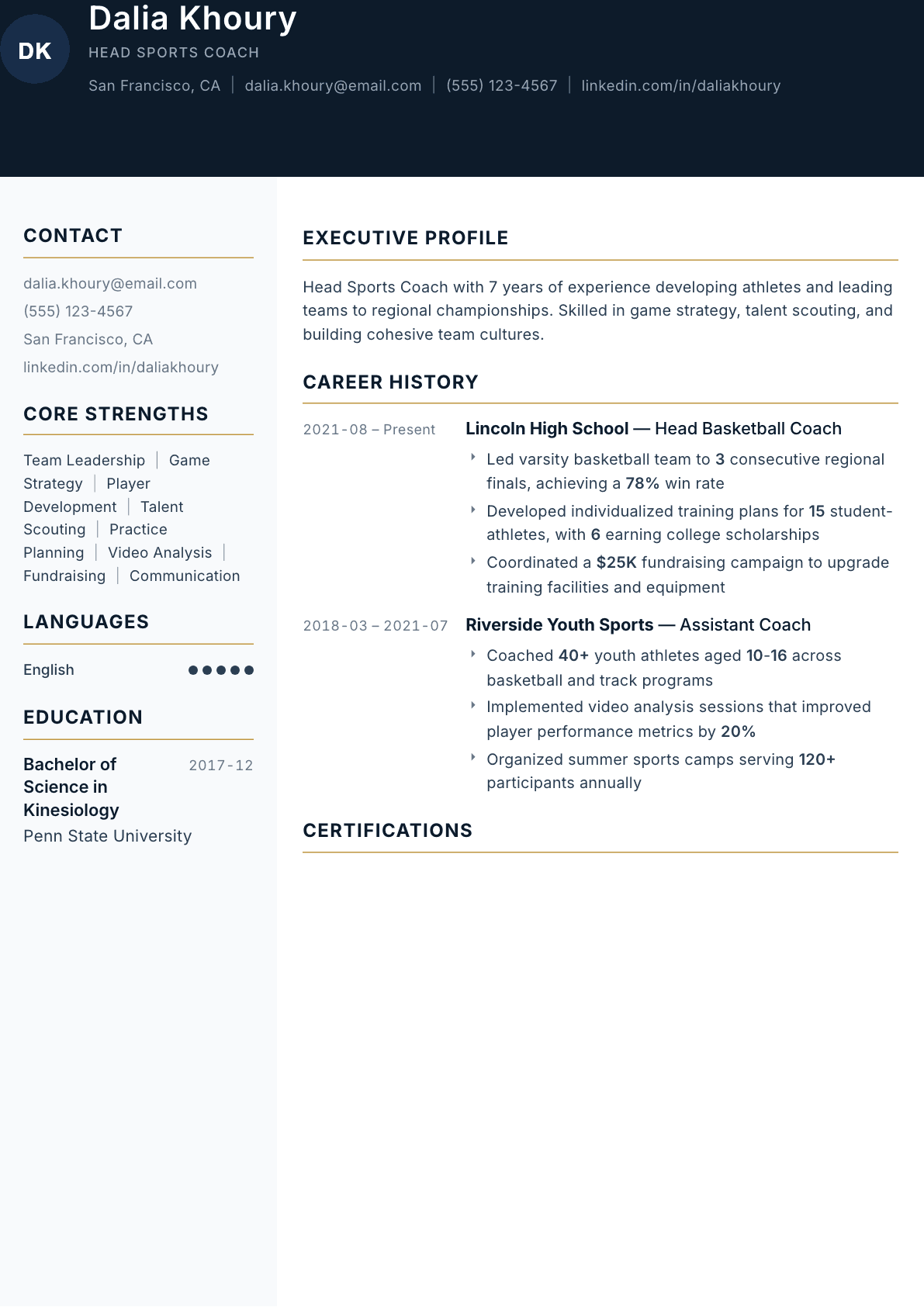
Example Sports Coach summary
Head basketball coach, 7 years across high school varsity and youth programs, with a 78% win rate and three straight regional finals. Six athletes have signed college scholarships out of the program, and a $25K fundraising campaign paid for the current strength and conditioning setup.
Skills to list on a Sports Coach resume
- Team Leadership
- Game Strategy
- Player Development
- Talent Scouting
- Practice Planning
- Video Analysis
- Strength & Conditioning
- Conflict Resolution
- Recruitment
- Budget Management
What actually gets this resume read
- Lead with your win-loss record and championship appearances to grab attention immediately.
- Showcase player development outcomes such as scholarship placements or career milestones.
- Include fundraising or budget management experience to demonstrate off-field leadership.
- Tailor your resume to the specific sport and level (youth, high school, collegiate) you are targeting.
How to write a sports coach resume
Coaching resumes are read by an athletic director, a club director or a school principal, and each of them is solving a slightly different problem. The athletic director wants a program that wins enough, graduates its players and never generates a parent complaint that reaches the superintendent. The club director wants coaches who fill rosters and keep families paying registration into the next season. All of them check the same two boxes first: are your background screening and safety courses current, and have you coached at the level you are applying to.
The mistake most coaches make is writing the resume as a highlight reel of results with no evidence of the work underneath. A win-loss record without practice planning, athlete development, roster management or compliance detail reads as luck. The reverse mistake is a page of philosophy with no record at all. A strong coaching resume carries both: what the program did while you ran it, and the specific systems that produced it.
This guide covers the section order for school, club and collegiate applications, what belongs in a coaching record block, how to write athlete development so it survives scrutiny, three summaries from an assistant to a head coach, before-and-after bullets, and the questions coaches ask when they apply.
Format: a coaching record block that a director can scan
Use reverse-chronological order and give the coaching record its own compact block near the top: sport, level, seasons, record, postseason results. Athletic directors read that block first and everything else second, so making them reconstruct it from four job entries costs you the read.
School applications are often submitted through a district portal alongside a teaching application, so keep the file plain text friendly and avoid tables. Club and collegiate applications go straight to a director and can carry a second page once you have five or more seasons as a head coach.
- Header: name, city and state, phone, email, and the sport plus level you coach.
- Sections in this order: summary, coaching record, coaching experience, certifications and clearances, playing background, education.
- Teachers applying to a combined teaching and coaching post keep the teaching license and endorsement visible, since the school hires the teaching line first.
- Assistant coaches name the head coach they worked under and the responsibilities they owned outright.
Summary: sport, level, seasons, and what your teams are known for
Name the sport, the level, the number of seasons and the thing your program does well. A coach known for defensive structure and a coach known for developing pitchers are two different hires, and a director reading fifty applications will remember the one who said which he was.
If you are moving between levels, address it in the summary. A successful club coach applying for a high school head position should name the transferable part, such as running tryouts, managing a multi-team age group, and communicating with families, because a director will otherwise assume you have never handled eligibility, transportation or a school calendar.
Experience: the program, the roster, the season, the systems
Head each entry with the school or club, the sport, the level, the roster size and the season length. "Head coach, varsity girls basketball, 14-player roster, 24-game season plus district tournament" gives the reader the scale before the bullets argue about quality.
Then write bullets across four areas: competitive results, athlete development, program operations and off-field duties. Results are the record and postseason finishes. Development is placements, position changes, individual improvement and athletes who moved up a level. Operations covers practice planning, scouting, film, strength and conditioning coordination, and equipment or facility work. Off-field covers fundraising, budget, travel, parent meetings, and eligibility or academic monitoring.
Directors are wary of coaches who only talk about wins, because a hire that wins and burns through assistants or alienates parents costs them more than a losing season. One bullet on retention, one on communication with families, and one on academic monitoring do more for a serious application than a fourth line about a championship.
- Competitive: record by season, conference finish, postseason appearances, tournament results.
- Development: athletes advancing to the next level, position conversions, individual skill benchmarks, off-season program participation.
- Operations: practice plan structure, film and scouting workflow, conditioning periodization, injury protocols with the trainer.
- Program health: roster retention year over year, participation numbers, assistant coach development, booster and fundraising work.
Certifications, clearances and safety courses
This section is a gate, not a decoration. Most school and club positions require background screening, concussion recognition training, sudden cardiac arrest awareness, first aid with CPR and AED, and abuse prevention training before a coach may run a practice. List each with the issuing body and keep the status current.
Sport-specific coaching licenses belong here as well, since they signal that you have been through a governing body curriculum rather than only playing experience. Name the governing body in full so a director outside your sport can place it.
A teaching license, an athletic administration credential or a strength and conditioning certification each open a different door, so give them their own lines rather than folding them into education.
Playing background and keyword choices
Playing history earns three lines at most: level, position, years, and any honors. It matters because parents and athletes respond to it, but a director hires the coach you became, not the player you were, and a long playing section on a coaching resume reads as thin coaching experience.
Match the language of the posting. School postings use terms like practice planning, athlete supervision, eligibility, sportsmanship, and compliance with the state association. Club postings use player development, curriculum, age group, tryouts, and retention. Collegiate postings use recruiting, film breakdown, academic progress, and compliance rules. Mirror the set that fits the job you are applying for and drop the rest.
Sports Coach resume summary examples
Assistant coach
Assistant soccer coach with three seasons at the junior varsity level, running position group sessions, warm-up blocks and film review for a 22-player roster. SafeSport trained with current first aid and concussion certification, and a four-year college playing background at defender. Seeking a varsity assistant role.
Head coach, high school
Head varsity basketball coach with seven seasons and a 78% conference win rate, three district finals and six athletes signed to college programs. Runs a year-round development plan with an in-house summer league, and grew program participation from 26 to 41 athletes across three levels.
Program director
Coaching director with fourteen seasons across high school and club, the last five leading a nine-coach staff and 240 registered athletes over eight age groups. Owns curriculum, tryouts, coach hiring and certification compliance, and rebuilt retention between age groups from 61% to 84%.
Work experience bullets: before and after
Before: Coached the varsity team to a winning season.
After: Led varsity girls basketball to a 21-4 record and a district final in the second season of a rebuild, after inheriting a roster that had won five games the prior year.
Naming the record, the round and the starting point turns a claim into a measurable turnaround.
Before: Developed players and helped them improve.
After: Ran a four-day-a-week off-season skills block for 18 returning athletes, with six earning college roster spots across two signing periods.
The training structure explains the outcome, so the placements read as a product of the program rather than incoming talent.
Before: Planned practices for the team.
After: Built weekly practice plans on a competition-week template, splitting sessions into 20-minute blocks for individual technique, small-sided work, set pieces and conditioning, with the film review scheduled the morning after each game.
The structure shows a coach who runs an organized session rather than one who improvises on the whistle.
Before: Raised money for the team.
After: Organized a summer camp for 120 youth participants and an alumni tournament that funded new uniforms, video equipment and two away-trip charters over two seasons.
Naming the events and what the money bought shows off-field capability that athletic directors actively look for.
Before: Communicated with parents and school staff.
After: Held a preseason parent meeting on playing time, travel and academic expectations, then sent a weekly schedule update, and finished three seasons with no complaint escalated past the athletic director.
A specific communication routine and its result answer the question a director will not ask out loud.
Hard skills
- Practice planning and periodization
- Game strategy and in-game adjustments
- Film breakdown and scouting reports
- Athlete skill assessment
- Strength and conditioning coordination
- Tryouts and roster selection
- Eligibility and academic monitoring
- Injury protocol coordination with athletic trainers
- Budget and equipment management
- Fundraising and camp operations
- Recruiting and college placement support
- Travel and schedule coordination
Soft skills
- Athlete motivation
- Parent communication
- Conflict resolution
- Staff mentoring
- Composure under crowd pressure
- Team culture building
Certifications worth listing
- SafeSport Trained (U.S. Center for SafeSport)
- Fundamentals of Coaching (National Federation of State High School Associations)
- Concussion in Sports (National Federation of State High School Associations)
- First Aid, CPR and AED (American Red Cross)
- Certified Strength and Conditioning Specialist (CSCS) (National Strength and Conditioning Association)
- United Soccer Coaches Diploma (United Soccer Coaches)
- USA Basketball Coach License (USA Basketball)
- USA Football Certified Coach (USA Football)
Mistakes that cost sports coach candidates the interview
- Opening with coaching philosophy instead of the record, so the director has to read three paragraphs before learning what your teams did.
- Listing wins without roster size, level or season length, which makes the record impossible to weigh.
- Leaving out background screening, concussion training and abuse prevention courses that the position legally requires before a first practice.
- Devoting half the page to your own playing career, which signals thin experience on the sideline.
- Skipping the off-field work: budget, transportation, fundraising and parent meetings are most of a head coaching job.
- Applying to a school post with a club resume that never mentions eligibility, academic monitoring or the state association.
- Naming athletes who are minors alongside personal details, which a school administrator reads as a judgment problem.
Sports Coach resume questions
Should I put my win-loss record on a coaching resume?
Yes, in a compact record block with the sport, level and seasons attached, because a bare record is unreadable without context. If your record is weak, show the trend and the program health numbers instead, such as participation, retention and athletes moving to the next level.
How do I write a coaching resume when I have only been an assistant?
Name the head coach and the program, then list what you owned outright rather than what the staff did collectively: a position group, the scouting report, the conditioning block, the junior varsity schedule. Directors promote assistants who already ran something alone.
Do I need a teaching license to coach at a high school?
It depends on the state and whether the position is attached to a teaching contract. Many districts hire non-faculty coaches with the required safety certifications and a background check, so list those clearly and state whether you hold or are pursuing a teaching license.
How much of my playing career belongs on a coaching resume?
Two or three lines: the highest level you played, your position, the years, and any honors that a reader in your sport would recognize. Anything longer competes with your coaching record for attention and suggests you have little of it.
What should a club coach add when applying to a school program?
Address the level change in the summary, then translate club work into school language: tryouts become roster selection, curriculum becomes practice planning, family communication becomes parent meetings. Add any experience with academic eligibility, travel logistics and multi-team scheduling.
Related resume examples
- Fitness Instructor Resume example
- Athletic Trainer Resume example
- Gym Manager Resume example
- Sports Agent Resume example
- Sports Journalist Resume example
- Sports Analyst Resume example