Athletic Trainer Resume Examples: the lines they read
Create an Athletic Trainer Resume That Stands Out
By Mustafa Tarabya, founder of CVBooster · Published · Updated
Design an athletic trainer resume that showcases your injury prevention expertise, rehabilitation skills, and sports medicine knowledge.
Sample resumes for a athletic trainer
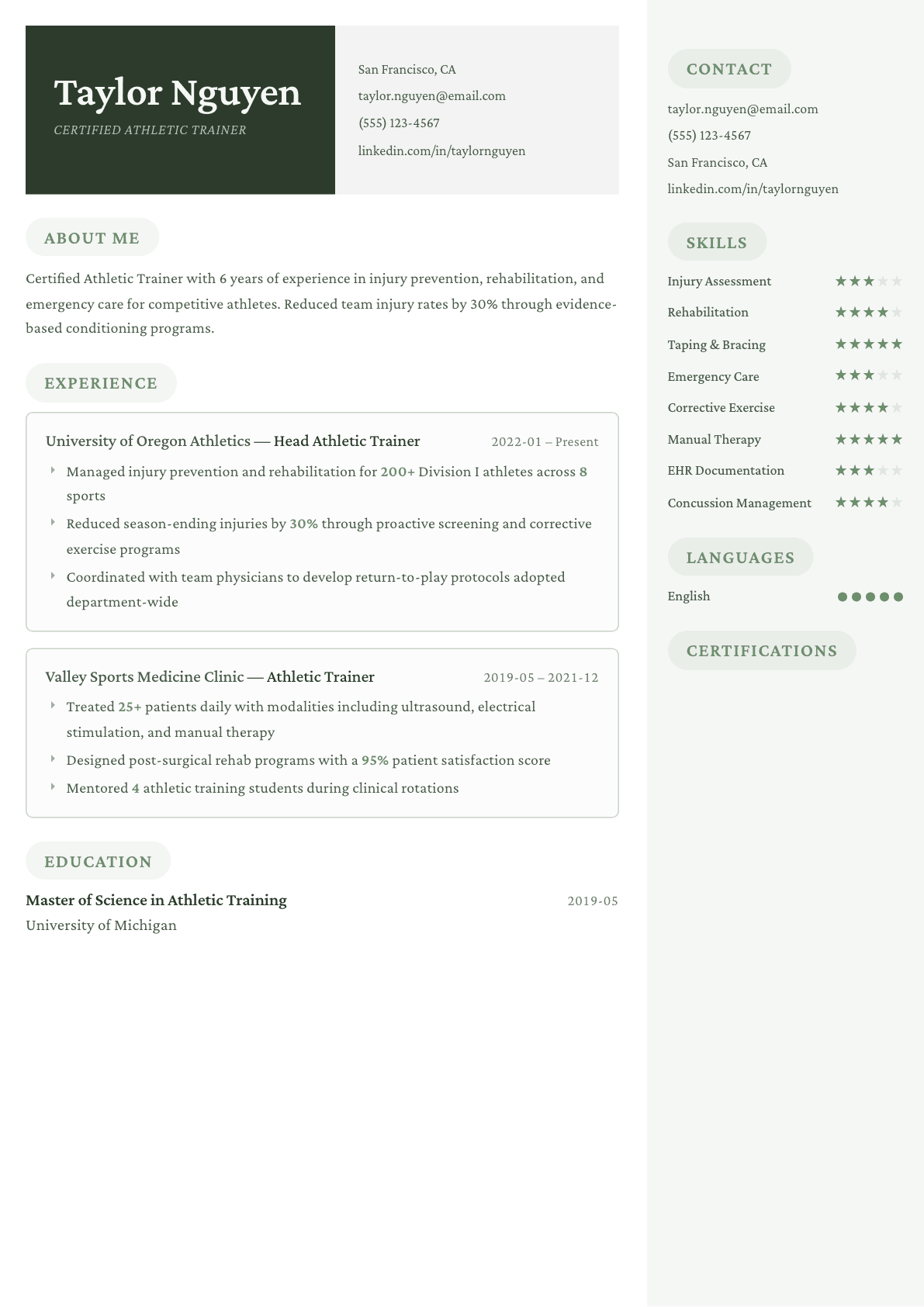
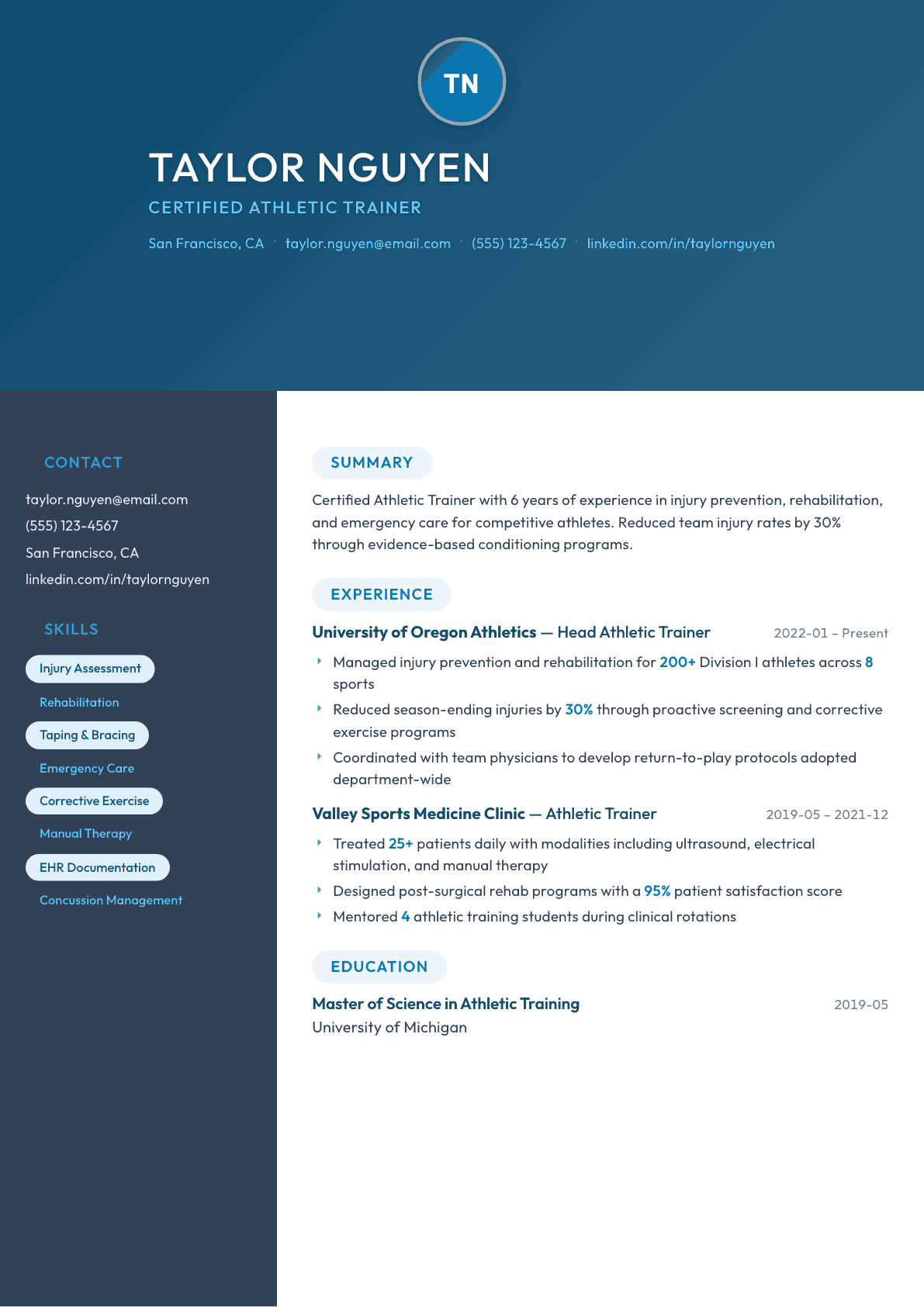
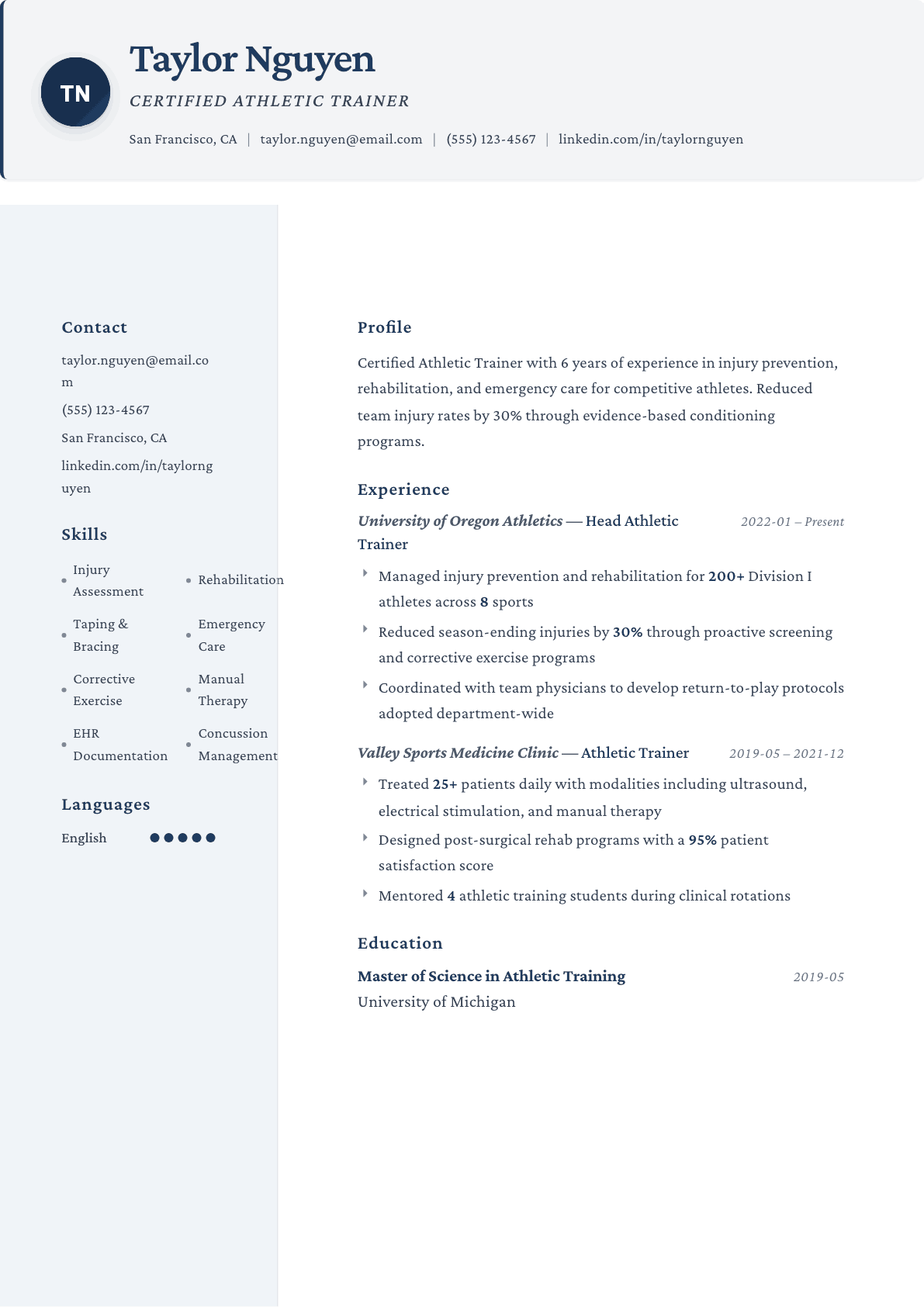
The same athletic trainer content laid out in three CVBooster templates, so you can see what the finished document looks like before you write a word.
Example Athletic Trainer summary
Certified athletic trainer, BOC credentialed, 6 years covering 200 collegiate athletes across eight sports. Cut season-ending injuries 30% with preseason screening and corrective exercise, and wrote the return-to-play protocol the athletics department now uses across every team.
Skills to list on a Athletic Trainer resume
- Injury Prevention
- Rehabilitation Protocols
- Emergency Response
- Concussion Management
- Therapeutic Modalities
- Corrective Exercise
- Taping & Bracing
- Patient Documentation
- Return-to-Play Assessment
- Manual Therapy
What actually gets this resume read
- List your BOC certification and state licensure prominently as they are non-negotiable requirements.
- Quantify injury reduction rates and return-to-play timelines to demonstrate clinical impact.
- Highlight experience with specific sports or populations (collegiate, professional, youth).
- Include continuing education courses to show commitment to evidence-based practice.
How to write a athletic trainer resume
An athletic trainer resume clears two gates. The first is administrative: BOC certification current, state licensure or registration in the state of the job, and emergency cardiac care credentials in date. Miss any of those on the page and the file usually stops there, because an employer cannot place an uncredentialed clinician on a sideline.
The second gate is the head athletic trainer or clinical director, who is trying to picture you alone at a Saturday event when something goes wrong. They read for the settings you have covered, the sports and the contact level, the emergency situations you have actually managed, and whether you write like someone who documents properly and communicates with physicians.
This guide covers credential placement, how to describe coverage and rehabilitation work in the terms the profession uses, summaries for a new certified athletic trainer through a head athletic trainer, and the rewrites that turn taping and treating into clinical practice.
Format: credentials in the header, coverage visible immediately
Put your credentials after your name: degree, ATC, and state license abbreviation where your state uses one. Then a certifications and licensure section near the top with the BOC certification number status, the state license and expiration, and current CPR and AED for the professional rescuer or equivalent emergency cardiac care.
Under each job, lead with a coverage line: the setting, the sports, the number of athletes, the level of play, and whether you were the sole provider or part of a staff. Working alone at a high school with four hundred athletes is a different clinical reality from being one of six in a Division I sports medicine department, and that context frames everything else.
- Header: name, degree, ATC, state license, city and state, phone, email.
- Order: summary, credentials and licensure, clinical experience, clinical rotations for new graduates, education, skills, continuing education.
- State whether you were the sole athletic trainer on site, since it changes the scope of judgment you carried.
Summary: setting, sports, and what you are strongest at
Three lines naming the setting you know, the sports and contact level, the athlete population, and one area of depth. Depth in this field looks like concussion management under a state protocol, post-surgical return to play for knee reconstruction, throwing programs and shoulder care, heat illness policy, or emergency action planning.
Say what setting you are aiming for if it differs from where you are. Movement between secondary schools, colleges, clinics, professional teams, performing arts and industrial settings is common, and naming the target helps a reader connect your experience to their opening.
Experience: evaluation, treatment, and the emergency you ran
Bullets should follow the clinical arc. Injury evaluation using specific special tests, working diagnosis, referral to the team physician, treatment plan, therapeutic exercise progression, and a documented return to play decision under the criteria your setting uses.
Then the emergency side, which is what an employer worries about most. Emergency action plan development and rehearsal with coaching staff, spine boarding, splinting, cervical stabilization, on-field airway management, epinephrine and asthma protocols, exertional heat illness with rectal thermometry and cold water immersion, and sudden cardiac arrest response with an AED. If you have run these live, say so.
Add the parts that keep a program legal and organized: preparticipation physical examinations, concussion baseline testing, insurance and injury reporting, budget and supply ordering, hydration and heat acclimatization policy, and supervision of students or interns.
- Athletes covered, sports, contact level and number of events per season.
- Special tests and evaluation approach you actually use.
- Physician communication and referral pathway.
- Emergency situations managed and the protocol followed.
- Return-to-play criteria and documentation practice.
Rehabilitation: progression, criteria and outcomes
Describe rehabilitation as a criteria-driven progression, not a list of modalities. Range of motion and strength benchmarks, limb symmetry index testing, hop testing, functional movement progression, sport-specific drills and a graded return under physician clearance is the language of a clinician who follows evidence rather than habit.
Modalities still belong on the page but in proportion. Manual therapy, instrument-assisted soft tissue work, cupping, dry needling where your state permits it and you are trained, blood flow restriction training, and therapeutic ultrasound and electrical stimulation are worth naming, ideally attached to a case where you used them.
Documentation, technology and prevention
Name the electronic medical record you chart in: Healthy Roster, ATS, SportsWare, Rank One, Presagia, or a clinic system. Say what you produced from it, such as injury surveillance summaries that shaped a preseason conditioning change.
Prevention is where an athletic trainer proves value to an administrator. Preseason screening, neuromuscular training programs for lower limb injury reduction, throwing and pitch count management, equipment fitting, heat acclimatization scheduling and workload monitoring are all defensible prevention work when you can attach a change in injury numbers.
Athletic Trainer resume summary examples
Newly certified
BOC-certified athletic trainer and recent graduate with 900 clinical hours across high school football, collegiate soccer and an orthopedic clinic. Trained in concussion protocol administration, spine boarding and heat illness management, and comfortable as a sole provider at practices.
Five years in
Athletic trainer with 5 years as the sole provider at a secondary school covering 380 athletes across 14 sports. Built the emergency action plan, ran preparticipation screening, and cut lower limb non-contact injuries by adding a neuromuscular warm-up to every team practice.
Head athletic trainer
Head athletic trainer with 12 years in collegiate sports medicine, supervising 4 staff athletic trainers and 8 students while covering football and coordinating physician clinics. Rebuilt the concussion protocol, standardized documentation in Healthy Roster, and manages the department budget.
Work experience bullets: before and after
Before: Provided athletic training services to student athletes.
After: Served as sole athletic trainer for 380 athletes across 14 sports, covering roughly 190 practices and 90 competitions a season including all home football and wrestling events.
Athlete count, sport count and event volume tell a director exactly what coverage load you have carried alone.
Before: Evaluated and treated injuries.
After: Performed on-field and clinical evaluations using orthopedic special testing, established working diagnoses, referred to the team physician within a set pathway, and documented every encounter the same day.
The evaluation to referral to documentation sequence shows clinical process instead of a general duty.
Before: Managed concussions according to protocol.
After: Administered baseline testing for all contact-sport athletes, managed 27 concussions across a season under the state protocol, and coordinated graduated return to learn and return to play with school staff and physicians.
Baseline testing, a case count and the return to learn coordination prove protocol ownership, not compliance.
Before: Helped athletes recover from surgery.
After: Progressed 9 post-operative knee reconstruction athletes through criteria-based rehabilitation with limb symmetry and hop testing at each phase, returning 8 to full competition within the physician timeline.
Criteria-based progression with named tests and outcomes reads as clinical practice rather than supervision of exercises.
Before: Worked to prevent injuries on the teams.
After: Introduced a neuromuscular warm-up before every team practice, ran preseason movement screening for 380 athletes, and tracked non-contact lower limb injuries across 2 seasons to measure the change.
A named intervention plus surveillance over two seasons turns prevention into something an administrator can evaluate.
Hard skills
- Orthopedic injury evaluation and special testing
- Emergency action planning and rehearsal
- Spine boarding and cervical stabilization
- Exertional heat illness recognition and cold water immersion
- Concussion baseline testing and return to play
- Criteria-based rehabilitation progression
- Therapeutic exercise and corrective programming
- Manual therapy and soft tissue techniques
- Taping, bracing and protective equipment fitting
- Preparticipation physical examination coordination
- Injury surveillance and documentation
- Healthy Roster and ATS record systems
Soft skills
- Composure in an emergency
- Physician communication
- Saying no to a coach
- Athlete trust and adherence
- Parent communication
- Teaching students on the field
Certifications worth listing
- Board of Certification for the Athletic Trainer (ATC) (Board of Certification, Inc.)
- State athletic training license or registration (State licensing boards, requirements vary by state)
- CPR and AED for the Professional Rescuer (American Red Cross)
- Basic Life Support (BLS) for Healthcare Providers (American Heart Association)
- Certified Strength and Conditioning Specialist (CSCS) (National Strength and Conditioning Association)
- Performance Enhancement Specialist (PES) (National Academy of Sports Medicine)
Mistakes that cost athletic trainer candidates the interview
- Leaving out the state license, which many employers treat as a hard screen before any clinical experience is read.
- Listing modalities as a skill set without ever showing an evaluation, a referral or a return-to-play decision.
- Failing to say whether you were the sole provider, which is the main variable in an athletic trainer job.
- Omitting emergency experience, since that is the scenario every hiring supervisor is mentally testing you against.
- Reporting injury reduction without saying what you introduced or how you counted it.
- Skipping documentation and the record system, when charting quality is a real reason clinicians are moved out.
- Listing every continuing education course rather than the ones that support the setting you are applying to.
Athletic Trainer resume questions
Where do athletic trainer credentials go on a resume?
After your name as degree then ATC then state license, and again in a credentials section near the top with expiration dates and current emergency cardiac care certification. Employers verify these before they read your clinical experience, so make them impossible to miss.
How do new graduates show enough experience?
Treat clinical rotations as jobs. Give each one the setting, the sports, the supervising athletic trainer, the total hours and two bullets on the clinical work you did. Add the emergency skills you have practiced, because employers assume nothing about a new certificant.
Should I include the sports I have covered?
Yes, and be specific about contact level and season. A hiring supervisor filling a football and wrestling assignment reads a resume with those sports on it very differently from one built entirely on non-contact sports, even at the same level of play.
How do I move from a secondary school to a college or clinic setting?
Name the target setting in the summary and lead with the transferable clinical depth: post-operative rehabilitation, physician clinic coordination, documentation quality and supervision of students. Then add any continuing education aimed at the setting you want.
Do I need a strength and conditioning credential as an athletic trainer?
It is not required, but it strengthens applications in settings where you will write performance programming or work closely with a strength staff. Add it only if it is current, and keep the athletic training credentials in the primary position.
Related resume examples
- Fitness Instructor Resume example
- Sports Coach Resume example
- Sports Nutritionist Resume example
- Personal Trainer Resume example
- Kinesiologist Resume example
- Exercise Physiologist Resume example