Graduate Teaching Assistant Resume Examples: free score
Write a Graduate Teaching Assistant Resume That Shows Classroom Ownership
By Mustafa Tarabya, founder of CVBooster · Published · Updated
Graduate teaching assistant resume example with section and grading detail, instructor of record language, keywords and a full writing guide.
Sample resumes for a graduate teaching assistant
The same graduate teaching assistant content laid out in three CVBooster templates, so you can see what the finished document looks like before you write a word.
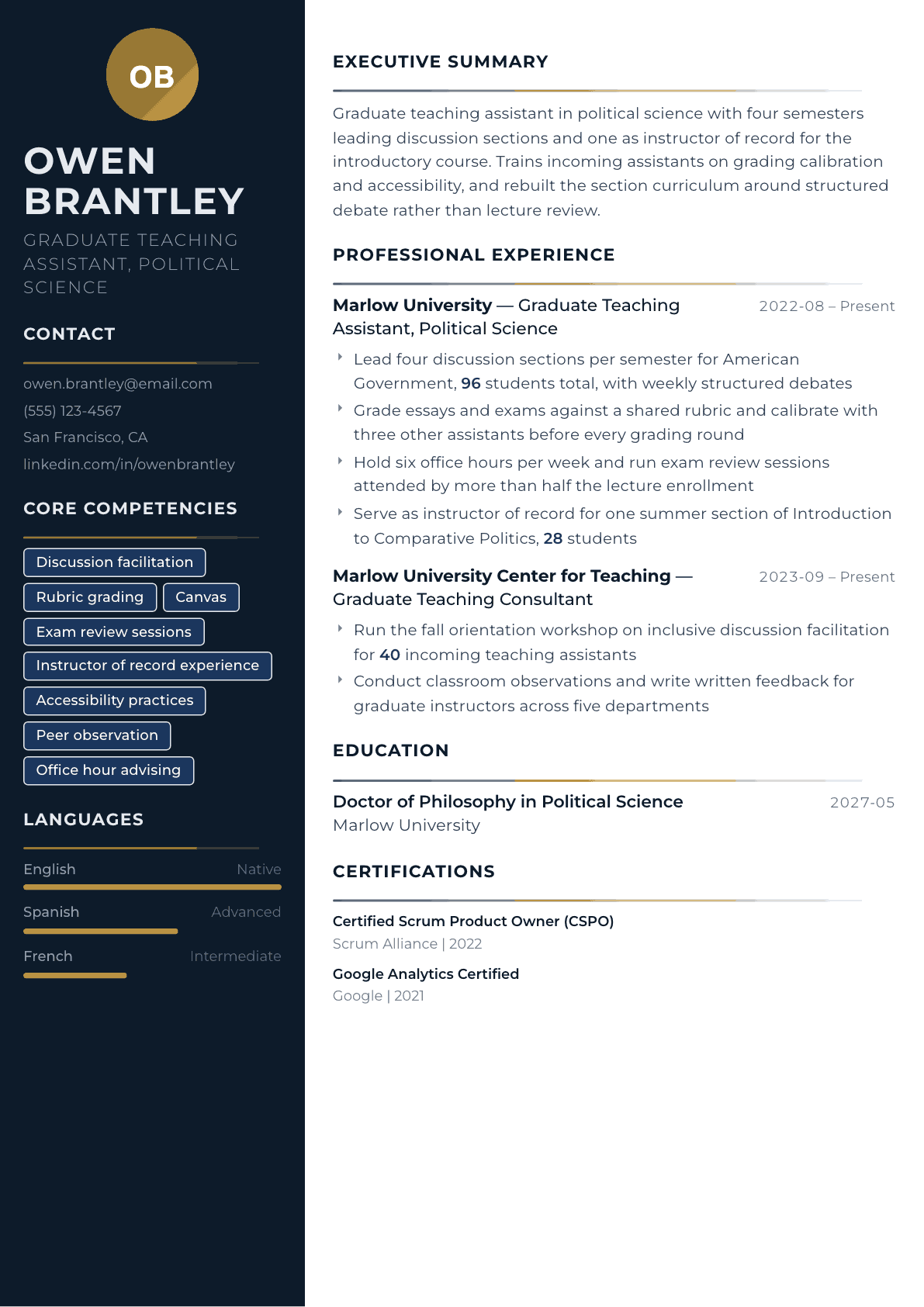
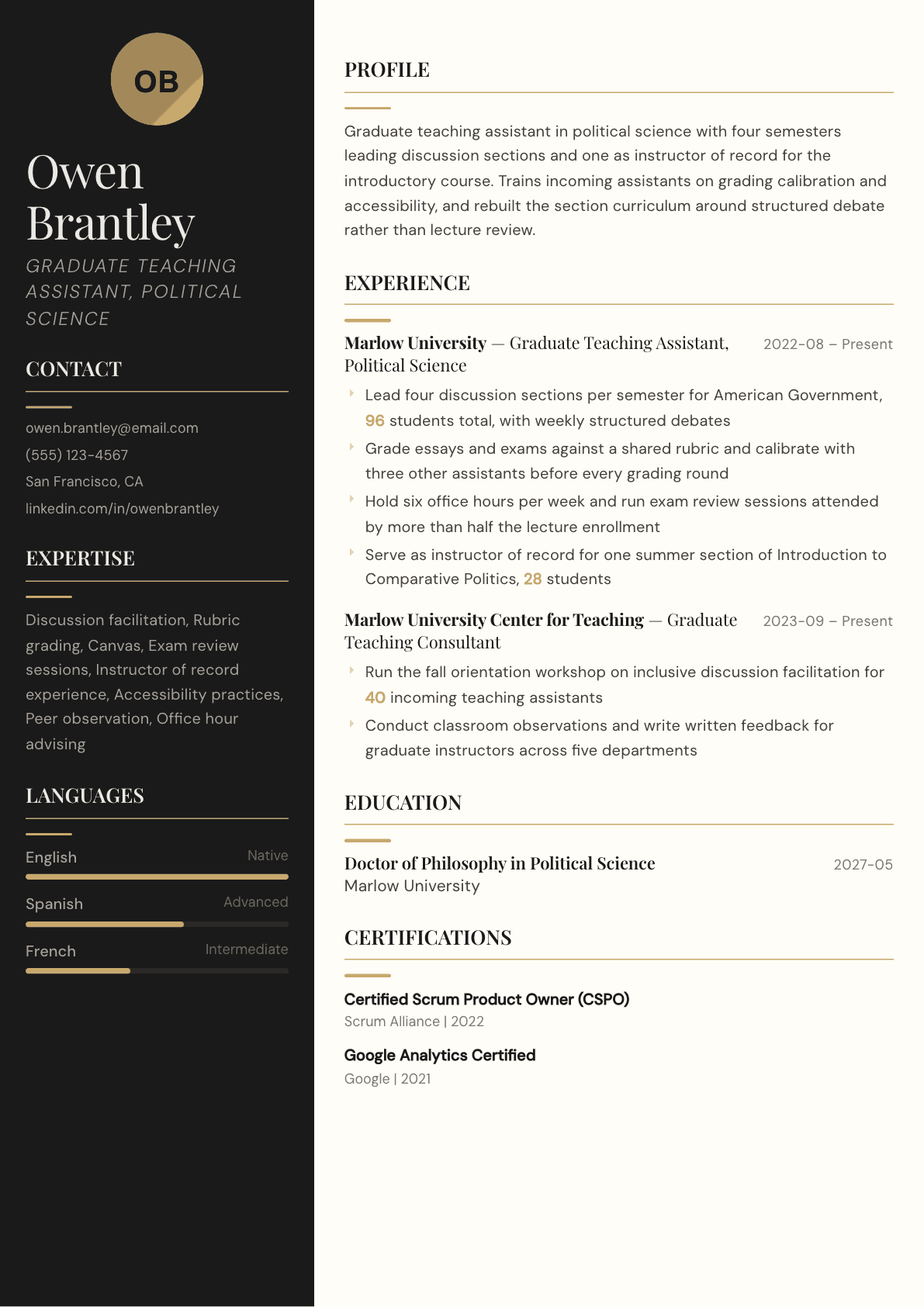
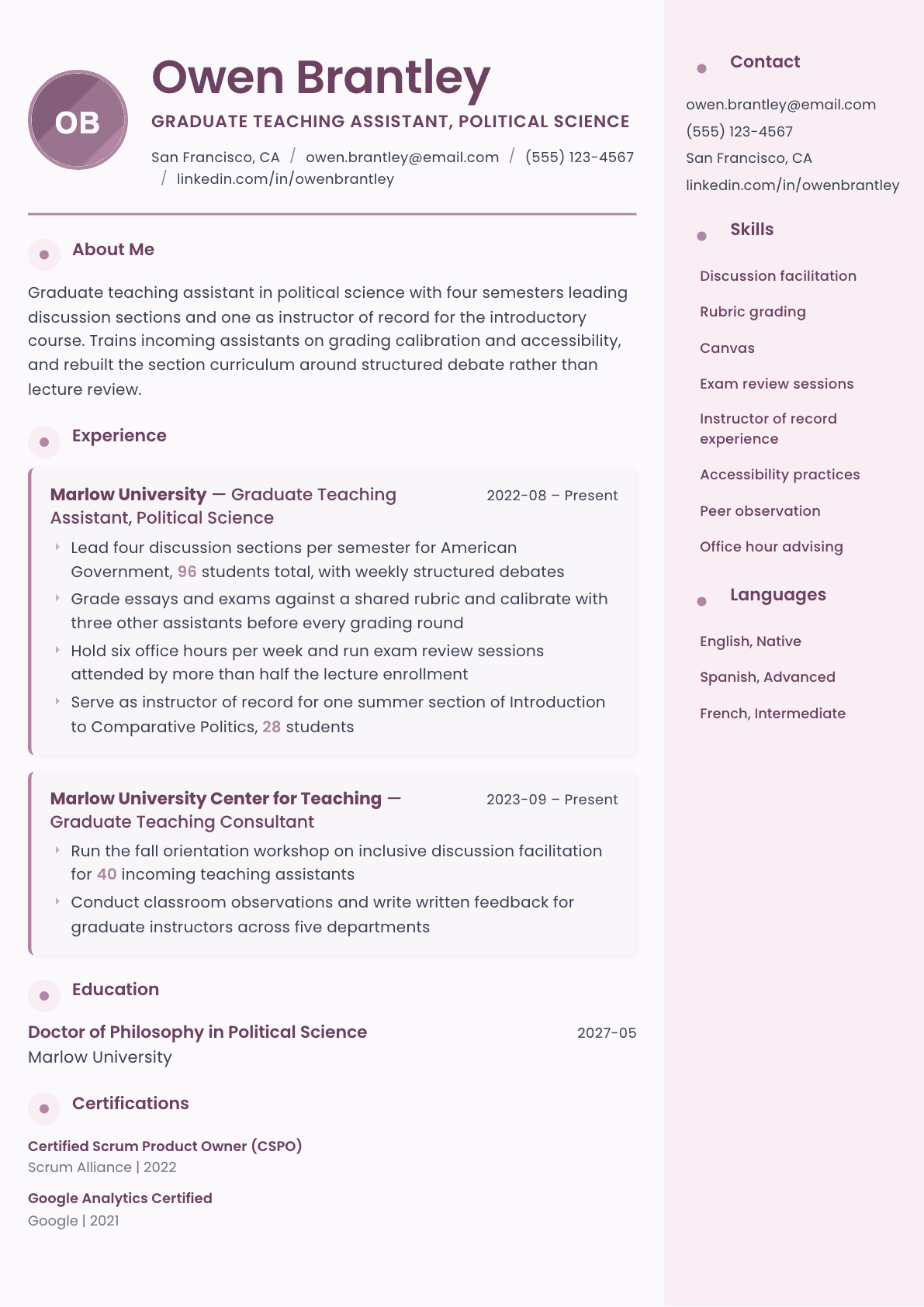
Example Graduate Teaching Assistant summary
Graduate teaching assistant in political science with four semesters of discussion section instruction, ninety-six students per term, and one summer as instructor of record. Grades against shared rubrics with calibrated review, runs exam sessions attended by most of the lecture, and trains incoming assistants through the campus teaching center. Seeking a teaching assistantship or an instructor appointment in an undergraduate program.
Skills to list on a Graduate Teaching Assistant resume
- Discussion section facilitation
- Rubric development and grading
- Lecture support
- Exam and quiz writing
- Office hour advising
- Canvas
- Instructor of record experience
- Inclusive teaching practices
- Accessibility accommodations
- Peer observation and feedback
- Curriculum alignment
- Student progress tracking
- Academic integrity procedures
- Public speaking
What actually gets this resume read
- Say exactly what you owned: leading sections, grading with a rubric, writing exams or serving as instructor of record are different levels of responsibility.
- Give section counts and student numbers each term, because a chair reading the file wants to know the load you have carried.
- Name the learning management system and any accessibility or universal design training you completed alongside your teaching.
- Include teaching center work such as orientations, observations or consulting, since it separates you from assistants who only graded.
- Add a short teaching interests line listing the courses you are prepared to teach, which helps departments staff you quickly.
- Keep research on the page but compact if the target is a teaching post, and reverse that emphasis when applying to research programs.
How to write a graduate teaching assistant resume
A graduate teaching assistant resume is read by someone who already knows the title means almost nothing on its own. Across departments the same appointment can mean grading a stack of exams, running four discussion sections a week, or teaching an entire summer course as instructor of record. The reader wants to know which of those you did.
So the whole document turns on ownership. What you led, what you graded, what you wrote, what you decided when a student challenged a grade at eleven at night. Assistants who describe their appointment instead of their responsibilities all look identical, and none of them look ready for their own classroom.
This guide covers how to structure the file for teaching assistantships, instructor appointments and academic job applications, three summaries from a first assignment through an experienced assistant, before-and-after bullets, and the questions graduate instructors ask when they start applying for teaching work.
Format: one to two pages, responsibilities before duties
One page while you are early, two once you have taught your own sections and taken on teaching center work. Reverse chronological, single column, headings a human can scan. Departments hiring instructors are not looking for design, they are looking for whether you can be put in front of a room.
Put a short teaching experience block immediately under the summary: courses, terms, sections per term, students per term, and your role in each. Role is the field everyone leaves out and every chair wants.
- Header: name, department, institution, phone and professional email.
- Sections in this order: summary, teaching experience, teaching development, research, education, service.
- Add a teaching interests line naming courses you are prepared to teach next term.
Say exactly what you owned
There is a hierarchy in graduate instruction and everyone in academic hiring knows it. Grading only, then grading with office hours, then leading discussion or laboratory sections, then writing assessments, then instructor of record with full syllabus authority. Name your level for each appointment, and do not blur one into the next.
If you held instructor of record even once, give it its own line with the course, the enrollment and the term. That single appointment is the strongest item most graduate teaching files contain, and it frequently ends up buried in a bullet three lines down.
Scale and consistency: sections, students, calibration
Give numbers each term: sections led, students across those sections, office hours held, exams graded. A chair reading the file is estimating whether you can carry a load, and estimates need figures.
Then address consistency, because it is the failure mode departments fear in multi-section courses. Grading calibration with other assistants, a shared rubric, a norming session before each round, or a regrade policy you applied uniformly all demonstrate that your sections will not drift away from the rest of the course.
Include what you built. Supplementary problem sets, review sessions, section activities, a study guide the whole course adopted, or a rubric that replaced ad hoc grading are contributions rather than duties, and they read that way.
Teaching development and inclusive practice
Departments increasingly want graduate instructors who have had formal training. Teaching center certificates, course design institutes, orientation workshops you completed or delivered, and peer observation programs all belong in their own short section.
Accessibility and inclusive teaching deserve explicit mention because they are now written into instructor expectations. Accommodation implementation, accessible course materials, structured discussion protocols that distribute participation, and academic integrity procedures are all concrete practices rather than sentiments.
- Name the learning management system you work in and what you built inside it.
- List any teaching award or nomination with the granting unit.
- Include mentoring of newer assistants, since it separates you from the rest of the cohort.
Balancing research and teaching for the target
For a teaching assistantship or an instructor appointment, teaching leads and research sits in a compact section afterward. For a research fellowship or a doctoral program application, reverse it. The same record, ordered by what the reader is deciding.
The vocabulary teaching postings use is predictable: discussion facilitation, formative assessment, rubric development, learning outcomes, active learning, universal design for learning, academic integrity, student engagement and office hours. Use those exact phrases where they are true and follow each with the evidence.
Graduate Teaching Assistant resume summary examples
First assignment
Political science graduate student beginning a teaching assistantship for American Government, supporting two discussion sections and grading against a shared rubric. Completed the campus teaching orientation and a workshop on inclusive discussion facilitation before the first term started.
Two years in
Graduate teaching assistant leading four discussion sections a semester for American Government, 96 students total, with weekly structured debates. Grades essays against a shared rubric with calibration before each round and runs exam review sessions attended by most of the lecture enrollment.
Experienced graduate instructor
Graduate instructor with four semesters of discussion sections and one summer as instructor of record for Introduction to Comparative Politics. Consults for the campus teaching center, running the fall orientation on inclusive facilitation and conducting classroom observations across five departments.
Work experience bullets: before and after
Before: Assisted the professor with a large lecture course.
After: Led four discussion sections a semester for American Government, 96 students total, built around weekly structured debates rather than lecture review.
Section count, student numbers and the pedagogical choice show independent instruction instead of assistance.
Before: Graded exams and papers.
After: Graded essays and exams against a shared rubric, calibrating with three other assistants before each round to hold scoring consistent across sections.
Calibration is exactly the practice a course coordinator worries about, and it turns grading into quality control.
Before: Taught my own class one summer.
After: Served as instructor of record for a summer section of Introduction to Comparative Politics, 28 students, with full responsibility for the syllabus, assessments and grades.
Naming the role and its scope makes the strongest item in the file impossible for a reader to miss.
Before: Held office hours for students.
After: Held six office hours a week and ran pre-exam review sessions attended by more than half the lecture enrollment.
Hours and attendance turn an expected duty into evidence that students actively sought your instruction.
Before: Helped train other teaching assistants.
After: Ran the fall orientation workshop on inclusive discussion facilitation for 40 incoming assistants and conducted classroom observations with written feedback.
Training peers and observing classrooms is faculty-level work and should be shown at that level of detail.
Hard skills
- Discussion section facilitation
- Rubric development and grading
- Exam and quiz writing
- Laboratory or recitation instruction
- Canvas
- Learning outcomes alignment
- Formative assessment design
- Accessibility accommodations
- Academic integrity procedures
- Classroom observation and feedback
- Student progress tracking
- Review session design
- Course material development
- Public speaking
Soft skills
- Approachability in office hours
- Fairness in grading disputes
- Clear explanation of difficult material
- Coordination with course instructors
- Managing a room of undergraduates
- Balancing teaching against research deadlines
Certifications worth listing
- CIRTL Associate Certification (Center for the Integration of Research, Teaching and Learning)
- ACUE Certificate in Effective College Instruction (Association of College and University Educators)
Mistakes that cost graduate teaching assistant candidates the interview
- Writing assisted with a course when you led sections, wrote assessments or held full grading authority.
- Leaving out section counts and student numbers, so a chair cannot estimate the load you have carried.
- Burying an instructor of record appointment inside a bullet instead of giving it a line of its own.
- Skipping grading calibration, which is the practice that reassures a coordinator about multi-section consistency.
- Ignoring teaching center training, workshops and observations that separate you from assistants who only graded.
- Leading with research on an application for a teaching appointment, which signals the wrong priority to the reader.
Graduate Teaching Assistant resume questions
How do I make a teaching assistantship sound substantial?
Report the responsibilities rather than the title. Sections led, students taught, assessments written, rubrics built, office hours held and grading authority held all describe a real instructional load that the phrase teaching assistant conceals entirely.
Does grading-only experience count?
It counts, and it should be described accurately. Say you graded against a shared rubric, note the volume and the calibration process, and add any office hours or review sessions. Overstating the role is far more damaging than the limitation itself.
Should I include student evaluation results?
Only with context, and usually only in a teaching portfolio. A departmental teaching award, a nomination or a peer observation summary carries more weight than a numeric average that a reader cannot interpret against the department baseline.
How do I use this experience to get a lecturer position?
Build the parts a teaching search scores: instructor of record appointments, course materials you created, teaching center training, and mentoring of other instructors. Then order the file so teaching leads and research follows in a compact section.
What belongs in a teaching interests line?
The courses you can deliver next term without a full preparation cycle, named as they appear in a typical catalog. Keep it honest and short, because a chair may build a schedule around that line before you ever interview.