Department Supervisor Resume Examples: read this first
Write a Department Supervisor Resume Around Sales and Staffing
By Mustafa Tarabya, founder of CVBooster · Published · Updated
Department supervisor resume examples with sales, staffing, and merchandising bullets, plus a guide to showing ownership of a retail department.
Sample resumes for a department supervisor
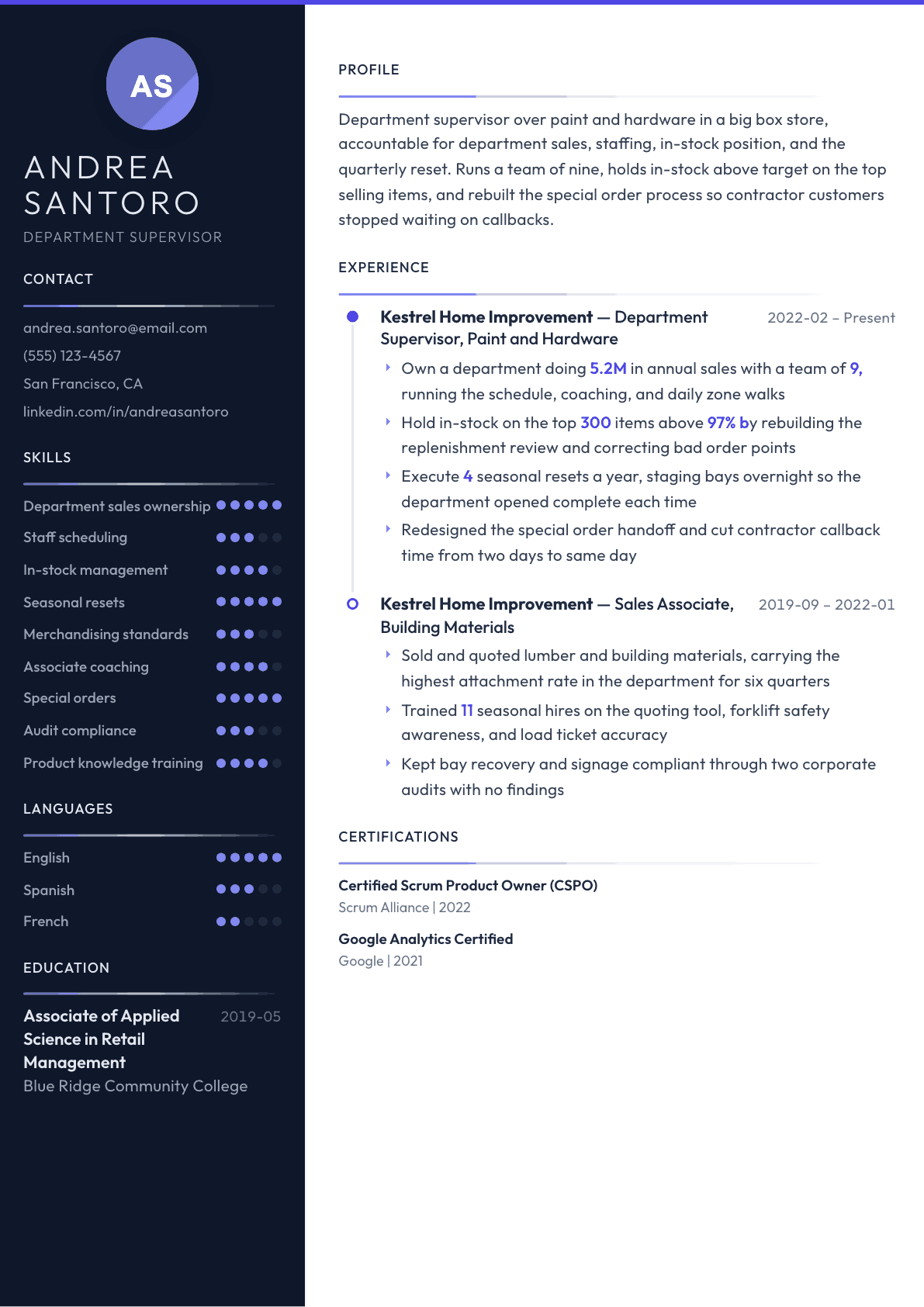
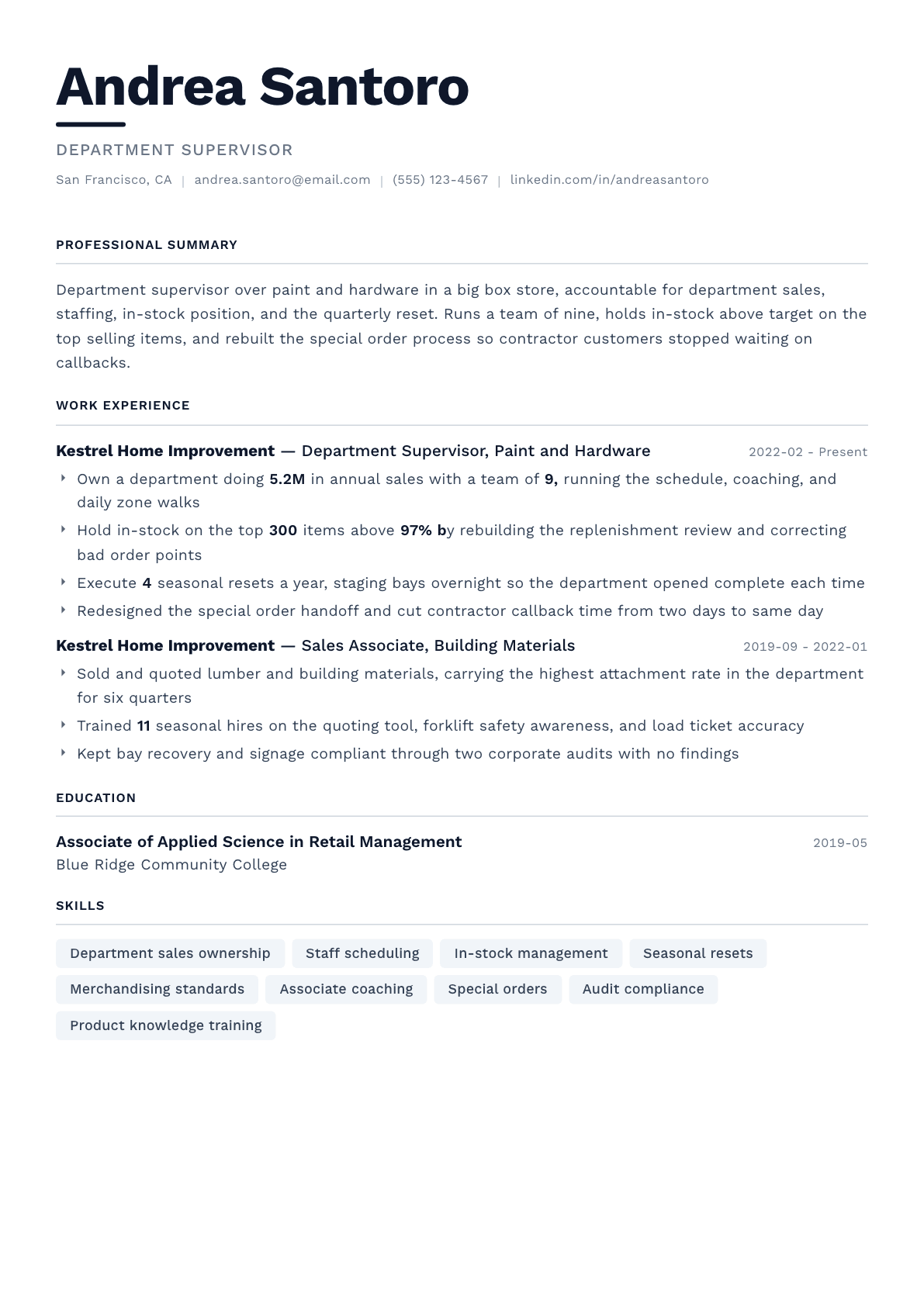
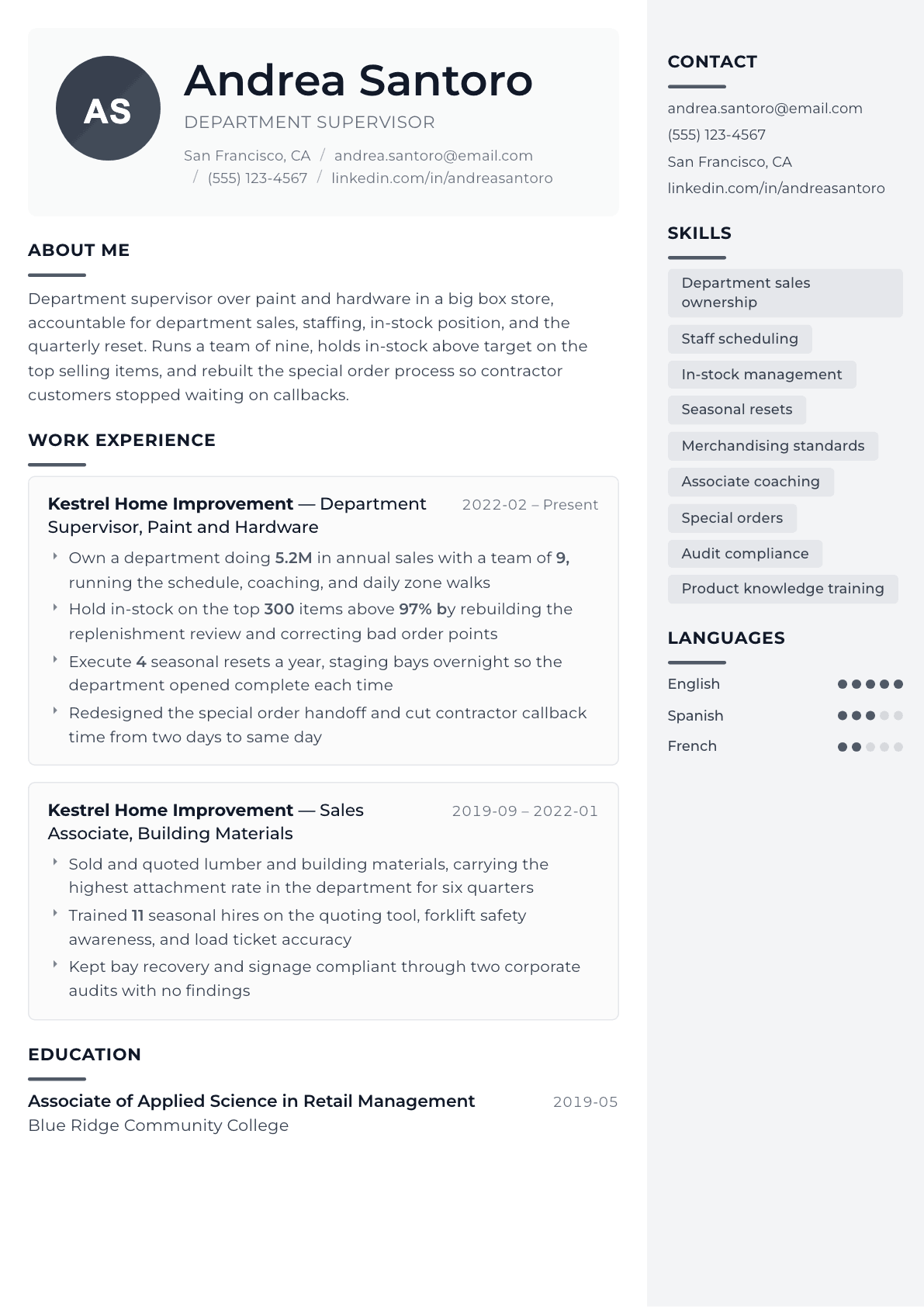
The same department supervisor content laid out in three CVBooster templates, so you can see what the finished document looks like before you write a word.
Example Department Supervisor summary
Department supervisor over paint and hardware in a big box store, accountable for 5.2M in annual department sales and a team of nine. Holds in-stock above 97% on the top 300 items, executes four seasonal resets a year without an incomplete opening, and rebuilt the special order handoff to a same day contractor callback.
Skills to list on a Department Supervisor resume
- Department sales management
- Staff scheduling
- Associate coaching
- In-stock and replenishment
- Order point maintenance
- Seasonal reset execution
- Planogram compliance
- Merchandising standards
- Special order handling
- Inventory accuracy
- Audit readiness
- Product knowledge training
- Customer escalation handling
- Safety compliance
What actually gets this resume read
- Open with the department, its annual sales, and how many people reported to you, in that order.
- Show in-stock, sales to plan, or attachment rate, since those are the numbers a store manager reviews weekly.
- Describe the resets you executed and how you staged them, because seasonal resets are where supervisors fail.
- Give the coaching detail: who you trained, on what, and whether any of them were promoted afterward.
- Mention product knowledge specific to your department, from paint mixing to appliance specifications.
- Keep general customer service to one line and use the space for ownership of the department numbers.
How to write a department supervisor resume
A department supervisor owns a piece of the store the way a small business owner owns a shop: the sales number, the people on the floor, the in-stock position, and how the bays look at eight in the morning. A store manager reading the resume is checking whether you have carried that responsibility or only worked inside someone else's department.
The resume that fails is the one written as an extended sales associate role. Assisted customers, maintained displays, and helped with inventory describe the work of the team, not the person accountable for it. Department volume, headcount, in-stock rate, reset execution, and the associates you developed describe the supervisor.
This guide covers the layout for a department resume, how to state scope in one line, three summary examples from a new supervisor to a candidate ready for assistant store manager, before and after bullets, and the questions supervisors ask when they want the next step.
Format: one page, department scope first
One page, reverse chronological, single column. Before the bullets in each role, write a scope line: the department, its annual sales, the headcount reporting to you, and the store format. A supervisor over seasonal in a small format store and a supervisor over appliances in a big box are doing different jobs, and the reader needs to know which one you did.
When you have supervised more than one department, list them as separate scope lines under the same employer rather than merging them. Range across departments is valuable to a store manager filling a vacancy that is not the one you last held.
- Header: name, city and state, phone, email, and open and close availability.
- Section order: summary, experience, skills, certifications, education.
- Name the ordering, task, and scheduling systems you used, since chains filter on them.
Summary: department, sales, team, and one operating result
Three lines. Department and category, annual sales, headcount, then the operating result you were measured on, usually sales to plan, in-stock rate, or attachment on a key category. Close with the ownership detail that most supervisors leave out: the resets, the schedule, or the ordering you personally control.
If you are stepping up from a senior associate role, name the supervisor tasks you already carry. Writing the zone assignments, correcting order points, and staging a reset overnight are supervisor work, and a store manager will recognize them.
Experience: sales, in-stock, resets, people
Sales first, but always with the mechanism. A department that grew because you fixed the order points, added a secondary location for a top seller, or trained the team on the quoting tool tells a much better story than a growth number floating on its own.
In-stock is the daily fight. Write the replenishment review you run, the order points you corrected, and the in-stock rate you held on your top selling items. Store managers read this as the difference between a supervisor who walks the aisle and one who waits for a report.
Resets and merchandising standards are where supervisors are judged publicly. Say how many seasonal resets you executed a year, how you staged them, and whether the department opened complete. Then finish with people: who you trained, on what, and which of them were promoted.
Product knowledge is part of the job, so name it
Departments hire for category depth. Paint mixing and tinting, appliance specifications, lumber quoting, plumbing fittings, cosmetics regimens, or bike assembly are real technical knowledge, and a hiring manager for that department will look for it before anything else on the page.
Show how you spread that knowledge. Training the team on the quoting tool, writing a cheat sheet for special orders, or running a vendor product session turns your own expertise into department capability, which is what a supervisor is paid for.
Skills, systems, and the audit vocabulary
Use the operating nouns a retail leader searches for: department sales, in-stock rate, replenishment, order points, planogram compliance, seasonal reset, markdown execution, special orders, cycle count, audit readiness, and associate coaching. Split systems out so they are easy to spot.
Include audit results if you have them. Passing a corporate merchandising or safety audit without findings is a hard, verifiable outcome, and it says more about your standards than any adjective in a skills list.
Department Supervisor resume summary examples
New supervisor
Department supervisor promoted from senior associate, running seasonal and outdoor living in a mid volume store with a team of five. Writes the daily zone assignments, corrects order points on top sellers, and staged two full seasonal resets overnight so the department opened complete.
Three years over a department
Department supervisor over paint and hardware, accountable for 5.2M in annual sales and a team of nine. Holds in-stock above 97% on the top 300 items by rebuilding the replenishment review, executes four seasonal resets a year, and cut contractor callback time on special orders to same day.
Multi-department lead
Senior supervisor over three departments totaling 14M in annual sales and 26 associates, covering the assistant store manager on vacation weeks. Promoted four associates into supervisor roles, closed two corporate merchandising audits with no findings, and led a full store remodel zone.
Work experience bullets: before and after
Before: Managed a department and its employees.
After: Owned a paint and hardware department doing 5.2M in annual sales with a team of nine, running the schedule, daily zone walks, and coaching.
Department, volume, headcount, and the routines you run give a store manager the scope in one line.
Before: Made sure products were in stock.
After: Held in-stock above 97% on the top 300 items by rebuilding the replenishment review and correcting order points that were set below real sell-through.
An in-stock figure with the mechanism behind it proves you fixed a system rather than chased empty shelves.
Before: Set up seasonal displays.
After: Executed four seasonal resets a year, staging bays overnight so the department opened complete at the first customer each time.
Reset count and the opening standard show execution discipline, which is what resets actually test.
Before: Helped contractors with their orders.
After: Redesigned the special order handoff between the desk and the vendor rep and cut contractor callback time from two days to same day.
A process change with a before and after is a supervisor result; helping customers is an associate task.
Before: Trained seasonal staff on the job.
After: Trained 11 seasonal hires on the quoting tool, forklift safety awareness, and load ticket accuracy before their first unsupervised shift.
Naming the topics and the readiness gate makes training a program instead of a favor to the team.
Hard skills
- Department sales ownership
- In-stock and replenishment management
- Order point maintenance
- Seasonal reset execution
- Planogram and merchandising compliance
- Markdown and promotion execution
- Staff scheduling and zone assignment
- Associate coaching and development
- Special order and quoting processes
- Cycle counting and inventory accuracy
- Merchandising and safety audit readiness
- Category product knowledge training
Soft skills
- Setting a visible standard
- Coaching to a specific behavior
- Prioritizing during a rush
- Working across departments
- Holding a team through a reset week
- Direct feedback without drama
Certifications worth listing
- RISE Up Business of Retail: Operations and Profit (National Retail Federation Foundation)
- RISE Up Customer Service and Sales (National Retail Federation Foundation)
- Certified Manager (CM) (Institute of Certified Professional Managers)
- OSHA 10-Hour General Industry (OSHA Outreach Training Program, U.S. Department of Labor)
Mistakes that cost department supervisor candidates the interview
- Writing the department as a place you worked rather than a business you were accountable for.
- Leaving out department sales and headcount, the two figures that let a store manager compare you with other candidates.
- Giving a sales increase with no mechanism, which reads as luck or as someone else's promotion calendar.
- Ignoring in-stock and order points, even though that is the work a supervisor does every single morning.
- Treating resets as decoration when they are the visible test of whether a supervisor can plan and finish.
- Listing category expertise without showing how you transferred it to the team through training or documentation.
Department Supervisor resume questions
What is the difference between a department supervisor and an assistant store manager?
A supervisor owns one department: its sales, its people on shift, its in-stock and its standards. An assistant store manager owns the building when the manager is away, including payroll for the whole store, shrink, and the cash office. Write toward whichever scope you can evidence.
What numbers should a department supervisor include?
Annual department sales, headcount, in-stock rate on top items, sales to plan, reset count per year, and any audit result. If your chain treats sales as confidential, use a band and put the operating figures such as in-stock and reset execution in their place.
How do I apply to a department I have not supervised before?
Lead with the transferable operating work: replenishment, order points, resets, scheduling, and coaching all behave the same across departments. Then name any product knowledge you have in the new category, and say plainly that you are willing to learn the specifications.
Should I include the associates I promoted?
Yes. Promotions out of your team are the strongest single signal that you develop people rather than just cover shifts. Give the number, the roles they moved into, and briefly what you did to prepare them, such as a development plan or a certification path.
How do I show merchandising standards without photos?
Use the outcomes a store already measures: audit results with no findings, planogram compliance, reset completion at opening, and signage accuracy through a promotion cycle. Those describe the look of your department far more credibly than the word immaculate.