Author Resume Examples: what a hiring manager reads first
Write an Author Resume for Publishers and Speaking Work
By Mustafa Tarabya, founder of CVBooster · Published · Updated
Author resume examples covering book credits, platform and speaking, editorial process, and the keywords publishers and event bookers scan.
Sample resumes for a author
The same author content laid out in three CVBooster templates, so you can see what the finished document looks like before you write a word.
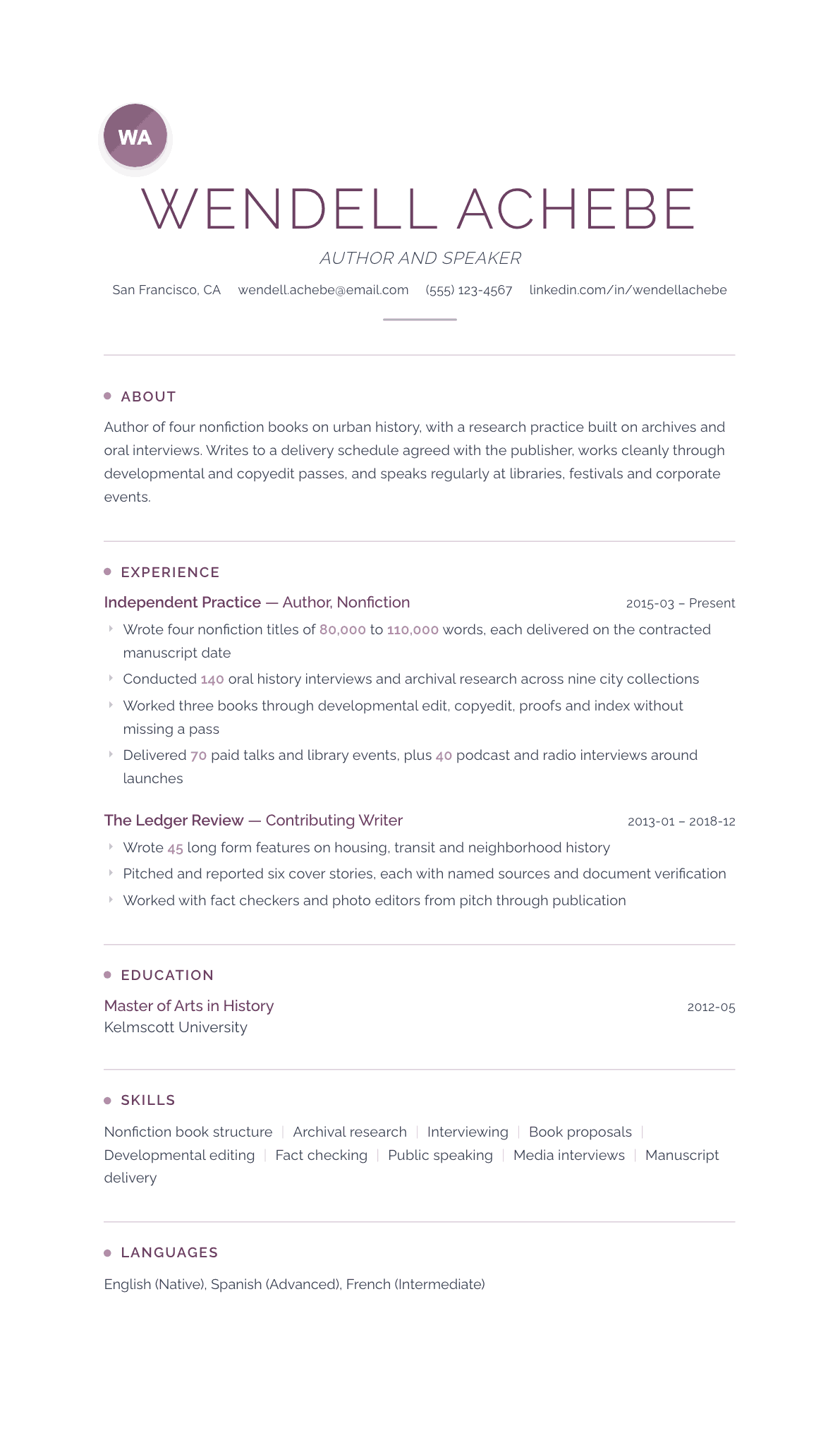
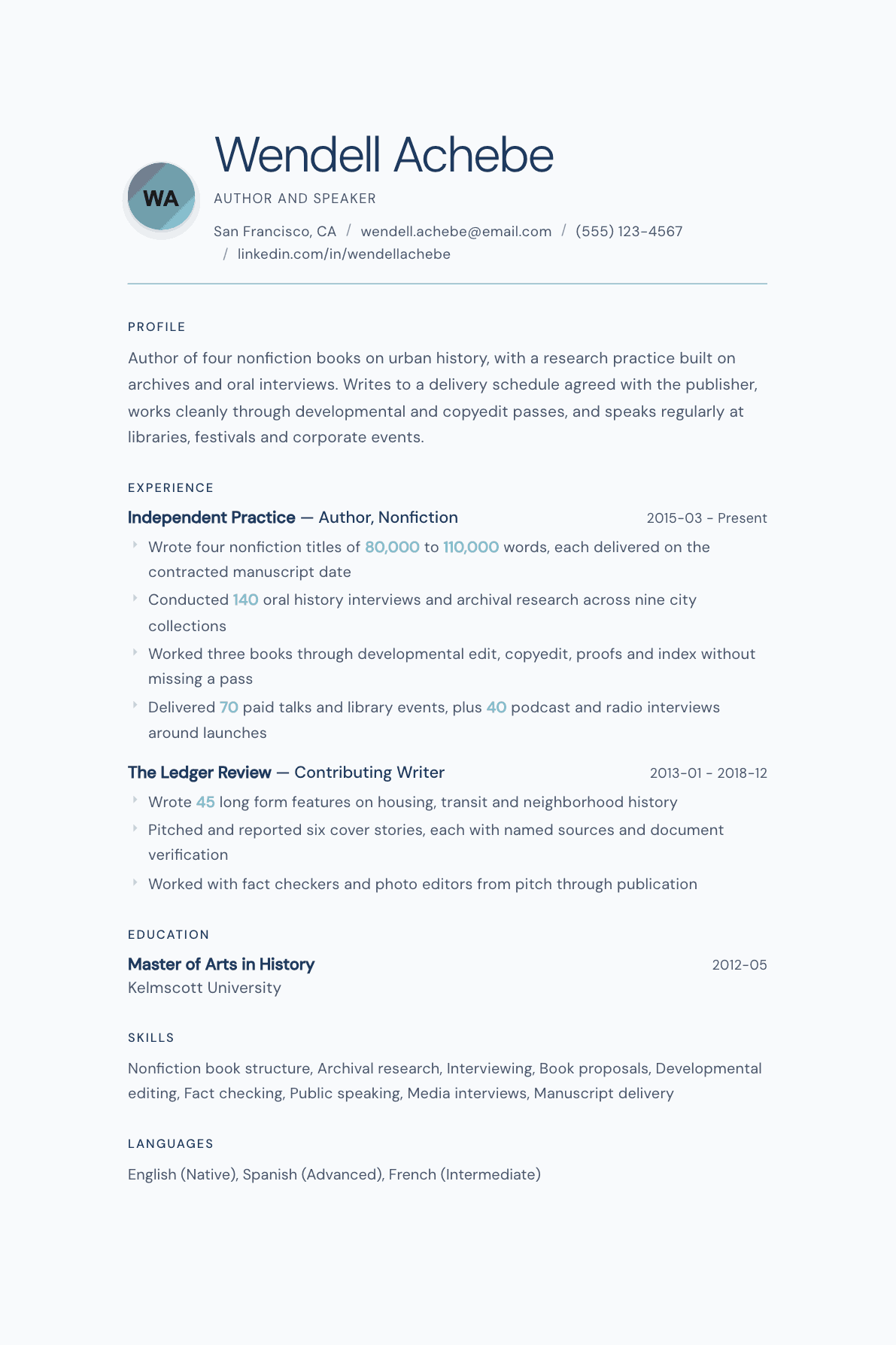
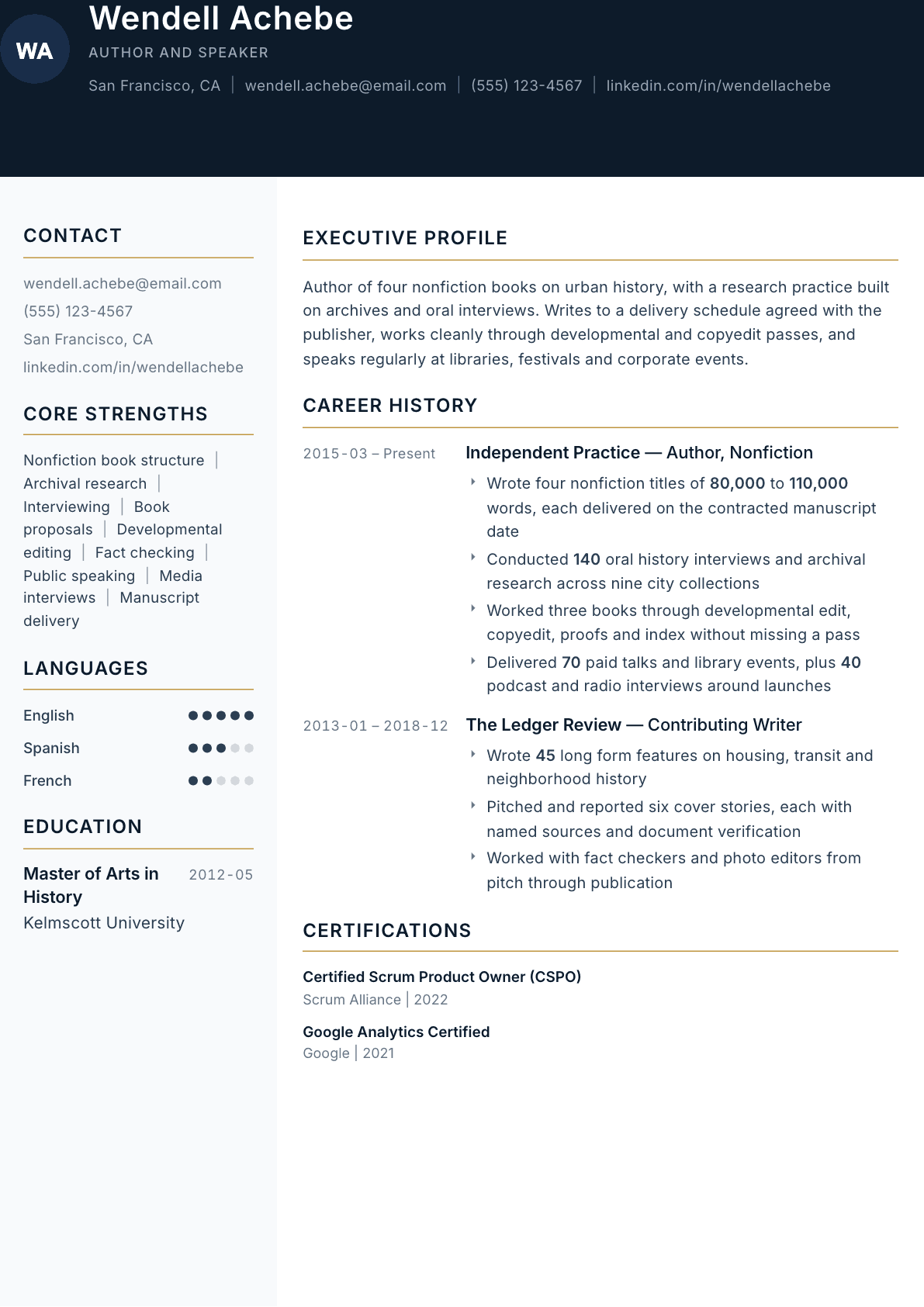
Example Author summary
Author of four nonfiction books on urban history, each delivered on the contracted date and carried cleanly through developmental edit, copyedit and proofs. Research runs on archival work and 140 recorded interviews. Speaks at libraries, festivals and corporate events, and has given 70 paid talks around four launches. Seeking a publisher for a fifth title.
Skills to list on a Author resume
- Book proposals
- Nonfiction structure
- Archival research
- Interviewing
- Long form writing
- Developmental editing
- Fact checking
- Source notes and citations
- Manuscript delivery
- Public speaking
- Media interviews
- Newsletter writing
- Ghost collaboration
- Audiobook narration
What actually gets this resume read
- Start with a books section listing title, publisher, year and format, newest first.
- Show your platform in concrete terms: talks given, newsletter, columns and regular media appearances.
- Say what your research method is, since a nonfiction editor buys the method as much as the idea.
- Give evidence that you hit delivery dates, because a late manuscript is the risk an editor fears.
- Separate speaking and teaching from writing credits so an event booker can find them quickly.
- List translation, audio and foreign editions if you have them, with the territory and publisher.
How to write a author resume
An author resume is read by acquiring editors, agents, event bookers and the occasional university department, and each of them is answering a risk question. The editor wants to know whether you deliver a manuscript on the contracted date. The booker wants to know whether you can hold a room for forty minutes. The agent wants to know whether there is an audience already listening. None of them is reading for prose quality, which lives in the proposal.
That reframing changes what belongs on the page. Books with publisher, year and format come first. Then the platform, stated in concrete units: talks given, media appearances, a column, a newsletter. Then the research method, because for nonfiction an editor is buying the method as much as the idea. Everything else is decoration.
This guide covers how to build the books section, how to show a platform without inflating it, how to prove you hit delivery dates, and the questions an author asks when a publisher or a conference organizer asks for a resume instead of a bio.
Format: books, platform, method, one page for a long time
Reverse-chronological, one page until the credits truly overflow. Lead with a books section that carries title, publisher, year and format, newest first. Include audio, paperback reissue and foreign editions on the same line rather than as separate entries, since a reader wants the book count to be honest.
Keep a shorter speaker version alongside the publisher version. The speaker version leads with talks, audiences and topics, and puts books second. Event bookers will not hunt through a publication list to find whether you have keynoted before.
- Header: name, city, phone, email, agent name where you have one, and a site that lists the same titles.
- Sections for a publisher: books, journalism and long form, research method, delivery record, speaking, training.
- Sections for a booker: speaking topics, talks and audiences, media, books, training.
Books: publisher, format, and the honest word count
Give the publisher for every title, and say plainly whether a book was traditionally published, published with a hybrid press, or self published. Editors find out in a minute and think better of an author who said it first. Word counts help too, because a book of eighty thousand words and one of a hundred and ten thousand are different production propositions.
List translation, audio and territory editions with the publisher and the territory. Foreign rights sales are the clearest evidence an editor has that a previous book traveled, and they are the detail most authors leave in a bio paragraph instead of a resume line.
Platform: concrete units, never adjectives
Platform means the audience that already exists for your next book, and it has to be counted rather than described. Number of paid talks, number of library and festival events, podcast and radio interviews around a launch, a regular column and where it runs, a newsletter and how often it goes out. An author who has given seventy paid talks around four launches has said something an editor can plan a marketing meeting around.
Do not inflate. Follower counts that do not convert into event bookings or preorders are noticed and discounted, and an author who overstates reach loses credibility on the parts of the page that were true.
- Name your speaking topics as titles, since bookers program by topic not by book.
- Separate paid engagements from unpaid appearances so a booker can price you.
- Note media training or broadcast experience where you have it.
Method and delivery: the two things an editor fears
For nonfiction the method is the product. Say how you research: archival collections, recorded interviews, freedom of information requests, field reporting, document verification, or a mix. Naming the number of interviews conducted and the number of collections worked in makes the method verifiable rather than aspirational.
Then address delivery, which is the risk an editor actually loses sleep over. A line stating that every contracted manuscript arrived on the delivery date, and that each book went through developmental edit, copyedit, proofs and index without missing a pass, does more for an acquisition than a paragraph about your voice.
Keywords editors and bookers scan for
The recurring terms are practical: book proposal, manuscript delivery, developmental edit, copyedit, source notes, fact checking, archival research, oral history interviews, public speaking, media interviews, audiobook. Use the exact phrasing from the request once near the top and once in a credit line.
Cut the words that describe every author on the list. Passionate, compelling and deeply researched are claims the proposal will either prove or fail to prove, and on a resume they crowd out an interview count or a publisher name that would have earned the meeting.
Author resume summary examples
First book under contract
Author with a first nonfiction title under contract and a decade of long form journalism behind it. Research runs on archival collections and recorded interviews, with every feature fact checked before publication. Has given library talks and podcast interviews around published features. Seeking speaking bookings ahead of a first launch.
Two books published
Author of two nonfiction books on urban history with an independent press, both delivered on the contracted date and carried through developmental edit, copyedit and proofs. Research built on archival work and recorded oral history interviews. Speaks at libraries and regional festivals, with regular podcast and radio appearances around each launch.
Established author and speaker
Author of four nonfiction books on urban history, each delivered on the contracted manuscript date. Research draws on 140 oral history interviews and nine city archival collections. Has given 70 paid talks and library events plus 40 podcast and radio interviews across four launches. Seeking a publisher for a fifth title.
Work experience bullets: before and after
Before: Wrote four books that were published.
After: Wrote four nonfiction titles of eighty thousand to a hundred and ten thousand words, each delivered on the contracted manuscript date.
Length and on-time delivery answer the two questions an acquiring editor asks before anything about the subject.
Before: Did extensive research for my books.
After: Conducted 140 recorded oral history interviews and archival research across nine city collections, with source notes tied to every claim.
Counting the interviews and the collections turns extensive into a method an editor can evaluate.
Before: Worked with my publisher through the editing process.
After: Carried three books through developmental edit, copyedit, proofs and index without missing a pass or a scheduled return date.
Naming each pass shows an editor you know the production calendar and have never been the reason it slipped.
Before: Spoke at events and did interviews.
After: Delivered 70 paid talks and library events plus 40 podcast and radio interviews across four launches, working from three programmed talk topics.
Paid versus unpaid, the counts and the topic structure give a booker everything they need to make an offer.
Before: Wrote articles for a magazine.
After: Wrote 45 long form features on housing, transit and neighborhood history, and pitched six cover stories with named sources and document verification.
Volume, beat and the verification standard establish the reporting discipline a nonfiction editor is buying.
Hard skills
- Book proposals
- Nonfiction structure
- Archival research
- Interviewing
- Long form writing
- Developmental editing
- Fact checking
- Source notes and citations
- Manuscript delivery
- Public speaking
- Media interviews
- Newsletter writing
- Audiobook narration
Soft skills
- Editorial collaboration
- Deadline discipline
- Audience reading
- Interview rapport
- Handling criticism
- Self-direction
Mistakes that cost author candidates the interview
- Opening with a personal narrative instead of the books section every reader came for.
- Hiding whether a title was traditionally, hybrid or self published, which an editor checks in a minute.
- Describing your platform with adjectives rather than counting talks, interviews and columns.
- Leaving out any evidence that you hit delivery dates, which is the risk an acquiring editor weighs most.
- Mixing paid keynotes with unpaid appearances so a booker cannot work out your fee band.
- Sending the publisher version of the page to an event organizer who only wants topics and audiences.
Author resume questions
What is the difference between an author bio and an author resume?
A bio is written to be read aloud or printed on a jacket and runs on voice. A resume is a record: books with publishers and dates, talks with counts, research method and delivery history. Editors and bookers ask for the second when they are making a decision.
Should I list self published books on an author resume?
Yes, and label them as self published rather than letting the format be inferred. A well performing self published title with real sales history is an asset in an acquisition conversation, but a concealed one becomes a credibility problem the moment it is found.
How do I show platform if I have a small following?
Count what actually converts: library and bookstore events booked, podcast appearances, a column, a newsletter and how often it goes out, and any professional association that invites you to speak. Real small numbers read better than vague large ones.
Does an author need to list a literary agent on the resume?
Name your agent and agency in the header if you have one, since it saves an editor a search and signals your submissions are vetted. If you are unagented, leave the field off rather than explaining, and let the books section do the work.
How do I write an author resume for speaking work?
Build a second version that leads with programmed talk topics, then the venues and audience types you have spoken to, then media and books. Bookers program by topic and room size, so the books belong below the material they are actually buying.