Speechwriter Resume Examples: free ATS score and gap list
Present a Speechwriter Resume That Shows Voice and Judgment
By Mustafa Tarabya, founder of CVBooster · Published · Updated
Speechwriter resume examples and a guide to capturing a principal's voice, remarks volume, briefing packs and confidentiality on paper.
Sample resumes for a speechwriter
The same speechwriter content laid out in three CVBooster templates, so you can see what the finished document looks like before you write a word.
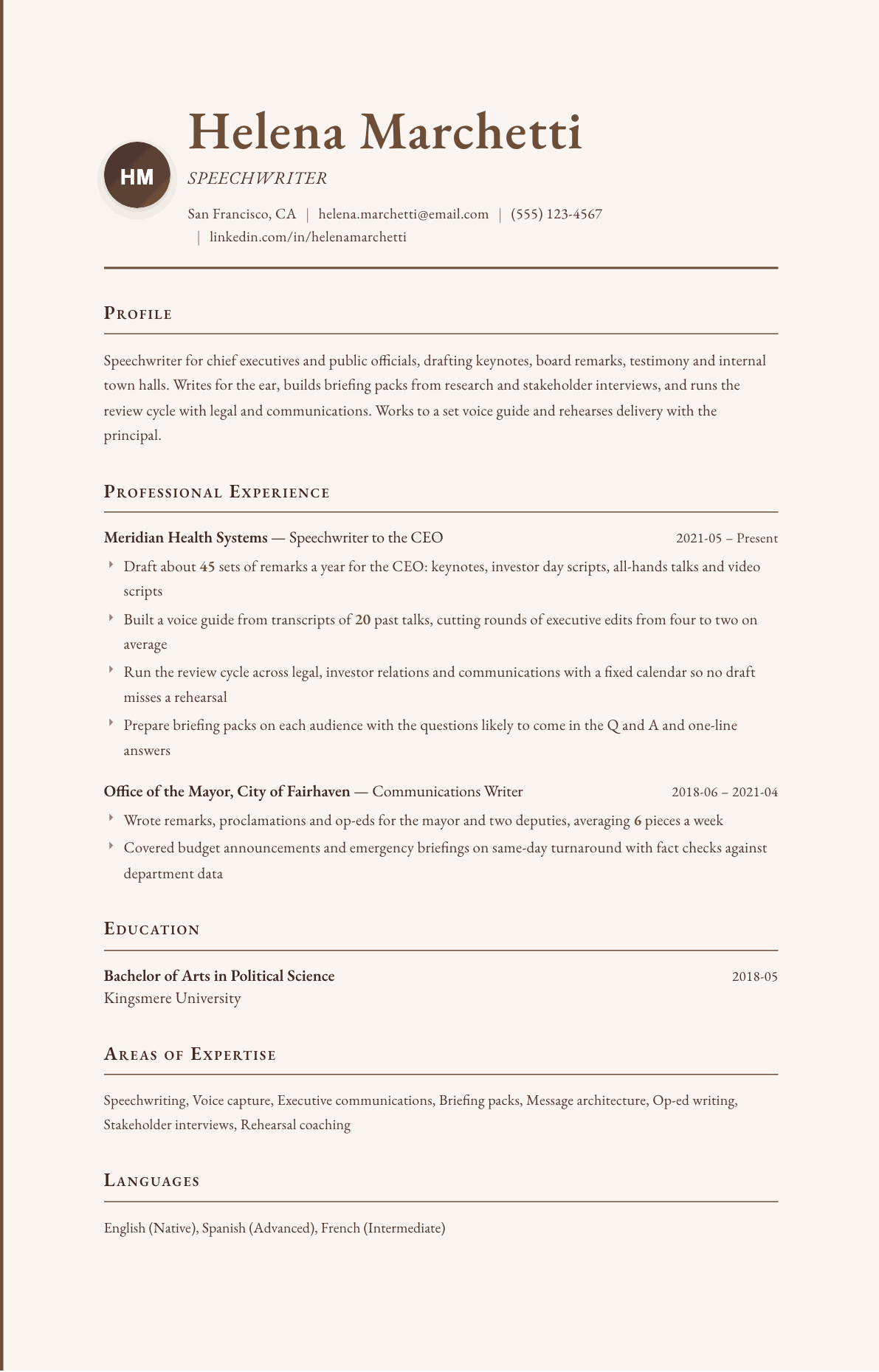
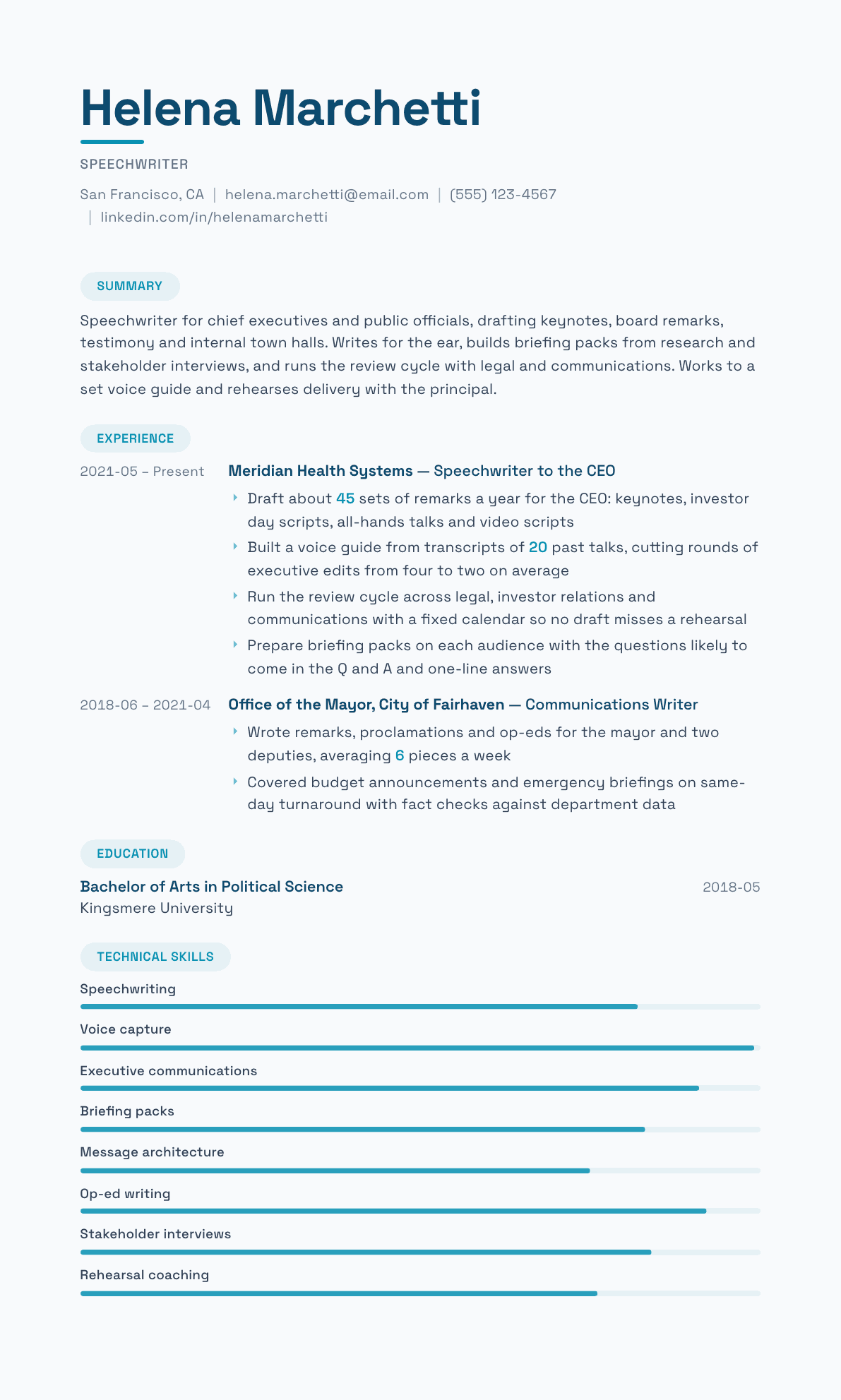
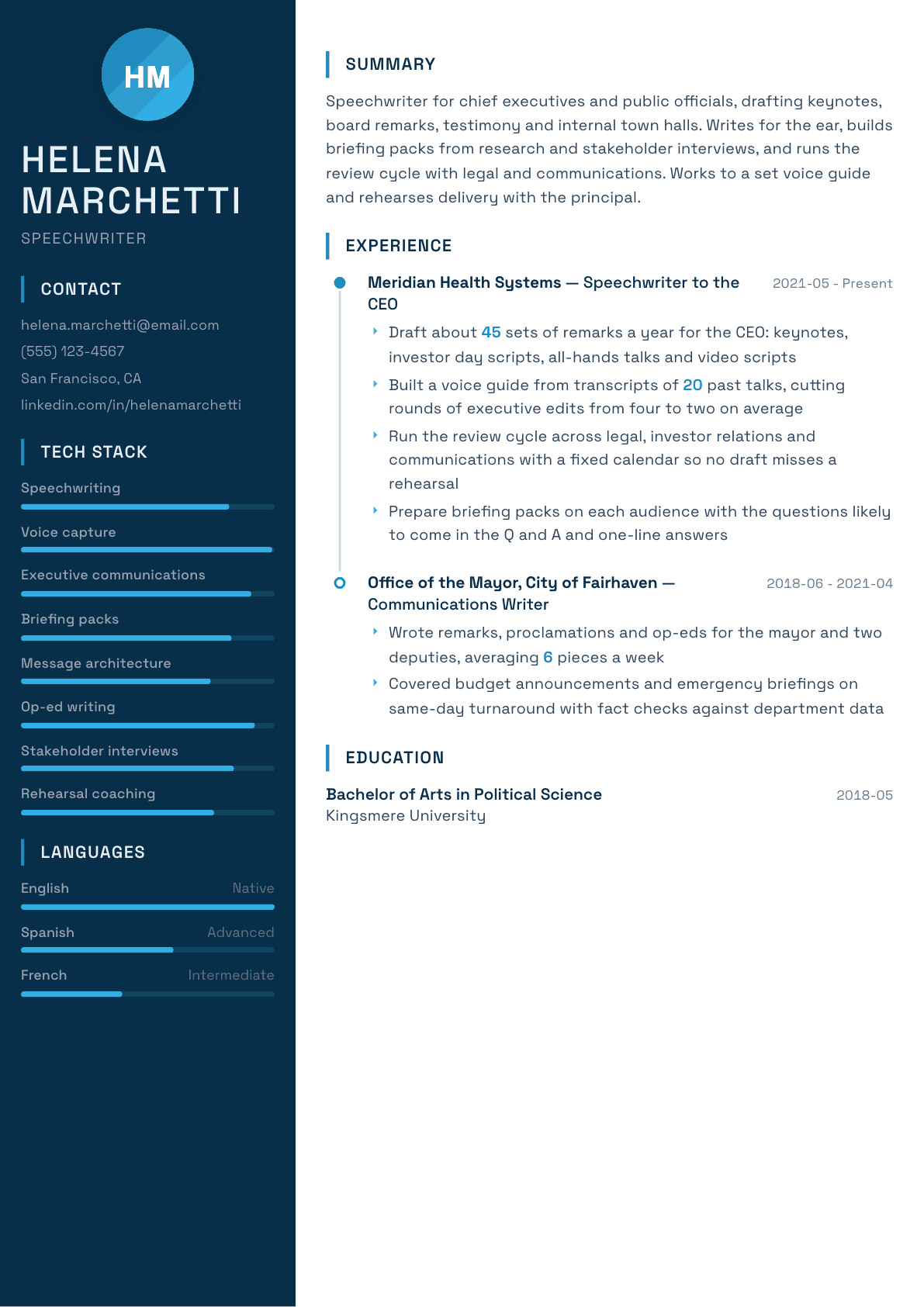
Example Speechwriter summary
Speechwriter for chief executives and elected officials, drafting about forty-five sets of remarks a year across keynotes, board talks, testimony and internal town halls. Builds a voice guide from transcripts and interviews, prepares audience briefing packs with likely questions, and runs the legal and communications review on a fixed calendar. Cut average executive edit rounds from four to two.
Skills to list on a Speechwriter resume
- Speechwriting
- Executive communications
- Voice and tone matching
- Message architecture
- Briefing and research packs
- Op-ed and byline writing
- Talking points
- Testimony preparation
- Stakeholder interviews
- Rehearsal and delivery coaching
- Crisis messaging
- Teleprompter scripting
- Confidentiality management
What actually gets this resume read
- Say who you wrote for by role rather than name when the work was confidential, such as a health system CEO.
- Give the annual volume of remarks and the range of formats, from keynote to testimony to internal town hall.
- Prove voice capture: describe how you build a voice guide from transcripts and interviews with the principal.
- Show the review cycle you manage across legal, communications and investor relations, since that is half the job.
- Add audience size or setting for two signature moments, such as an annual meeting or a legislative hearing.
- State your confidentiality practice, because principals need to know their drafts and your samples stay private.
How to write a speechwriter resume
Speechwriting is hired on trust before craft. The person reading your resume is deciding whether to let you inside the room where a chief executive says something unfinished out loud, or where an official rehearses testimony before a hearing. That means the file has to prove three things: you can capture a voice that is not yours, you can survive a review cycle with legal and communications, and you can be trusted with what you hear along the way.
It also has to survive an unusual constraint. Much of your best work is either confidential or credited to someone else, so the normal portfolio argument is unavailable. The way around it is to describe volume, formats, process and outcomes rather than reproducing text, and to name principals by role rather than by name when the work was private.
This guide covers how to structure the file around voice and process, how to write bullets about words that carry another person name, three summaries at different levels, and the questions speechwriters ask when they move between political, corporate and agency work.
Format: two pages, plain, with the principal roles up front
Keep it conventional and unornamented. Communications leaders read a lot of resumes and a decorated one from a writer suggests style over substance. Two pages is fine once you have written for more than one principal, with the first page carrying current work and the formats you cover.
Name principals by role when the work was confidential: a health system chief executive, a mayor, a university president, a chief financial officer at a listed company. That gives the reader the seniority and the risk level without breaching anything, and it demonstrates the discretion the job requires more effectively than a promise would.
- Header: name, city and state, phone, email, and the sectors you have written in.
- Section order: summary, speechwriting experience, formats and volume, process, other writing, education.
- Add a formats line covering keynotes, board and investor remarks, testimony, town halls, video scripts and op-eds.
Summary: who you wrote for, how much, and in what formats
Open with the level of the principal and the sector, then the annual volume of remarks, then the format range. Forty-five sets of remarks a year spanning keynotes, investor day scripts, all-hands talks and video is a workload a communications director can compare against her own calendar.
Finish with the differentiator that matters most in this trade: voice. Say how you build a voice guide, from transcripts of past talks and sessions with the principal, and give the effect it had, usually a reduction in edit rounds. A speechwriter who reduces the number of times a chief executive rewrites a draft is buying back the most expensive hours in the organization.
Experience: volume, stakes, and the review cycle you run
Give the annual count and break it by format, because the formats have different difficulty. An all-hands talk is written for a room that already knows the speaker. A keynote is written for strangers. Testimony is written to be quoted against the speaker later, and an investor day script is written with counsel reading every line. Naming the range proves you can move between registers.
Then describe the review cycle, which is half the job. Legal, investor relations, communications, subject matter experts and sometimes a board chair all touch the draft. Say how you sequence them, what deadline structure you enforce, and how you protect the voice through the edits, because losing the voice to committee is the standard failure mode of the role.
Add the preparation work behind the text. Audience research, stakeholder interviews, briefing packs with likely questions and one-line answers, rehearsal with the principal, teleprompter formatting and timing to the minute. The resume that includes rehearsal and question preparation reads as a communications partner rather than a supplier of paragraphs.
Give two signature moments with the setting and audience size rather than the content. An annual meeting, a legislative hearing, a national conference or a crisis briefing tell the reader the pressure level you have already worked under.
Voice capture: the part that decides the hire
Explain your method explicitly, because most candidates assert voice capture and few describe it. Transcribing past talks and marking recurring rhythms, sentence lengths and favored constructions, listening for the anecdotes the principal reaches for naturally, sitting in on unscripted meetings, and writing a short voice guide that another writer on the team could use are all concrete steps.
Include the checks you run for the ear rather than the eye. Reading drafts aloud against a timer, breaking lines for breath, avoiding constructions that fail when spoken, and rewriting any sentence the principal stumbles over twice in rehearsal. Prose written for a page and prose written for a podium are different crafts, and saying so plainly separates you from the applicants who send an essay as a sample.
- Say how many past talks you analyze before writing for a new principal.
- Describe how you handle a principal who edits heavily, since managing that relationship is part of the role.
- State your confidentiality practice for drafts, briefing material and samples rather than claiming to be discreet.
Samples, keywords and the writing test
Nearly every hire ends with a test: a set of remarks written to a brief for a real or invented principal, usually with a short turnaround. Prepare two sanitized samples, one corporate and one public sector, with names and identifying details removed and a note explaining the restriction. Offering that on the resume answers the confidentiality question before it is asked.
Recurring posting terms are executive communications, message architecture, talking points, briefing materials, op-ed and byline writing, internal communications, crisis messaging and teleprompter scripting. Use the wording the posting uses once in a skills block and once inside a bullet where the work is shown.
Speechwriter resume summary examples
Communications writer moving into remarks
Communications writer producing remarks, proclamations and op-eds for a mayor and two deputies, averaging six pieces a week. Covers budget announcements and emergency briefings on same-day turnaround, fact-checking every figure against department data before the podium.
Five years writing for principals
Speechwriter to a health system chief executive, drafting about 45 sets of remarks a year across keynotes, investor day scripts, all-hands talks and video. Built a voice guide from transcripts of 20 past talks that cut executive edit rounds from four to two, and runs the legal and communications review on a fixed calendar.
Head of executive communications
Executive communications lead writing for a chief executive and three officers, with two writers reporting in. Owns the message architecture for the annual meeting cycle, prepares testimony and briefing packs for regulatory hearings, and has led crisis messaging through a recall and a leadership transition.
Work experience bullets: before and after
Before: Wrote speeches for the CEO.
After: Drafted about 45 sets of remarks a year for the chief executive, spanning keynotes, investor day scripts, all-hands talks and video narration.
Annual volume and format range show the workload and the register shifts the job actually demands.
Before: Captured the executive voice well.
After: Built a voice guide from transcripts of 20 past talks and three sessions with the principal, cutting average executive edit rounds from four to two.
A method plus a measurable effect converts the vaguest claim in the trade into evidence.
Before: Coordinated with legal and communications on drafts.
After: Ran the review cycle across legal, investor relations and communications on a fixed calendar so every draft cleared approvals before the scheduled rehearsal.
The sequencing and the deadline structure prove you can protect a draft through committee.
Before: Prepared the speaker for events.
After: Prepared briefing packs on each audience with the likely question and answer session mapped and one-line answers rehearsed with the principal.
Question preparation and rehearsal position you as a communications partner rather than a text supplier.
Before: Wrote op-eds that were published.
After: Placed six bylined op-eds a year under the principal name in regional and trade outlets, working with the communications team on pitch and timing.
Placement volume and the pitching partnership show the work landed rather than merely being written.
Hard skills
- Speechwriting for the ear
- Executive communications
- Voice and tone matching
- Message architecture
- Briefing and research packs
- Talking points and Q and A preparation
- Op-ed and byline writing
- Testimony preparation
- Teleprompter scripting and timing
- Stakeholder interviews
- Crisis and holding statements
- Internal and all-hands communications
- Review cycle management
Soft skills
- Discretion and confidentiality
- Ego subordinated to the principal
- Reading a room and an audience
- Composure at short notice
- Diplomacy with reviewers
- Listening for what someone means to say
Certifications worth listing
- Accredited in Public Relations (APR) (Public Relations Society of America)
- Communication Management Professional (CMP) (Global Communication Certification Council)
Mistakes that cost speechwriter candidates the interview
- Naming confidential principals, which proves the exact opposite of the discretion the job requires.
- Sending an essay or article as the sample when the hire is about words written to be spoken aloud.
- Leaving out the review cycle, which is half the work and the part that separates senior from junior writers.
- Asserting voice capture without describing a method, when every applicant makes the same claim.
- Giving no annual volume or format range, so the reader cannot tell a full-time writer from an occasional one.
- Quoting long passages of a principal remarks to fill the page instead of describing process and outcome.
- Ignoring preparation work such as briefing packs and rehearsal, which is where the trust is really earned.
Speechwriter resume questions
How do I show speechwriting samples if the work is confidential?
Prepare two sanitized samples with names, figures and identifying details removed, and say on the resume that samples are available under those conditions. Describe volume, formats and the review process for everything you cannot show.
Should a speechwriter resume name the executives written for?
Name them only when the credit is public, such as a published byline or an acknowledged role. Otherwise use the role and the sector, which conveys seniority and stakes while demonstrating the confidentiality practice the next principal will rely on.
Is political speechwriting experience transferable to corporate work?
Yes, and the pressure and turnaround usually translate well. Reframe the vocabulary for the reader: constituent audiences become employees and investors, department data becomes financial reporting, and legislative sensitivities become disclosure rules and counsel review.
What do hiring managers test in a speechwriting exercise?
Usually voice, structure and restraint. They give a brief with a principal and an audience and see whether you write to be spoken rather than read, land an opening that earns attention, and keep to the requested length without padding.
How many words is a typical set of remarks?
Plan on roughly 130 to 150 spoken words a minute, so ten minutes of remarks runs near 1,400 words. Saying that you write and time to the minute signals you understand the podium constraint rather than treating a speech as an article.