Grant Writer Resume Examples: free ATS score and gap list
Fund Your Future with a Grant Writer Resume
By Mustafa Tarabya, founder of CVBooster · Published · Updated
Build a grant writer resume showcasing your proposal writing, research skills, and track record of securing funding from foundations and government agencies.
Sample resumes for a grant writer
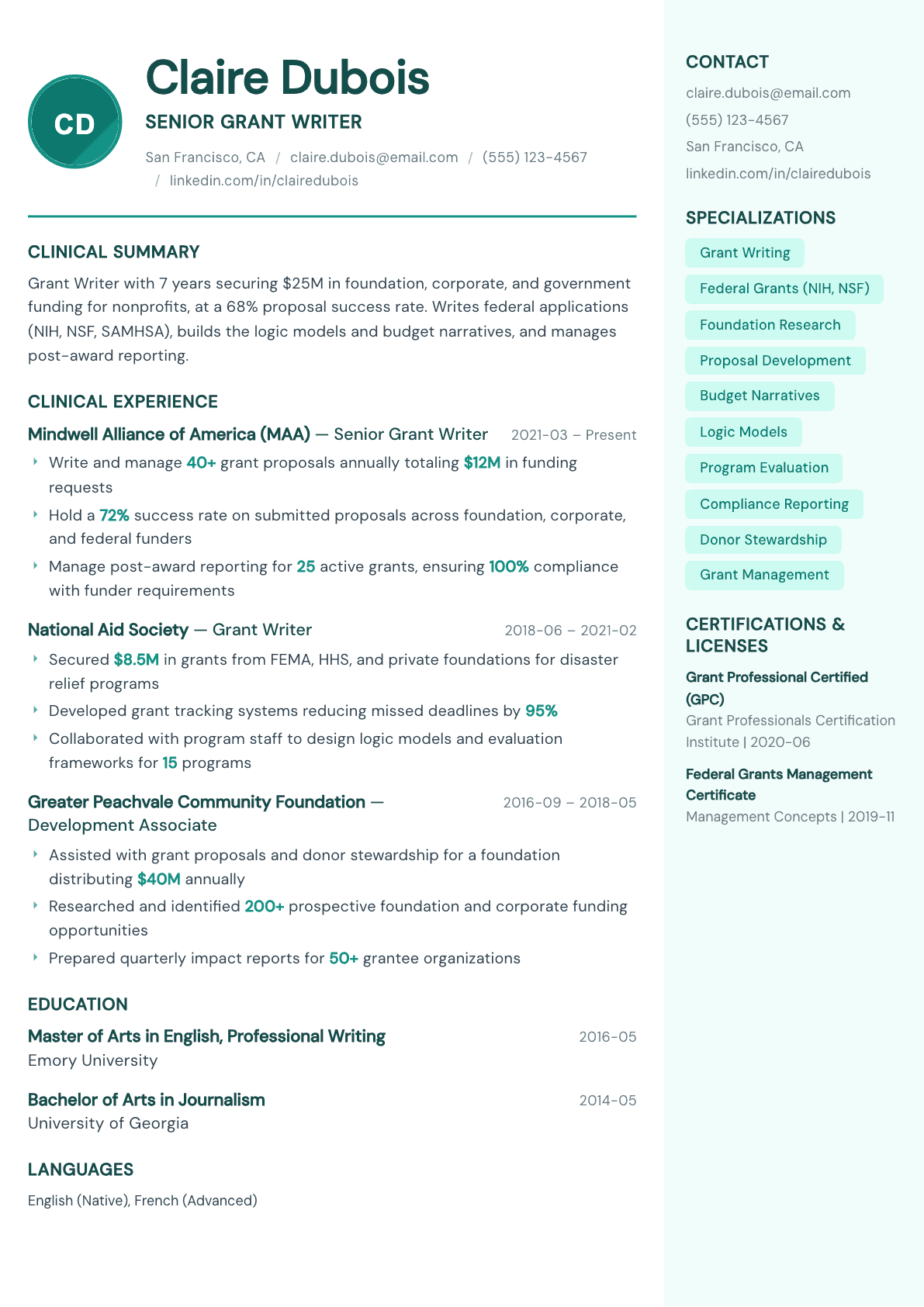
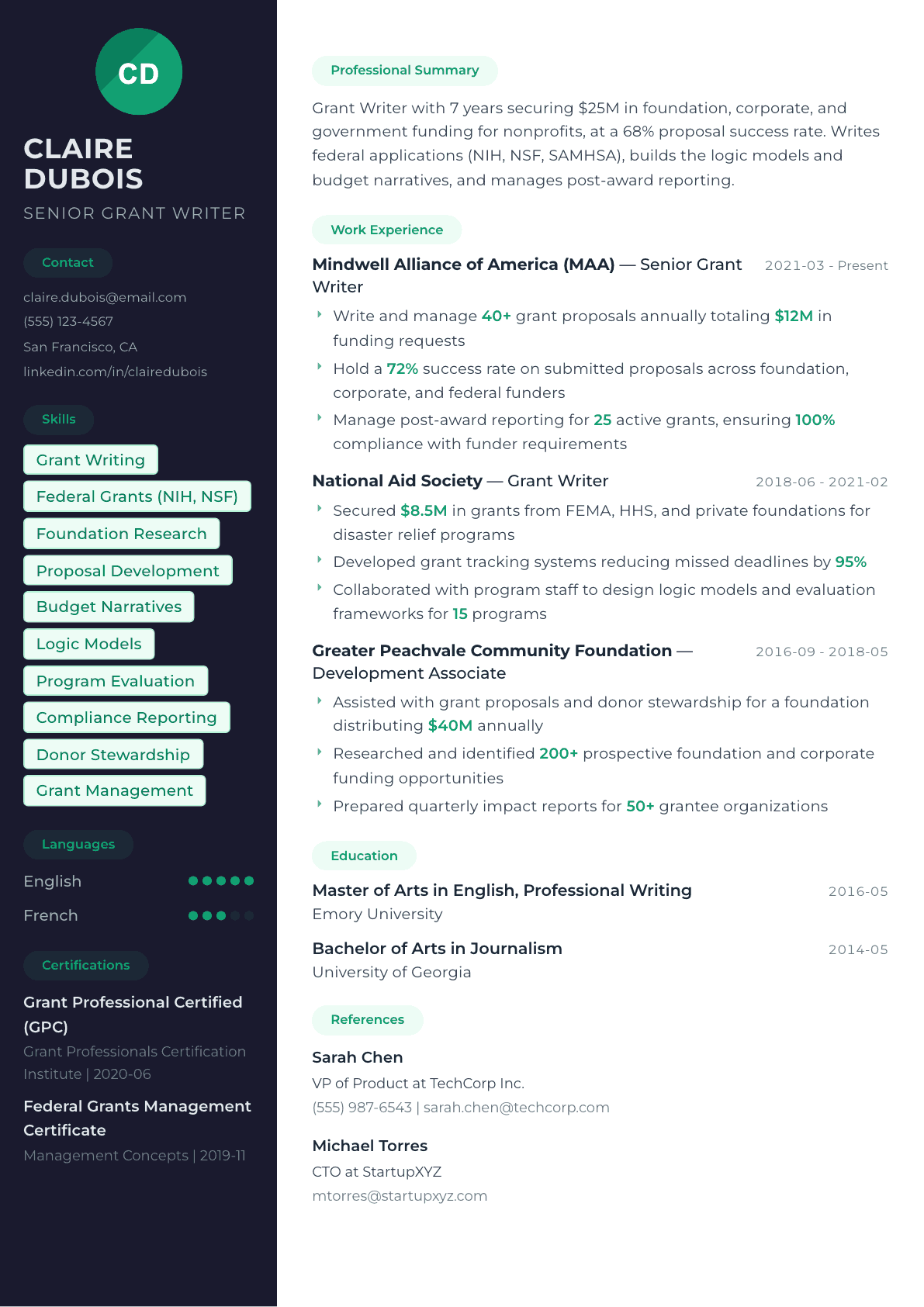
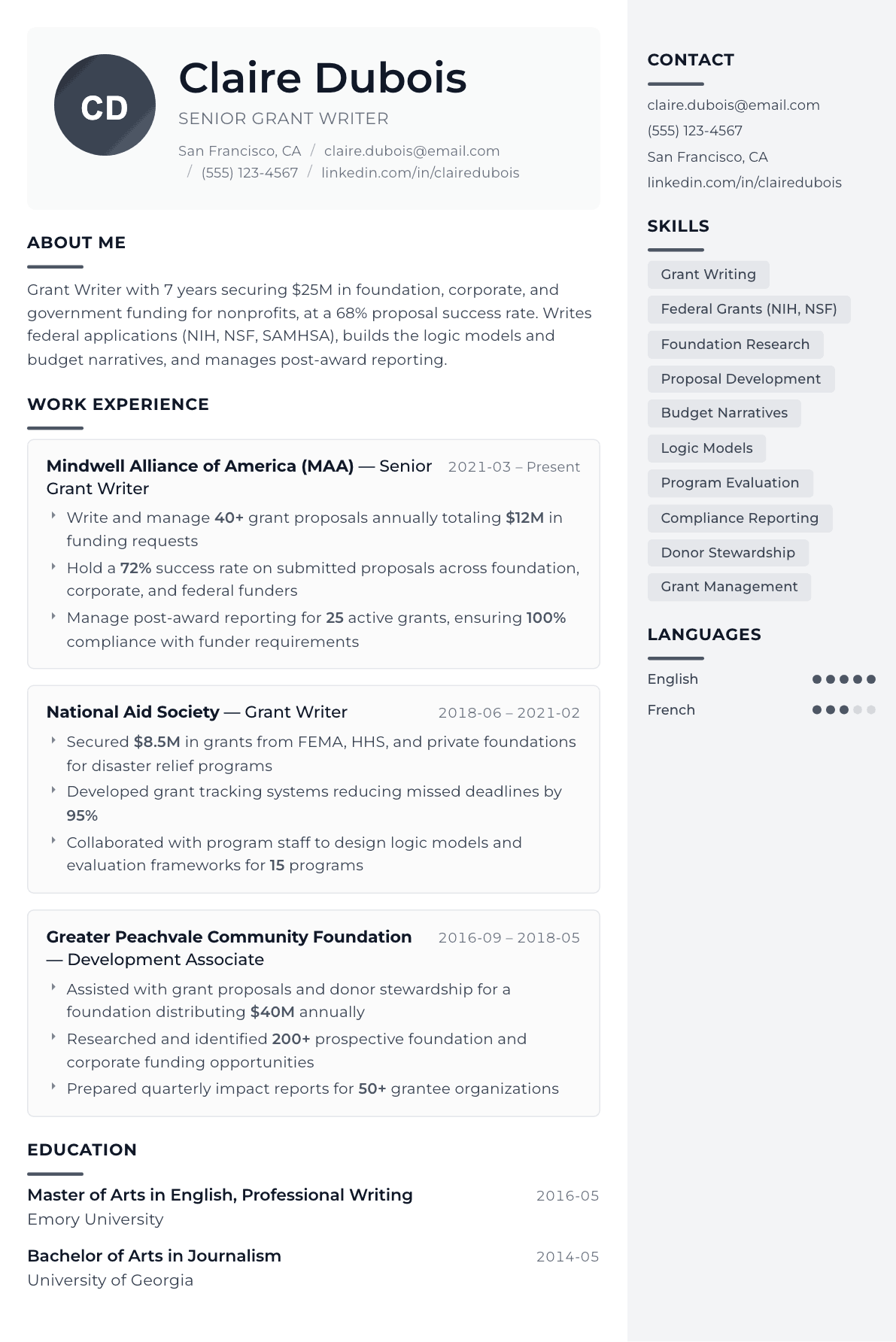
The same grant writer content laid out in three CVBooster templates, so you can see what the finished document looks like before you write a word.
Example Grant Writer summary
Senior Grant Writer with 7 years of experience securing $25M+ in grants from federal agencies, foundations, and corporations. Maintains a 68% proposal success rate and manages 25+ active grant portfolios. Seeking a director of grants role at a mission-driven organization.
Skills to list on a Grant Writer resume
- Grant Writing
- Federal Grant Applications
- Foundation Research
- Proposal Development
- Budget Development
- Logic Models
- Program Evaluation
- Compliance & Reporting
- Donor Research
- Grants Management
- Data Analysis
- Persuasive Writing
- Strategic Planning
- CRM / Grant Databases
What actually gets this resume read
- Lead with your funding track record: total dollars secured, success rate, and types of funders.
- Quantify your proposal volume: applications submitted per year, average grant size, portfolio managed.
- Include GPC certification as it is the gold standard credential for grant professionals.
- Specify funder types: federal agencies (NIH, NSF, SAMHSA, FEMA), foundations, corporate sponsors.
- Highlight compliance and reporting skills. Funders value writers who manage the full grant lifecycle.
How to write a grant writer resume
A grant writer resume is one of the few resumes that is itself a writing sample. The person hiring you spends their week reading proposals, and they will read your bullets the way a program officer reads a narrative: looking for a clear need statement, a specific ask, and evidence rather than adjectives. A vague grant writer resume argues against itself.
What they want to establish quickly is the kind of funder you write to. Private foundation letters of inquiry, federal applications submitted through Grants.gov, state formula and competitive awards, corporate giving, and research proposals through a university sponsored programs office are five different crafts with different page limits, review criteria and compliance burdens. Writers who do not name their funder types get sorted into the generic pile.
This guide covers how to structure the resume, how to report a success rate honestly, summaries from a first grants job through a lead proposal writer, and rewrites that show submission volume, funder relationships and the compliance work that happens after the award.
Format: one page early, two once you have a federal record
Keep the document clean and conventional. A grants hiring manager will notice unusual formatting the way a reviewer notices a proposal that ignores the page limit, and neither reaction helps you. One page until you have several years of submissions, two once you have a federal or research portfolio worth listing.
Consider a short funders line under the summary that names the agencies and foundation types you have written to. It functions the way a technology stack functions on an engineering resume: it tells the reader in one line whether you can do the specific work they need done next month.
- Order: summary, funder types, grants experience, writing and research skills, education, credentials.
- Name the submission portals you have worked in, since they are a real barrier for new writers.
- Keep the resume free of design flourishes, because plain formatting is the norm the field expects.
Summary: funder mix, volume, and what you win
Say what you write, to whom, and how much of it. Volume matters in this job: a writer who submits forty proposals a year has different habits from one who writes four large federal applications. Then name the subject areas, because a health services writer moving into arts funding has a learning curve a hiring manager will want to discuss.
Be careful with the win rate. State it with the denominator and the type of application, since a foundation renewal rate and a competitive federal rate are not comparable numbers, and an inflated figure invites a question you cannot answer.
Experience: the whole grant cycle, not just the narrative
The narrative is the visible part and the smallest part. Show the research and qualification work: prospect screening in Candid, Instrumentl or Grant Station, reading the last few years of a funder's awards, and the discovery call with a program officer that decides whether to apply at all.
Then show what makes an application actually submittable: the logic model, the evaluation plan, the budget and budget narrative built with the finance staff, the letters of support you chased, the registrations such as SAM.gov and a Unique Entity Identifier, and the attachments and certifications that sink applications when they are late.
Finish with post-award work, since most grant writer jobs are really grant management jobs with writing attached. Interim and final reports, expenditure tracking against the approved budget, no-cost extensions, budget modifications, and the calendar that keeps a dozen report deadlines from colliding.
- Proposals submitted per year and the range of award sizes.
- Funder types: private foundation, family foundation, corporate, city, state, federal.
- Portals: Grants.gov, eRA Commons, Research.gov, state and city systems, foundation portals.
- Post-award: reporting, budget modifications, compliance with award terms.
- Collaboration: program staff interviews, finance for budgets, evaluators for outcome measures.
Show that you can write, without saying you write well
Everyone claims strong writing. Prove it by describing what your writing had to do. Compressing a complex program into a two-page letter of inquiry, translating clinical outcomes for a lay review panel, rewriting a need statement around current local data, and building a reusable boilerplate library that cut drafting time are all specific, checkable claims.
If you have served as a grant reviewer for a foundation, a state agency or a federal panel, put it on the resume. Reading fifty applications against a scoring rubric changes how a writer writes, and hiring managers know it.
Skills and education: research, evaluation, and the vocabulary
The skills that carry weight are research and evaluation literacy: logic models, theory of change, SMART objectives, needs assessment using census and public health data sources, and the difference between outputs and outcomes. Add the practical ones: budget building, cost allocation across awards, and version control on a document with six contributors.
Degrees in English, public health, social work, public administration and the sciences all appear in this field. What matters more is a demonstrated ability to learn a program area fast, so if you have moved between subject areas successfully, make that visible.
Grant Writer resume summary examples
First grants role
Grant writer with 2 years supporting a community health center, drafting 24 foundation proposals and letters of inquiry a year and managing reporting for 9 active awards. Built the prospect research process in Instrumentl and wrote the first reusable organizational boilerplate.
Five years in
Grant writer with 5 years across foundation and government funding for youth development programs, submitting roughly 35 applications a year with a 41% award rate on foundation requests. Experienced with state competitive awards, logic models and budget narratives built with finance.
Lead proposal writer
Lead grants writer with 11 years including federal applications through Grants.gov and eRA Commons, managing a portfolio of 20 active awards and supervising 2 writers. Served on a state review panel, and rebuilt the reporting calendar after 3 late submissions predated my arrival.
Work experience bullets: before and after
Before: Wrote grant proposals for the organization.
After: Drafted and submitted 35 proposals a year across private foundation, city and state funders, from 2-page letters of inquiry to 30-page competitive applications with logic models and evaluation plans.
Volume, funder mix and the range of formats tell a hiring manager exactly what you can be handed.
Before: Successful in securing grant funding.
After: Won 14 of 34 foundation requests and 3 of 7 state competitive applications, including 2 first-time funders identified through prospect research rather than existing relationships.
A rate with its denominator and a note on new funders is verifiable, where a bare success claim is not.
Before: Managed reporting requirements for awards.
After: Managed reporting for 20 active awards, built a shared deadline calendar with program and finance leads, and submitted every interim and final report on time across 2 fiscal years.
Portfolio size, the coordination mechanism and an on-time record are what post-award management is judged on.
Before: Worked with program staff to gather information.
After: Ran structured interviews with 8 program managers to build a boilerplate library of need statements, outcome data and staff biographies, cutting first-draft time on a standard proposal by half.
The process and the time saved show a writer who improved the system, not just the document.
Before: Familiar with federal grant applications.
After: Submitted federal applications through Grants.gov and maintained SAM.gov registration and the Unique Entity Identifier, coordinating attachments, certifications and letters of support ahead of the deadline.
Naming the portals and registrations proves hands-on federal experience that familiarity language hides.
Hard skills
- Proposal and narrative writing
- Letters of inquiry
- Federal applications and Grants.gov
- Prospect research and funder screening
- Logic models and theory of change
- Evaluation plans and outcome measures
- Budget and budget narrative development
- Post-award reporting and compliance
- Needs assessment with public data
- Instrumentl and Candid research tools
- Letters of support coordination
- Boilerplate and content library management
Soft skills
- Interviewing program staff
- Working to a hard deadline
- Editing other people's prose
- Translating technical detail
- Persistence with program officers
- Accuracy under page limits
Certifications worth listing
- Grant Professional Certified (GPC) (Grant Professionals Certification Institute)
- Certified Grants Management Specialist (CGMS) (National Grants Management Association)
- Certified Fund Raising Executive (CFRE) (CFRE International)
Mistakes that cost grant writer candidates the interview
- Quoting a success rate with no denominator and no funder type, which an experienced reader will discount entirely.
- Listing only the narrative work and leaving out budgets, attachments and reporting, which is most of the job.
- Failing to name funder types, so the reader cannot tell whether you have ever handled a federal application.
- Claiming strong writing skills instead of describing what a particular piece of writing had to accomplish.
- Naming confidential funder relationships or declining amounts in a way that embarrasses a current employer.
- Submitting a resume with a typo, which in this role is read as evidence about your proposals.
- Ignoring grant review panel service, which is one of the strongest signals a grant writer can carry.
Grant Writer resume questions
Should I put my grant success rate on my resume?
Yes, if you can state it precisely with the denominator and the funder type. Separate foundation requests from competitive government applications, since the odds differ enormously. A vague high rate reads as unverifiable and invites a skeptical interview question.
Do I need a Grant Professional Certified credential?
It is not required for most jobs and many strong writers do not hold one. It helps when you are moving between sectors or competing for a senior grants role, because it signals familiarity with ethics and post-award standards that resumes rarely otherwise show.
How do I break into grant writing with no paid grants experience?
Volunteer to write for a small organization, document what you submitted and won, and take a course on logic models and budgets. Then present that work exactly as you would paid work, with funder types, volume and outcomes attached.
Should freelance grant writers list client names?
Name organizations only with permission, and describe the rest by sector and size. What a hiring manager actually needs is the funder types, the award ranges and the volume, which you can present fully without breaking a client confidence.
How much program knowledge do I need for a new subject area?
Enough to write a credible need statement and to ask program staff sharp questions. Hiring managers care more about how fast you learn than about prior subject expertise, so show a time you moved into an unfamiliar field and won there.
Related resume examples
- Development Director Resume example
- Executive Director (Nonprofit) Resume example
- Fundraising Manager Resume example
- Nonprofit Program Manager Resume example
- Executive Director Resume example
- Business Development Manager Resume example