Novelist Resume Examples: free score, then the gap list
Build a Novelist Resume for Agents and Teaching Posts
By Mustafa Tarabya, founder of CVBooster · Published · Updated
Novelist resume examples with publication credits, genre and word count, residencies and the keywords agents and programs actually read.
Sample resumes for a novelist
The same novelist content laid out in three CVBooster templates, so you can see what the finished document looks like before you write a word.
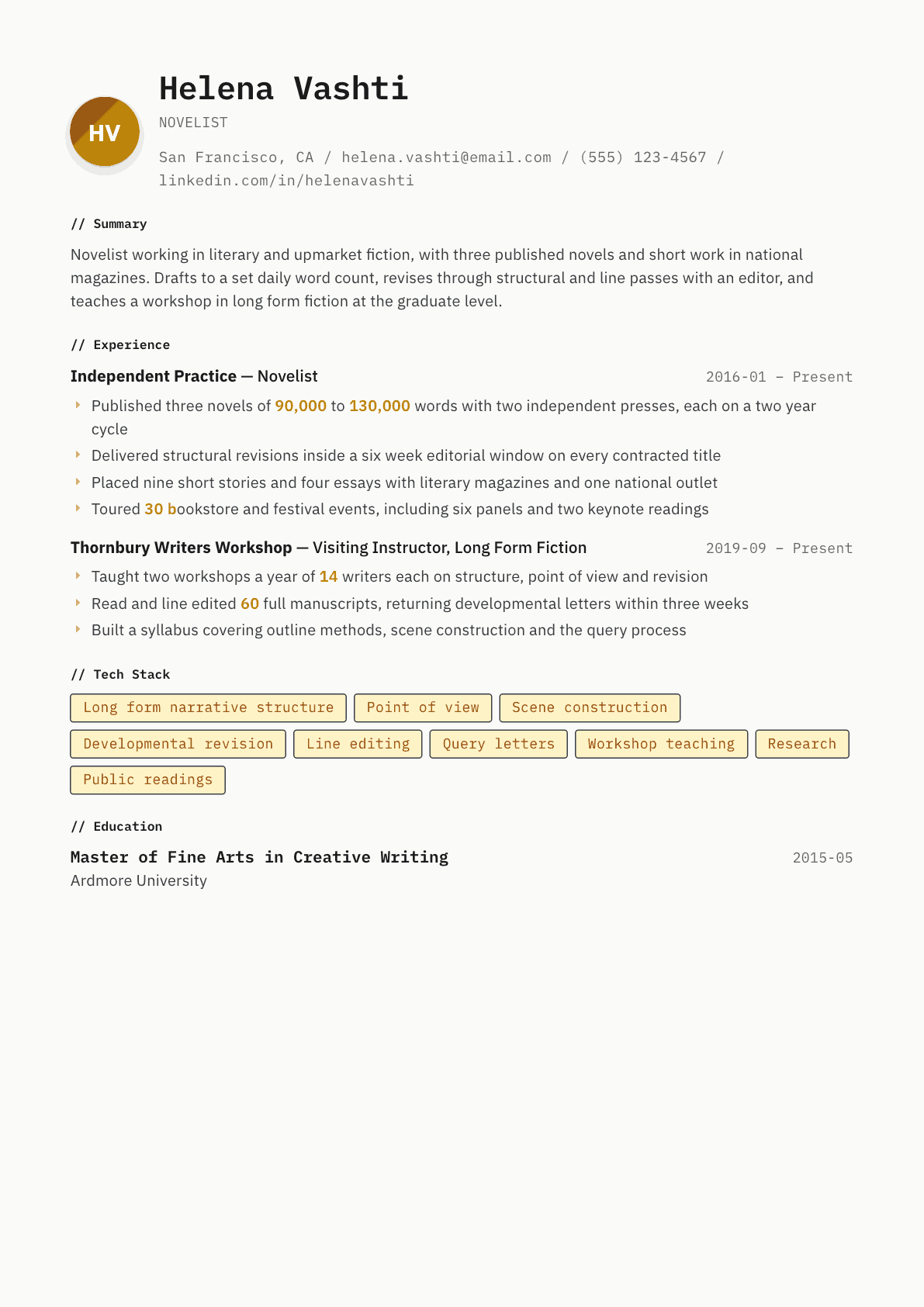
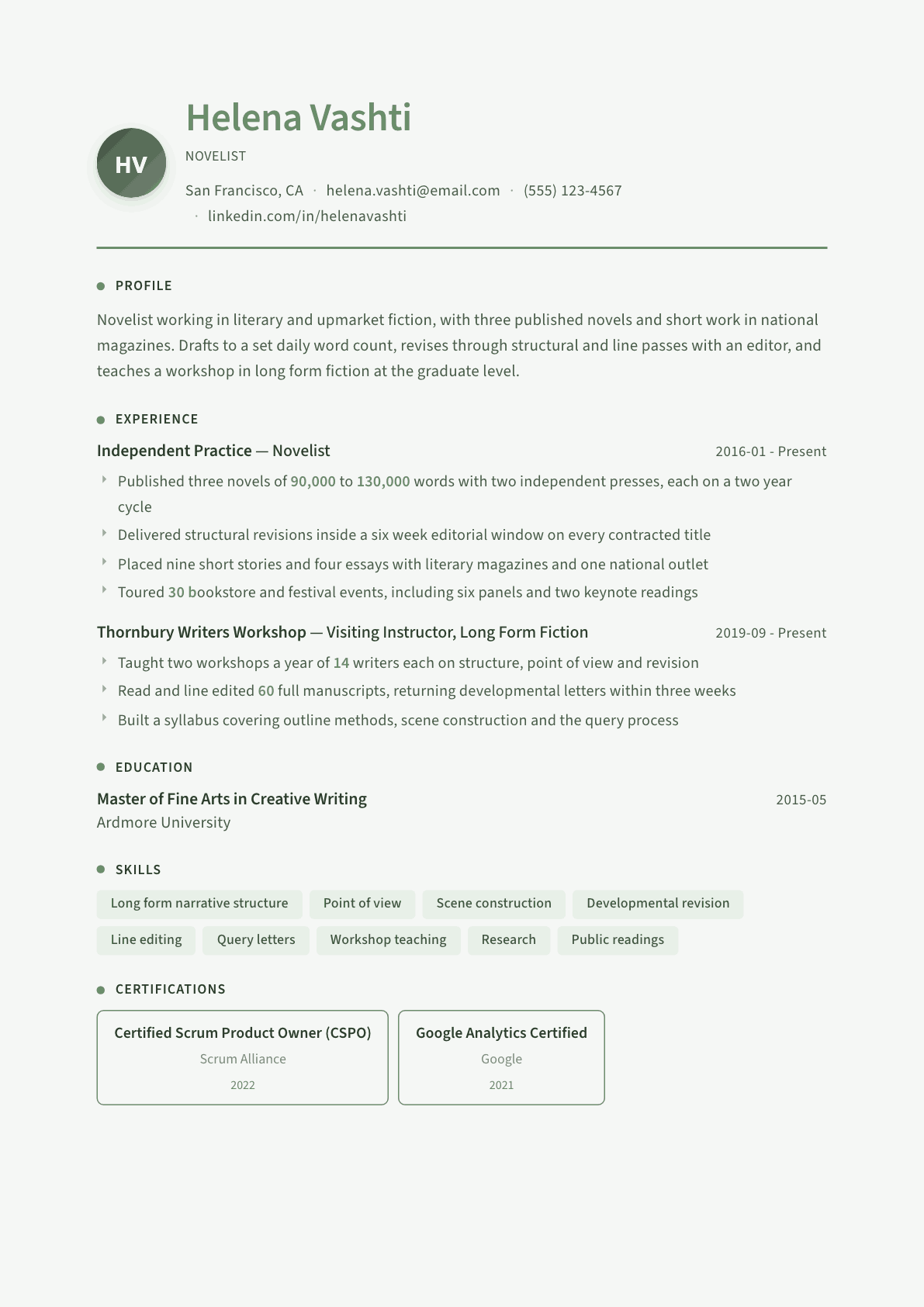
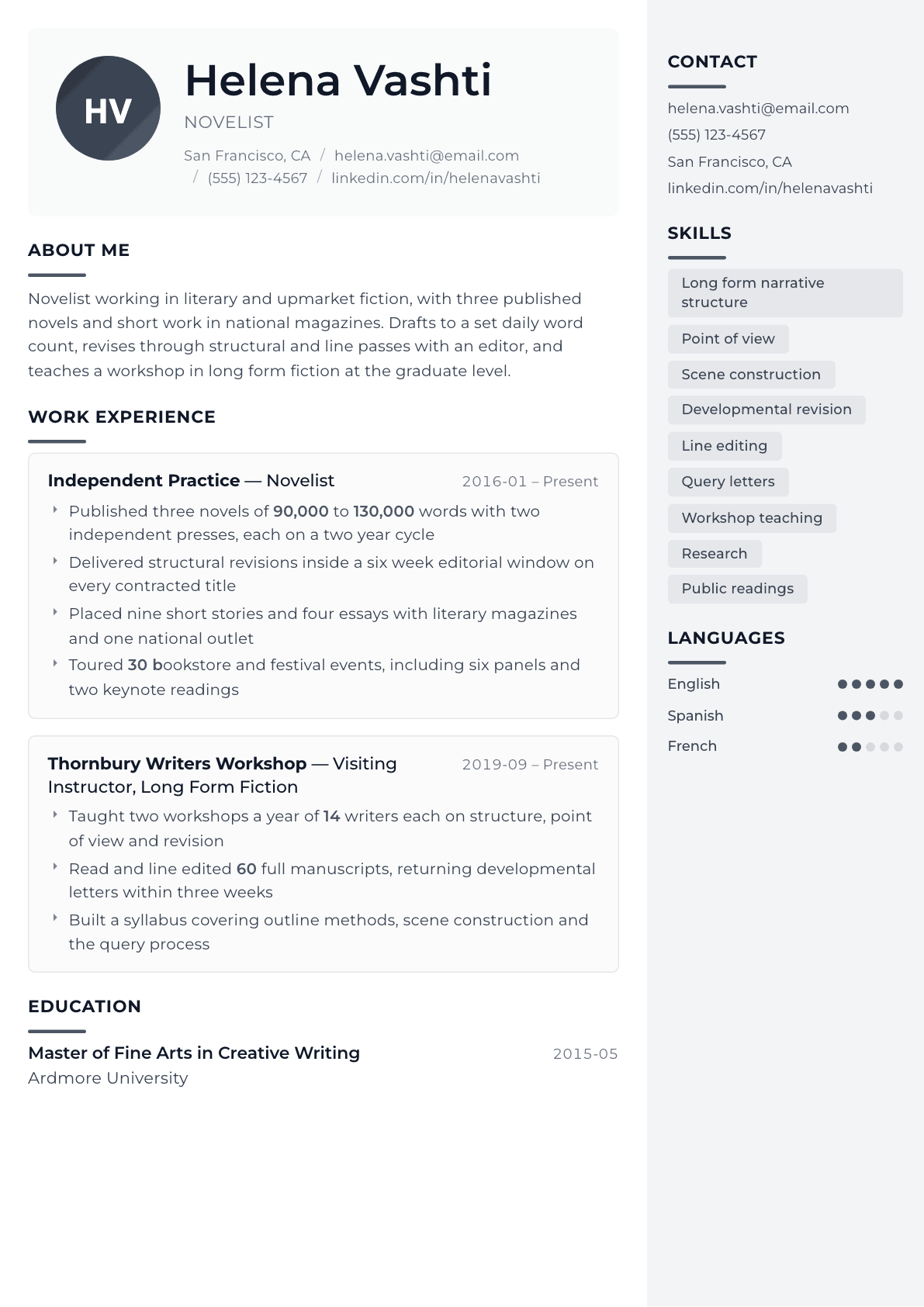
Example Novelist summary
Novelist in literary and upmarket fiction with three published novels between 90,000 and 130,000 words, plus short work in literary magazines. Delivers structural revisions inside a six week editorial window, teaches long form fiction to graduate writers, and reads 60 manuscripts a year. Seeking representation for a fourth novel and a visiting faculty term.
Skills to list on a Novelist resume
- Narrative structure
- Character development
- Point of view
- Scene construction
- Dialogue
- Developmental revision
- Line editing
- Outlining
- Query letters
- Manuscript formatting
- Research
- Workshop teaching
- Public readings
- Copyedit review
What actually gets this resume read
- Lead with a publications section: title, press, year and word count, newest first.
- Name your genre and comparable shelf placement, because agents and programs sort by category.
- List residencies, fellowships and prizes with the awarding body rather than the prize name alone.
- Give teaching credits their own section if you want a faculty post, with class size and level.
- Include short fiction and essays only when the outlet is one an editor will recognize.
- Say how you work: outline or discovery, daily word count, and how you handle a structural rewrite.
How to write a novelist resume
A novelist rarely applies for a job in the ordinary sense, so the resume does an unusual amount of work: it goes to literary agents alongside a query, to graduate programs and workshop faculties, to residency and fellowship committees, and to festivals that book panels. Each of those readers wants a different section first, which is why the document has to be organized well enough to be reordered in a minute.
What every one of them checks is the publication list. Title, press, year and word count, newest first. A committee can read a career from those four fields: whether you write long or short, whether your presses are getting stronger, whether you finish books on a rhythm or once a decade. Prose about your themes does not answer any of that.
This guide covers how to build a publications section, where teaching and residencies belong, how to describe your working method in a way that reassures an agent about the next book, and the questions novelists ask when they are asked for a resume rather than a bio.
Format: publications first, then teaching, then everything else
Reverse-chronological within each section, one page for most novelists, two once teaching and residencies accumulate. Lead with books. A resume that opens with education signals a writer who has not published yet, which is fine when true and damaging when it is not.
Keep two versions of the document. The agent version leads with books, genre and short fiction placements. The academic version leads with teaching, workshops taught, class sizes, level and syllabus design, with publications immediately after. Sending the wrong one is the most common self-inflicted wound in this field.
- Header: name, city, phone, email, and the address of a site that lists the same titles.
- Sections for an agent: publications, short fiction and essays, prizes and residencies, representation history, teaching.
- Sections for a faculty post: teaching, publications, workshops and craft talks, service, training.
Publications: title, press, year, word count, category
Give the word count for each novel. Ninety thousand words and a hundred and thirty thousand words are different books to acquire, to edit and to price, and a novelist who states length is telling an agent they understand the commercial reality of the shelf. Round to the nearest thousand and be honest.
Name your category as the trade uses it: literary, upmarket, book club, historical, speculative, crime, romance. Then keep to it across the page. A resume that claims to write literary fiction, thrillers and cozy mysteries in the same paragraph reads as someone still deciding, and agents sign writers who have decided.
List short fiction and essays only when the outlet is one an editor recognizes. Ten unnamed placements weaken a page that two named ones would have strengthened.
Method: what an agent is really asking about the next book
The unspoken question behind every submission is whether the writer can produce a second and third book on a schedule. A short method section answers it: whether you outline or discover, the daily or weekly word count you hold, and how you handle a structural rewrite when an editor asks for one after the draft is finished.
Evidence beats intention. Delivering structural revisions inside a six week editorial window on every contracted title is the kind of fact that makes an acquiring editor relax, and almost nobody puts it on the page. It is also easy to verify, which is what gives it weight.
Teaching, residencies and prizes: name the awarding body
For a teaching post, give class size, level and what you taught: structure, point of view, scene construction, revision, the query process. Add the manuscript load, since reading sixty full manuscripts a year and returning developmental letters inside three weeks is the part of the job a program is actually staffing.
For residencies and prizes, name the awarding body, not just the prize. Committees know their peers and are checking the institution as much as the honor. A shortlisting is worth listing when the body is one they recognize, and it should say shortlist rather than implying a win.
- List festival and bookstore events with the count and the format: panel, reading, keynote.
- Include translation and foreign editions with the territory and the press.
- Note agent representation history plainly, since an agent will ask about it in the first call anyway.
Keywords programs and committees scan for
The vocabulary is stable: narrative structure, point of view, scene construction, developmental revision, line editing, outlining, manuscript formatting, workshop teaching, craft talk, public readings. Use the exact terms a program posting uses once near the top and once inside a credit line.
Skip the adjectives about voice and lyricism. Those belong in the sample pages, which is where they will be judged, and on the resume they take the room a word count or a press name would use better.
Novelist resume summary examples
Unpublished, querying
Novelist working in upmarket fiction with a completed manuscript of ninety five thousand words and a second in outline. Short fiction in three literary magazines, plus a residency at a juried writers colony. Drafts to a set weekly word count and revises through structural and line passes. Seeking representation for a debut.
Two books published
Novelist with two published novels of ninety thousand and a hundred and ten thousand words with independent presses, on a roughly two year cycle. Delivers structural revisions inside the contracted editorial window, teaches an annual long form fiction workshop, and has read for a magazine fiction desk. Working on a third novel under the same category.
Established, seeking faculty
Novelist in literary and upmarket fiction with three published novels between ninety thousand and a hundred and thirty thousand words plus short work in national magazines. Teaches two graduate workshops a year of 14 writers each, reads 60 full manuscripts annually with developmental letters returned inside three weeks, and has toured 30 events.
Work experience bullets: before and after
Before: Published several novels with small presses.
After: Published three novels of ninety thousand to a hundred and thirty thousand words with two independent presses, each delivered on a two year cycle.
Word counts, press count and cadence let an agent read your commercial shape instead of guessing at it.
Before: Worked with editors on revisions.
After: Delivered structural revisions inside a six week editorial window on every contracted title, then carried each book through line edit and proofs.
Naming the window and the passes proves the reliability an acquiring editor is quietly assessing.
Before: Taught creative writing workshops.
After: Taught two graduate workshops a year of 14 writers each on structure, point of view and revision, with a syllabus covering outline methods and the query process.
Class size, level and syllabus content are what a program hires on, and none of them are visible in the weak version.
Before: Read and gave feedback on student manuscripts.
After: Read and line edited 60 full manuscripts, returning a developmental letter on each inside three weeks.
Volume and turnaround turn feedback into a workload a department chair can plan around.
Before: Did events and readings for my books.
After: Toured 30 bookstore and festival events across three launches, including six panels and two keynote readings.
Event count and format tell a publicist whether you can carry the promotion half of a book deal.
Hard skills
- Narrative structure
- Point of view
- Scene construction
- Dialogue
- Developmental revision
- Line editing
- Outlining
- Query letters
- Manuscript formatting
- Research
- Workshop teaching
- Copyedit review
Soft skills
- Working to deadline
- Taking editorial notes
- Public readings
- Peer critique
- Sustained solo focus
- Author collaboration
Mistakes that cost novelist candidates the interview
- Opening with education when you have published books, which makes a reader assume you have not.
- Leaving word counts off the novels, so an agent cannot tell a novella from a doorstop.
- Claiming three unrelated categories at once, which reads as a writer who has not chosen a shelf.
- Listing every small magazine placement instead of the two an editor would actually recognize.
- Sending the agent version of the resume to a faculty search, or the reverse.
- Writing about themes and voice on a page whose only job is to establish record and reliability.
Novelist resume questions
Does a novelist need a resume at all?
Yes, for anything other than a query letter. Residencies, fellowships, festival bookings and teaching posts all ask for one, and having a current version means you are not building it at midnight before a deadline you only just noticed.
What goes on a novelist resume before the first book sells?
Completed manuscripts with word count and category, short fiction and essay placements with named outlets, residencies and prizes with the awarding body, workshop or conference training, and any editorial or reading work you have done for a magazine.
Should I include word counts for my novels?
Yes. Length signals category, production cost and shelf placement, and stating it shows an agent you understand the trade. Round to the nearest thousand and use the final manuscript figure rather than the draft you started from.
How do I list a novel that is finished but unpublished?
In a separate section headed completed manuscripts, with the title, word count and category, and no implication of publication. Agents read that as a working writer with inventory, which is a genuine advantage over someone with a single book.
Do prizes and shortlists belong on a novelist resume?
Yes, with the awarding body named and the word shortlist used where it applies. Committees recognize their peer institutions more than individual prize names, and overstating a shortlist as a win is the kind of thing that gets checked.