Freelance Writer Resume Examples: the lines they read
Freelance Writer Resume: Freelance Writing Samples That Work
By Mustafa Tarabya, founder of CVBooster · Published · Updated
Freelance writing resume samples for content marketing, journalism and business writers, plus a freelance writer resume example and how to list clients.
Sample resumes for a freelance writer
The same freelance writer content laid out in three CVBooster templates, so you can see what the finished document looks like before you write a word.
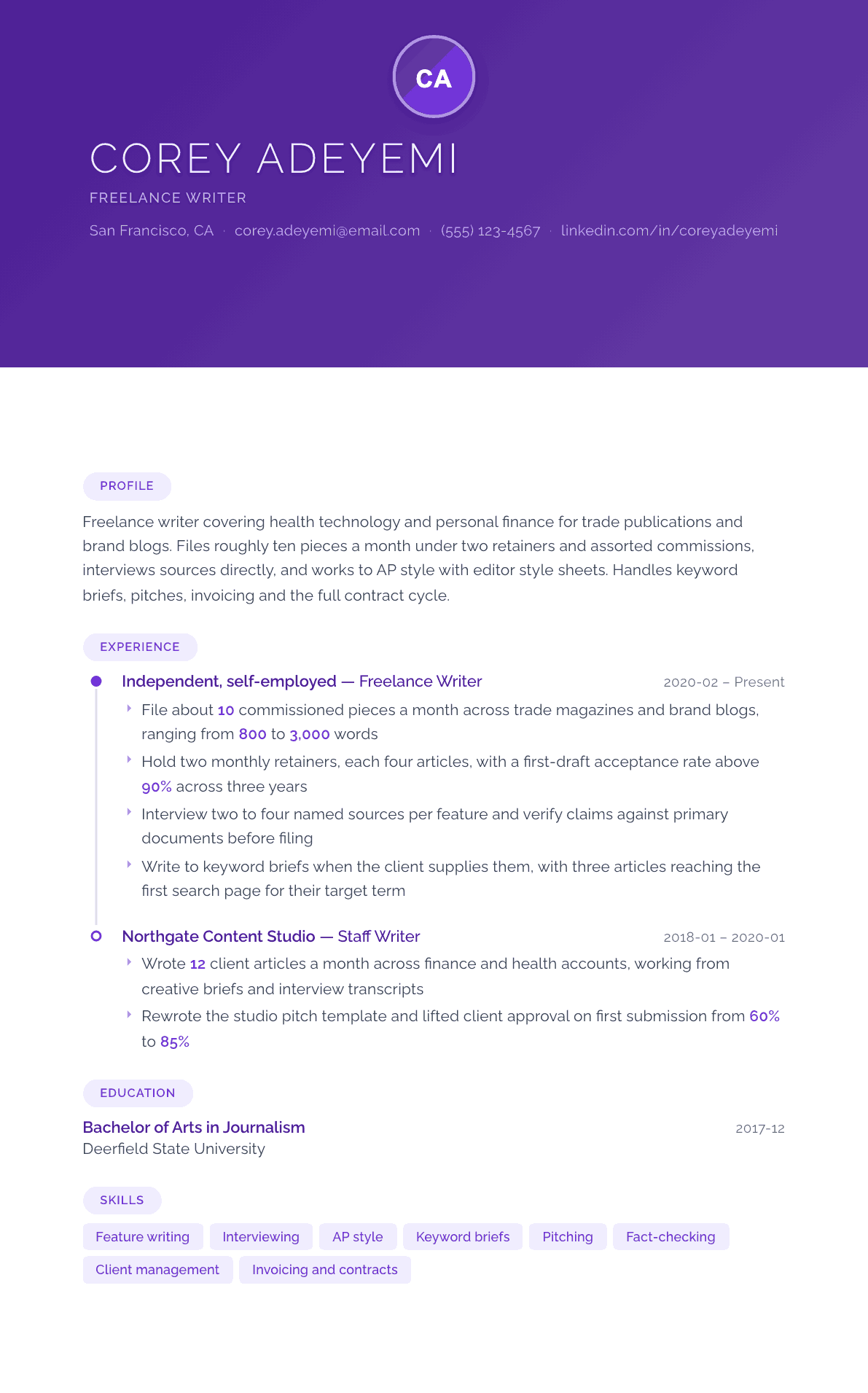
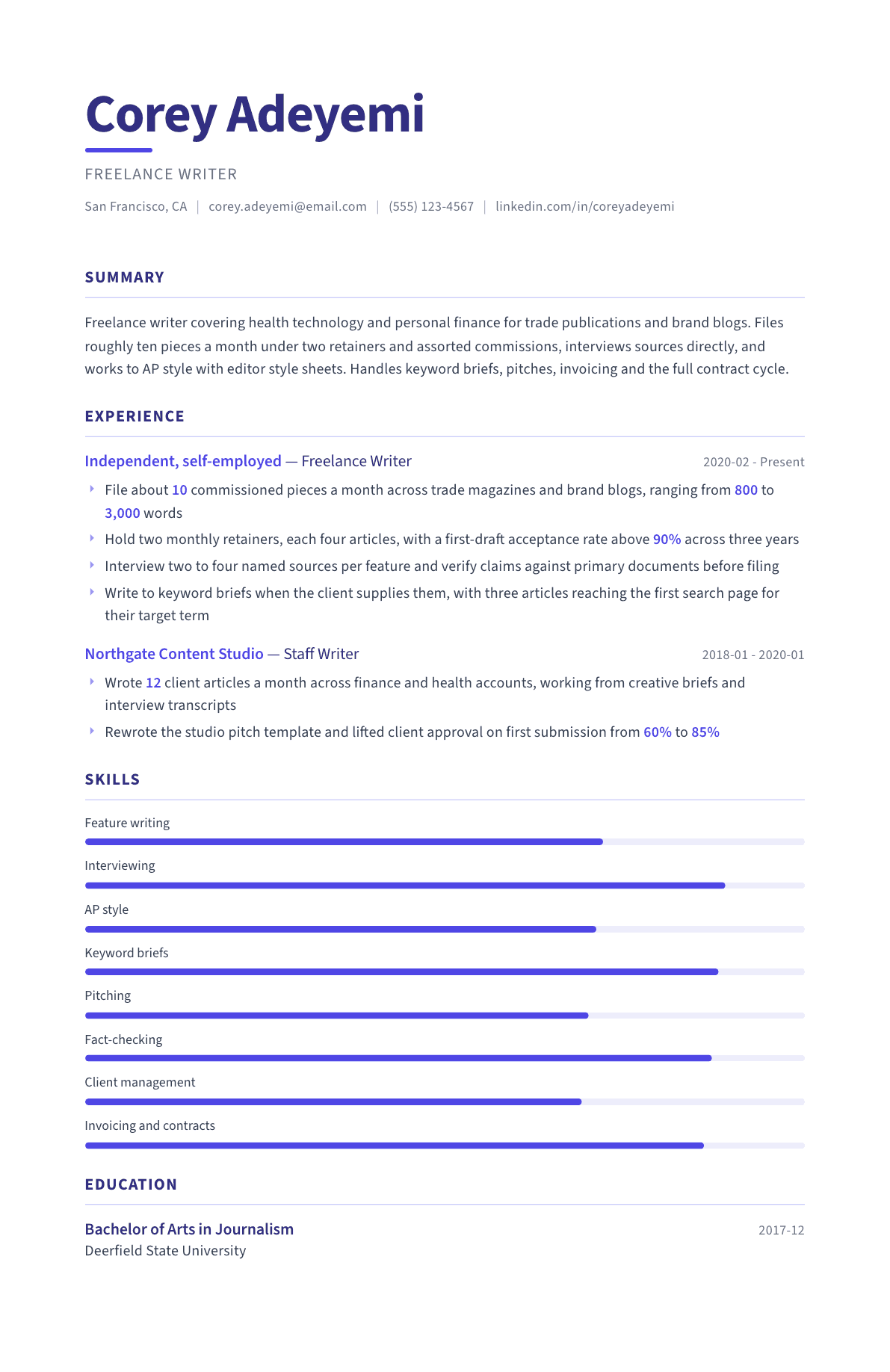
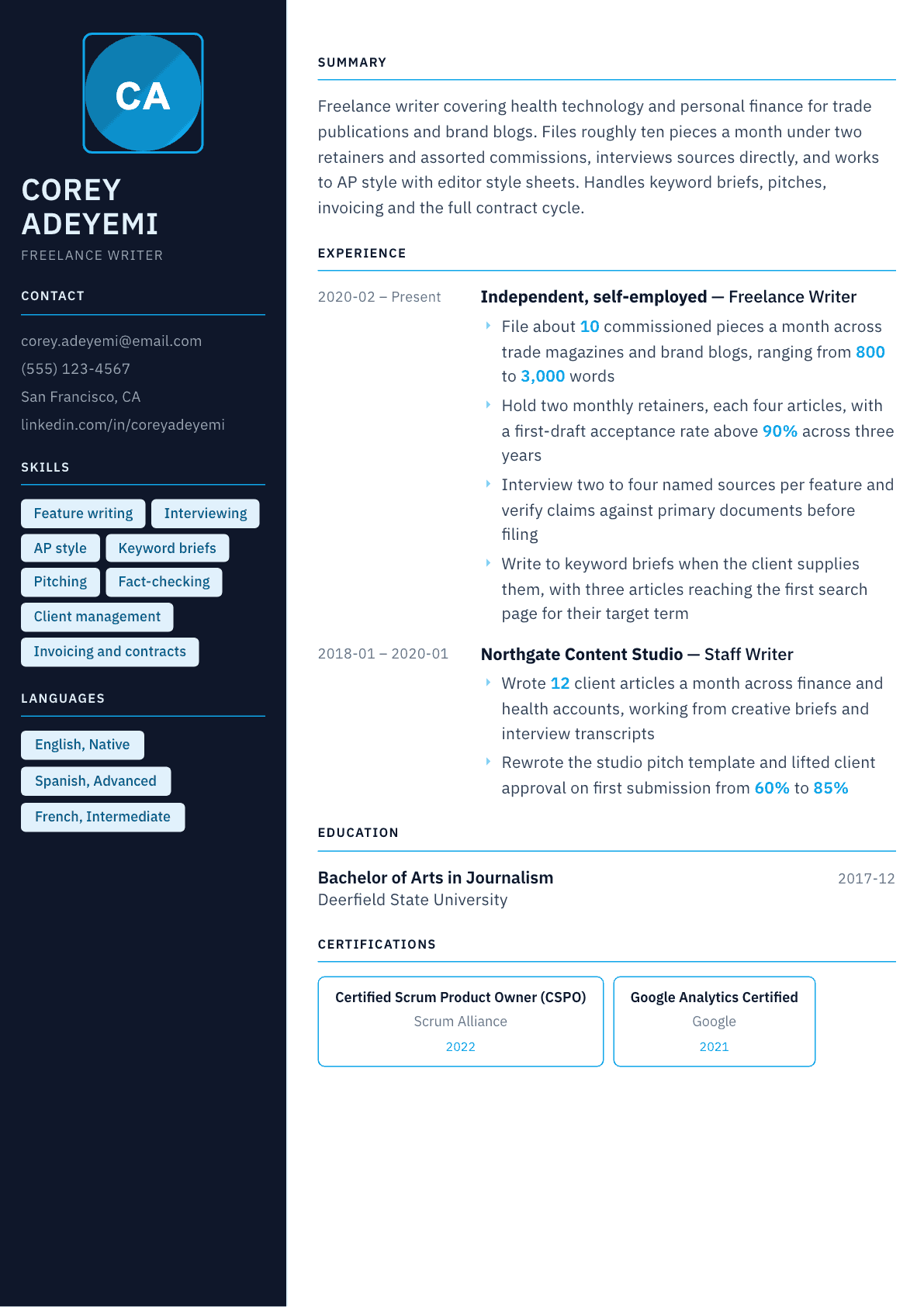
Example Freelance Writer summary
Freelance writer covering health technology and personal finance, filing about ten commissioned pieces a month for trade magazines and brand blogs. Holds two monthly retainers, interviews named sources for every feature, and writes to AP style plus client style sheets. First-draft acceptance has stayed above 90% for three years, and three keyword-brief articles now rank on the first search page.
Skills to list on a Freelance Writer resume
- Feature writing
- Interviewing
- Pitching editors
- AP style
- Long-form reporting
- SEO briefs
- Fact-checking
- Copywriting
- Ghostwriting
- Client management
- Contracts and invoicing
- WordPress
- Research
- Deadline management
What actually gets this resume read
- Name your two or three niches at the top, because editors hire subject knowledge before they hire prose.
- List publications as one job with client names underneath instead of a separate entry for every commission.
- Give monthly output and typical word counts, since that is how an editor judges whether you can carry a beat.
- Add a clips line with three of your strongest pieces and their outlets, and keep the links off the resume text.
- Mention retainers by name, because ongoing contracts prove editors keep coming back to you.
- Say which parts of the business you run yourself: pitching, contracts, invoicing, sourcing and rights.
How to write a freelance writer resume
A freelance writing career produces a mess of a resume if it is written as a job history, because there is no job. There are commissions, retainers, dry months, three clients who came back for four years and one who paid late. An editor or content lead reading it wants to answer two questions quickly: can this person carry a beat, and will the copy arrive on the agreed day in a state close to publishable.
The answer is structure. One entry for the freelance practice with a date range, clients grouped underneath, monthly output and typical word counts stated plainly, and the niches named at the top. Written that way, a decade of scattered commissions reads as a business. Written as a list of every article, it reads as a person looking for work.
This guide covers how to organize client work, what to say about rates and retainers without turning the resume into a proposal, three summaries at different stages of a freelance career, and the questions writers ask when they move between commissioned work and a staff job.
Format: one entry for the practice, clients grouped underneath
Create a single experience entry titled freelance writer with the date range, then bullets that describe the practice as a whole: monthly output, word count range, the sectors covered, and how the work arrives. Underneath, add a short line listing recurring clients or outlets by name, grouped by sector rather than listed at random.
Do not create a separate job entry per client. It fragments a coherent career into what looks like a series of short stints, and it pushes the staff roles that establish your level onto the second page. Keep the document to one page under about eight years of work.
- Header: name, city and state, phone, email, and the two or three subjects you cover.
- Section order: summary, freelance practice, staff or agency roles, selected clips, skills, education.
- Selected clips means three pieces with outlet and subject, not a link list pasted into the text.
Summary: niches first, then output, then reliability
Editors hire subject knowledge before they hire prose, so name the beats in the first clause. Health technology and personal finance is a positioning statement. Versatile writer covering a wide range of topics is a way of saying nobody thinks of you first for anything.
Follow with output: pieces a month, typical word count range, and the mix of trade publications, brand blogs, ghostwritten work or long-form features. Close with a reliability signal, which for a freelance writer is usually the first-draft acceptance rate, the retainers that have renewed, or the years a client has kept coming back.
Experience: commissions, retainers, reporting and revisions
Quantify the throughput. About ten commissioned pieces a month across a range from short news items to three-thousand-word features tells an editor how much of her section you could take. Add the turnaround you work to and whether you file to a brief, a pitch of your own, or an outline agreed in advance.
Show that you report rather than only write. Named sources interviewed per feature, documents verified against primary records, data pulled from public filings or datasets, and site visits all separate a writer from a rewriter. Editors have been burned by writers who assemble features from other articles, so the sourcing bullet earns disproportionate trust.
Retainers deserve their own bullet. An ongoing monthly contract proves that editors kept choosing you after the first commission, which is a stronger signal than any single prestigious byline. Give the shape of it: four articles a month, a standing column, a newsletter, or an ongoing ghostwritten series.
Add revisions honestly. A first-draft acceptance rate, or the fact that most pieces publish after one light edit round, is the fact an assigning editor most wants and almost never sees on a resume.
The business half: pitching, contracts, search briefs and invoices
A freelance writer runs a small business, and saying so is an advantage when applying to content teams who need someone self-directing. Name the parts you handle: pitching editors cold, negotiating rates and rights, contracts and kill fees, invoicing and chasing payment, tracking deadlines across several clients at once, and managing your own research budget.
If you write to keyword briefs for brand clients, describe how you work with them rather than claiming search expertise you do not have. Writing to a supplied brief, matching search intent, structuring for scannability and reporting on how the pieces performed is honest and useful. Content leads screen for it and editorial editors do not mind it.
- Say whether you sell first rights, all rights or work made for hire, since it signals contract literacy.
- Mention interview volume and recording or transcription workflow if you file reported features.
- Include ghostwriting separately, because it explains gaps in the byline record without seeming evasive.
Clips, keywords and applying for a staff job
Keep a three-line clips block: the piece, the outlet, and one clause on what made it hard, such as an on-the-record interview with a reluctant source or a data set you had to clean yourself. The links belong in the email or the portfolio, not inside the resume text where they break parsing.
When applying for a staff role, add a short line explaining the move and what you bring from freelance life: an existing source network, the ability to pitch a full section, and the habit of filing without supervision. Recurring posting terms are feature writing, interviewing, AP style, pitching, content strategy, search briefs, copywriting, ghostwriting and deadline management, so mirror the wording the posting uses.
Freelance writing resume samples for three kinds of writers
Freelance writing resume samples differ mostly in what comes second. Content marketers lead with niches and search work, journalists with outlets and beats, and business or technical writers with the documents they produce and the clients who keep coming back. The practice entry and the grouped client list stay the same.
Each freelance writing resume example below gives the summary and the first two bullets under the practice entry, written the way they read on the page.
- Sample one, content marketing writer: Freelance writer for software and finance brands, five years, about eight long form articles a month on retainer for three clients. Writes from search briefs, interviews subject matter experts and delivers drafts ready for the editor.
- Sample one, second bullet: Wrote a twenty article guide series for a payroll software company that became the client's main source of organic signups, and was asked to extend it into a second series.
- Sample two, freelance journalist: Freelance reporter covering housing and local government, published in two regional dailies and a national news site. Pitches, reports and files on deadline, including same day news pieces.
- Sample two, second bullet: Broke a story on delayed repairs in public housing that was followed by two other outlets and led to a council hearing.
- Sample three, business and technical writer: Freelance writer producing white papers, case studies and user guides for B2B technology companies, six repeat clients over four years. Works from engineering interviews and product documentation.
- Sample three, second bullet: Rewrote the onboarding guide for a logistics platform, and the client's support team reported fewer setup questions from new customers.
Freelance Writer resume summary examples
First two years freelancing
Freelance writer covering small business and personal finance for trade blogs and two regional outlets, filing about six pieces a month from 800 to 1,500 words. Interviews named sources for every feature, writes to AP style, and files to brief on the agreed date without chasing.
Five years freelancing
Freelance writer covering health technology and personal finance, filing about ten commissioned pieces a month for trade magazines and brand blogs from 800 to 3,000 words. Holds two monthly retainers, interviews two to four named sources per feature, and has kept first-draft acceptance above 90% for three years.
Established, with a staff background
Freelance journalist and ghostwriter with a decade across health and finance, filing long-form features alongside two retainers and an executive byline program. Reports from primary documents and named sources, mentors two junior writers on a studio roster, and has moved three commissions into ongoing columns.
Work experience bullets: before and after
Before: Wrote articles for various clients.
After: Filed about 10 commissioned pieces a month across trade magazines and brand blogs, ranging from 800-word news items to 3,000-word reported features.
Monthly output and a word count range let an editor judge whether you could carry part of her section.
Before: Worked with repeat clients.
After: Held two monthly retainers of four articles each, both renewed across three years, alongside one-off commissions from six recurring outlets.
Renewal is the clearest evidence that editors kept choosing you after the first assignment.
Before: Interviewed people for stories.
After: Interviewed two to four named sources per feature and verified every factual claim against primary documents before filing.
Sourcing detail separates a reporter from someone assembling features from existing coverage.
Before: Wrote SEO content for brands.
After: Wrote to client keyword briefs with search intent mapped to structure, and three of those articles reached the first search page for their target term.
It describes the actual working method and the result rather than claiming search expertise in the abstract.
Before: Editors liked my drafts.
After: Kept first-draft acceptance above 90% across three years, with most pieces publishing after a single light edit round.
Revision load is what an assigning editor is quietly worried about, so answering it directly is rare and persuasive.
Hard skills
- Feature writing
- Reported interviewing
- Pitching editors
- AP style
- Long-form structure
- Search briefs and content structure
- Fact-checking and verification
- Copywriting
- Ghostwriting
- Client and account management
- Contracts, rights and invoicing
- WordPress and content systems
- Research and public records
- Deadline management across clients
Soft skills
- Self-direction without a manager
- Taking an edit without friction
- Source relationship building
- Negotiating scope and rate
- Steady output through quiet months
- Curiosity about an unfamiliar subject
Certifications worth listing
- Google Analytics Certification (Google Skillshop)
- Content Marketing Certification (HubSpot Academy)
Mistakes that cost freelance writer candidates the interview
- Making a separate job entry for every client, which turns a steady practice into what looks like constant turnover.
- Opening with versatile writer covering many topics, which removes the subject knowledge editors hire for.
- Giving no monthly output or word count range, so nobody can tell whether you write full time or occasionally.
- Pasting a wall of article links into the resume text, which breaks parsing and buries the career underneath.
- Hiding ghostwriting, which leaves unexplained gaps in the byline record and looks worse than naming it.
- Ignoring the business side, when self-management is the reason content teams hire experienced freelancers.
- Listing outlets you pitched once alongside multi-year clients with no way to tell them apart.
Freelance Writer resume questions
How do I list freelance work on a resume?
One entry titled freelance writer with the date range, bullets describing output, sectors and reliability, then a grouped client line underneath. Keep individual commissions out of the job structure and save the strongest three for a selected clips block.
What does a good freelance writing resume example look like?
One entry for your freelance practice with dates, a summary naming your niches and output, then clients grouped underneath with bullets for retainers, notable pieces and results. Link three to five clips that match the job. The freelance writing resume samples above show versions for content marketing, journalism and business writing.
How do I explain gaps between commissions?
Do not itemize quiet months. A single date range for the practice covers the whole period, and a monthly average smooths the variance. If you took a long break for study, caregiving or another job, state it in one plain line.
Can a freelance writer move to a staff job?
Yes, and freelance experience is an asset when framed as self-direction, an existing source network and the ability to pitch a section rather than wait for assignments. Add one line naming the move so the reader is not left guessing at your intent.
How many clips should I send with an application?
Three, chosen to match the outlet rather than to show range. Pick the closest subject, the closest length and the closest register, and add one sentence per clip explaining what was difficult about it so the editor sees the work behind the byline.