Benefits Specialist Resume Examples: what gets the call
Write a Benefits Specialist Resume That Survives the Compliance Screen
By Mustafa Tarabya, founder of CVBooster · Published · Updated
Create a benefits specialist resume with a complete example, the plan administration detail employers verify, ATS keywords and a step-by-step guide.
Sample resumes for a benefits specialist
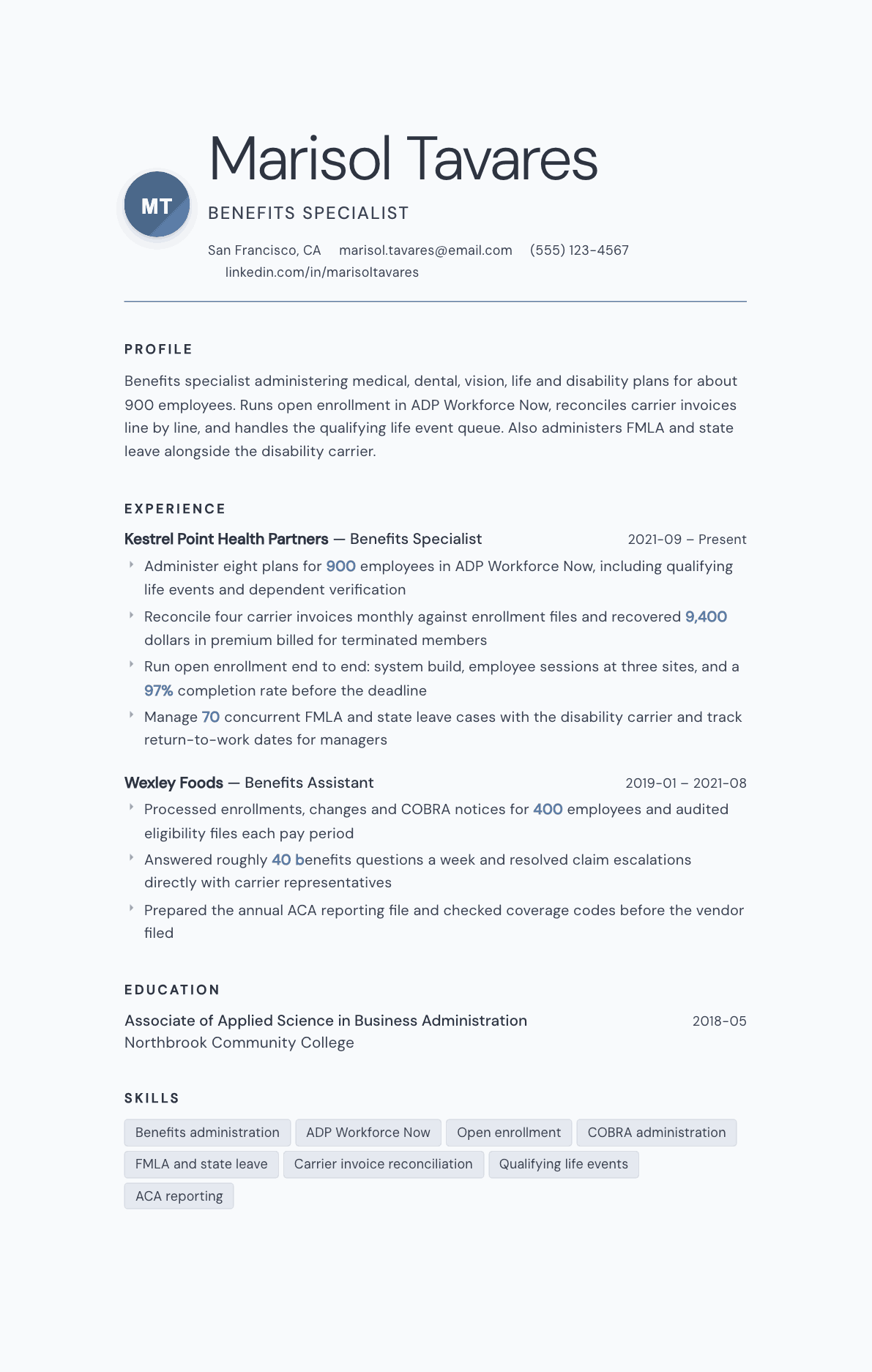
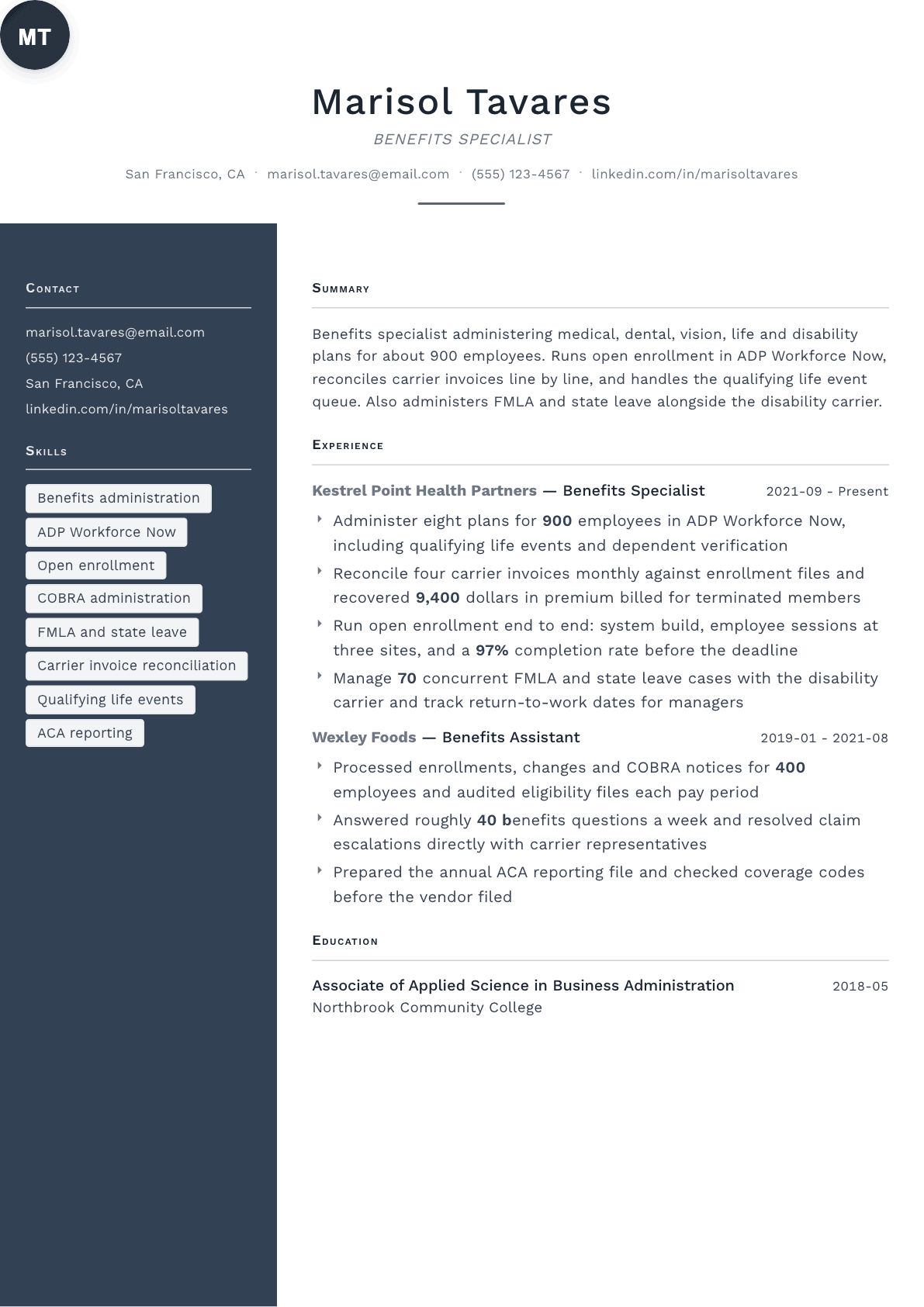
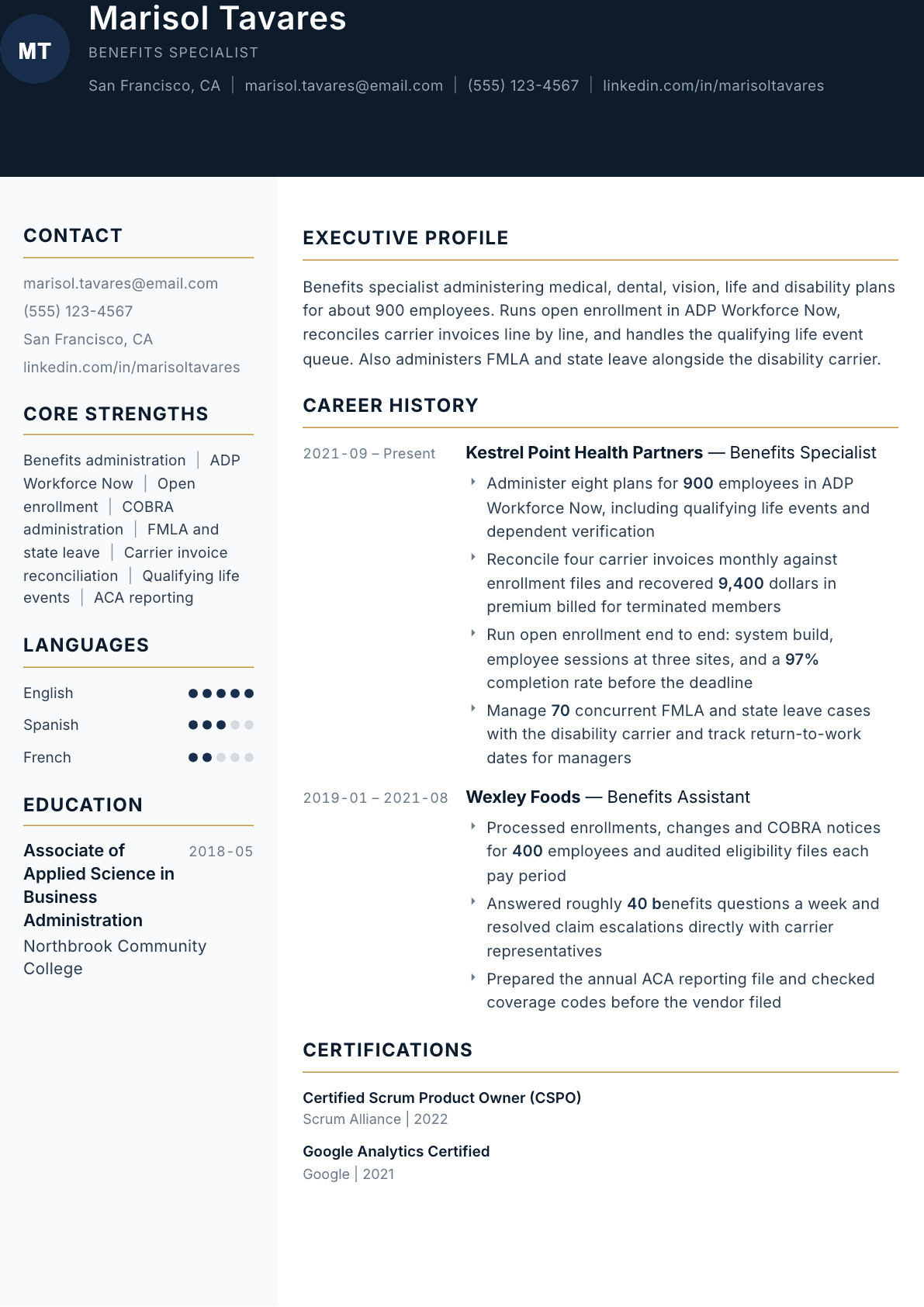
The same benefits specialist content laid out in three CVBooster templates, so you can see what the finished document looks like before you write a word.
Example Benefits Specialist summary
Benefits specialist administering eight health and welfare plans for roughly nine hundred employees. Owns open enrollment build and communication in ADP Workforce Now, reconciles carrier invoices against enrollment files every month, and manages a standing caseload of FMLA and state leave requests. Recovered premium billed for terminated members through a monthly eligibility audit.
Skills to list on a Benefits Specialist resume
- Benefits administration
- Open enrollment
- ADP Workforce Now
- Workday Benefits
- COBRA administration
- FMLA administration
- ADA accommodation support
- Qualifying life events
- Carrier invoice reconciliation
- Eligibility auditing
- ACA reporting
- HSA and FSA administration
- 401(k) enrollment support
- Employee benefits communication
What actually gets this resume read
- Lead with the covered population and the number of plans, because a benefits specialist for 200 people does different work than one for 9,000.
- Name the benefits administration system and the carriers you worked with, since postings screen for the exact platform.
- Show the reconciliation habit: invoice auditing, eligibility files and any premium you recovered from a carrier.
- List the compliance work you personally touched, such as COBRA notices, ACA coverage codes and Form 5500 support.
- Include leave administration if you handled it, with case volume and the interplay of FMLA, ADA and state programs.
- Prove the employee-facing side with enrollment completion rates or the number of sessions you delivered each year.
How to write a benefits specialist resume
The person hiring a benefits specialist has one recurring fear: a mistake that costs money or coverage. A dependent who stayed on the plan after a divorce, a COBRA notice that went out late, an enrollment file that did not reach the carrier, a leave case with no return-to-work date. A resume that shows you catch those things beats a resume that lists plan names.
That is why detail beats breadth here. The reader wants the covered population, the number of plans, the administration platform, and evidence of a reconciliation habit. Volume of employee questions answered matters too, because half of this job is explaining a deductible to someone who is upset.
This guide lays out how to structure the page, three summaries for different experience levels, before-and-after bullets from real benefits work, the credentials worth earning, and the questions that come up most when specialists write their resume.
Format: one page, plain, with the plan scope stated once
One page holds a benefits specialist career comfortably up to about eight years. Reverse chronological order. Under each employer, give a scope line: employee count, plan lineup, funding type if you know it, and the administration system. That single line prevents four bullets of throat clearing.
Avoid columns, graphics and skill rating bars. Benefits teams often sit inside HR shared services where resumes are parsed by the same tool used for employee files, and decorative layouts lose data on the way in.
- Header: name, city and state, phone, email, and a credential such as CEBS coursework or SHRM-CP if held.
- Order: summary, experience, skills and systems, education, certifications.
- Add a leave administration block if you carried a standing case load, since many employers hire for that specifically.
Summary: population, plans, platform, and the audit habit
Open with how many employees you support and how many plans you administer, then the platform, then one clause about accuracy. Something like reconciling carrier invoices against enrollment every month tells a manager more than any adjective available.
If your population is unusual, say why. Multi-state hourly workforces with variable-hour eligibility tracking, collectively bargained plans with separate trust funds, or a workforce split across two legal entities are all harder than a single-site salaried group, and naming that complexity is what earns the interview.
Experience: run the plan year in order
Structure your bullets the way the plan year runs. Enrollment build and testing, communication and sessions, ongoing life event processing, monthly invoice reconciliation and eligibility audits, carrier escalations, and the annual filings. Under each, put a count: plans, participants, life events processed per month, invoices reconciled, escalations resolved.
The bullets that impress are the ones where you found money or fixed a break. Premium billed for terminated members, a carrier file that stopped transmitting, an employee enrolled in a plan they were not eligible for, an evidence of insurability request nobody followed up on. State what you found, how you found it, and what changed so it does not recur.
Cut any bullet that could describe a benefits inbox rather than a benefits professional. Responding to employee inquiries is assumed; resolving a claim escalation directly with the carrier and getting a denial reversed is not.
Compliance and leave: name the specific work
List the compliance items you personally touched: COBRA notice timing and the qualifying events that trigger them, ACA measurement periods and coverage code review, Form 5500 support, summary plan description updates, and Section 125 election rules that limit mid-year changes. Precision here reads as experience, because these are the details people learn on the job.
If you administered leave, treat it as its own paragraph. Give the concurrent case load, how you coordinated FMLA with state programs and the disability carrier, how accommodation requests were routed, and how you tracked return-to-work dates for managers. Leave administration is frequently the reason a benefits specialist gets hired.
Skills and keywords worth spelling out
Write the system names in full: ADP Workforce Now, Workday Benefits, UKG Pro, bswift, Employee Navigator, Businessolver. Add the process terms a posting repeats: open enrollment, qualifying life event, dependent verification, eligibility audit, carrier feed, COBRA, HSA and FSA administration, evidence of insurability.
Keep soft skills out of the list and inside a bullet where they are visible. Patience shows up as an escalation you resolved, not as a word.
Benefits Specialist resume summary examples
First benefits role
HR assistant moving into benefits after two years processing enrollments, changes and COBRA notices for 400 employees. Audited eligibility files each pay period, answered about 40 employee questions a week, and prepared the annual ACA reporting file for vendor filing. Studying for the aPHR.
Four years in
Benefits specialist administering eight health and welfare plans for 900 employees in ADP Workforce Now. Owns open enrollment build and communication, monthly carrier invoice reconciliation, and a standing caseload of 70 FMLA and state leave cases coordinated with the disability carrier.
Lead specialist
Lead benefits specialist for a multi-state employer of 3,000, covering medical, dental, vision, life, disability, HSA and a 401(k) with automatic enrollment. Manages two coordinators, owns the eligibility audit calendar, and served as project lead on a move to a new benefits administration platform.
Work experience bullets: before and after
Before: Administered employee benefit plans.
After: Administer eight health and welfare plans for 900 employees in ADP Workforce Now, including qualifying life events, dependent verification and evidence of insurability follow-up.
Plan count, headcount, system and three named tasks make the scope verifiable in one line.
Before: Reviewed carrier bills each month.
After: Reconcile four carrier invoices monthly against enrollment files and recovered premium billed for 31 terminated members over one plan year.
A reconciliation with a recovery attached shows the control worked instead of merely existing.
Before: Assisted with open enrollment.
After: Ran open enrollment end to end: system configuration and testing, a manager briefing pack, employee sessions at three sites, and a 97% completion rate before the deadline.
Naming the phases proves ownership of the project rather than help during a busy season.
Before: Handled leave of absence requests.
After: Manage 70 concurrent FMLA and state leave cases with the disability carrier, tracking eligibility, certification deadlines and return-to-work dates in a shared manager view.
Case load and the specific tracking mechanism separate real leave administration from forwarding forms.
Before: Answered employee benefits questions.
After: Resolve roughly 40 employee questions a week and escalate denied claims directly with carrier representatives, including a reversal on a preauthorization error affecting three members.
Volume plus a named escalation outcome shows the reader what happens when the easy answer is not enough.
Hard skills
- Health and welfare plan administration
- Open enrollment
- ADP Workforce Now
- Workday Benefits
- COBRA administration
- FMLA and state leave administration
- Qualifying life event processing
- Carrier invoice reconciliation
- Eligibility and dependent audits
- ACA measurement and reporting
- HSA and FSA administration
- 401(k) enrollment support
Soft skills
- Accuracy under deadline
- Plain-language explanation
- Confidentiality
- Patience with escalations
- Vendor follow-up
- Documentation discipline
Certifications worth listing
- Certified Employee Benefit Specialist (CEBS) (International Foundation of Employee Benefit Plans)
- Group Benefits Associate (GBA) (International Foundation of Employee Benefit Plans)
- Certified Benefits Professional (CBP) (WorldatWork)
- Associate Professional in Human Resources (aPHR) (HR Certification Institute)
- SHRM Certified Professional (SHRM-CP) (Society for Human Resource Management)
Mistakes that cost benefits specialist candidates the interview
- Naming plan types without the covered population, which leaves the reader guessing at the scale of the work.
- Skipping the administration platform, when many employers screen for that exact system before reading further.
- Presenting the job as answering questions, which hides the reconciliation and compliance work that carries risk.
- Leaving leave administration off the resume after carrying cases for years, because it is often the deciding skill.
- Writing about accuracy in the summary with no audit, recovery or error-rate example anywhere in the experience.
- Listing every carrier by name instead of the work you did with them, which fills space without adding evidence.
Benefits Specialist resume questions
How is a benefits specialist resume different from a benefits manager resume?
A specialist proves execution and accuracy: cases processed, invoices reconciled, deadlines met. A manager proves design and negotiation: renewal strategy, plan changes, budget and vendor selection. Write to the level you are applying for and keep the other side to a single supporting bullet.
Do I need the CEBS to advance in benefits?
It is not required, but it is the most recognized study path in the field and many postings mention it as preferred. The Group Benefits Associate designation sits along the way to it, so listing completed courses shows momentum even before the full credential.
Should I list the carriers I have worked with?
Only where it adds context, such as administering a plan with a national carrier network or managing a stop-loss relationship. A bare list of insurers takes space that a reconciliation result or leave caseload would use better.
How do I show self-service and system work?
Describe what you configured rather than what you clicked: enrollment events, eligibility rules, carrier file feeds, confirmation statements and the testing you ran before enrollment opened. Add any platform migration you supported, including data validation and parallel testing.
What if I only supported benefits part time in a generalist job?
Give benefits its own labeled group of bullets inside that job instead of scattering the tasks. State the share of your week it took, the population covered, and the full plan year steps you handled, so the reader sees continuity rather than occasional help.
Related resume examples
- Benefits Administrator Resume example
- Compensation Analyst Resume example
- Compensation and Benefits Manager Resume example
- Leave Administrator Resume example
- HR Specialist Resume example
- HR Generalist Resume example