Compensation and Benefits Manager Resume Examples: free
Build a Compensation and Benefits Manager Resume That Proves Program Ownership
By Mustafa Tarabya, founder of CVBooster · Published · Updated
Write a compensation and benefits manager resume with a worked example, the plan and pay-cycle detail HR leaders look for, keywords and a full guide.
Sample resumes for a compensation and benefits manager
The same compensation and benefits manager content laid out in three CVBooster templates, so you can see what the finished document looks like before you write a word.
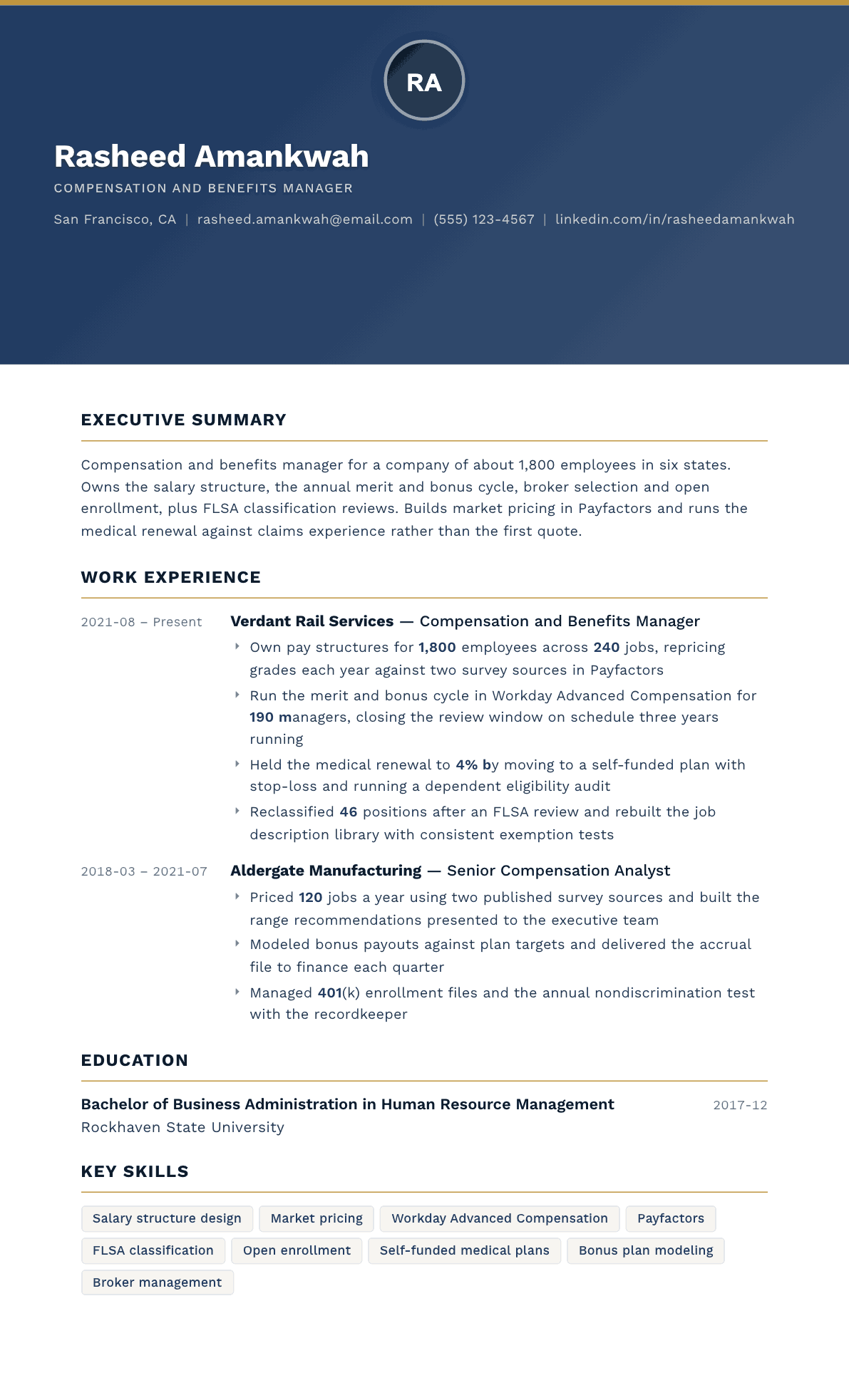
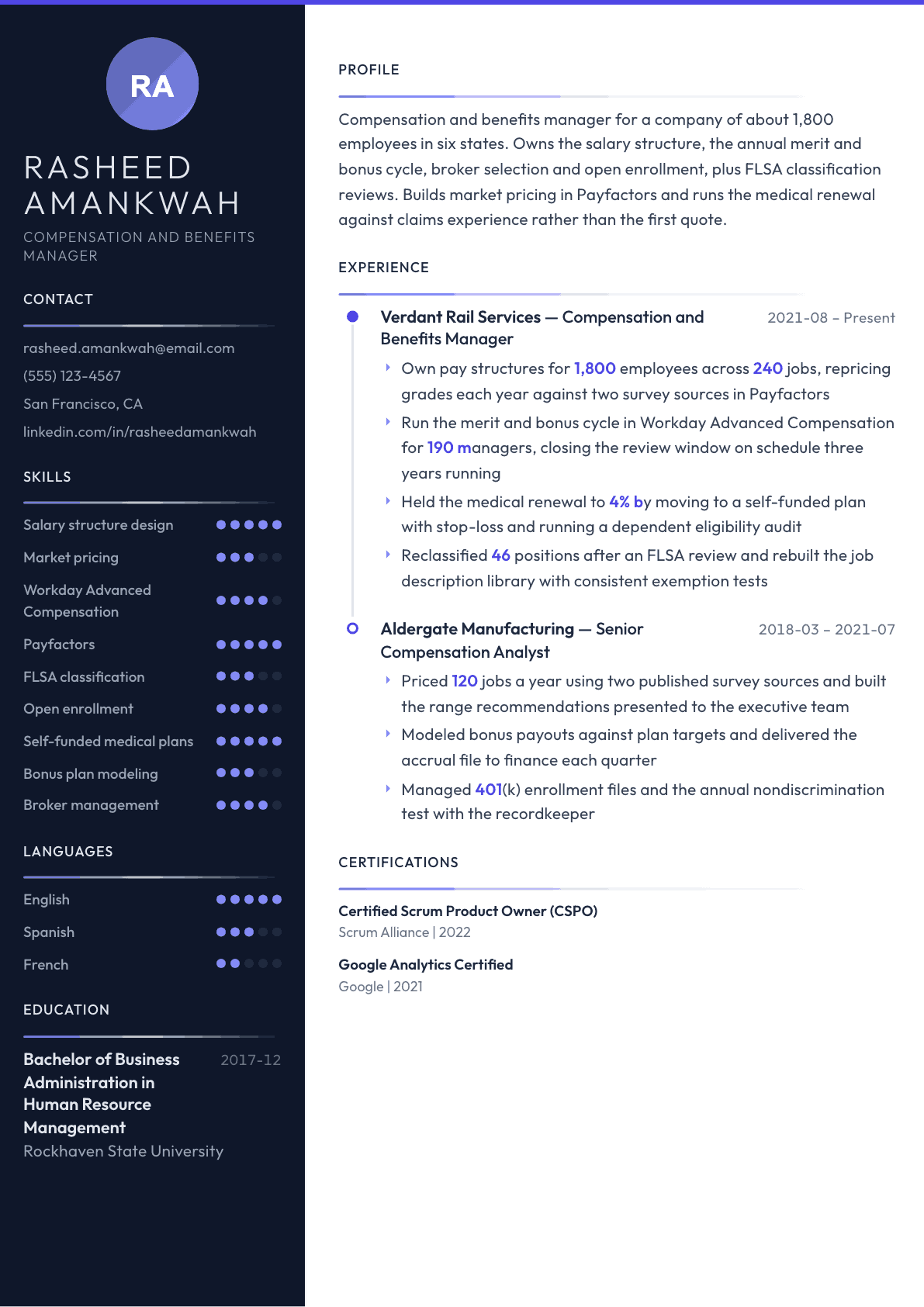
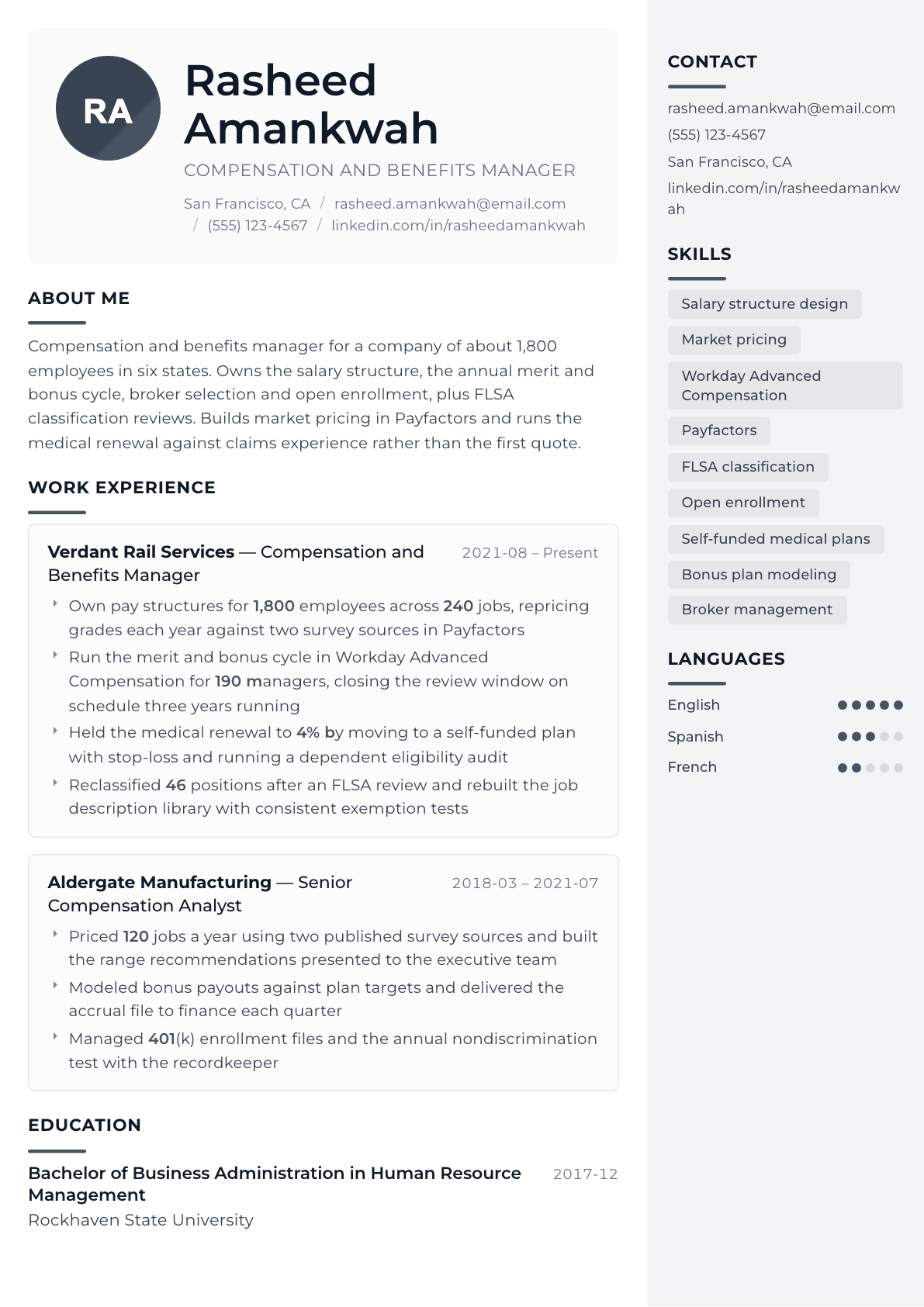
Example Compensation and Benefits Manager summary
Compensation and benefits manager owning pay structures and health plans for a multi-state employer of nearly two thousand people. Reprices two hundred jobs a year against published survey data, runs merit and bonus planning in Workday, and manages a self-funded medical renewal with the broker and stop-loss carrier. Led an FLSA reclassification review and rebuilt the job description library behind it.
Skills to list on a Compensation and Benefits Manager resume
- Salary structure design
- Job architecture
- Market pricing and benchmarking
- Merit cycle administration
- Short-term incentive design
- Workday Advanced Compensation
- Payfactors
- FLSA exemption testing
- Pay equity analysis
- Open enrollment
- Self-funded plan management
- Stop-loss and broker negotiation
- ACA reporting
- Form 5500 filing
- Nondiscrimination testing
- Excel modeling
What actually gets this resume read
- State the population you priced: headcount, number of distinct jobs, countries or states, and whether the roles were union or exempt.
- Name the survey sources and the compensation platform you actually used, since postings screen for those tools by name.
- Show the full annual cycle, from job architecture through merit planning to the accrual handed to finance.
- Put benefits renewal work in dollars of trend held or plan design changed, not just the phrase open enrollment.
- Call out compliance work by name: FLSA testing, ACA reporting, Form 5500 filing and nondiscrimination testing.
- Show the executive audience: which recommendations you presented to a compensation committee and what they approved.
How to write a compensation and benefits manager resume
A compensation and benefits manager resume gets read by an HR leader who wants to know one thing before anything else: did this person own the annual cycle, or did they support someone who did. Ownership means the pay structure, the merit and bonus run, the renewal negotiation and the numbers that went to finance. Support means running reports for the person who owned it.
The resumes that stall are the ones written as a list of duties: administers compensation programs, manages benefits vendors, ensures compliance. A screener cannot tell from that whether you priced twelve jobs or three hundred, whether the medical plan was fully insured or self-funded, or whether you have ever sat across from a broker with a renewal you refused to accept.
What follows is the structure this role expects, three summaries at different stages, before-and-after bullets for both halves of the job, the credentials that carry weight in pay and benefits work, and the questions candidates ask when they draft this page.
Format: two pages is normal, and the numbers go near the top
This is a role where a second page is expected once you have run several cycles, because pay and benefits scope does not compress. Reverse chronological, one clean font, and dates on the right. Put a short scope line under each employer rather than forcing the detail into bullets: headcount, number of jobs or grades, states or countries, plan funding type and total participants.
Resist a design-heavy template. Compensation leaders read fast and check for structure. A resume that looks like a well-organized pay analysis signals the same habits the job needs.
- Header: name, credentials such as CCP or SHRM-SCP, city and state, phone, email.
- Order: summary, experience, education, certifications, systems and technical skills.
- Add a short line naming survey sources and the compensation module you work in, since those are hard filters.
Summary: scope on both sides of the title
The title carries two disciplines and a screener wants to know your balance between them. State headcount and geography, then name what you own in pay: the structure, the merit and incentive cycle, the market pricing method. Then what you own in benefits: plan count, funding type, renewal responsibility and open enrollment.
If you are stronger on one side, say so and say what you have done on the other. A candidate who has run pay for years and supported benefits renewals twice should write exactly that, because the alternative is an interview that exposes the gap in the first ten minutes.
Compensation bullets: pricing, structure, cycle, governance
Write the pay work as a cycle a reader can follow. How many jobs you price and against which published survey sources, how you build and age ranges, how the merit and bonus run is configured and communicated, how many managers plan inside it, and what you hand to finance for accrual. Every one of those steps has a number attached, so use them.
Then add the work that is not annual: FLSA exemption reviews, job description rewrites, geographic differentials, offer approvals and exception handling, and pay equity analysis. Say who reviewed your recommendations. A range recommendation approved by a compensation committee is a different claim than a spreadsheet emailed to a manager.
Benefits bullets: funding, renewal, compliance, employee reach
Name the plan lineup and how it is funded, because self-funded plan management with stop-loss and claims review is a different job than administering a fully insured package. Give the renewal outcome as a trend number or a design change, and say what produced it: a network change, a dependent eligibility audit, a contribution restructure, a new broker.
Then the compliance stack you personally handled: ACA reporting and coverage codes, Form 5500 filing, nondiscrimination testing, COBRA administration, and the 401(k) audit support finance asks for. Close with employee reach: enrollment completion, session counts, and how you communicated a plan change people disliked.
Systems and keywords
Name the platforms plainly: Workday Advanced Compensation, SAP SuccessFactors, UKG Pro, ADP, Payfactors, and the survey publishers whose data you licensed. Add Excel modeling and any SQL or reporting tool you used to build the analysis rather than request it.
Sprinkle the process terms the posting will use through your bullets rather than stacking them in one block: salary structure, market pricing, merit cycle, incentive design, total rewards, open enrollment, stop-loss, plan design, pay equity.
Compensation and Benefits Manager resume summary examples
Stepping up from analyst
Senior compensation analyst ready for manager scope. Prices 120 jobs a year against two published survey sources, builds range recommendations for the executive team, and models bonus payouts and quarterly accruals. Supported two medical renewals and the 401(k) nondiscrimination test with the recordkeeper. CCP candidate.
Running the cycle
Compensation and benefits manager for 1,800 employees across six states. Owns 240 job pay structures, the merit and bonus run in Workday for 190 planning managers, and a self-funded medical plan with stop-loss. Led an FLSA review that reclassified 46 positions and rebuilt the job description library behind it.
Multi-entity leader
Compensation and benefits manager supporting three operating companies and roughly 5,000 employees. Harmonized four legacy pay structures into one grade framework after an acquisition, consolidated benefits onto a single carrier lineup, and presents renewal and merit budget recommendations to the executive team each year.
Work experience bullets: before and after
Before: Managed compensation programs for the company.
After: Own pay structures covering 240 jobs and 1,800 employees, repricing every grade annually against two published survey sources and aging ranges to the market movement.
Job count, headcount and the pricing method replace a claim of ownership with the evidence of it.
Before: Ran the annual merit process.
After: Configure and run the merit and bonus cycle in Workday for 190 planning managers, including budget allocation, guideline modeling and the accrual file delivered to finance.
Naming the tool, the manager count and the finance handoff shows the whole cycle instead of a calendar event.
Before: Negotiated with benefits vendors at renewal.
After: Held the medical renewal to 4% by moving the plan to self-funded with stop-loss, running a dependent eligibility audit, and rebidding the network with the broker.
The outcome and the three levers that produced it show a negotiation strategy, not an email exchange.
Before: Ensured compliance with pay laws.
After: Led an FLSA exemption review of 300 positions, reclassified 46 to nonexempt, and rewrote the affected job descriptions with consistent duties tests.
A named review with a count and a follow-through action is checkable, while a claim of compliance is not.
Before: Handled open enrollment each year.
After: Run open enrollment for eight plans, including system build, a manager briefing pack and on-site sessions at three locations, closing at a 97% completion rate before the deadline.
Enrollment is a project, so the bullet names the deliverables and the result rather than the season.
Hard skills
- Salary structure design
- Market pricing and survey participation
- Merit and incentive cycle administration
- FLSA exemption testing
- Pay equity analysis
- Self-funded plan management
- Broker and carrier negotiation
- Open enrollment management
- ACA reporting
- Form 5500 and nondiscrimination testing
- Workday Advanced Compensation
- Excel and financial modeling
Soft skills
- Executive communication
- Negotiation
- Confidentiality
- Analytical rigor
- Manager education
- Vendor accountability
Certifications worth listing
- Certified Compensation Professional (CCP) (WorldatWork)
- Certified Benefits Professional (CBP) (WorldatWork)
- Certified Employee Benefit Specialist (CEBS) (International Foundation of Employee Benefit Plans)
- SHRM Senior Certified Professional (SHRM-SCP) (Society for Human Resource Management)
- Senior Professional in Human Resources (SPHR) (HR Certification Institute)
Mistakes that cost compensation and benefits manager candidates the interview
- Writing one generic block for both disciplines, which leaves a reader unsure whether you have ever owned a renewal.
- Omitting plan funding type, so nobody can tell whether you managed claims risk or paid a carrier invoice.
- Listing survey names without saying how many jobs you matched or how you handled poor survey matches.
- Skipping the finance handoff, when accruals and budget files are half of what this manager is trusted with.
- Presenting pay equity work as a project title with no scope, no method and no remediation outcome.
- Treating compliance as a single bullet instead of naming the filings and tests you personally ran.
Compensation and Benefits Manager resume questions
Should compensation or benefits come first on the resume?
Lead with whichever the posting weights more heavily, then prove the other within the same job. Most openings list pay structure and the annual cycle first, so if your background is balanced, open with pay and give benefits its own two bullets underneath.
Is the CCP worth listing if I have not finished it?
Yes, if you are actively enrolled. Write it as in progress with the modules completed, placed in the certifications section rather than the summary. Claiming a credential you have not earned is the fastest way to lose an offer during verification.
How do I show pay equity work without exposing confidential findings?
Describe the method and the scale, not the results by group. Say how many employees were in scope, what statistical approach or outside counsel was involved, how many flagged cases were reviewed, and that remediation was completed inside a defined cycle.
What if my company used only one salary survey?
Say so and explain how you handled the limitation: aging factors, geographic differentials, secondary sources for hard-to-match jobs, or a slotting method for roles the survey did not cover. Judgment about weak data is a skill worth showing.
How technical should the systems section be?
Technical enough to prove you configure rather than request. Name the compensation module, the reporting tool, and whether you built the merit worksheet, the eligibility rules and the statement templates yourself or worked from a vendor build.
Related resume examples
- Compensation Analyst Resume example
- Benefits Administrator Resume example
- Total Rewards Manager Resume example
- Benefits Specialist Resume example
- HR Director Resume example
- HR Generalist Resume example