Compensation Analyst Resume Examples: what gets the call
Build a Compensation Analyst Resume That Demonstrates Your Value
By Mustafa Tarabya, founder of CVBooster · Published · Updated
Create a data-driven Compensation Analyst resume with market benchmarking expertise, salary modeling achievements, and pay equity analysis.
Sample resumes for a compensation analyst
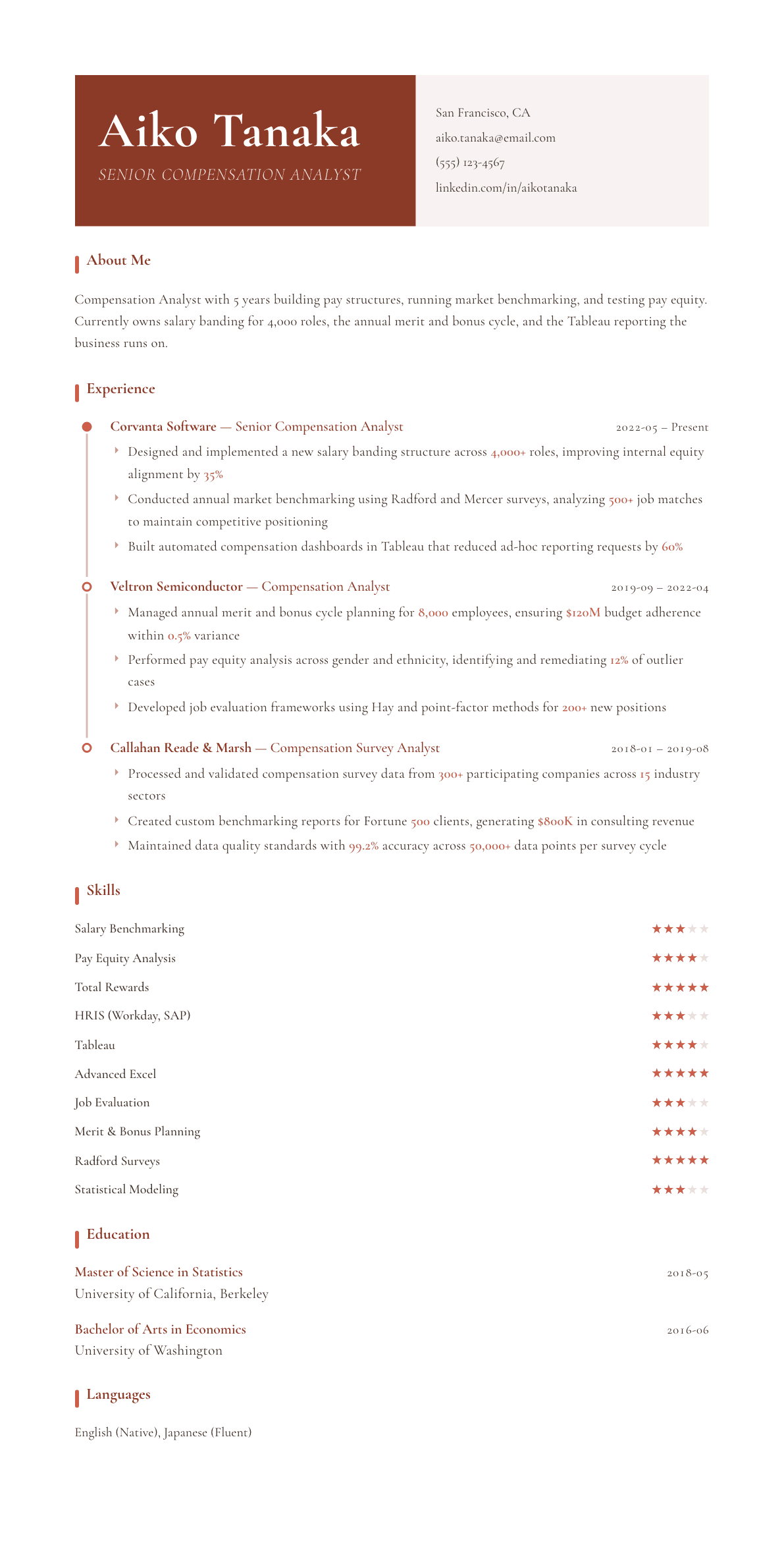
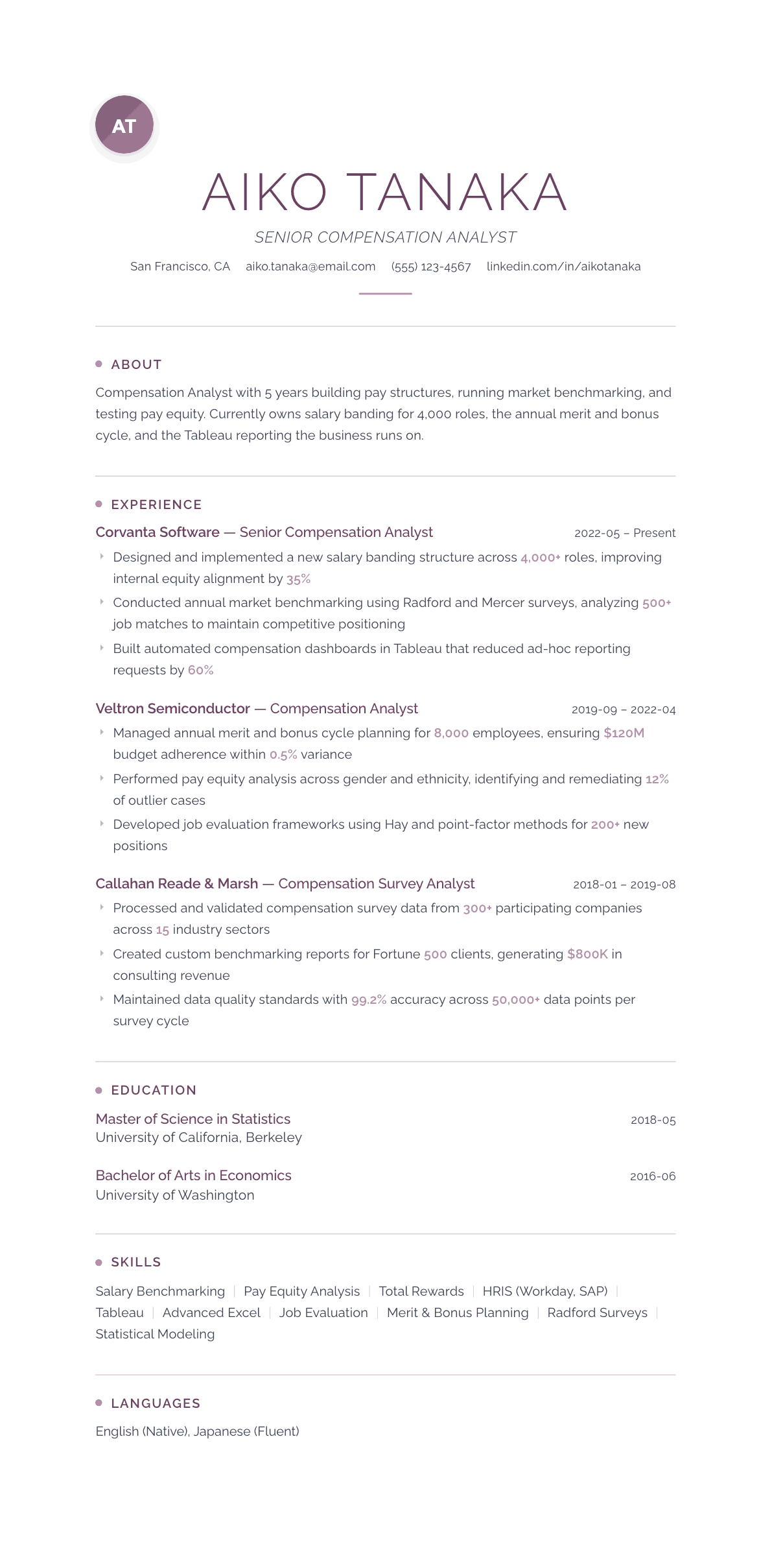
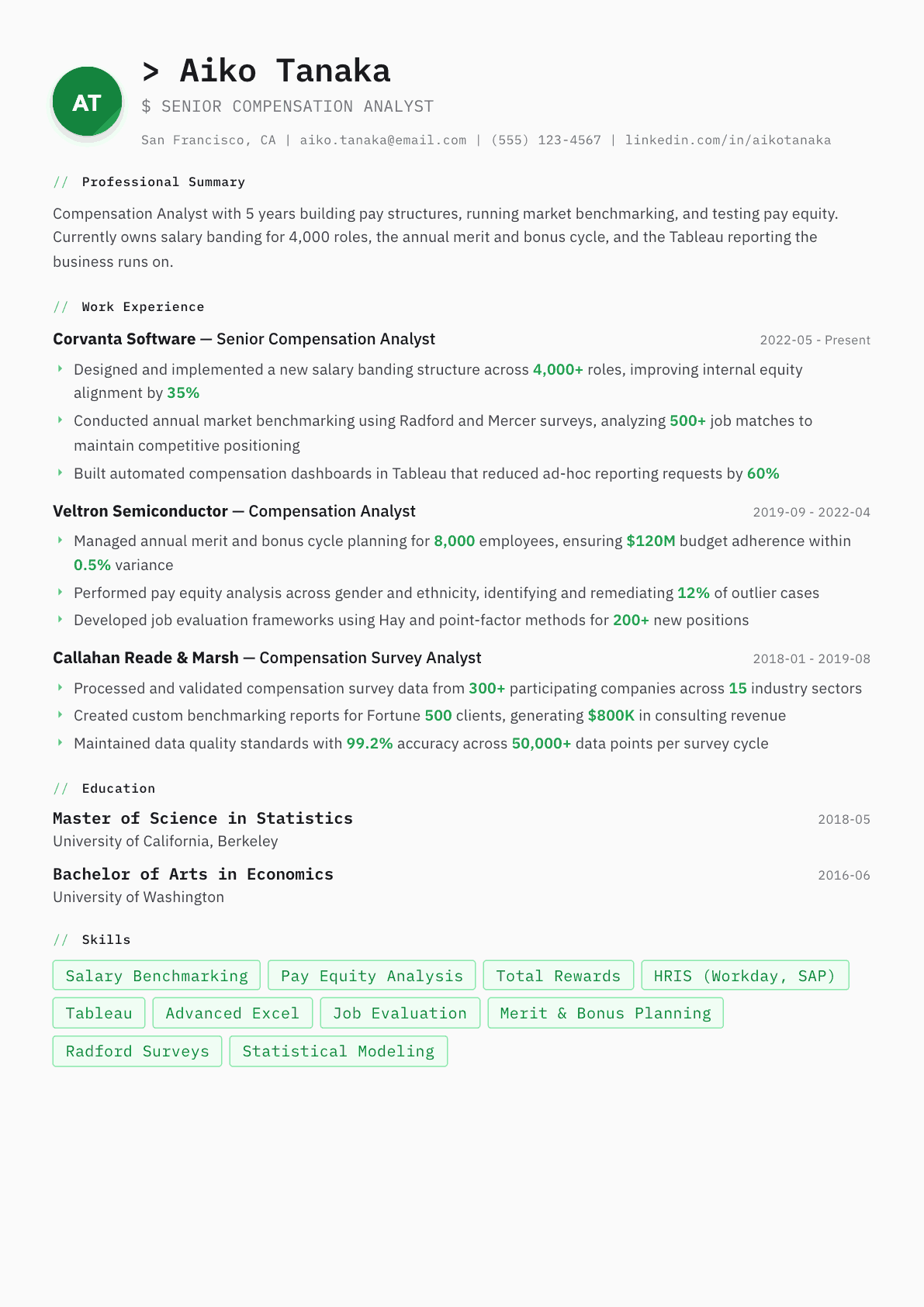
The same compensation analyst content laid out in three CVBooster templates, so you can see what the finished document looks like before you write a word.
Example Compensation Analyst summary
Analytical Compensation Analyst with 5 years of experience designing competitive pay structures, conducting market benchmarking, and ensuring pay equity across diverse workforces. Proficient in Radford, Mercer, and Tableau with a track record of managing $120M+ compensation budgets. Seeking a senior total rewards role to drive data-informed pay strategy.
Skills to list on a Compensation Analyst resume
- Salary Benchmarking
- Pay Equity Analysis
- Total Rewards Strategy
- Market Pricing
- Job Evaluation
- Merit & Bonus Planning
- Executive Compensation
- HRIS Analytics
- Tableau
- Advanced Excel
- Statistical Modeling
- FLSA Compliance
- Radford Surveys
- Mercer IPE
What actually gets this resume read
- Emphasize quantitative outcomes: budget accuracy, pay equity remediation percentages, and cost savings from restructured compensation plans.
- List survey tools and data sources (Radford, Mercer, Aon, Culpepper) to demonstrate market expertise.
- Highlight proficiency in analytical tools like Excel (advanced), Tableau, Python, or R for compensation modeling.
- Include certifications such as CCP (Certified Compensation Professional) to differentiate yourself from generalist candidates.
- Showcase compliance knowledge around pay transparency laws, FLSA, and state-specific equal pay legislation.
- Describe your role in annual merit, bonus, and equity planning cycles with specific budget figures.
How to write a compensation analyst resume
A compensation analyst resume is screened by a total rewards manager or a compensation director who is testing for two capabilities that rarely appear together: rigorous handling of pay data, and the judgment to explain a pay decision to a manager who disagrees with it. Most resumes for the role prove neither, because they list responsibilities instead of methods.
The details that separate candidates are technical and specific. Which survey sources you submit to and price against, how many jobs you have matched and to what depth, which job evaluation methodology the organization used, whether you built the salary structure or applied it, what you ran the analysis in, and how you handled the annual merit and bonus cycle. Pricing 200 benchmark jobs from two survey sources for a single-country business is a different job from maintaining a global grade architecture across many markets.
This guide walks through the sections a compensation director reads, how to write analysis bullets that show method rather than output, the numbers worth quoting, three summaries at different stages, and the errors that make a competent analyst look like a report runner.
Format: one page, scope line under every role
One page under eight years, two after that. Reverse chronological, single column, no charts. This is a role where a hiring manager will notice if your own document is inconsistent, so keep date formats, capitalization and number formatting identical throughout the page.
Under each employer, add a scope line: employee population, countries, the job architecture in use, the survey sources subscribed to, the systems, and whether you supported one business or the whole organization. That line does the work of an entire paragraph.
- Header: name, city and state, phone, email, and a compensation credential if you hold one.
- Order: summary, compensation experience with scope lines, technical and analytical skills, systems, education, certifications.
- Analysts with a quantitative degree should keep education visible; this is one of the human resources roles where the degree still gets read.
Summary: population, architecture, and the cycle you run
Three lines. The population and geography you price, the structure you maintain, the survey sources you work in, and the part of the annual cycle you own. Merit and bonus planning is the flagship claim, so lead with it if you have run one.
If you are moving in from analytics, finance or human resources operations, name the compensation work you have already done: market pricing, structure modeling, pay equity analysis, offer support, or building the merit planning file.
Experience: show the method behind the number
Compensation bullets are strongest when they name the method. Market pricing is not a single activity: it is job matching against a survey, aging the data to a common date, blending sources, choosing a percentile strategy and testing the result against internal equity. Say which of those you did and how the job matches were validated.
Structure work deserves its own bullets. Building or refreshing salary ranges, setting midpoint progression and range spreads, mapping jobs into grades, handling employees who fall outside the range, and the geographic differentials or pay zones you applied. Then variable pay: bonus plan design, target setting, accrual and funding, plan documents, and sales compensation if you have touched it, since sales plans are a specialty of their own.
The annual cycle is where an analyst proves reliability. Building the merit and bonus planning tool, loading budgets, guiding managers through calibration, checking outliers, holding the budget, and producing the statements. Add pay equity: the model used, the variables controlled for, how outliers were identified and how remediation was funded, described in the language of analysis rather than of advocacy.
- Pricing: survey participation and submission, job matching and match confidence, aging, source blending, percentile strategy.
- Structure: grade and band design, range spread and midpoint progression, geographic differentials, job architecture and job families.
- Variable pay: annual incentive design, target setting, funding and accrual, sales plan mechanics, equity refresh and grant guidelines.
- Cycle: merit matrix design, budget allocation, manager calibration, outlier review, statement production and audit.
Tools, data and the analysis stack
Name the survey providers, the job evaluation methodology and the software, because compensation postings filter on all three. Say what you actually build in the tools rather than that you know them. Advanced spreadsheet modeling is expected in this role; a query language, a statistics package or a visualization tool is a genuine differentiator.
Show data hygiene. Compensation analysis fails on bad job matches, stale data and inconsistent job codes far more often than on bad math, and an analyst who talks about validating matches and reconciling the human resource information system data will be trusted faster than one who talks about producing dashboards.
- Survey and benchmarking sources: Radford, Mercer, Willis Towers Watson, Aon, Payscale, and industry association surveys.
- Methodologies: point factor job evaluation, the Hay method, job leveling and job family architecture.
- Systems and analysis: Workday, SAP SuccessFactors, Oracle, advanced spreadsheet modeling, SQL, Python or R, Tableau or Power BI.
The figures a compensation director checks
Quantify scope and accuracy rather than vague improvement. A compensation director wants to know how many jobs, how much budget, how many employees and how clean the result was.
- Jobs priced and benchmark matches maintained, plus the number of survey sources blended.
- Population covered by the cycle you ran and the merit or bonus budget administered, expressed as a variance against plan.
- Compa ratio and range penetration distribution before and after a structure refresh.
- Pay equity outliers identified, variables controlled for, and the share of the gap closed after remediation.
- Turnaround time on offer and promotion pricing requests, and the volume handled per cycle.
- Reporting automation: recurring reports replaced by a self service view and the analyst hours returned.
Compensation Analyst resume summary examples
Compensation analyst, early career
Compensation analyst with two years pricing 300 benchmark jobs against two survey sources for a 2,000-person organization, maintaining the salary structure and turning around offer and promotion requests within 48 hours. Built the merit planning workbook used by 90 managers and validated 99% of job matches against updated descriptions.
Five years in
Compensation analyst supporting 8,000 employees across four countries, running the annual merit and bonus cycle to within 0.5% of a large approved budget. Rebuilt salary bands for 4,000 roles using point factor evaluation, and completed a pay equity review that identified and remediated 12% of flagged outliers.
Senior compensation analyst
Senior compensation analyst owning job architecture, structure design and executive benchmarking for a multi-country business. Consolidated three legacy grade systems into one global architecture, automated the survey submission process, and built the dashboards that cut ad hoc reporting requests by 60%.
Work experience bullets: before and after
Before: Conducted market pricing and benchmarking for jobs.
After: Priced 500 benchmark jobs annually against two survey sources, aging data to a common effective date and validating every match against the current job description before publishing the range.
Volume, sources and the validation step show a method that another compensation team can trust.
Before: Built salary structures for the organization.
After: Designed a nine-grade salary structure covering 4,000 roles with a 50% range spread and 15% midpoint progression, then mapped every job into a grade and produced a remediation plan for employees below range minimum.
The structural parameters and the treatment of out-of-range employees prove you built the structure rather than inherited it.
Before: Supported the annual merit increase process.
After: Ran the merit and bonus cycle for 8,000 employees: built the merit matrix, loaded budgets by business unit, ran calibration sessions with 40 leaders and closed the cycle within 0.5% of the approved budget.
Owning each stage of the cycle and landing on budget is the concrete evidence a compensation director screens for.
Before: Performed pay equity analysis.
After: Ran a regression-based pay equity review controlling for job level, function, location and tenure, flagged 12% of employees as outliers for review and funded remediation inside the annual cycle without reopening the budget.
Naming the model, the controls and how remediation was paid for turns a sensitive claim into defensible analysis.
Before: Created compensation reports for leadership.
After: Replaced eleven recurring compensation reports with three self service dashboards covering compa ratio, range penetration and cycle spend, cutting ad hoc requests by 60% and returning several analyst days each month.
It quantifies what the automation removed rather than describing that reports existed.
Hard skills
- Market pricing and job matching
- Survey participation and submission
- Salary structure design
- Job evaluation and job architecture
- Merit and bonus cycle administration
- Pay equity and regression analysis
- Incentive plan design
- Sales compensation mechanics
- Equity and long term incentive support
- Compa ratio and range penetration analysis
- Advanced spreadsheet modeling
- SQL and data visualization
- HRIS compensation modules
Soft skills
- Explaining a pay decision to a skeptical manager
- Discretion with sensitive pay data
- Precision in documentation
- Partnering with finance on budget
- Questioning a suspicious data point
- Written clarity in recommendations
Certifications worth listing
- Certified Compensation Professional (CCP) (WorldatWork)
- Global Remuneration Professional (GRP) (WorldatWork)
- Certified Sales Compensation Professional (CSCP) (WorldatWork)
- Certified Executive Compensation Professional (CECP) (WorldatWork)
- SHRM Certified Professional (SHRM-CP) (Society for Human Resource Management)
- Professional in Human Resources (PHR) (HR Certification Institute)
Mistakes that cost compensation analyst candidates the interview
- Listing benchmarking as a duty without saying which survey sources, how many jobs or how matches were validated.
- Claiming a structure refresh without the parameters, so the reader cannot tell whether you designed it or applied it.
- Describing pay equity work in advocacy language instead of naming the model, the controls and the remediation approach.
- Writing proficient in Excel when the differentiator is what you build in it: models, matrices, planning tools and reconciliations.
- Leaving the annual cycle vague. Owning merit and bonus planning end to end is the strongest claim available in this role.
- Inconsistent number and date formatting on a resume for a job whose entire value is consistency in data.
Compensation Analyst resume questions
What should a compensation analyst put on a resume with no compensation title?
Pull out any market pricing, offer support, structure modeling, incentive calculation or people data analysis you have done, and describe the method rather than the task. Then name the survey sources, systems and analytical tools you have used, since those are the screening keywords.
Should I name the compensation surveys I use?
Yes. Survey source familiarity is a genuine skill because matching and aging conventions differ between providers, and hiring managers filter on the provider names. Name the ones you have submitted to as well as the ones you have priced against.
How technical should a compensation analyst resume be?
Technical enough to prove you can work with the data, not so technical that the judgment disappears. Show modeling, a query language or a visualization tool alongside at least one bullet about explaining a pay decision to a manager or a business leader.
Is the compensation professional certification worth listing?
Yes, and even partial progress is worth a line. The compensation credential from the total rewards professional body is the recognized technical standard in the field, and hiring managers use it as shorthand for knowing structure design and job evaluation properly.
How do I write about pay data without disclosing anything confidential?
Describe scope and method rather than levels. Population covered, jobs priced, budget variance in percentage terms, compa ratio distribution and outliers remediated all demonstrate the work while keeping actual pay levels and named employees off the page.
Related resume examples
- Benefits Administrator Resume example
- HR Manager Resume example
- HRIS Analyst Resume example
- Total Rewards Manager Resume example
- Compensation and Benefits Manager Resume example
- HR Analyst Resume example