Construction Project Manager Resume Examples: free score
Write a Construction Project Manager Resume Built on Delivered Projects
By Mustafa Tarabya, founder of CVBooster · Published · Updated
A construction project manager resume sample, project-by-project writing tips, the contract and scheduling keywords owners screen for, plus a full guide.
Sample resumes for a construction project manager
The same construction project manager content laid out in three CVBooster templates, so you can see what the finished document looks like before you write a word.
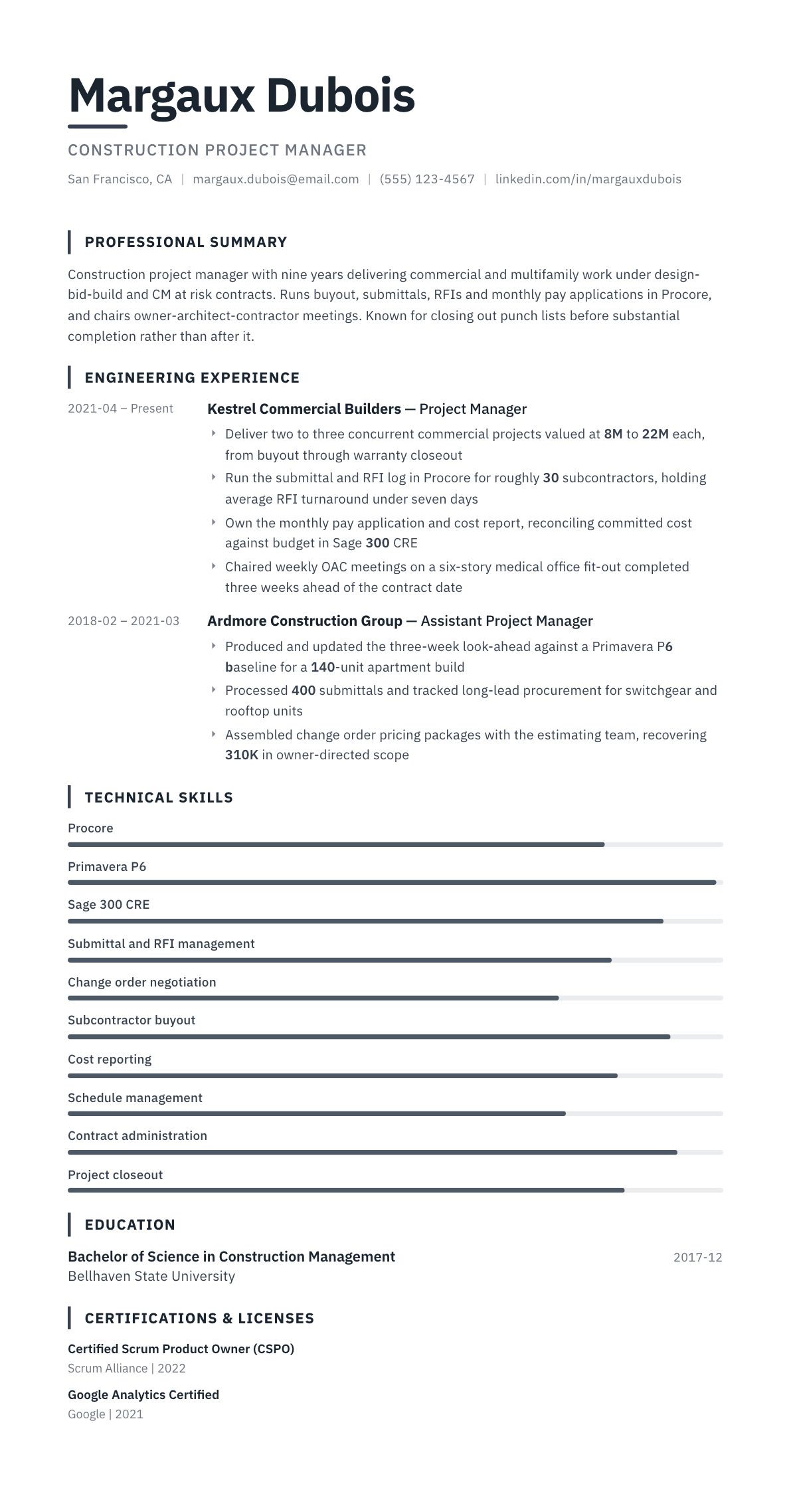
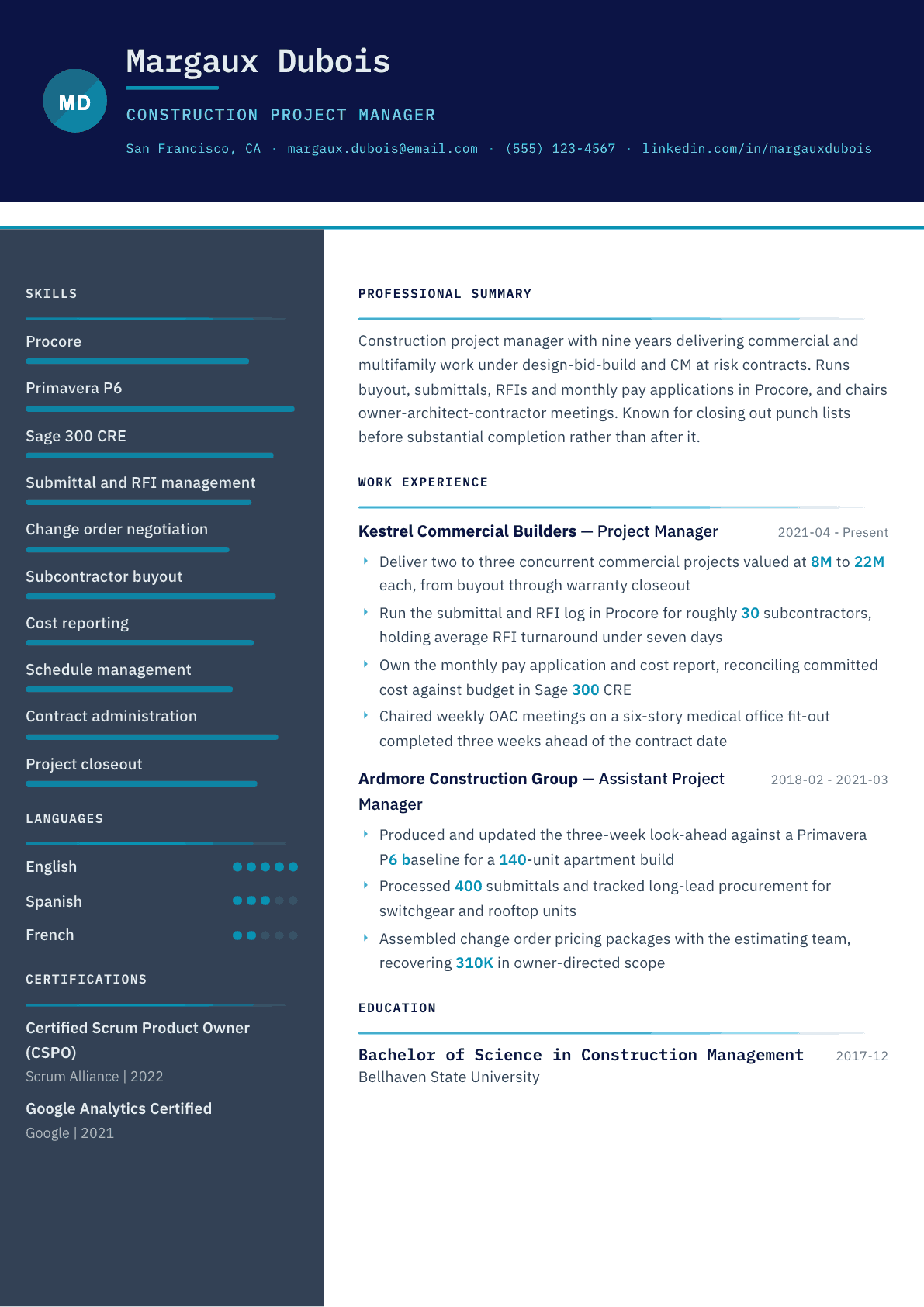
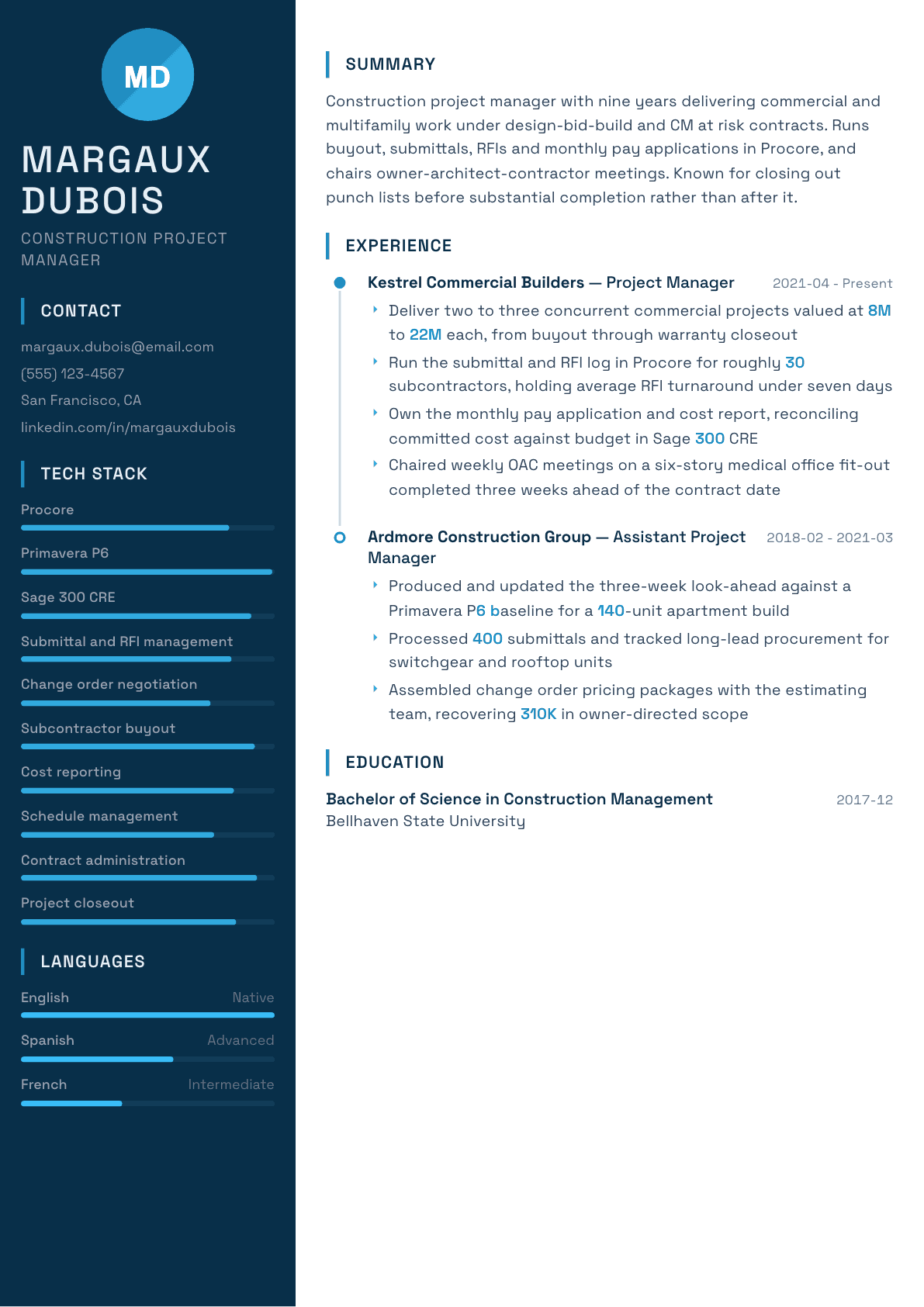
Example Construction Project Manager summary
Construction project manager with nine years on commercial and multifamily projects from buyout to warranty. Delivers concurrent jobs in the 8M to 22M range under CM at risk and design-bid-build contracts, running submittals, RFIs, cost reports and monthly pay applications in Procore and Sage 300 CRE. Comfortable chairing owner-architect-contractor meetings and pricing owner-directed changes without stalling the schedule.
Skills to list on a Construction Project Manager resume
- Procore
- Primavera P6
- Microsoft Project
- Bluebeam Revu
- Sage 300 CRE
- Subcontractor buyout
- Change order management
- Submittal and RFI logs
- Cost forecasting
- Pay application review
- Contract administration
- Value engineering
- Schedule of values
- Punch list and closeout
- Owner and architect coordination
What actually gets this resume read
- Open every job with the project types, contract delivery method and dollar range you carried, because that is the first filter an owner applies.
- List projects by name, size and square footage under each employer so a reader can picture the work instead of guessing at it.
- Say which scheduling tool you actually drive, Primavera P6 or Microsoft Project, and whether you build the baseline or only update it.
- Quantify change orders and buyout savings in dollars, since a project manager is judged on the cost report more than on activity counts.
- Name the project management platform by product, Procore or Autodesk Build, and say what you run inside it: submittals, RFIs, daily logs.
- Put safety and closeout evidence on the page, punch list turnaround and recordable rate, because those are the numbers general contractors compare.
How to write a construction project manager resume
A construction project manager resume is judged against a very short list of questions. What did you build, how big was it, which contract delivery method were you working under, and did it finish on budget? A hiring director at a general contractor can answer all four in about twenty seconds if the resume is built properly, and cannot answer any of them if it opens with a paragraph about being a results-driven leader.
The second reader is the operations manager who has an open seat on a specific job. She wants to know whether your project history matches hers. Someone who has delivered ground-up healthcare work is not automatically the right fit for a data center or a garden-style apartment build, and pretending the difference does not exist costs you the interview rather than winning it.
What follows is the structure that answers those questions in order: a project list with real numbers, experience bullets that show cost and schedule control, and the software, contracts and credentials the field expects to see named outright.
Format: a project list is the section that does the work
Use reverse-chronological employment, then add a projects section, either nested under each employer or standing on its own. For a project manager the project list carries more weight than the job titles, because two people with the same title can have carried wildly different scope.
Give every project four facts: what it was, the contract value, the square footage or unit count, and the delivery method. "Ground-up medical office building, 84K square feet, CM at risk" is a complete entry. Two pages is normal once you have more than five years, and nobody in construction penalizes a second page that is full of real projects.
- Header: name, city and state, phone, email, and any professional credential you hold.
- Order: summary, key projects, experience, education, certifications, software.
- Keep the project list to the work that matches the posting, not everything you have ever touched.
Summary: sectors, contract types, dollar range
Three lines. Name the market sectors you have delivered, the contract vehicles you have run, the dollar range of your typical project, and the phase you own, whether that is preconstruction through closeout or buyout onward.
If you are moving between sectors, say it plainly and name the transferable exposure. A manager coming from multifamily into senior living should point at the shared unit-by-unit sequencing and the same finishes trades rather than hoping the reader draws the line.
Experience: cost, schedule, and the parts you personally owned
A project manager is accountable for the cost report and the schedule, so those two belong in the first bullets of every job. Say who prepared the monthly pay application, who reconciled committed cost against budget, who priced change orders and who negotiated them with the owner.
Then show the operating machinery: buyout and subcontract awards, the submittal and RFI log with turnaround, procurement of long-lead items, and the meeting you chair. A bullet that names the number of subcontracts you bought out and the savings against the estimate says more than any adjective.
Avoid bullets that describe the profession rather than your work. "Managed all aspects of construction projects" fits every resume in the stack and takes the space a real number needed.
- Cost: budget size, change order volume and value, buyout savings, final margin trend.
- Schedule: baseline tool, look-ahead ownership, recovery actions, delivery against contract date.
- Risk: long-lead procurement, weather and permit delays, and what you did about them.
Software and contracts: name the products and the forms
General contractors hire around their own stack. Name the project management platform you actually drive, Procore or Autodesk Build, the scheduling tool, Primavera P6 or Microsoft Project, the accounting system, Sage 300 CRE or Viewpoint Vista, and Bluebeam Revu for drawing markup.
Contract literacy is a differentiator that most resumes leave off. Say which standard forms you have worked under, AIA or ConsensusDocs, and whether you have run lump sum, guaranteed maximum price, cost plus or design-build work. Owners and their representatives screen for exactly that language.
Keywords a construction hiring manager scans for
Postings recycle the same vocabulary: buyout, submittals, RFIs, schedule of values, pay application, change order, punch list, closeout, owner-architect-contractor meeting, substantial completion. Use each phrase once where it is true, once in the summary or skills block and once inside a bullet that proves it. Do not build a keyword wall at the bottom of the page, because the person reading after the software will notice.
Construction Project Manager resume summary examples
Assistant project manager
Construction management graduate with two years as an assistant project manager on a 140-unit multifamily build. Processed 400 submittals, maintained the RFI log in Procore, and updated the three-week look-ahead against a P6 baseline. OSHA 30 trained and ready to run a small commercial project.
Six years in
Project manager with six years delivering commercial interiors and ground-up retail between 4M and 15M under lump sum and CM at risk contracts. Owns buyout, submittals, monthly pay applications and cost reporting in Procore and Sage. Delivered the last three projects at or ahead of the contract completion date.
Senior project manager
Senior project manager with fourteen years in healthcare and higher education construction, including two projects above 60M under guaranteed maximum price contracts. Leads preconstruction through closeout, manages a team of three assistant managers and two engineers, and negotiates owner change orders directly with facilities leadership.
Work experience bullets: before and after
Before: Managed construction projects from start to finish.
After: Delivered three concurrent commercial projects between 8M and 22M from buyout through warranty, each closed within 1% of the approved budget.
Dollar range, concurrency and a budget result replace a phrase that could describe anyone with the title.
Before: Handled submittals and RFIs.
After: Ran the submittal and RFI log in Procore for 30 subcontractors, holding average RFI turnaround to six working days across a 20-month build.
The platform, the subcontractor count and the turnaround turn an administrative task into evidence of control.
Before: Worked on the project schedule.
After: Built the three-week look-ahead against the Primavera P6 baseline and recovered eleven days of steel delay by resequencing the envelope package.
Naming the tool and a specific recovery shows schedule ownership rather than schedule attendance.
Before: Responsible for change orders.
After: Priced and negotiated 46 owner change orders totaling 1.8M, closing each within thirty days so the pay application never carried unresolved scope.
Volume, value and cycle time show commercial judgment, which is what a project manager is paid for.
Before: Coordinated with subcontractors and the owner.
After: Chaired weekly owner-architect-contractor meetings and led buyout of 28 subcontracts, capturing 640K against the estimate on mechanical and glazing.
The meeting you chair and the buyout result are checkable facts, while coordination is only a claim.
Hard skills
- Procore
- Primavera P6
- Microsoft Project
- Bluebeam Revu
- Sage 300 CRE
- Subcontractor buyout
- Change order pricing and negotiation
- Submittal and RFI management
- Schedule of values and pay applications
- Cost forecasting and job cost reporting
- Guaranteed maximum price contracts
- Value engineering
- Project closeout and warranty administration
Soft skills
- Owner communication
- Subcontractor negotiation
- Decision making under schedule pressure
- Team development
- Conflict resolution
- Written documentation discipline
Certifications worth listing
- Certified Construction Manager (CCM) (Construction Manager Certification Institute)
- Project Management Professional (PMP) (Project Management Institute)
- OSHA 30-Hour Construction (OSHA Outreach Training Program)
- LEED AP Building Design and Construction (Green Business Certification Inc.)
- Certified Professional Constructor (CPC) (American Institute of Constructors)
Mistakes that cost construction project manager candidates the interview
- Listing employers with no project detail, which leaves the reader unable to tell a tenant fit-out from a hospital tower.
- Omitting contract value and delivery method, the two facts every construction hiring conversation opens with.
- Claiming credit for the whole team when your actual role was assistant manager on a project someone else ran.
- Writing bullets about coordination and communication instead of cost variance, schedule dates and buyout results.
- Leaving the software stack off the page when the posting names Procore, P6 or Viewpoint in its first three lines.
- Running the same resume at a self-perform concrete contractor and a construction management firm, which want opposite evidence.
Construction Project Manager resume questions
How long should a construction project manager resume be?
Two pages once you have more than five years of delivered work. Construction hiring managers expect a project list, and squeezing ten projects onto one page forces you to cut the values and square footage that make the list useful.
Should I list every project I have worked on?
No. Pick the six to ten that match the posting by sector, size and delivery method, then add a line noting additional projects available on request. A padded list of small jobs dilutes the two or three that would win the interview.
Do I need a PMP or a CCM for a construction project manager role?
Neither is required by most general contractors, who weigh delivered projects more heavily. Both help on owner side and program management postings, and the CCM is the one construction employers recognize as specific to the built environment.
How do I show cost performance without disclosing confidential numbers?
Use ranges and percentages rather than absolute contract values when a client agreement restricts you. Saying a project closed within one percentage point of budget, or that buyout beat the estimate, communicates performance without publishing anything a former employer would object to.
What if I have only ever worked as an assistant project manager?
Title yourself accurately and let the scope carry the weight. Show the submittal volume, the look-ahead ownership and the change order packages you assembled, and name the size of the project you supported, because that is how a hiring manager judges readiness.
Related resume examples
- Construction Manager Resume example
- Crane Operator Resume example
- Construction Superintendent Resume example
- Construction Estimator Resume example
- Site Engineer Resume example
- Site Manager Resume example