Bootcamp Graduate Resume Examples: the lines they read
Bootcamp Graduate Resume That Connects Your Old Career to the New One
By Mustafa Tarabya, founder of CVBooster · Published · Updated
Bootcamp graduate resume example and writing guide for career changers, covering capstone projects, transferable experience and credential proof.
Sample resumes for a bootcamp graduate
The same bootcamp graduate content laid out in three CVBooster templates, so you can see what the finished document looks like before you write a word.
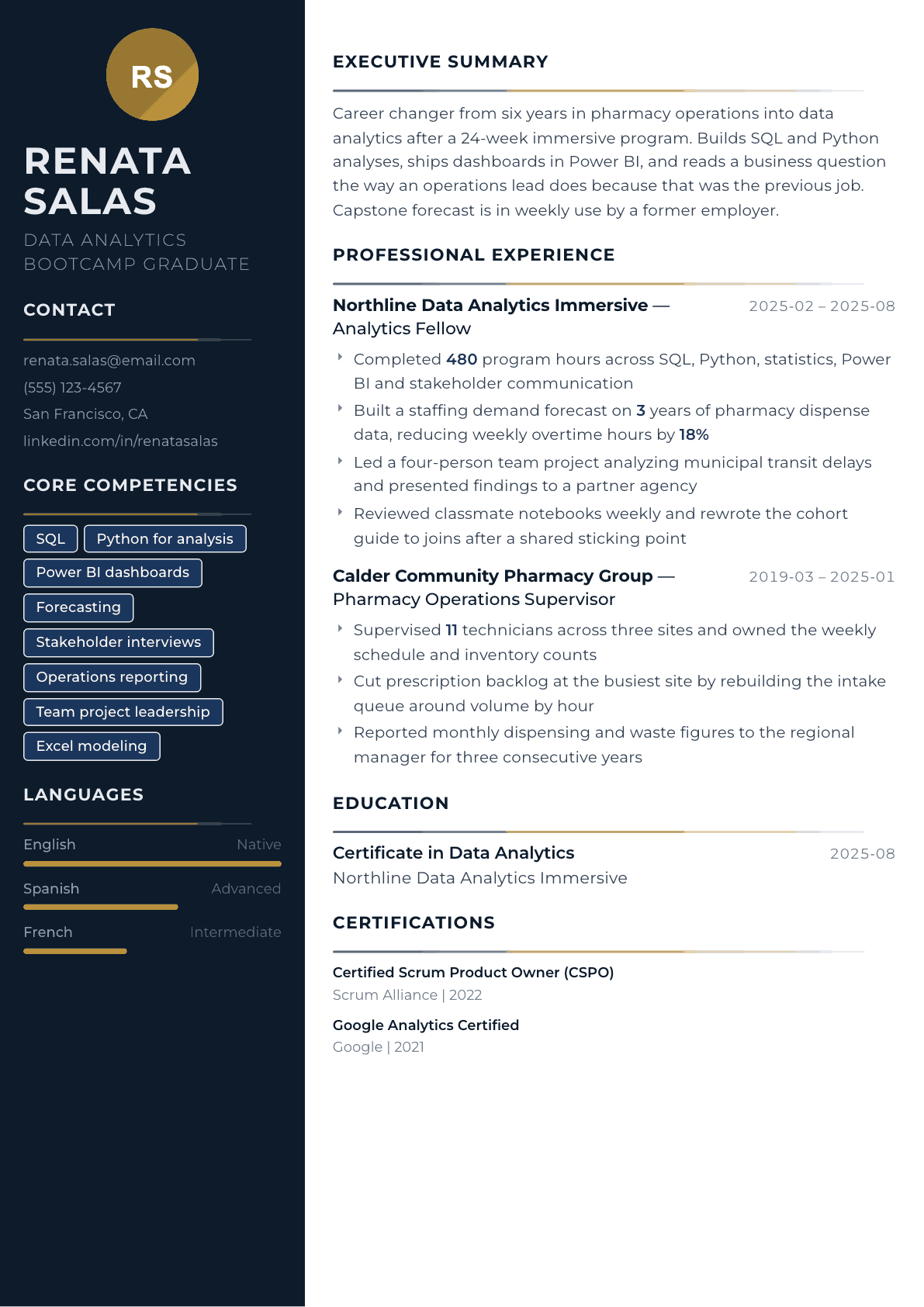
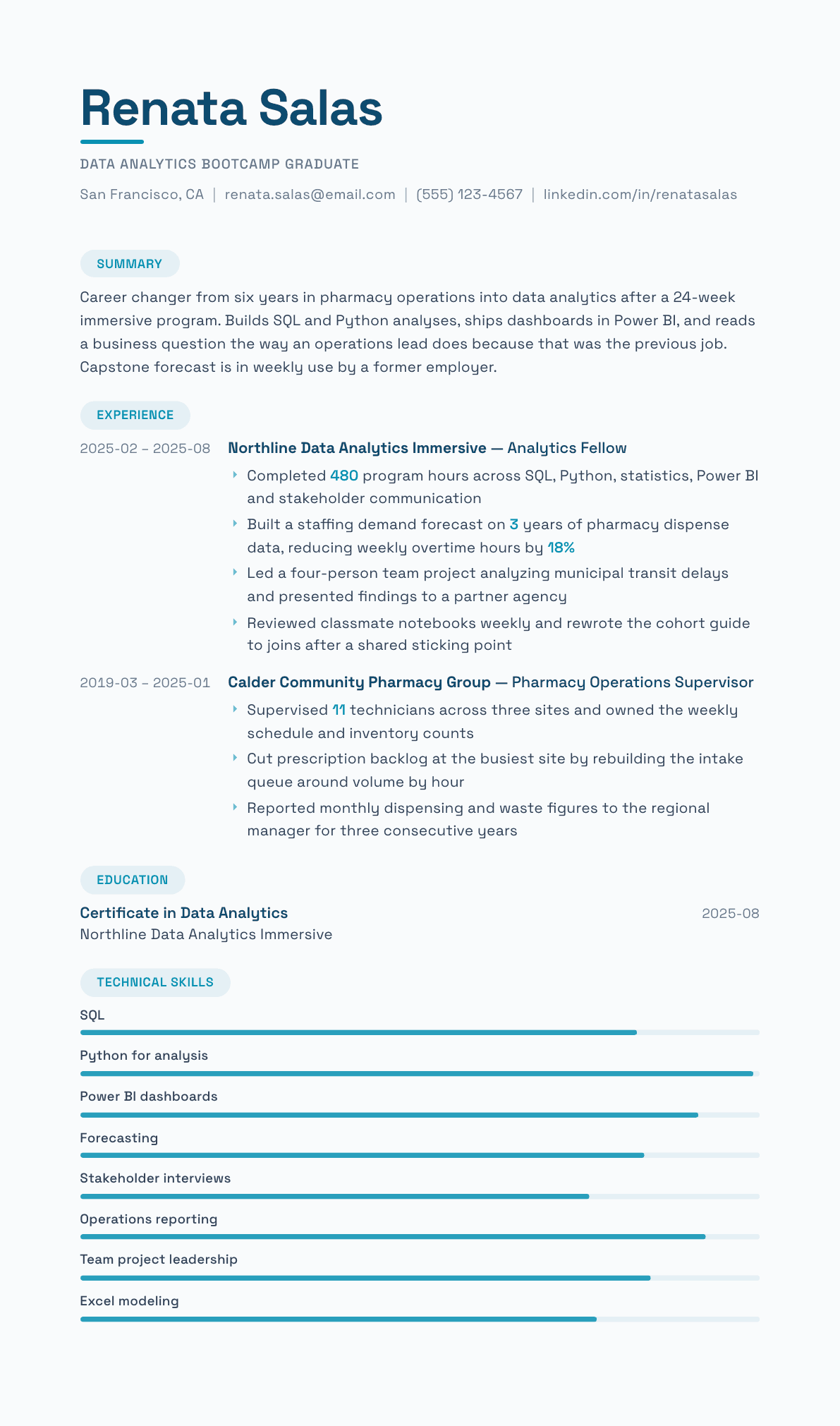
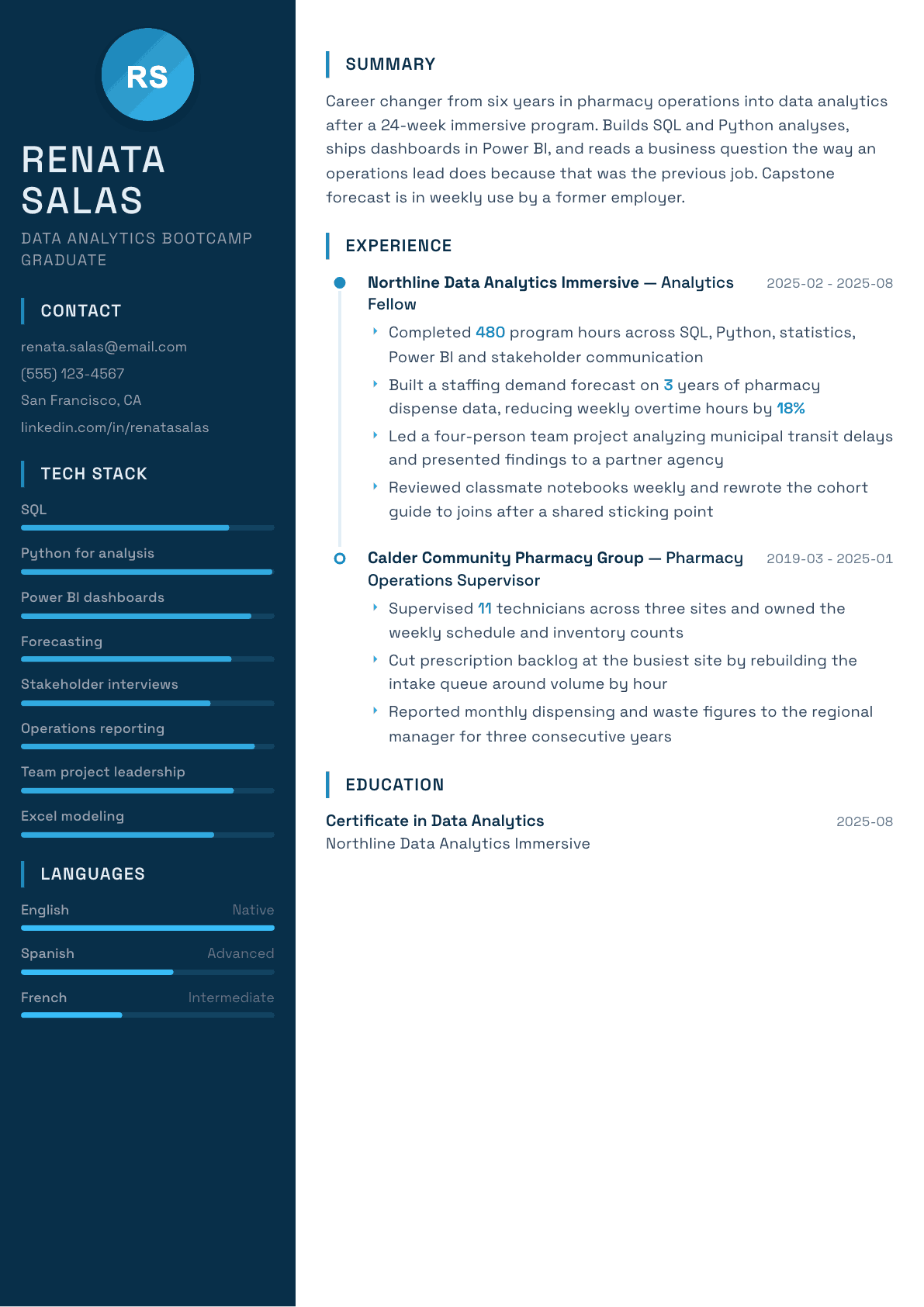
Example Bootcamp Graduate summary
Bootcamp graduate moving from six years in pharmacy operations into data analytics after a 480 hour immersive program. Writes SQL and Python analyses, builds Power BI dashboards, and brings the operational judgment of someone who used to own the schedule being forecast. Capstone staffing model is in weekly use at a former employer. Seeking a junior analyst role in healthcare or retail operations.
Skills to list on a Bootcamp Graduate resume
- SQL querying and joins
- Python for data analysis
- Power BI and dashboard design
- Spreadsheet modeling
- Descriptive statistics
- Forecasting and trend analysis
- Data cleaning and validation
- Stakeholder requirement gathering
- Capstone project delivery
- Version control basics
- Presenting to non-technical audiences
- Process documentation
- Team collaboration in sprints
- Domain knowledge from prior industry
What actually gets this resume read
- Name the program, its hour count and the format, because a 12-week part-time course and an immersive differ.
- Put the prior career on the page in full, since the domain knowledge is the reason a hiring manager calls you.
- Describe the capstone as a piece of work with a user, not as an assignment that earned a grade.
- Translate old duties into the new vocabulary: schedules become forecasting, counts become data quality.
- Give a link line for your portfolio and keep the projects there matching the ones named on the resume.
- Skip the objective paragraph about passion and use the space to show what you built during the program.
- List any certification you earned alongside the bootcamp with the issuing body, since those are verifiable.
How to write a bootcamp graduate resume
Bootcamps cover far more than software now. Data analytics, user experience design, cybersecurity, digital marketing, product management and cloud administration all run intensive programs, and every graduate of one walks into the same hiring problem: a hiring manager holding a resume with a certificate on it and no obvious way to judge what it is worth. She has met bootcamp graduates who were excellent and bootcamp graduates who could not do the job, and nothing on the page tells her which one you are.
The candidates who get past that are almost never the ones who wrote the most about the program. They are the ones who made the previous career visible. Six years in pharmacy operations, four years teaching, a decade in insurance claims: that history is the reason a manager would prefer you over a graduate with no working past, because you already understand a business context she would otherwise have to teach.
This guide covers how to structure a career-change resume after an intensive program, how to write the capstone so it reads as work rather than coursework, three summaries for a recent finisher, a graduate with a first contract behind them and a career changer with real domain depth, and the questions that come up when the credential is doing the arguing.
Format: a hybrid page, because pure chronology buries you
A strictly reverse chronological page puts your program at the top and your entire working life underneath it, which invites a reader to treat you as inexperienced. A pure functional page hides your dates and reads as evasive. The layout that works is a hybrid: a three-line profile naming the target role and the domain you came from, a projects section, then employment in reverse chronological order with the program listed as education.
Keep the profile factual. Name the role you are applying for, the program length in hours, and the domain knowledge you bring. A reader deciding in ten seconds needs those three facts, and none of them require her to believe anything about your passion for the field.
- Profile: target role, program hours and format, prior domain, and the tools you work in now.
- Projects section above employment, with the capstone first and any client or volunteer work beside it.
- Employment kept in full, written in the vocabulary of your new field where the work genuinely overlaps.
- Education block naming the program, its provider, the hour count and the completion month.
Write the program as hours and content, not as a brand
Program names mean nothing to most hiring managers, and the ones that do carry weight vary by city. What travels is the specification: how many hours, over how many weeks, full time or evenings, and which subjects were covered in enough depth that you would take a technical question on them. A four hundred and eighty hour immersive and a ten week evening course are different claims and should look different on the page.
Do not list every module in the syllabus. Pick the five or six subjects you could be tested on and put them in the skills block, then let the projects prove them. A curriculum copied onto a resume tells a reader you learned what you were shown, which is not the question she is asking.
Capstone and projects: give the work a user
The single biggest upgrade available to a bootcamp graduate is turning the capstone from an assignment into a piece of work with someone on the other end of it. Who was it for, what decision did it support, and did anyone keep using it. A staffing forecast built on a former employer's data and still run weekly is a different artifact from a notebook that scored well.
If your capstone had no real user, get one before you apply. A local nonprofit, a small business, a campus office or a former manager will usually accept a free analysis, a design audit or a security review. Two weeks of that turns a portfolio piece into an engagement with a stakeholder, a scope and a delivery, which is what your first employer wants to see you survive.
Write each project the way a consultant writes a case: the question, the data or the research, the method, the artifact, and what changed. Keep the tools in a single line under the project name so a scanner finds them without you salting the prose with keywords.
- Project name, one-line problem statement, and the tools line beneath it.
- Scale that makes the work credible: rows analyzed, users interviewed, systems reviewed, months of data.
- The artifact you handed over: a dashboard, a report, a prototype, a runbook, a remediation plan.
- What the recipient did with it, even if the answer is that they asked for a second version.
Translate the old career without erasing it
Career changers make two opposite mistakes. Some delete the old career to look like a fresh graduate, which throws away the only thing that makes them distinctive. Others leave it untranslated, so a hiring manager reading a pharmacy supervisor entry sees no connection at all. The fix is to keep every job and rewrite the bullets in the vocabulary of the new field where that is honest.
Scheduling eleven technicians across three sites is workforce planning under constraints. Monthly dispensing and waste reporting is operational reporting with data quality problems attached. Handling an angry customer at a counter is stakeholder management with no escalation path. None of this is exaggeration, it is naming the same work in words your new industry uses.
Then say the quiet part out loud in one line: the domain you came from is a market your new employer sells into or operates in. A healthcare analytics team hiring someone who has worked a pharmacy floor is buying context it cannot train.
Certifications, portfolio links and what recruiters filter on
Vendor and industry certifications are the fastest way to add verifiable evidence next to a bootcamp certificate, because they are issued by bodies a recruiter recognizes and can check. One credential relevant to your target role is worth more than three general courses, and it also gives a screening call an easy opening question.
Give one portfolio link, and make sure everything behind it matches what the resume claims. A dead link, a placeholder page or a portfolio full of projects the resume never mentions is worse than no link. Recruiters filter on tool names too, so make sure the exact spelling from your target postings appears where the work sits, not only in a list.
Bootcamp Graduate resume summary examples
Just finished the program
Data analytics bootcamp graduate with 480 program hours in SQL, Python, statistics and Power BI, moving from six years supervising pharmacy operations. Built a staffing demand forecast on 3 years of dispense data that cut weekly overtime by 18%. Seeking a junior analyst role in healthcare or retail operations.
One contract in
Analytics bootcamp graduate with a completed six month contract cleaning and modeling claims data for a regional insurer, following an immersive program and eight years in claims handling. Delivered a reconciliation dashboard now used weekly by two teams. Comfortable in SQL, Python and Power BI. Seeking a permanent analyst position.
Career changer with deep domain history
User experience bootcamp graduate with eleven years in clinical nursing, now designing for healthcare software. Ran 24 contextual interviews with nurses for a medication administration redesign and prototyped the revised flow in Figma. Brings the workflow knowledge that usability sessions normally have to buy. Seeking a product design role in health technology.
Work experience bullets: before and after
Before: Completed a data analytics bootcamp.
After: Completed a 480 hour immersive covering SQL, Python, statistics, Power BI and stakeholder communication, with four assessed projects and a capstone delivered to an outside organization.
Hours, subjects and assessed output let a manager judge the program instead of guessing at its rigor.
Before: Built a capstone project using real data.
After: Built a staffing demand forecast on 3 years of pharmacy dispense data for a former employer, reducing weekly overtime hours by 18%, and handed over the model with an update guide.
A named user, a real dataset and a result turn a graded project into delivered work.
Before: Supervised staff at a pharmacy.
After: Planned weekly coverage for 11 technicians across three sites against prescription volume by hour, which is the same demand modeling problem the capstone forecast later solved with data.
The old job is rewritten in the new field's language, making the career change look like continuity.
Before: Worked on a team project during the program.
After: Led a four-person team analyzing municipal transit delay data and presented the findings to a partner agency, splitting the work across data cleaning, modeling and the final presentation.
Team size, a real audience and a division of labor show collaboration under a delivery deadline.
Before: Helped classmates with difficult topics.
After: Reviewed classmate notebooks weekly and rewrote the cohort guide to table joins after tracking the same mistake across three project reviews.
Diagnosing a shared failure and producing a fix is exactly the instinct a team wants in a junior hire.
Hard skills
- SQL querying and joins
- Python for data analysis
- Dashboard design and reporting
- Spreadsheet modeling
- Descriptive statistics and trend analysis
- Data cleaning and validation
- Stakeholder requirement gathering
- User research and interviews
- Capstone project delivery
- Version control basics
- Process documentation
- Domain knowledge from a prior industry
Soft skills
- Explaining a result to someone who does not want a method lecture
- Asking for a real dataset instead of settling for a sample
- Taking a critique on work you spent a weekend building
- Restarting a career in public without pretending the past did not happen
- Keeping a study routine going after the cohort disbands
Certifications worth listing
- Google Data Analytics Professional Certificate (Google)
- Google UX Design Professional Certificate (Google)
- CompTIA Security+ (CompTIA)
- Salesforce Certified Administrator (Salesforce)
Mistakes that cost bootcamp graduate candidates the interview
- Deleting the previous career to look like a new graduate, which removes the only advantage you actually have.
- Writing the program name with no hour count or format, so a manager cannot tell an evening course from an immersive.
- Listing the whole syllabus as skills, then failing the screening question on a module you barely touched.
- Presenting a capstone with no user, no scope and no handover, which reads as coursework rather than delivery.
- Adding a portfolio link that is dead, empty, or full of projects the resume never mentions.
- Opening with a paragraph about passion for the field instead of the tools, hours and prior domain.
- Applying only to junior postings in the new field while ignoring hybrid roles where your old industry is the requirement.
Bootcamp Graduate resume questions
Do employers take bootcamp certificates seriously?
Some do, some do not, and you cannot control which. What you can control is giving the credential a context: hours, subjects, assessed projects and a capstone with a real recipient. Managers who distrust certificates still hire on demonstrated work.
Where should the bootcamp go on the page?
In the education block, with the program hours and completion month. The projects it produced go higher, in their own section, because they are the evidence. The certificate alone at the top of a page has to carry an argument it cannot make.
Should I apply to roles in the industry I came from?
Almost always, and first. A team hiring an analyst for a healthcare client or a designer for insurance software is looking for domain knowledge that normally takes a year to build. Your prior career makes you a shorter ramp than a stronger technical candidate from outside.
How do I handle the gap between leaving my job and finishing the program?
It is not a gap, it is the program, so list it with dates as a full-time entry. If you worked part time throughout, say so, because carrying an intensive course alongside paid work is read as evidence of exactly the stamina a first year in a new field demands.
Is a second certification worth the time before applying?
One recognized vendor or industry credential aligned to your target role is worth it, because it is verifiable by a recruiter who cannot verify your bootcamp. A third and fourth are not, and the same weeks spent delivering a real project for an organization will do more.