Coding Bootcamp Graduate Resume Examples: free ATS score
Coding Bootcamp Graduate Resume That Survives a Junior Developer Screen
By Mustafa Tarabya, founder of CVBooster · Published · Updated
Coding bootcamp graduate resume example with a projects section, stack keywords, repository links and a guide to passing the first technical screen.
Sample resumes for a coding bootcamp graduate
The same coding bootcamp graduate content laid out in three CVBooster templates, so you can see what the finished document looks like before you write a word.
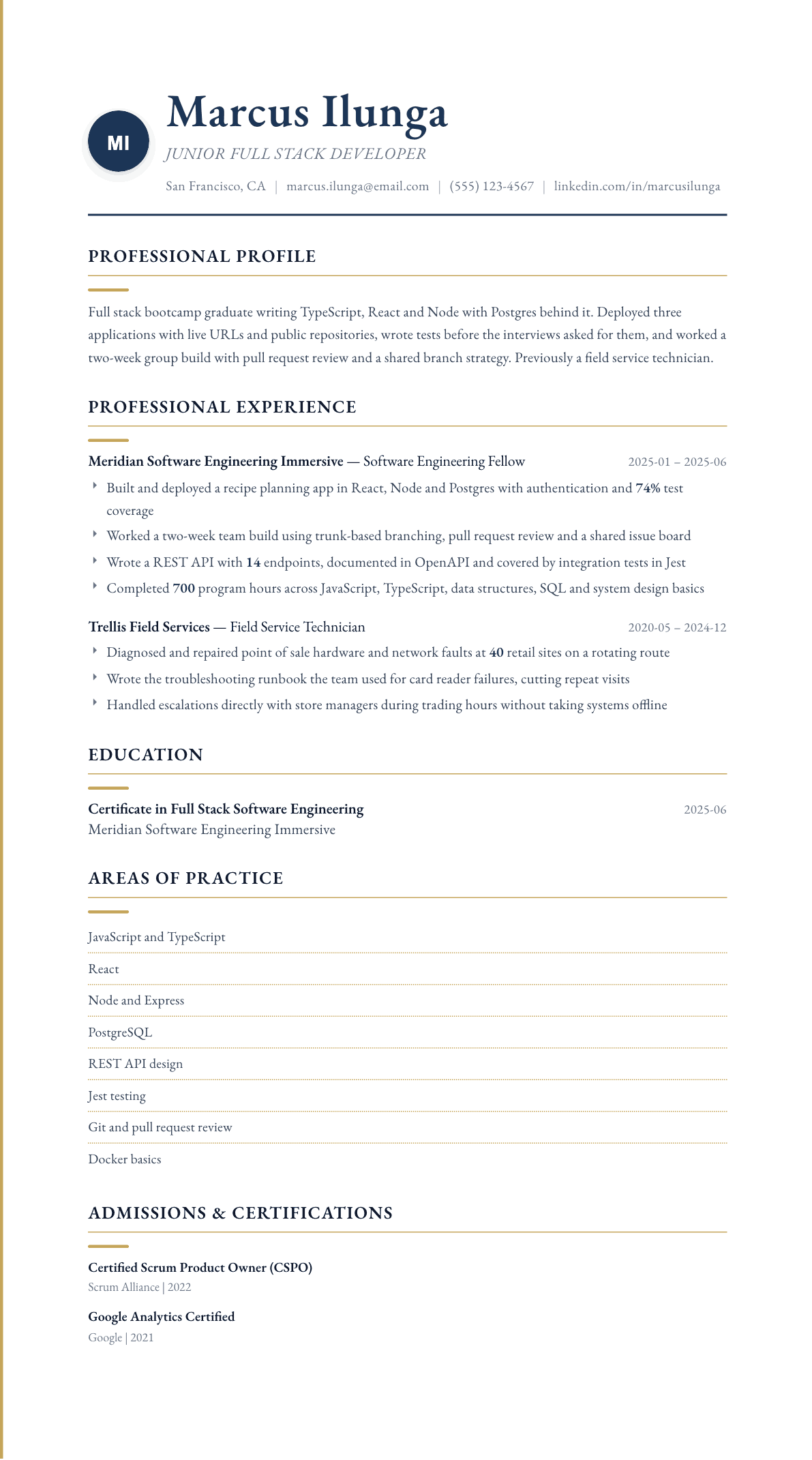
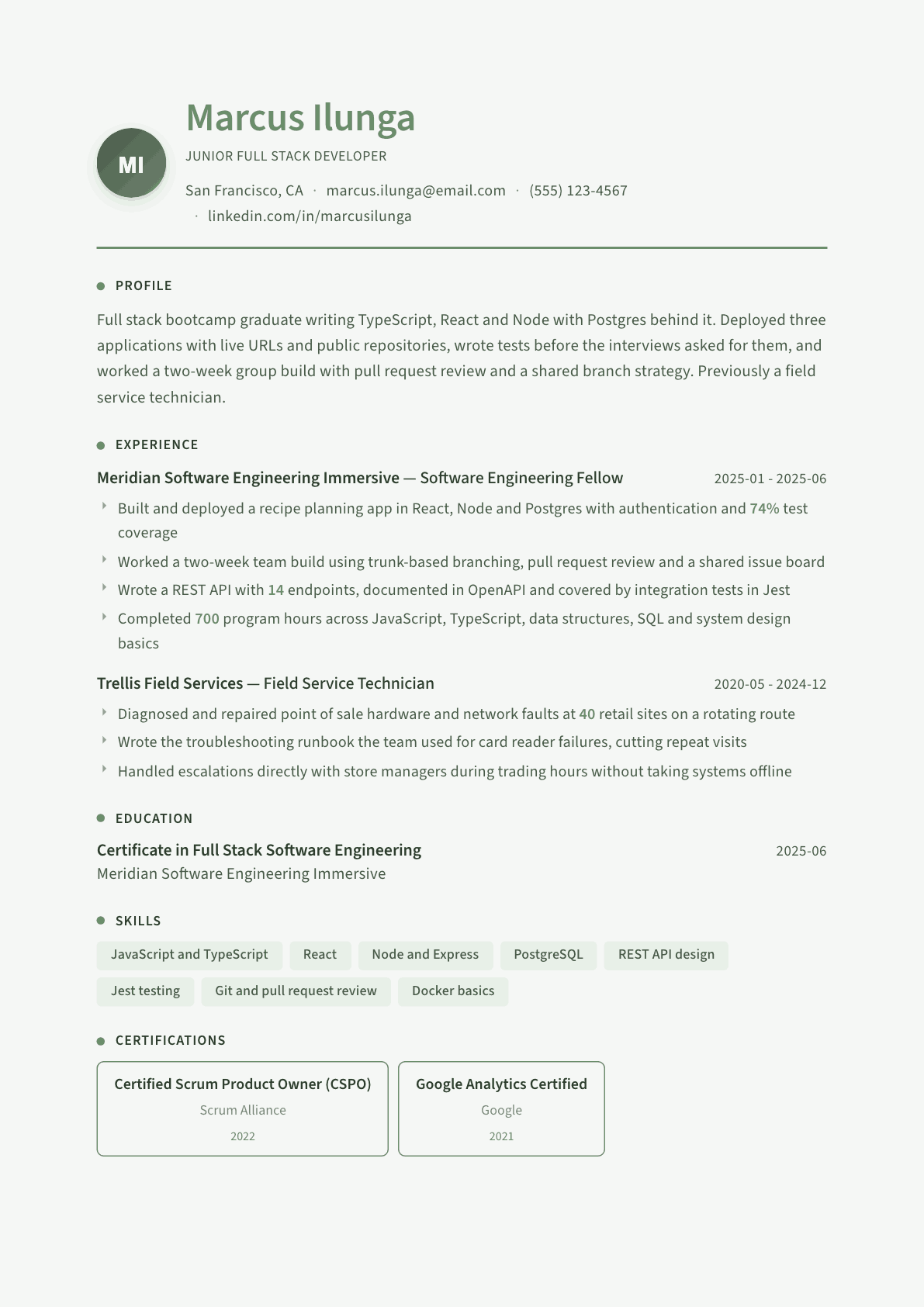
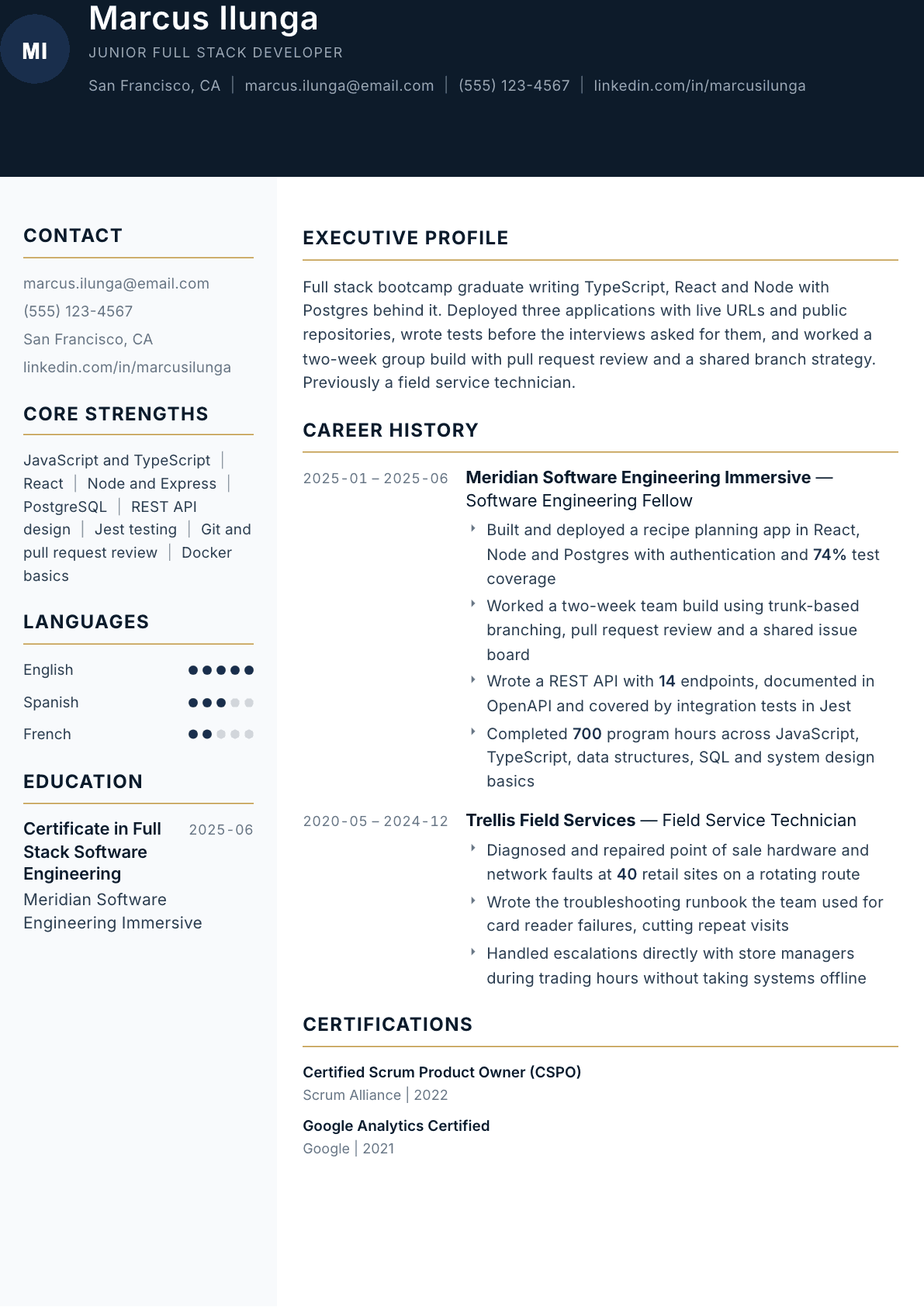
Example Coding Bootcamp Graduate summary
Coding bootcamp graduate with 700 program hours in JavaScript, TypeScript, React, Node and Postgres, and three deployed applications with public repositories. Wrote a documented REST API covered by integration tests and worked a team build with pull request review. Brings four years of field service troubleshooting and direct customer escalation handling. Seeking a junior full stack or front end developer role.
Skills to list on a Coding Bootcamp Graduate resume
- JavaScript and TypeScript
- React and component state
- Node and Express APIs
- PostgreSQL and schema design
- REST API design
- Unit and integration testing
- Git branching and pull requests
- Debugging and stack traces
- HTML and CSS layout
- Authentication and sessions
- Deployment and environment configuration
- Docker fundamentals
- Agile ceremonies
- Technical interview problem solving
What actually gets this resume read
- Put the projects section above education, because a junior developer screen starts at the code you can show.
- Give every project a live URL, a repository link and the stack in one line under the project name.
- Say what you personally built on a group project, since a hiring manager will open the commit history.
- Name the testing framework and the coverage you reached, which separates you from a portfolio of demos.
- Keep the prior career on the page when it involved troubleshooting, customers or systems under pressure.
- Write the stack in the words the posting uses, matching TypeScript, Node and Postgres exactly as spelled.
- Drop tutorial clones from the projects list and keep the applications that solve a problem you can describe.
How to write a coding bootcamp graduate resume
Junior developer hiring has one shape almost everywhere: a recruiter screen, then an engineer who opens your repositories before she opens your resume. She is looking for commit history that is yours, code she can read without an explanation, tests she did not have to ask for, and a README that tells her how to run the thing. Everything on your page is a promise about what she will find when she clicks.
Coding bootcamp graduates lose interviews for reasons that have nothing to do with ability. Three tutorial clones with identical structure. A group project where the commit log shows two contributors and neither is you. A skills list naming twelve technologies when the code uses four. An engineer notices all of that in about ninety seconds, and none of it can be argued away in a cover letter.
This guide covers the layout a junior developer screen rewards, how to write projects so an engineer wants to open them, three summaries across a fresh graduate, one with freelance or contract work behind them and a career switcher from a technical trade, and the questions that come up when there is no computer science degree on the page.
Format: projects above education, links that work
One page. A three-line header with your target title, your stack in the words the postings use, and links: repository host, portfolio, and a deployed application. Then projects, then experience, then the program under education, then a compact skills block. Projects go above education because a junior hire is assessed on code, and the code is the only unmediated evidence you have.
Check every link the day you send the application. A repository that 404s or a deployed URL that has expired on a free tier is the fastest rejection in this pipeline, because it reads as carelessness about the exact thing you are asking to be trusted with.
- Header links: repository profile, portfolio, one live application, and nothing else.
- Stack line spelled the way postings spell it: TypeScript, Node, PostgreSQL, React, Docker.
- Projects with the stack on one line under the title and two or three bullets beneath it.
- Program entry in education with hours, format and completion month, not a paragraph about the curriculum.
Projects: three real ones, and what an engineer checks in each
Three projects is the right number. One should be substantial enough to have a data model, authentication and tests. One should show you can work in a team repository with branches, pull requests and review comments. One can be small and odd, something you built because it annoyed you, which is often the project an interviewer enjoys most.
Under each, write the problem it solves in one sentence and then the technical decisions you made. The schema choice, why you cached that call, how you handled authentication, what you did about the query that was slow. Junior candidates rarely explain a decision on their resume, and an engineer reading one immediately treats you differently.
Delete tutorial clones. A to-do list, a weather dashboard and a movie search built from the same course produce three copies of one project, and hiring engineers have seen thousands. If a project came from a course, extend it past the tutorial and say what you added.
- Testing: framework, what is covered, and whether the tests run in a pipeline.
- Data: schema design decisions, migrations, and what the seed data looks like.
- Deployment: where it runs, how environment configuration and secrets are handled.
- README quality, because it is the first file an engineer opens and most candidates neglect it.
Group builds: separate what you wrote from what the team wrote
Every program ends with a team project, and every graduate lists it. What distinguishes the credible version is precision about your own contribution. The endpoints you wrote, the component tree you owned, the migration you ran, the bug you tracked down. An engineer will open the commit history and compare, so the page must match the log.
Write the collaboration mechanics too, because they are the part of the job a junior is genuinely expected to do on day one: branch naming, pull request review, resolving a merge conflict, working from an issue board, standing up in a daily and saying what is blocked. A candidate who has done those under a deadline needs far less onboarding.
The prior career belongs on the page when it was technical or human
A field service technician, a help desk analyst, a warehouse lead, a bartender who ran closing shifts: all of these carry something a junior developer role needs. Troubleshooting under time pressure, explaining a fault to someone upset about it, documenting a fix so the next person does not repeat the visit. Write one entry with two or three bullets and let it do that work.
Do not force the translation into fake engineering language. A hiring manager can tell when a retail job has been dressed up as agile delivery. The honest version, a job that involved diagnosis, customers and documentation, reads better and holds up when someone asks about it.
Skills, screens and the technical interview the page sets up
Keep the skills block to things you would take a question on. A junior page listing four languages, three frameworks, two clouds and a message broker invites the interviewer to pick the weakest item. Group them into languages, frameworks, data, testing and tooling, and let the projects carry the proof.
Recruiters screen on exact strings, so match the posting: React and not ReactJS if that is what the advert says, PostgreSQL rather than Postgres in the skills block, TypeScript spelled out. Then remember that the resume is the first half of a two-part test. Everything you list is something you might be asked to write on a shared screen, so a shorter honest list produces better interviews than a long one.
Coding Bootcamp Graduate resume summary examples
Fresh out of the program
Full stack bootcamp graduate with 700 program hours in JavaScript, TypeScript, React, Node and Postgres, and three deployed applications with public repositories. Wrote a documented REST API with 14 endpoints covered by integration tests. Previously a field service technician for four years. Seeking a junior full stack role.
With freelance work behind them
Junior developer eight months out of an immersive program, with two paid freelance builds for small businesses on React and Node and a live booking application handling real customer traffic. Comfortable owning a feature from issue to deploy, writing tests first, and reviewing another developer's pull request.
Career switcher from a technical trade
Software engineering bootcamp graduate with nine years in industrial controls, now writing Python and TypeScript. Built a machine downtime dashboard consuming a factory data historian, deployed it in a plant, and maintains it under change control. Seeking a developer role where hardware and industrial context is useful.
Work experience bullets: before and after
Before: Built a web app using React and Node.
After: Built and deployed a recipe planning application in React, Node and Postgres with session-based authentication, 74% test coverage in Jest and a documented local setup in the README.
Auth approach, coverage figure and setup documentation are the three things an engineer checks first.
Before: Worked on a team project with other students.
After: Owned the API layer on a two-week team build, writing 9 of the 14 endpoints and the database migrations, and reviewed pull requests from two teammates under a trunk-based branching model.
A contribution boundary that matches the commit log survives the moment an engineer opens the repository.
Before: Learned about testing during the program.
After: Wrote integration tests in Jest covering the authentication and booking flows, and added a pipeline check that blocks a merge when coverage drops on the touched files.
Naming what is tested and where the check runs distinguishes a testing habit from a completed testing module.
Before: Fixed bugs in my project.
After: Traced a slow booking page to an N plus one query, replaced the per-row lookups with a single join and an index, and brought the page response from about 2 seconds to under 200 milliseconds.
A diagnosis, a specific fix and a measured result is the closest a junior gets to a real production story.
Before: Previously worked as a technician doing repairs.
After: Diagnosed point of sale hardware and network faults at 40 retail sites on a rotating route, and wrote the card reader troubleshooting runbook that cut repeat visits for the team.
Diagnosis at scale plus written documentation is the part of the old job a developer team actually values.
Hard skills
- JavaScript and TypeScript
- React and component state management
- Node and Express APIs
- PostgreSQL schema design and migrations
- REST API design and documentation
- Unit and integration testing
- Git branching and pull request review
- Debugging from stack traces and logs
- Authentication and session handling
- Deployment and environment configuration
- Docker fundamentals
- HTML and CSS layout
Soft skills
- Reading someone else's code before rewriting it
- Saying what is blocking you on the day it blocks you
- Taking a pull request comment as information rather than criticism
- Narrating your reasoning during a live coding exercise
- Keeping a learning habit after the cohort ends
Certifications worth listing
- AWS Certified Cloud Practitioner (Amazon Web Services)
- Microsoft Certified: Azure Fundamentals (Microsoft)
Mistakes that cost coding bootcamp graduate candidates the interview
- Listing three tutorial clones that share the same structure, which an engineer recognizes on sight.
- Claiming a team project without separating your commits from everyone else's in the description.
- Naming twelve technologies in the skills block when four appear anywhere in your code.
- Sending links to a repository that returns an error or a deployment that has expired on a free tier.
- Leaving the README empty, so the first file an engineer opens tells her nothing about running the project.
- Cutting the prior technical job, when troubleshooting and customer diagnosis is exactly what a support-facing team wants.
- Writing a paragraph about a passion for coding in the space where the stack and the links should be.
Coding Bootcamp Graduate resume questions
Can I get a developer job from a bootcamp without a computer science degree?
People do it in every hiring cycle, and the ones who succeed lead with code rather than credentials. Expect to be tested on fundamentals like data structures, complexity and how the web request actually travels, so prepare those alongside your framework knowledge.
How many projects should be on the resume?
Three, each doing a different job: one substantial application with data and tests, one team repository showing collaboration, and one small personal build. A fourth adds nothing and dilutes the attention an engineer gives the first one.
Should I include the bootcamp capstone if it was a group build?
Yes, and write your own contribution precisely, because the commit history will be checked. Naming the endpoints, components or migrations you personally wrote is more convincing than describing the finished product as a shared achievement.
Do I need open source contributions to be competitive?
They help but they are not required, and a trivial documentation fix does not move a hiring decision. A genuine bug fix or a small feature in a project you actually use is worth listing, mainly because it proves you can work inside an unfamiliar codebase.
How do I explain a long stretch of applying with no job?
Fill it with work rather than words. Freelance builds for a small business, a maintained open source contribution, a project deployed and iterated on, or contract work of any length all read as continued practice, and each one gives an interviewer something current to ask about.