Career Change Resume Examples: free ATS score and gap list
Write a Career Change Resume That Survives the First Screen
By Mustafa Tarabya, founder of CVBooster · Published · Updated
Career change resume examples with objectives written out for five common moves, a combination format sample resume, retraining proof and keywords for the new field.
Sample resumes for a career change
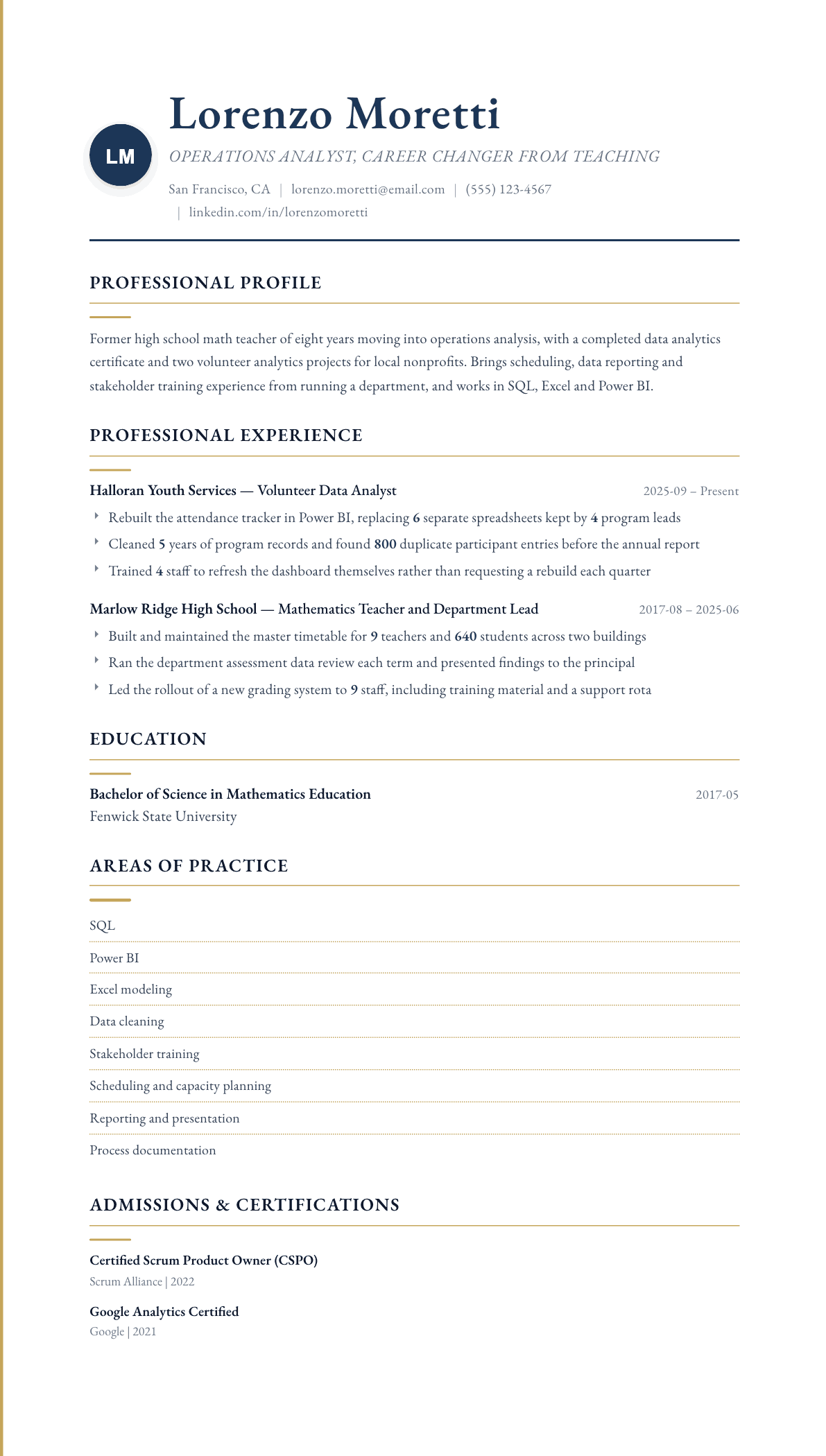
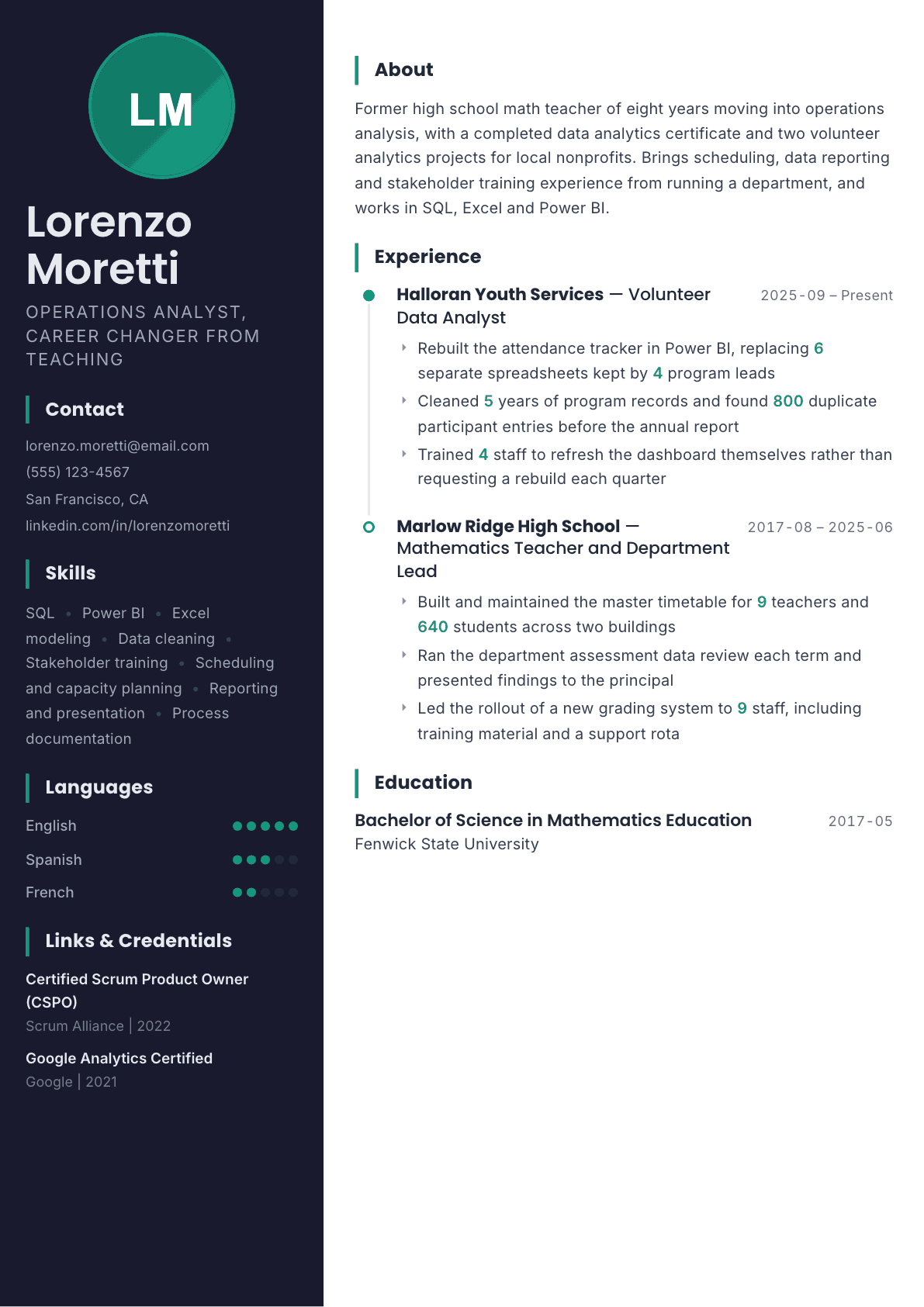
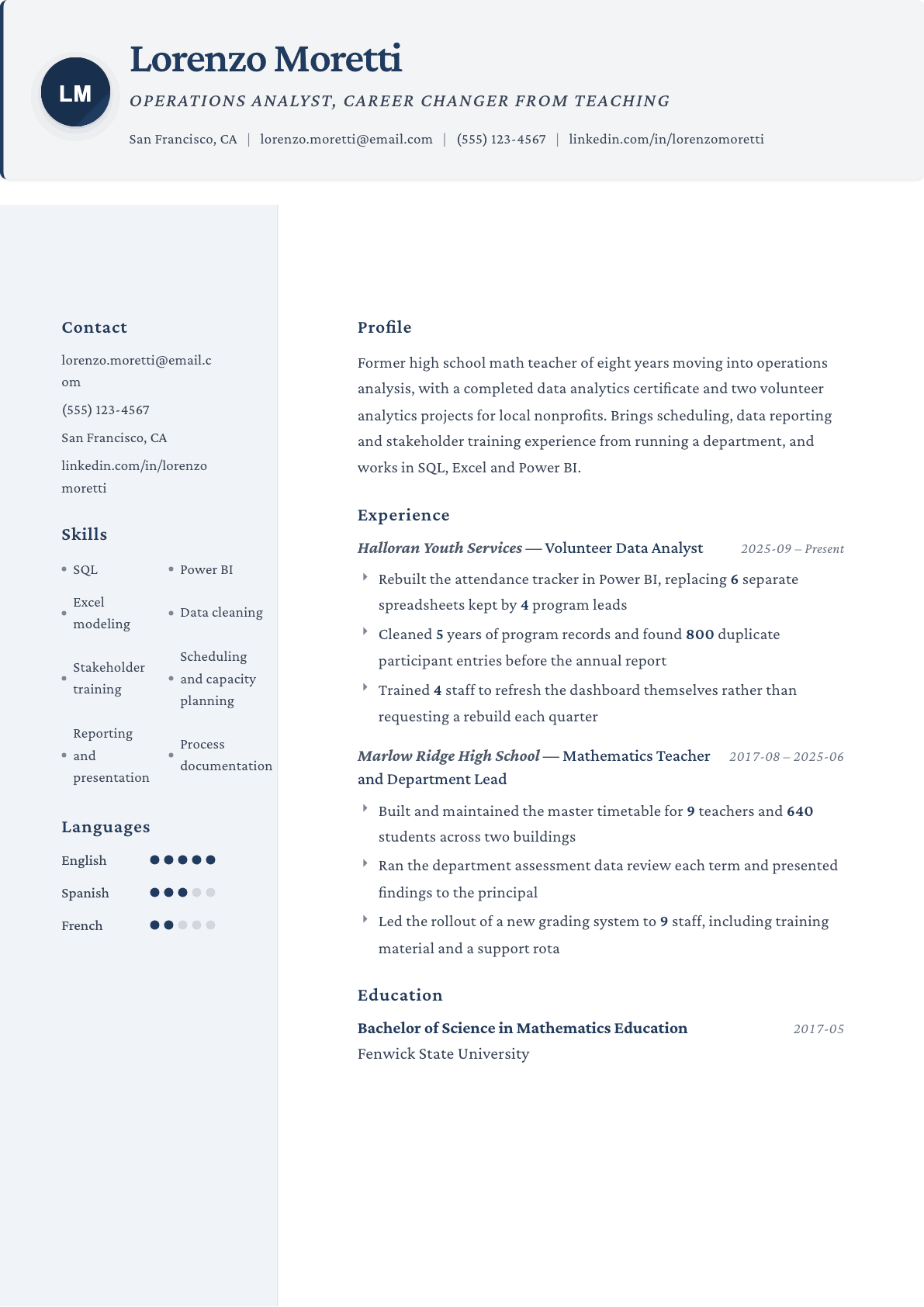
The same career change content laid out in three CVBooster templates, so you can see what the finished document looks like before you write a word.
Example Career Change summary
Operations analyst moving from eight years of teaching mathematics and leading a department, with a completed analytics certificate and two nonprofit projects behind it. Rebuilt a program attendance tracker in Power BI that replaced six spreadsheets kept by four leads, and cleaned five years of records before an annual report. Brings timetable planning, assessment data review and staff training from running a department of nine.
Skills to list on a Career Change resume
- Transferable skills mapping
- Combination resume format
- Target title alignment
- SQL
- Power BI
- Excel modeling
- Data cleaning
- Stakeholder communication
- Training and enablement
- Process documentation
- Project delivery
- Retraining and certification
- Portfolio of applied work
What actually gets this resume read
- Open with a target title that matches the posting, so no reader has to guess which field you are applying to.
- Use a combination format: a skills block first, then the full history, because a strict timeline buries your case.
- Rewrite old bullets in the vocabulary of the new field rather than leaving them in the language of the old one.
- Prove the retraining with a finished certificate and a project someone used, not an enrolled course line.
- Explain the switch in the cover letter and keep the resume free of apology or backstory.
- Keep the old job titles accurate but add a plain phrase describing the work in the new field terms.
- Show one paid or volunteer piece of work in the new field, because that is what turns a claim into evidence.
How to write a career change resume
A career change resume has to win an argument that a normal resume never has to make. The reader can see that your last several jobs are not the job you are applying for, and she is weighing two risks: that you cannot do the work, and that you will leave once the reality of a new field at a lower level stops feeling exciting. Both worries are reasonable. Neither is answered by enthusiasm.
What answers them is evidence in the target field, however small, plus a page arranged so the relevant material is not buried under a decade of the old career. A strict reverse chronological layout does exactly the wrong thing here: it puts eight years of teaching, nursing or retail at the top and leaves the analytics certificate and the two projects somebody actually used down near the fold.
This guide covers choosing a target title, building a combination layout that still passes an applicant tracking system, translating old bullets into the new field's vocabulary without inflating them, proving retraining with output rather than enrollment, and handling the level and pay conversation honestly.
Name the target role at the top of the page
Put a target title under your name that matches the posting: operations analyst, quality technician, account manager. Without it a reader spends her first ten seconds working out which job you think you are applying for, and a resume with an ambiguous target reads as a candidate applying everywhere.
Follow it with three or four lines of summary that state the switch as a fact and immediately supply proof. Former teacher, now an analyst, with a completed certificate and two nonprofit projects behind it is a complete argument in one sentence. Compare that with a summary describing a passion for data and a desire for a new challenge, which is the same claim with the evidence removed.
Do not explain the reasons for the change on the resume. The cover letter and the interview are where a reader wants the why, and a resume that starts apologizing for a background has spent its strongest space on defense.
- A target title line taken from the posting, not an aspirational job grade.
- A summary that pairs the switch with completed evidence in the new field.
- No explanation of motive, no apology, no phrase about seeking a fresh start.
- Contact details and a portfolio or repository link where the new field expects one.
Use a combination layout, and keep the dates intact
A combination resume opens with a skills and selected work block organized by capability, then gives the full employment history in reverse chronological order underneath with dates and titles unchanged. It lets a reader meet your relevant material first without hiding anything, which is what a purely functional format does and why recruiters distrust it.
The selected work block is where the career change is won. Three or four entries, each one a piece of work in the new field: the tool you built, the client, what changed. Volunteer and unpaid projects are allowed here and should not be marked as lesser, because a hiring manager is judging whether the work is real, not whether it was invoiced.
Below that, list every job in order with a full date range. Screening tools parse a chronological history and a manager checks the timeline for holes, so a layout that removes dates trades one problem for a worse one.
- Skills block grouped by capability with the posting's vocabulary, near the top.
- Selected projects, three or four, each with a client or user and an outcome.
- Full employment history with unbroken dates below, titles kept accurate.
- Education and retraining last, unless the new field gates entry on a credential.
Translate the old career instead of deleting it
Every long career contains work that maps onto the new field, and the mistake is to describe it in the language of where it happened. A teacher who built the master timetable for nine staff and six hundred students was doing capacity planning under constraints. A charge nurse who ran a handover for a ward was running a shift briefing with escalation rules. The facts do not change, only the words a reader can recognize.
The line to hold is honesty. Translate the vocabulary, never the substance. Calling a spreadsheet you maintained a data pipeline is the kind of stretch an interviewer finds in ninety seconds, and it costs you the credibility that the genuine translations were building.
Keep quantities from the old career, because scale transfers even when the domain does not. Headcount managed, budget held, customers served, cases carried, sites covered: a hiring manager reading those numbers understands the size of what you have handled before, and that is a thing the new field cannot teach a fresh graduate.
Prove the retraining with something someone used
A certificate line proves attendance. A project proves capability. The strongest career change resumes carry at least one piece of work in the new field that a person outside your household relied on: a nonprofit whose reporting you rebuilt, a small business whose books you cleaned up, a community group whose site you now maintain. Give it a client name, a scope and a result exactly as you would a paid role.
Finish what you started before you list it. An enrolled course, a partially complete bootcamp or a certification you intend to sit are weak lines that draw attention to what is missing. Wait until the credential exists, and until then let the project carry the argument on its own.
Where the field has a recognized entry credential, treat it as a gate rather than a bonus and get it early. Some employers will not put a resume in front of a manager without it, no matter how strong the transferable case looks on paper.
- One completed credential from a body the field recognizes, listed with its issuer.
- At least one project with a real user, described with scope and outcome.
- A public artifact where the field expects one: a repository, a dashboard, a portfolio.
- A reference from the new field, even a volunteer supervisor, added to your list.
Level, pay and the questions the resume sets up
Be realistic about the grade you are applying for. A candidate with twenty years of seniority applying for a junior role triggers the flight risk worry immediately, and pretending the seniority transfers triggers the opposite one. Aim for roles where the old career is genuinely relevant, such as an analyst role in the sector you came from, because domain knowledge is the bridge that keeps you out of the pure entry pool.
Expect the resume to generate three questions and prepare for them: why now, why this field, and what happens when the work turns out to be routine. Answer all three with the project you already completed rather than with conviction, because a manager who has hired career changers before has heard the conviction version and knows how little it predicts.
Career change resume objective examples, written out
A career change resume objective is two sentences under your name: the first names the role you are moving into and the proof you already have, the second names what the old career brings to it. Use an objective instead of a summary when the job history does not yet point at the new field. These career change resume examples show objectives for four common moves; the full sample resume for a career change further down this page shows the layout that goes under them.
Each objective names a target title, one completed credential or project in the new field, and a skill the reader can check. None of them explains why you want to leave, because that belongs in the cover letter and the interview.
- Teacher to instructional designer: Former middle school science teacher moving into instructional design, with a completed e-learning certificate and two online courses built in Articulate Rise for a local literacy nonprofit. Brings eight years of lesson planning, assessment design and training adults on new classroom technology.
- Retail manager to human resources: Store manager of six years seeking an HR coordinator role, with a completed SHRM Essentials of HR course. Hired, scheduled and onboarded more than forty associates and handled attendance and conduct cases with the district HR partner.
- Nurse to health informatics: Registered nurse with nine years on a medical surgical unit moving into clinical informatics, after serving as unit super user for the hospital's electronic health record upgrade. Trained thirty nurses on the new charting screens and logged their issues for the build team.
- Military to project management: Army logistics noncommissioned officer of ten years seeking a project coordinator role, with the Google Project Management Certificate. Planned equipment moves for a unit of four hundred soldiers and kept schedules, budgets and handoffs on track across three locations.
- Hospitality to sales: Restaurant general manager moving into inside sales, with a completed sales development course and a first quarter of part time lead qualification for a software reseller. Brings daily work with guests, upselling and a team of twenty five staff.
Career Change resume summary examples
Switching with a certificate and a first project
Retail supervisor moving into bookkeeping, with a completed bookkeeping certificate and six months keeping the accounts for a neighborhood arts group. Reconciled two years of unposted receipts and produced the first clean annual statement the group had filed. Brings four years of cash handling and daily reconciliation from a store floor.
Mid-career switch with a domain bridge
Operations analyst moving from eight years of teaching mathematics and leading a department, with a completed analytics certificate. Rebuilt a program attendance tracker in Power BI that replaced six spreadsheets kept by four leads, and cleaned five years of records before an annual report. Brings timetable planning and staff training from running a department of nine.
Senior professional changing sector
Logistics manager of fourteen years moving into healthcare operations, with two years on a hospital supply advisory group and a completed process improvement credential. Redesigned a depot replenishment cycle that removed two days from lead time. Targeting a supply chain role where regulated inventory and clinical scheduling meet.
Work experience bullets: before and after
Before: Taught mathematics and was head of department.
After: Built and maintained the master timetable for 9 teachers and 640 students across two buildings, and led the rollout of a new grading system with training material and a support rota.
Written this way the teaching job reads as scheduling, systems rollout and enablement work.
Before: Completed an online data analytics certificate.
After: Completed a data analytics certificate, then rebuilt a youth charity's attendance tracker in Power BI, replacing 6 separate spreadsheets maintained by 4 program leads.
The credential is only credible once it is followed by something a real organization now runs on.
Before: Volunteer data work for a local nonprofit.
After: Cleaned 5 years of program records for a youth services charity and found 800 duplicate participant entries before the annual report went to the board.
Unpaid work with a named scope and a found problem is evaluated as professional work, not as charity.
Before: Good at working with people from my previous career.
After: Trained 4 charity staff to refresh the dashboard themselves rather than requesting a rebuild each quarter, and wrote the one-page instructions they still use.
Enablement described with headcount and an artifact is a capability, where being good with people is not.
Before: Looking for a fresh start in a new industry.
After: Targeting an operations analyst role in education or nonprofit services, where eight years inside a school makes the data and the constraints familiar from day one.
It converts a vague motive into a targeted application where the old career is an asset rather than a detour.
Hard skills
- Transferable skills mapping
- Combination resume construction
- Target title alignment
- SQL querying
- Power BI and dashboard building
- Excel modeling
- Data cleaning and deduplication
- Process documentation
- Scheduling and capacity planning
- Training material development
- Project scoping with a client
- Applicant tracking keyword matching
Soft skills
- Learning a field from the bottom again
- Taking feedback from younger colleagues
- Explaining a switch without defensiveness
- Persistence through a longer search
- Building a network in an unfamiliar sector
- Comfort with a temporary drop in seniority
Certifications worth listing
- Google Project Management Certificate (Google)
- CompTIA A+ (CompTIA)
- Certified ScrumMaster (Scrum Alliance)
Mistakes that cost career change candidates the interview
- Leaving the target role unnamed, so the reader spends her first seconds guessing which job the application is for.
- Using a purely functional layout with no dates, which recruiters read as an attempt to conceal a timeline.
- Listing an enrolled course or a partially finished bootcamp instead of waiting until the credential exists.
- Describing the previous career in its own internal vocabulary, leaving the reader to do the translation.
- Inflating a translated bullet into something the old job never was, which collapses under one interview question.
- Explaining the reasons for the switch on the resume instead of saving them for the cover letter and interview.
- Applying only to pure entry roles when a bridge role in the old sector would value the domain knowledge.
Career Change resume questions
Should a career change resume be functional or chronological?
Neither on its own. Use a combination layout: a capability and selected work block first, then the full employment history with unbroken dates. It puts the relevant evidence in front while keeping the timeline screening tools and hiring managers both expect to find.
How much of my old career should I keep?
Keep all of it in the history, but write only the recent and relevant roles in full detail. Older or unrelated positions can be compressed to a title, employer and date range. Removing them creates a gap that raises a bigger question than the jobs themselves would.
Do I need a degree in the new field to be taken seriously?
Usually not, unless the field is licensed or the employer gates on it. A recognized certificate plus one or two projects that a real organization uses will get most applications read. Where a credential is a legal requirement, obtain it before applying at all.
How do I handle the pay drop question?
Decide your floor before you apply and target roles that clear it, rather than negotiating from a number that was never viable. If a recruiter raises it, say what range you are working toward and why the role is worth entering at that level.
What is a good career change resume objective?
Two sentences: the target job title and one proof in the new field, such as a credential or a project someone used, then the strongest skill from your old career that the new role needs. Leave out the reasons for leaving. Change the target title for each application so it matches the posting.