Entry Level Resume Examples: free ATS score and gap list
Write an Entry Level Resume That Answers the Posting Directly
By Mustafa Tarabya, founder of CVBooster · Published · Updated
Entry level resume example and guide to mirroring a job posting, handling the two years experience trap, and passing an applicant tracking screen.
Sample resumes for a entry level
The same entry level content laid out in three CVBooster templates, so you can see what the finished document looks like before you write a word.
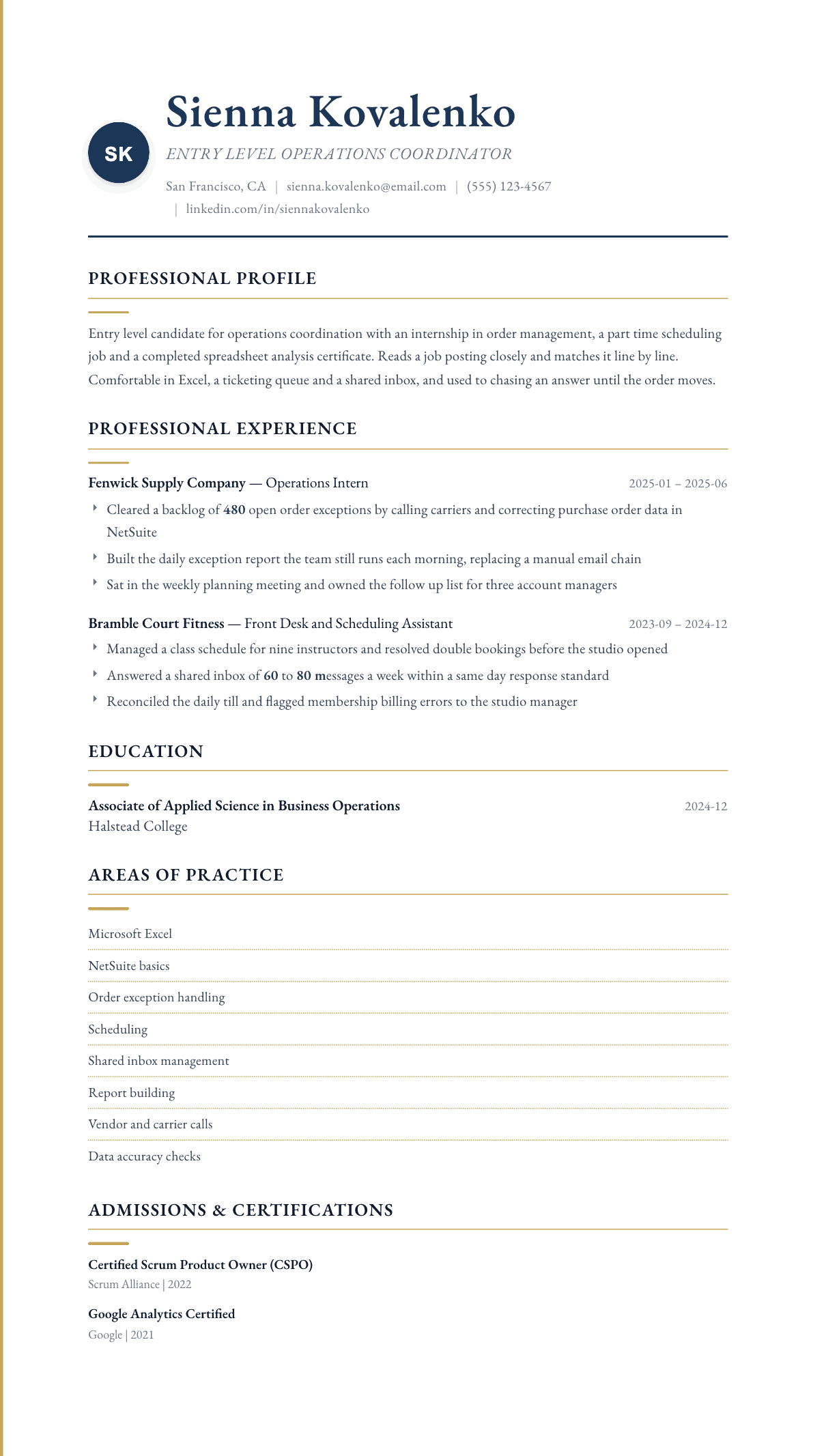
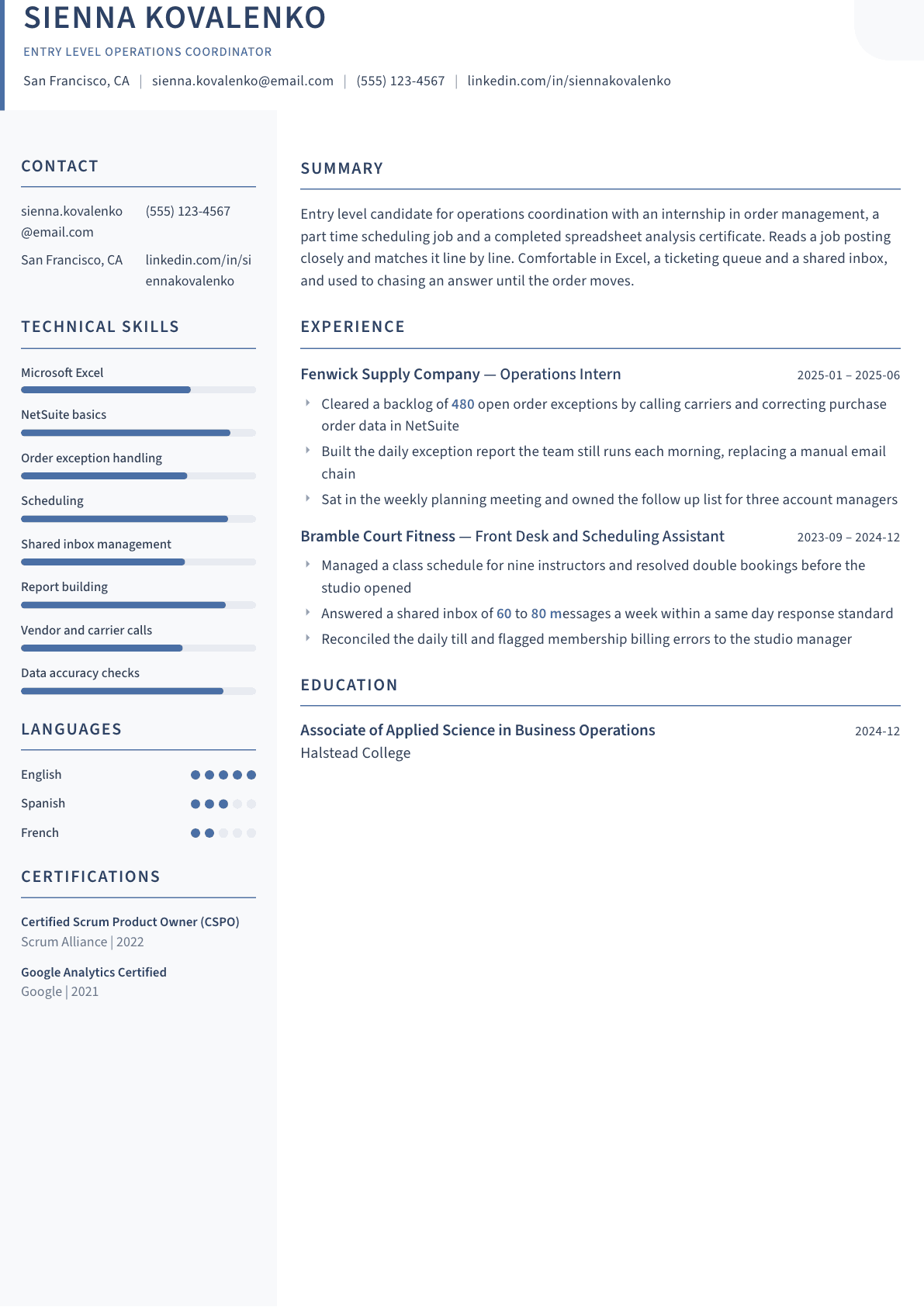
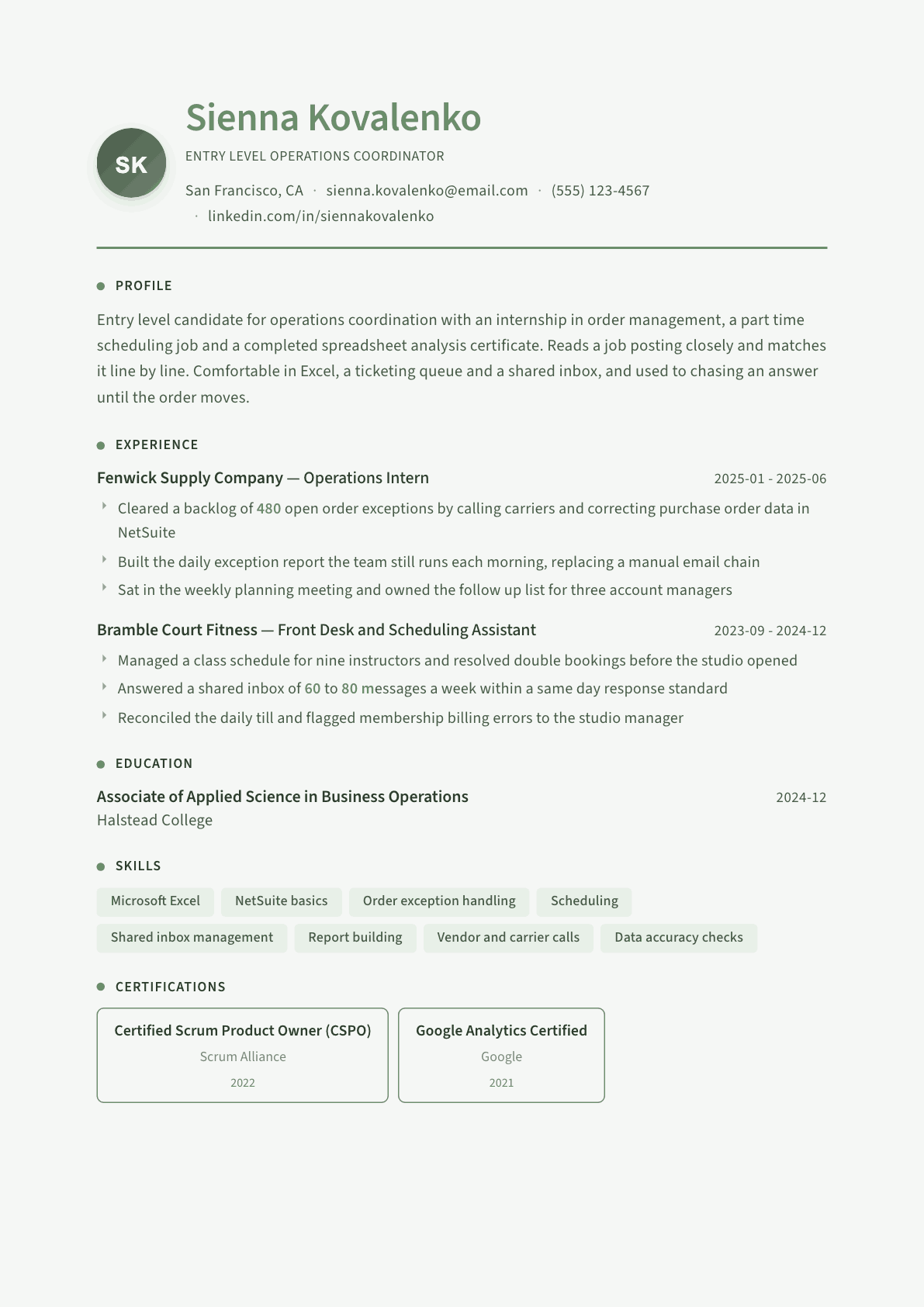
Example Entry Level summary
Entry level operations candidate with a six month internship clearing order exceptions, a year on a studio front desk running schedules and a shared inbox, and an associate degree in business operations. Cleared a backlog of 480 open exceptions by calling carriers and fixing order data, and built a daily exception report the team still uses. Reads the posting closely and answers each requirement with evidence rather than adjectives.
Skills to list on a Entry Level resume
- Microsoft Excel
- Report building
- Order and exception management
- Scheduling and calendar handling
- Shared inbox and ticket queues
- NetSuite basics
- Data accuracy checks
- Vendor and carrier communication
- Meeting follow up
- Process documentation
- Prioritizing a daily queue
- Written business communication
- Applicant tracking keyword matching
What actually gets this resume read
- Rewrite the summary for each posting using the title in the advert, because a generic title costs you the first screen.
- Answer the requirement list in order, and give a line of evidence for every requirement you can honestly meet.
- When a posting asks for two years and you have one, count internships, part time months and course projects openly.
- Use the exact tool names from the posting where you know the tool, since tracking systems match strings and not synonyms.
- Keep bullets to one line each and start with a verb, because entry level piles are read fast and in bulk.
- Show one thing you built or fixed that is still in use, which separates you from candidates who only attended.
- Save the file as your name and the role title, and send a plain document unless the posting asks for something else.
How to write a entry level resume
Entry level is a category invented by employers, not by candidates, and that is the key to writing for it. Somewhere a hiring manager wrote a requisition, chose a title, listed six requirements and asked for one to three years of experience in a role she has labeled the bottom of the ladder. Your page is not competing against an abstract standard. It is competing against that specific list.
Which is why the most common complaint about entry level postings, that they ask for experience nobody entering the field could have, is best treated as a formatting problem rather than an injustice. Those requirement lists are written optimistically and screened generously. Candidates who address them line by line, counting internships, part time months, coursework and projects openly, get interviews. Candidates who read the list, feel disqualified and send a generic page do not.
This guide covers how to read a posting properly, how to calibrate what entry level means in different fields, how to write internship and part time work with the weight it deserves, how applicant tracking screens actually treat your wording, and how to answer a requirement you only partly meet without overstating it.
Read the posting as a checklist and answer it in order
Print the advert and mark it up. Separate the requirements into three groups: the ones you meet with evidence, the ones you meet partly, and the ones you do not meet at all. Then build the page so the first group appears in the top third, the second group appears inside your experience bullets where the context softens the gap, and the third group is not mentioned.
The order matters as much as the content. A screener reading two hundred applications is checking whether her top three requirements appear early, not reading your page as prose. If the advert leads with reporting and stakeholder communication, your first bullets should be a report you built and a readout you delivered, even when other work of yours was more interesting.
- A summary that uses the posting job title rather than your degree subject.
- Skills block ordered to match the requirement list, with the ones you cannot support removed.
- The two strongest requirement matches evidenced in the first three bullets of the page.
- Tools named as the advert names them, not as a synonym you prefer.
- A single page with one line bullets, because these piles are read in bulk and at speed.
Work out what entry level means in the field you are applying to
The label covers very different distances. In some fields an entry level opening genuinely expects a graduate with no professional history and comes with a training structure. In others it means the first rung above an internship and assumes a placement, a portfolio or a license already in hand. Applying to the second kind with a page built for the first is a mismatch no amount of polish fixes.
Read the responsibilities, not the title, to tell them apart. If the duties include owning a process, handling clients directly or working unsupervised, the employer is expecting someone who has done a version of it before, and your internship or part time work needs to be the spine of the page. If the duties are mostly support and learning, the employer is buying potential and your coursework, projects and reliability record carry more weight.
Give internships and part time jobs their full weight
Six months of internship work described precisely will outperform a year of vague full time work described loosely, so write the placement like a job. The team, the tools, the queue or backlog you were given, what you cleared, and whether anything you built stayed in use. An intern who cleared a backlog of open exceptions by calling carriers has done recognizable operational work, and saying so is not inflation.
Part time jobs in unrelated fields still earn their place when you extract the transferable half. A front desk role at a studio involves scheduling, a shared inbox, till reconciliation and billing errors escalated to a manager. Those four things are the same tasks an operations coordinator does at a larger scale, and naming them that way is accurate rather than generous.
When you add up your experience for the requirement line, count everything honestly and say what it is. Nine months of internship plus a year of relevant part time work is a real answer to a two year requirement, and stating it plainly reads far better than leaving the reader to add it up herself or, worse, rounding it into a claim you cannot support.
How the screening software reads you, and what it changes
Most entry level applications pass through a tracking system before a person opens them, and its behavior is simpler than the rumors suggest. It matches strings. If the posting says one tool and you write a different name for the same product, no match is recorded. If the advert uses a phrase for a process and you use your own phrase, the same thing happens. Mirroring exact terminology, only where it is true of you, is the entire trick.
Beyond wording, keep the mechanics dull. A standard document format, real section headings, dates in one style, no text inside images or headers, and no columns that scramble when parsed. Save the file under your name and the role title so a recruiter who downloads fifty applications can find yours again.
Requirements you only partly meet, and what to do with them
Partial matches are worth claiming carefully. If the advert wants a system you used for four months, say four months rather than listing it flatly alongside skills you have used for years. If it wants a certification you are studying for, put it in with the expected completion month. Precision here builds credit for everything else on the page, because a reader who catches one inflated claim rereads the rest suspiciously.
Where you cannot meet a requirement at all, leave it off the resume and address it in the cover letter or not at all. Applying anyway is usually right, since requirement lists are aspirational, but arguing with the list on your own resume wastes the space you needed for the requirements you do meet.
- Name the duration when your exposure to a tool is short, rather than implying depth.
- Mark studies in progress with an expected completion month.
- Convert coursework into a project entry when the posting asks for hands on work.
- Leave unmet requirements unmentioned rather than explaining them away.
Entry Level resume summary examples
Straight out of study
Entry level operations candidate with a six month internship clearing order exceptions and an associate degree in business operations. Cleared a backlog of 480 open exceptions by calling carriers and correcting purchase order data, and built the daily exception report the team still runs. Strong in Excel and comfortable in a ticket queue.
A year of mixed experience
Entry level coordinator with 9 months of internship work in order management and 15 months on a studio front desk running schedules for nine instructors and a shared inbox of 80 messages a week. Reconciled the daily till and escalated billing errors. Available immediately for a full time operations seat.
Entry level in a new field after other work
Moving into operations coordination after 4 years in retail management, where I scheduled 22 staff, ran weekly inventory counts and owned a shrink target. Completed a supply chain fundamentals course and a spreadsheet analysis certificate. Seeking an entry level seat with a path into planning.
Work experience bullets: before and after
Before: Assisted the operations team during my internship.
After: Cleared a backlog of 480 open order exceptions over six months by calling carriers and correcting purchase order data in NetSuite.
A backlog figure, the method and the system make an internship read as delivered work.
Before: Created reports for the team.
After: Built the daily exception report the team still runs each morning, replacing an email chain that three account managers had been maintaining by hand.
What it replaced and who used it shows the report mattered beyond your own desk.
Before: Answered customer emails at a front desk job.
After: Managed a shared inbox of 60 to 80 messages a week to a same day response standard while covering the desk for nine instructors.
A volume and a service standard turn inbox work into a measurable operational duty.
Before: Familiar with scheduling software.
After: Ran the class schedule for nine instructors and resolved double bookings before opening, including four months on the studio booking platform.
Stating the exposure honestly at four months is more persuasive than an unqualified familiarity claim.
Before: Detail oriented and organized.
After: Reconciled the daily till and flagged 11 membership billing errors to the studio manager over one quarter, each traced back to a signup form field.
A count of errors caught and the root cause replaces two adjectives with a demonstrated habit.
Hard skills
- Microsoft Excel including lookups and pivot tables
- Report building and daily operational reporting
- Order and exception management
- Scheduling and calendar coordination
- Shared inbox and ticket queue handling
- Enterprise resource planning system basics
- Data accuracy and reconciliation checks
- Vendor and carrier communication
- Process documentation
- Business writing for internal updates
Soft skills
- Reading a job advert closely enough to answer it
- Working a queue in priority order rather than arrival order
- Chasing an answer politely until the task moves
- Flagging a problem before it reaches the customer
- Taking on the unglamorous half of a process without being asked twice
Certifications worth listing
- Microsoft Office Specialist: Excel Associate (Microsoft)
Mistakes that cost entry level candidates the interview
- Sending one identical page to every posting when each advert asks for a different top three.
- Skipping a posting entirely because of a two year requirement that internships and part time months would have answered.
- Describing an internship as assisting a team rather than as a backlog cleared or a report built.
- Using your own preferred name for a tool when the advert names a specific product.
- Building a two column layout that a parsing system reorders into nonsense.
- Claiming a system you touched briefly with the same weight as one you used daily.
- Writing three line bullets in a pile that a screener is reading at a few seconds a page.
Entry Level resume questions
Should I apply when an entry level job asks for two years of experience?
Yes, in most cases. Those lists are written optimistically and screened flexibly. Add up internships, part time months and project work honestly, state the total plainly, and let the employer decide rather than disqualifying yourself.
How do I count internship time toward an experience requirement?
Count it in months and say what it was. Nine months across two placements is a legitimate answer to a one to two year requirement, and describing it accurately is far stronger than blurring the distinction between placements and employment.
Does an applicant tracking system really reject my resume automatically?
Usually it ranks rather than rejects, and it matches the exact wording of skills and tools. Keeping the file format plain, using standard headings and mirroring the advert terminology where it is true of you is what improves your position.
What if my only experience is unrelated part time work?
Extract the transferable half and write it in the target vocabulary. Scheduling, cash reconciliation, inbox management and escalation exist in retail and hospitality exactly as they exist in an office, only at a different scale and with different labels.
How much should I customize each application?
Change the summary, reorder the skills block and move the two most relevant bullets up. Keep the underlying content stable. Fifteen minutes of targeting per posting beats sending twenty untargeted pages in the same time.