Fresher Resume Examples: free score, then the gap list
Build a Fresher Resume That Clears the Campus Screen
By Mustafa Tarabya, founder of CVBooster · Published · Updated
Fresher resume example with projects, batch year and technical keywords, plus a guide to campus placement and off-campus applications.
Sample resumes for a fresher
The same fresher content laid out in three CVBooster templates, so you can see what the finished document looks like before you write a word.
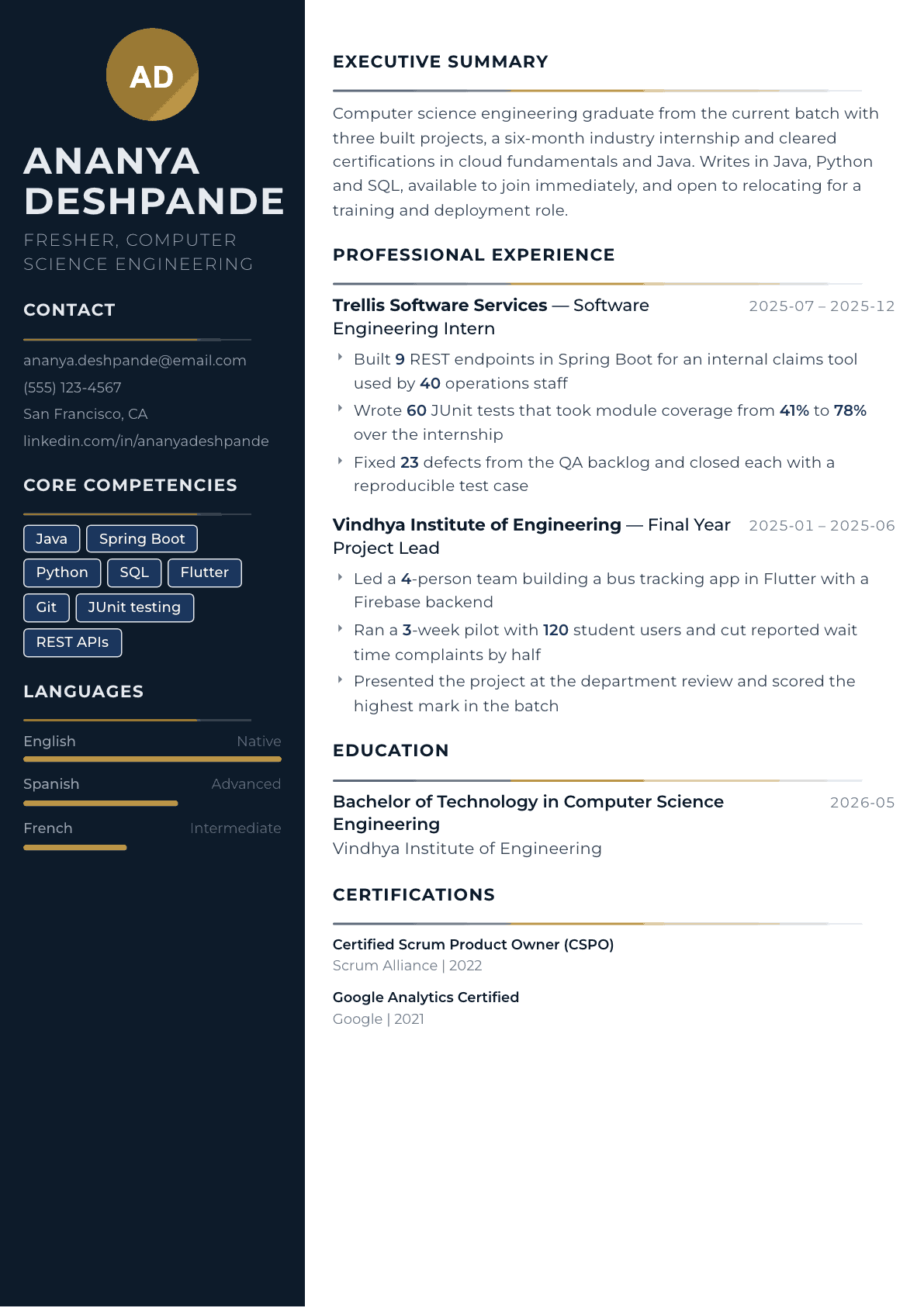
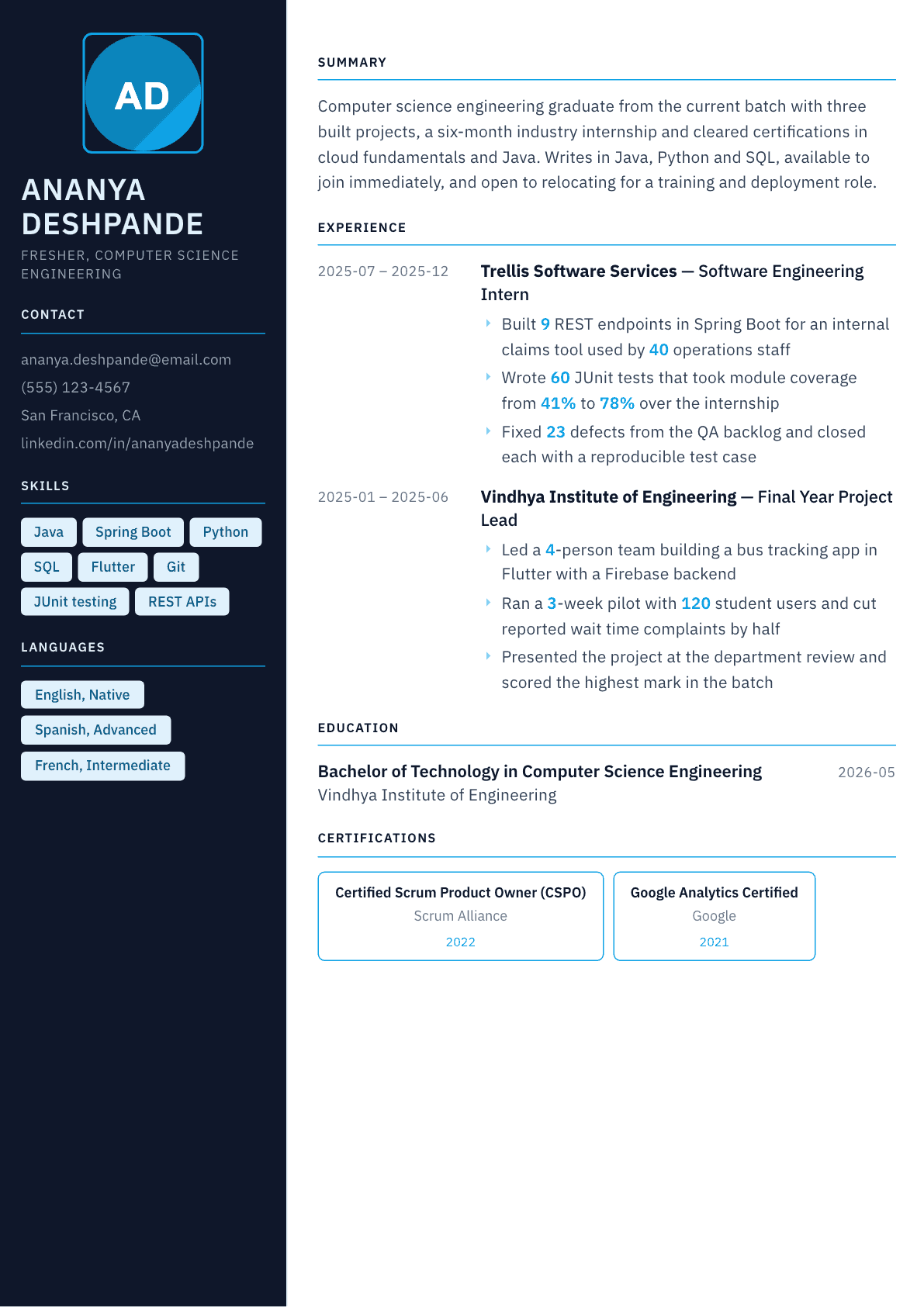
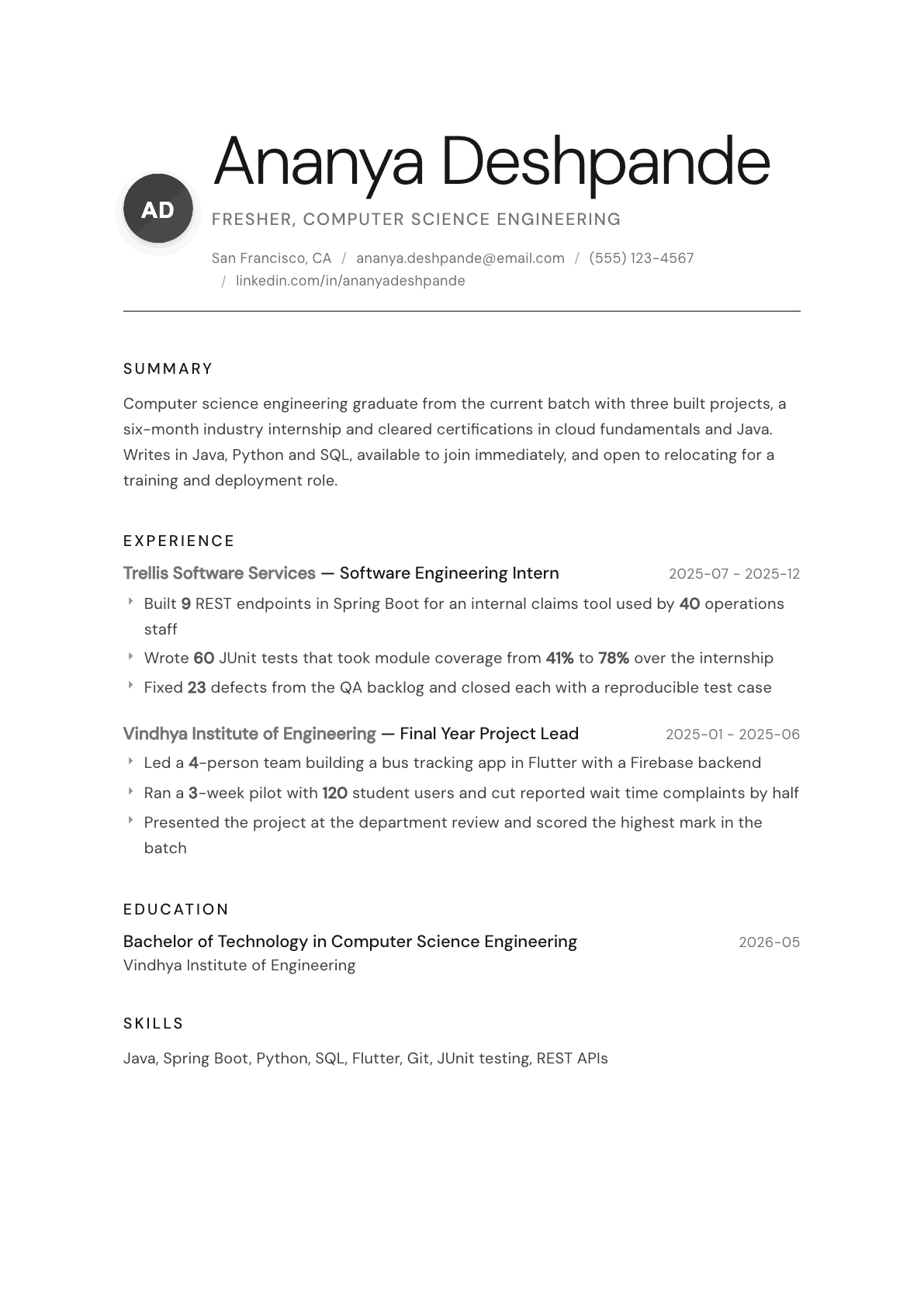
Example Fresher summary
Computer science engineering graduate from the current batch with a six-month internship where nine Spring Boot endpoints went into an internal claims tool used by forty staff. Led a four-person final year project that ran a three-week pilot with a hundred and twenty student users. Works in Java, Python, SQL and Flutter, holds cloud and Java certifications, and can join immediately.
Skills to list on a Fresher resume
- Java
- Python
- SQL and databases
- Spring Boot
- REST API development
- Version control with Git
- Unit testing
- Data structures and algorithms
- Object oriented programming
- Linux basics
- Academic project delivery
- Technical documentation
- Aptitude and coding tests
- Team collaboration
What actually gets this resume read
- Put your batch year, degree and branch in the header, because campus screens sort on those three fields first.
- Lead with projects rather than objectives, and give each one a stack, a team size and a working outcome.
- Say how soon you can join, since a recruiter filling a training cohort has a fixed start date to hit.
- List certifications with the issuing company, because an unverified course line carries no weight at screening.
- Keep the resume to one page and drop the hobbies section unless a hobby produced something you can show.
- Mirror the exact technology names from the posting, since the first pass through the stack is a keyword match.
- Add your academic score in the format your institution issues it, and give it once rather than per semester.
How to write a fresher resume
Fresher hiring runs at volume. A campus drive or a mass off-campus intake starts with thousands of profiles, filters them on branch, batch year and an aggregate score, puts the survivors through an aptitude and coding round, and only then does a human open a resume. By the time your page is read by a person, it is being used to pick interview questions rather than to decide whether you are worth interviewing.
Knowing that changes what you optimize. The header carries the fields the filter reads. The projects section carries the material the interviewer will spend twenty minutes on. Everything else is overhead. A fresher resume that spends its first four lines on a career objective about seeking a challenging position in a reputed organization has given away the most valuable space on the page to a sentence nobody reads.
This guide covers the header fields a campus screen sorts on, how to write projects an interviewer can question you about, which certifications carry weight, what to do about the joining date, and the formatting habits that follow the standard fresher template and quietly cost marks.
Format: one page, header fields first, no declaration block
One page. A fresher with a six-month internship and three projects has nothing that justifies a second, and recruiters processing a large batch treat length as noise. Put your degree, branch, institution, batch year and aggregate score in a compact header block, because those are the exact fields a campus screen sorts and rejects on.
Cut the fixtures that come with the standard template and add nothing: the objective paragraph, the declaration line with a place and a signature, the passport photograph, parents' names, date of birth, marital status and a hobbies list that names reading and listening to music. None of it is read, and together they can consume a third of the page a recruiter actually looks at.
Section order for a technical fresher: header, technical skills, projects, internship and experience, education, certifications, achievements. Skills sit high because the first human pass is a match against the stack in the posting.
- Degree, branch, institution, batch year and aggregate score, all in the top block.
- A technical skills block grouped by type: languages, frameworks, databases, tools.
- Projects with a stack, a team size and a working outcome, ahead of education.
- Availability to join, since a training cohort has a start date and a seat count.
Projects: the section the interview is built from
An interviewer picks a project off your page and asks how it works. That is the whole game for a fresher, so choose projects you can defend for fifteen minutes and describe them the way an engineer would: what it does, the stack, your part in it, the number of users who touched it, and one problem you had to solve inside it.
The problem is the part almost every fresher omits and every interviewer wants. Handling duplicate submissions when the network dropped, indexing a table after a query got slow, deciding between two libraries and being able to say why: those answers separate the student who built something from the student who followed a tutorial. Put one such detail into every project.
Three real projects beat seven shallow ones. A final year project with a team and a pilot, one personal project you can show running, and one course project with an unusual constraint make a page an interviewer can work with. Add a repository link and make sure it opens publicly and the README explains how to run it.
- Stack named precisely: the language, the framework, the database, the deployment target.
- Your contribution stated separately from what the team produced.
- A usage number: pilot users, records processed, endpoints built, tests written.
- One technical problem and the decision you made about it.
Internship and any real work, however small
An internship on a fresher resume is the closest thing to professional evidence you have, so it should be the most heavily written block on the page. Give the team you sat in, the system you touched, the tickets you closed and how your work was reviewed. Working inside somebody else's codebase with a code review and a QA backlog is a different experience from building alone, and hiring managers know it.
Freelance work, a paid college project, an open source contribution that was merged, or a system you built for a department office all count as the same kind of evidence. What matters is that a person outside your circle depended on the output, because that is what the phrase real project means to a recruiter.
Where a training program had no deliverable, say so honestly and keep it short. A month of instruction listed as an internship, with responsibilities copied from a brochure, is transparent to anyone who has interviewed freshers before.
Certifications, coding profiles and academic scores
List certifications with the issuing company and drop the rest. A cloud fundamentals certificate from the cloud vendor itself, a database or language certification from the company that makes the product, or a well-known platform certificate carries a verification number and means something. A downloadable completion badge from an unnamed portal does not, and padding the section with several of them weakens the ones that are real.
Coding platform profiles are worth one line when the record is genuinely strong: a rating, a rank, a contest history or a solved count that stands out. Otherwise leave it off, since a modest profile invites a comparison you will lose.
Give your academic score once, in the form your institution issues it, along with the tenth and twelfth standard results where a recruiter asks for them. Repeating a score for every semester wastes lines, and hiding a weak one is pointless when the filter has already read it from your application form.
Keywords, tailoring and the joining date
Match the posting's technology names exactly. A screen searching for Spring Boot does not find Spring framework, and one searching for a specific cloud service does not find a general phrase about cloud experience. Keep a master resume with everything and produce a version per posting where the matching items sit at the top of the skills block and the most relevant project sits first.
State when you can join. A fresher who is available immediately is easier to place into a training batch than one who finishes an academic requirement in three months, and recruiters filling seats will sort on it. If you are serving out a bond, an internship commitment or a pending backlog paper, say so plainly rather than discovering it during onboarding.
Fresher resume summary examples
Pre-final year, seeking an internship
Pre-final year computer science student seeking a six-month internship, with two built projects including a Django inventory tool used by a campus society of 90 members. Comfortable in Python, SQL and Git, solved 400 problems on a competitive programming platform, and available from January for a full six-month term.
Current batch graduate
Computer science engineering graduate from the current batch with a six-month internship where nine Spring Boot endpoints went into an internal claims tool used by forty staff. Led a four-person final year project that ran a three-week pilot with a hundred and twenty student users. Available to join immediately.
Fresher with a converted internship offer
Recent engineering graduate returning to the team that hosted a six-month internship, where twenty-three defects were closed and module test coverage rose across the placement. Works in Java, Spring Boot and PostgreSQL with hands-on Git and JUnit. Holds a cloud fundamentals certification and can relocate for a training cohort.
Work experience bullets: before and after
Before: Did an internship at a software company.
After: Built 9 REST endpoints in Spring Boot for an internal claims tool used by 40 operations staff, working inside an existing codebase with pull request review.
The framework, the scope and the review process show experience in a team rather than time on a seat.
Before: Final year project on bus tracking.
After: Led a 4-person team building a bus tracking app in Flutter with a Firebase backend, and ran a 3-week pilot with 120 student users that halved reported wait time complaints.
Team size, stack, pilot and a measured result give an interviewer four things to ask about.
Before: Wrote unit tests during the internship.
After: Wrote 60 JUnit tests that lifted module coverage from 41% to 78%, and closed 23 defects from the QA backlog each with a reproducible test case.
Coverage figures and closed defects prove testing discipline instead of listing it as a skill.
Before: Knowledge of Java, Python and databases.
After: Java and Spring Boot for the internship codebase, Python for a data cleaning script over 8,400 records, and PostgreSQL for schema design in two academic projects.
Attaching each language to where it was used converts a keyword list into demonstrated usage.
Before: Objective: seeking a challenging position in a reputed organization.
After: Available to join immediately for a backend training cohort, with a six-month internship in Spring Boot and a preference for relocation to any development center.
It replaces a sentence nobody reads with the joining date and preference a recruiter is sorting on.
Hard skills
- Java
- Python
- SQL and relational databases
- Spring Boot
- REST API development
- Git and branching workflow
- Unit testing with JUnit
- Data structures and algorithms
- Object oriented design
- Linux command line
- Debugging and defect reproduction
- Technical documentation
- Aptitude and coding assessments
Soft skills
- Learning an unfamiliar codebase quickly
- Taking code review feedback
- Explaining a design decision under questioning
- Working to a sprint deadline
- Collaborating in a project team
- Preparing steadily for placement season
Certifications worth listing
- Microsoft Certified: Azure Fundamentals (Microsoft)
- Oracle Certified Associate, Java SE 8 Programmer (Oracle)
- Google IT Support Professional Certificate (Google)
Mistakes that cost fresher candidates the interview
- Opening with an objective paragraph about a challenging position, which consumes the best space on the page.
- Keeping the declaration block, the photograph and the parents' names that the standard fresher template carries by default.
- Listing projects by title with no stack, no team size and no outcome, leaving an interviewer nothing to question.
- Padding the certification section with completion badges from unnamed portals alongside one genuine vendor credential.
- Repeating the academic score for every semester instead of giving the aggregate once in the issued form.
- Writing a general phrase about cloud or web experience when the screen is matching an exact product name.
- Leaving out the joining date, when a recruiter filling a training batch sorts candidates on exactly that field.
Fresher resume questions
What should a fresher put on a resume with no work experience at all?
Projects, in place of experience, written with the stack, your specific contribution and a usage figure. Add academic work with an unusual constraint, any open source contribution that was merged, and technical certifications from named vendors. Volume of projects matters less than being able to defend three.
Should a fresher resume be one page or two?
One page, always. A recruiter working through a campus batch scans hundreds of files and reads a second page from nobody without professional experience. If content overflows, cut the objective, the declaration and the hobbies before cutting a project.
Do I include my tenth and twelfth standard results?
Include them when the employer or the campus process asks for them, since many large recruiters screen on those figures alongside the degree aggregate. Give each once in a compact education block, and never spread academic scores across the page.
Are online course certificates worth listing?
The ones issued by the company that makes the product, or by a platform with a verification identifier, are worth listing. Generic completion badges dilute the section and suggest the candidate cannot tell a credential from a receipt. Keep three at most.
How do I stand out when everyone in my batch has the same coursework?
Through something that left the campus. A tool a department office actually uses, a pilot with real users, a merged pull request in a public repository, or freelance work with a paying client all prove your code met somebody outside a grading rubric.