Data Analyst Resume Examples: free ATS score and gap list
Create a Data Analyst Resume That Gets Noticed
By Mustafa Tarabya, founder of CVBooster · Published · Updated
Data Analyst resume examples with expert tips, ATS keywords, and professional templates. See exactly what a winning senior data analyst resume looks like.
Sample resumes for a data analyst
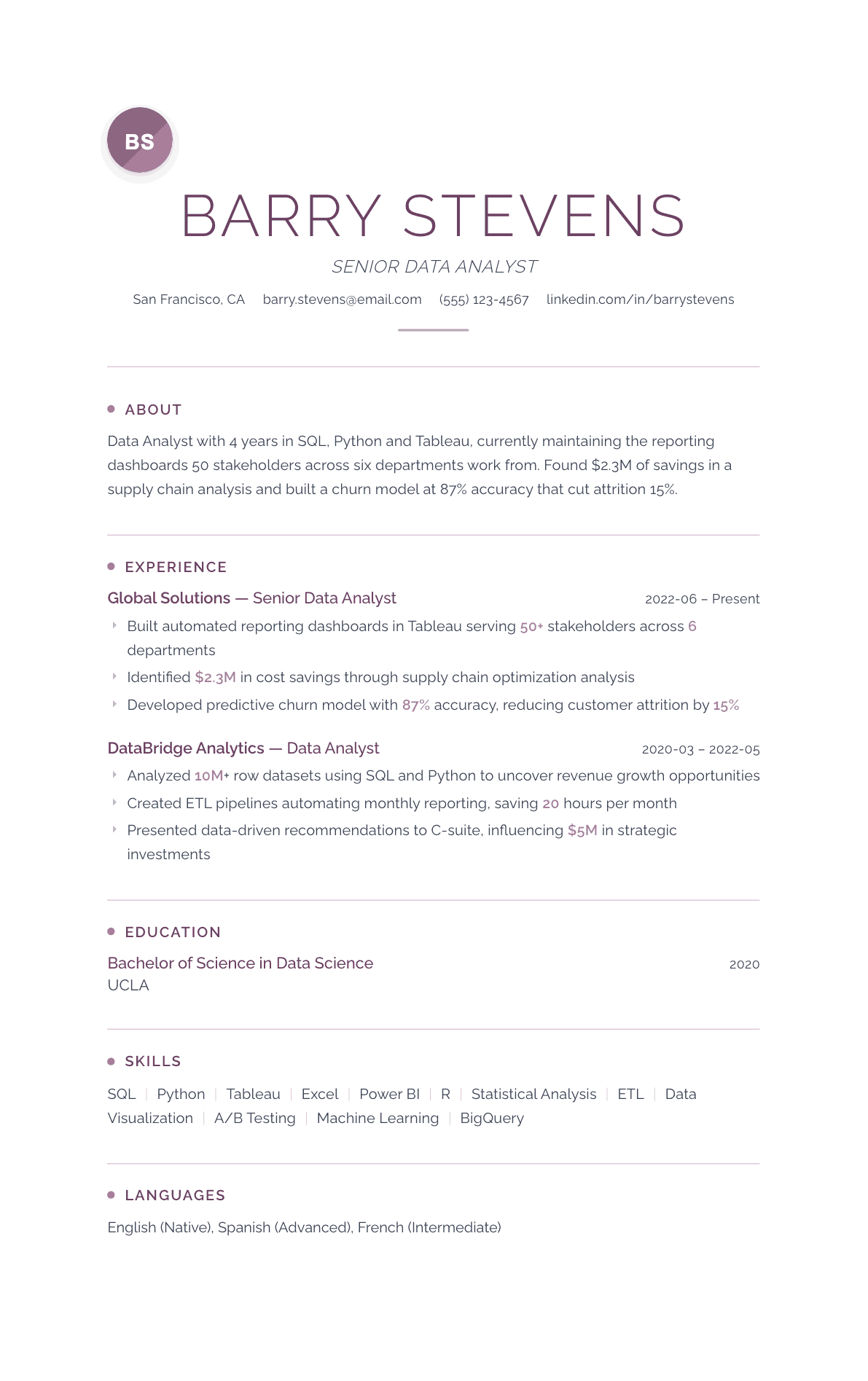
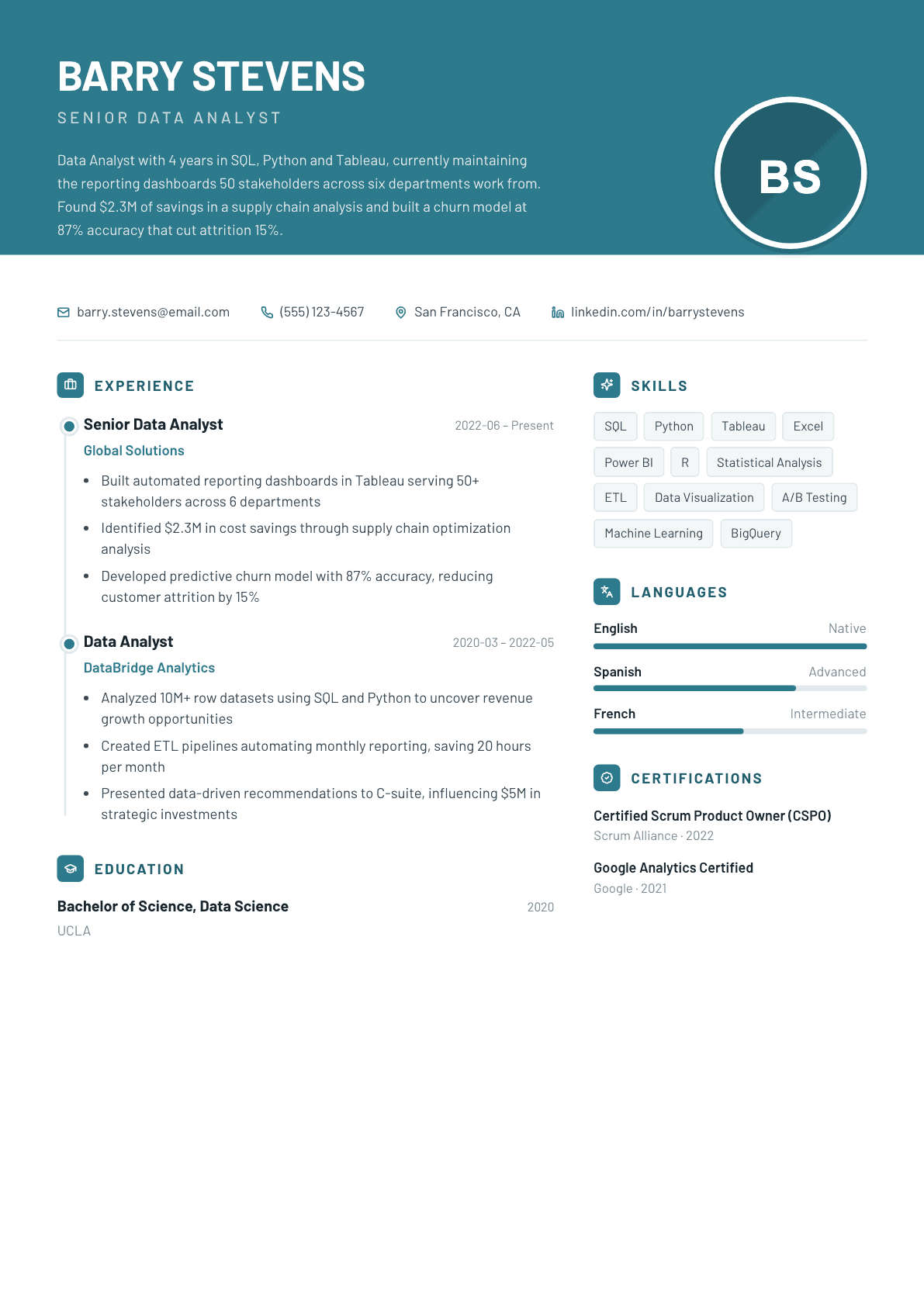
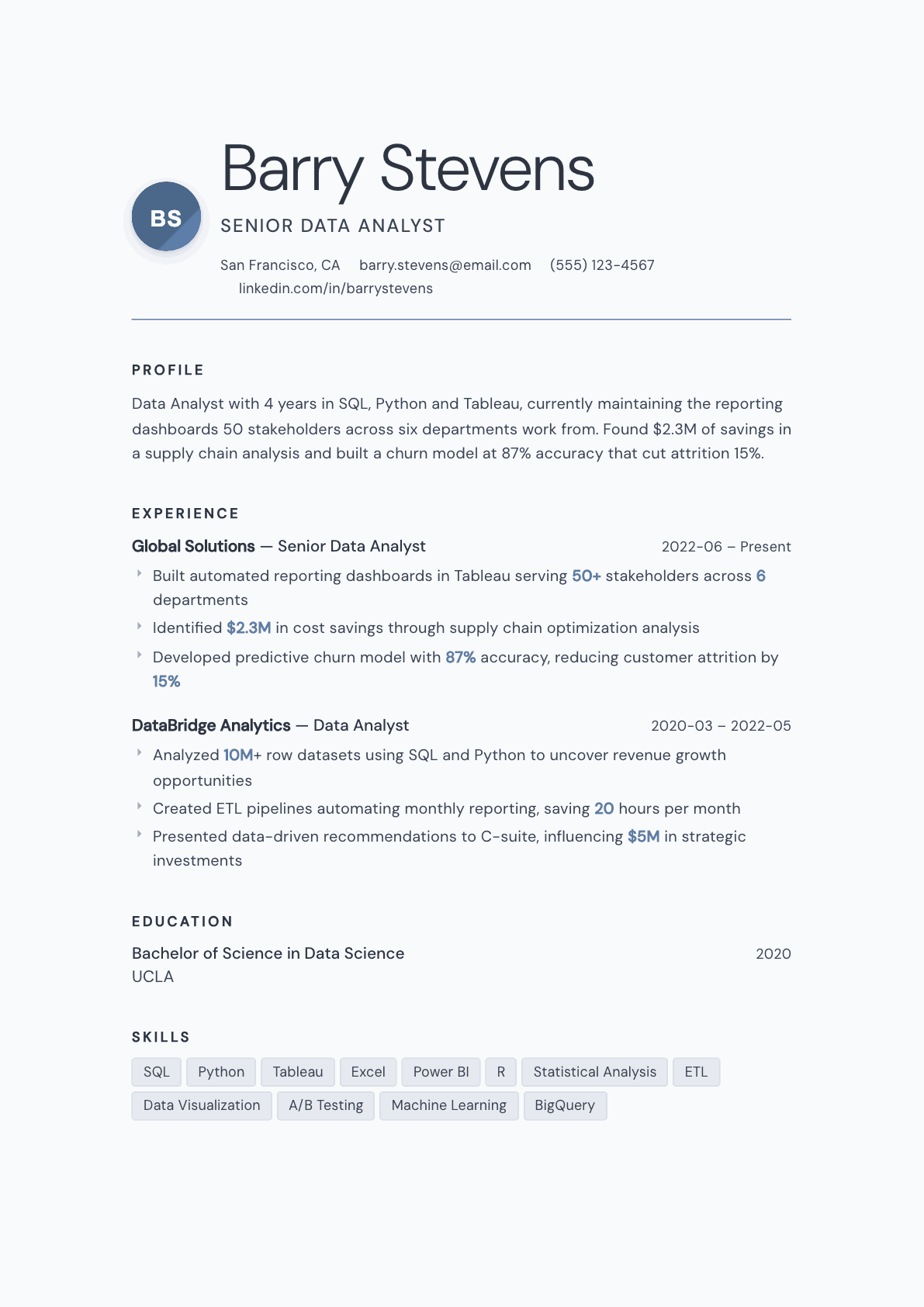
The same data analyst content laid out in three CVBooster templates, so you can see what the finished document looks like before you write a word.
Example Data Analyst summary
Data analyst, 4 years, working in SQL, Python, Tableau and Power BI on datasets in the tens of millions of rows. Automated the monthly reporting pack to save 20 hours a month, built a churn model that cut attrition 15%, and presents recommendations directly to executives.
Skills to list on a Data Analyst resume
- SQL
- Python
- Tableau
- Excel
- Power BI
- R
- Statistical Analysis
- ETL
- Data Visualization
- A/B Testing
- Machine Learning
- BigQuery
What actually gets this resume read
- Quantify business impact: revenue generated, costs saved, efficiency improved.
- List specific tools and databases you have hands-on experience with.
- Highlight communication skills, especially translating data into business recommendations.
- Include examples of dashboards or reports you've built and their adoption.
- Mention statistical methods and modeling techniques you've applied.
How to write a data analyst resume
A data analyst resume competes in one of the most crowded applicant pools there is, and most of the pile looks the same: SQL, Python, Tableau, a bootcamp certificate and three dashboard projects built on public datasets. The manager reading it is looking for the one thing those pages rarely show, which is evidence that your analysis changed a decision somebody made.
That is the whole game. A dashboard nobody opens is not an achievement. A query that ran is not an achievement. The analyst who writes down who used the output, what they decided, and what happened next is instantly in a smaller pile, because that is what the job is actually measured on.
This guide covers how to write each section so a hiring manager sees business judgment as well as technical fluency, with three summaries at recognizable levels, before-and-after bullets, and the questions analysts ask when their applications go quiet.
Format: one page, and put the tools where a screener finds them
One page until you have five or six years of work. Reverse chronological, single column, no charts inside the document. If you have a portfolio, one link in the header is enough.
Analytics postings are keyword-screened harder than most, because recruiters are usually not analysts and filter on tool names. Keep a technical skills block near the top with SQL, the language, the visualization platform and the warehouse spelled out plainly.
- Header: name, title, location, email, LinkedIn, and a portfolio link if the work is public.
- Order: summary, technical skills, experience, projects if experience is thin, education.
- Write the warehouse by name: Snowflake, BigQuery, Redshift or SQL Server. Analysts are hired into a specific stack.
Summary: the domain, the stakeholders, and the kind of question you answer
Three lines. Name the business domain you know, whether that is subscription growth, supply chain, credit risk, marketing performance or clinical operations, because domain knowledge is what makes an analyst fast on day one. Then name the stakeholders you work with and the type of analysis you are strongest at.
Domain beats tools here. Every candidate has SQL. Far fewer understand how a retention curve behaves in a subscription business or why a warehouse pick rate moves. Say which set of business questions you already understand.
Experience: the question, the analysis, the decision
Write each significant bullet as a chain. Someone had a question, you did specific work to answer it, and a decision followed. Pricing wanted to know whether the discount tier was cannibalizing full-price purchases, you built the cohort comparison, and the tier was restructured. That is one bullet and it beats ten that begin with the word analyzed.
Name the data. Rows, sources, the join that was hard, the definition you had to settle before the numbers could be trusted. Analysts spend a lot of their life reconciling two systems that disagree, and saying you resolved a metric definition dispute between finance and product is a credential in itself.
Dashboards need adoption numbers to count. Say who uses it, how often, and what it replaced. A weekly report you automated out of existence is a better bullet than a dashboard with an unknown audience.
Show your SQL depth without listing SQL twice
Everyone claims SQL, so prove the level in the bullets. Window functions for retention and sequencing, common table expressions for readable multi-step logic, incremental models rather than one enormous query, and query tuning when the warehouse bill or the runtime became a problem.
If you have moved analysis into a modeled layer, say so. Analysts who write tested, documented transformations rather than ad hoc queries are the ones who get promoted into analytics engineering, and hiring managers look for that signal specifically.
Statistics and experimentation: claim only what you have run
If you have designed or read out experiments, give it a bullet with the mechanics: the metric, the unit of randomization, how you handled multiple comparisons, and what the readout recommended. This is the single strongest differentiator in an analyst pile because most candidates have only read about it.
If you have not run experiments, do not pad the skills block with terms you cannot defend. Regression, forecasting, cohort analysis and segmentation are all legitimate to claim if you have applied them, and a manager will ask exactly how.
Data Analyst resume summary examples
First analyst role
Analyst with a mathematics degree and 1 year in operations reporting. Rebuilt the weekly fulfillment report in SQL and Power BI, cutting preparation from a full day to an automated refresh, and completed a portfolio project modeling churn on a public subscription dataset.
Four years in
Data analyst with 4 years supporting marketing and product in a subscription business. Owns the acquisition and retention reporting on BigQuery and Looker, ran the readouts on 12 experiments last year, and settled the active-user definition now used across finance and product.
Senior or lead analyst
Senior data analyst with 8 years in retail and supply chain analytics. Leads a team of 3, owns the demand and inventory reporting layer in Snowflake and dbt, and built the markdown analysis that changed the end-of-season pricing policy across 400 stores.
Work experience bullets: before and after
Before: Analyzed sales data to find trends.
After: Analyzed two years of transaction data to test whether the loyalty discount was pulling forward full-price purchases, found the effect concentrated in one category, and the pricing team removed the discount there.
The question, the finding and the decision that followed turn a routine verb into evidence of influence.
Before: Built dashboards in Tableau for stakeholders.
After: Built the regional performance dashboard in Tableau on a certified Snowflake model, adopted by 45 store managers weekly, which replaced 4 hand-built spreadsheets and removed a recurring dispute over which revenue figure was correct.
Adoption, what it replaced and the problem it ended prove the dashboard mattered to someone.
Before: Wrote complex SQL queries.
After: Rewrote the customer value query using window functions and incremental dbt models, bringing the nightly run from 40 minutes to under 4 and making the logic reviewable in pull requests.
Runtime and reviewability show the SQL skill level rather than asserting complexity.
Before: Supported A/B testing for the product team.
After: Designed and read out the onboarding experiment: user-level randomization, activation as the primary metric, guardrails on support contacts, and a recommendation to roll out to 100% after a 3.4% lift held across two weeks.
The design details show you can run an experiment rather than only report the result someone else designed.
Before: Cleaned and prepared data for analysis.
After: Traced a recurring gap between the billing system and the warehouse to duplicated refund events, wrote the deduplication logic and a test that fails the pipeline when it recurs, restoring trust in the monthly revenue report.
A named root cause and a permanent test show engineering discipline instead of repeated manual cleanup.
Hard skills
- SQL including window functions
- Python with pandas
- Tableau
- Power BI
- Looker
- dbt
- Snowflake and BigQuery
- Excel modeling
- A/B test analysis
- Cohort and retention analysis
- Forecasting
- Data quality testing
Soft skills
- Turning a vague request into a testable question
- Presenting to non-technical stakeholders
- Saying when the data cannot answer it
- Documentation and metric definitions
- Prioritizing across competing requesters
- Storytelling with charts
Certifications worth listing
- Google Data Analytics Professional Certificate (Google)
- Microsoft Certified: Power BI Data Analyst Associate (Microsoft)
- Tableau Certified Data Analyst (Tableau)
- SnowPro Core Certification (Snowflake)
- dbt Analytics Engineering Certification (dbt Labs)
Mistakes that cost data analyst candidates the interview
- Filling the page with verbs like analyzed, extracted and reported without ever naming a decision that followed.
- Listing five visualization tools when you have built production dashboards in one. Managers ask which one you would rebuild their stack in.
- Using three bootcamp portfolio projects on famous public datasets that every other applicant also used.
- Leaving out the business domain, which is the fastest way for a hiring manager to decide you will need six months of ramp-up.
- Claiming machine learning on the strength of a course notebook. It invites a question the rest of the page cannot support.
- Describing dashboards without an audience, so the reader cannot tell if anyone ever opened them.
- Writing the summary about what you want to learn instead of what you already answer for a business.
Data Analyst resume questions
How do I get a data analyst job with no analyst experience?
Mine the job you already have. Almost every operations, finance, support or marketing role involves reporting, and rewriting that work with the tool, the volume and the decision it fed gives you real experience to put above your portfolio projects.
Do I need Python to be a data analyst?
SQL is the non-negotiable one. Python widens the range of roles and is expected in product analytics, but plenty of strong analyst jobs run on SQL, a visualization platform and spreadsheets. List Python only if you have used it beyond a course.
Are portfolio projects worth including?
Yes when your paid experience is thin, but choose datasets others are not using and write up the question and conclusion rather than the cleaning steps. Two well-argued projects beat six notebooks that all end with a correlation heat map.
How technical should my resume bullets be?
Technical enough that an analyst reviewing it recognizes real work, plain enough that the hiring manager sees the business result. Name the method and the tool in one clause, then the decision or outcome in the next.
Should I put my degree first if it is not in a technical field?
No. Keep education at the bottom once you have any relevant work, and let the technical skills block and experience carry the page. Many strong analysts come from economics, biology, journalism and operations backgrounds.
Related resume examples
- Data Scientist Resume example
- Financial Analyst Resume example
- Business Analyst Resume example
- Business Intelligence Analyst Resume example
- Bioinformatics Scientist Resume example
- Power BI Developer Resume example