Recent Graduate Resume Examples: the lines they read
Rewrite a Recent Graduate Resume One Year After Commencement
By Mustafa Tarabya, founder of CVBooster · Published · Updated
Recent graduate resume example and guide for the first two years out: stopgap jobs, gaps, shrinking the education block and reordering the page.
Sample resumes for a recent graduate
The same recent graduate content laid out in three CVBooster templates, so you can see what the finished document looks like before you write a word.
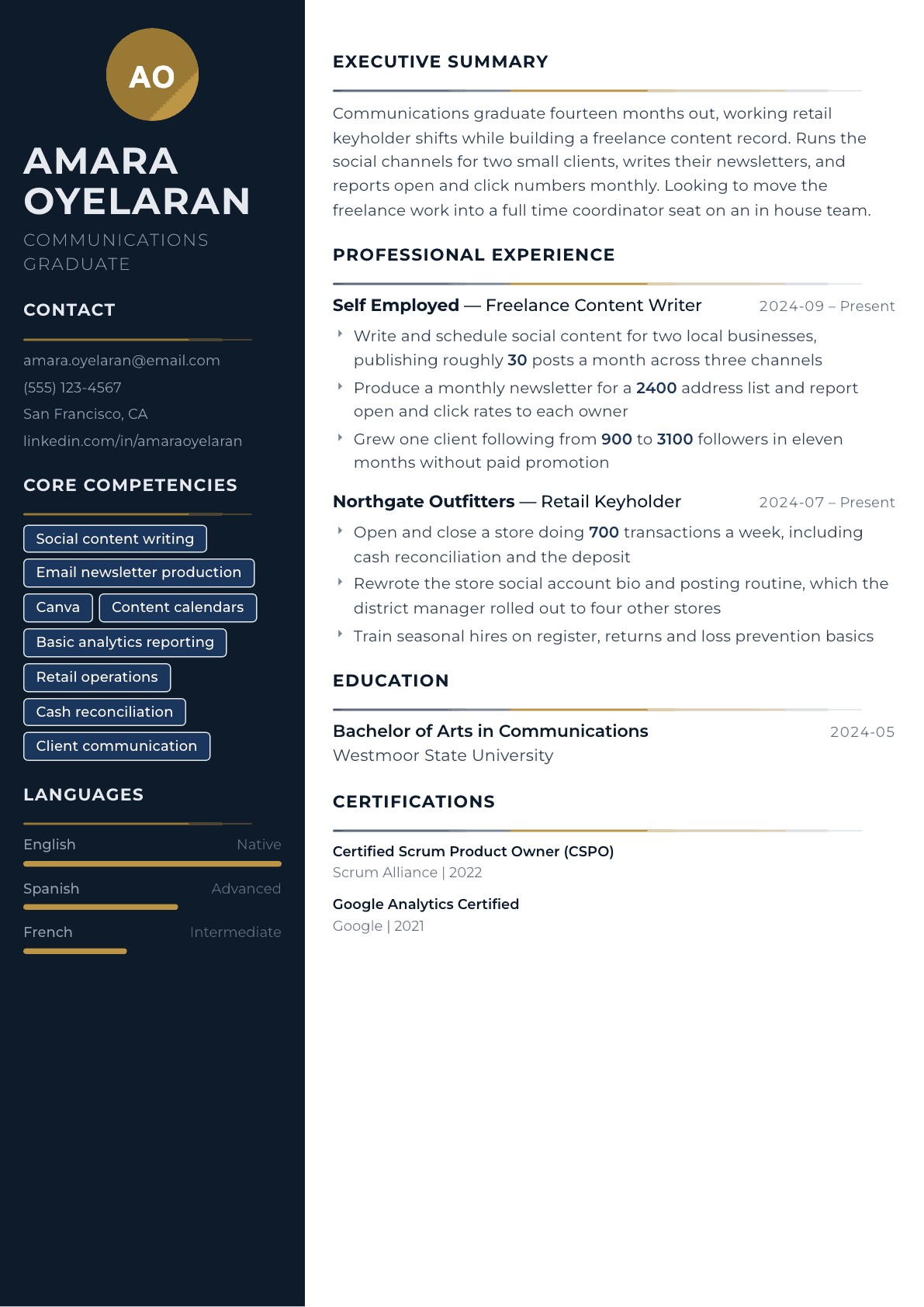
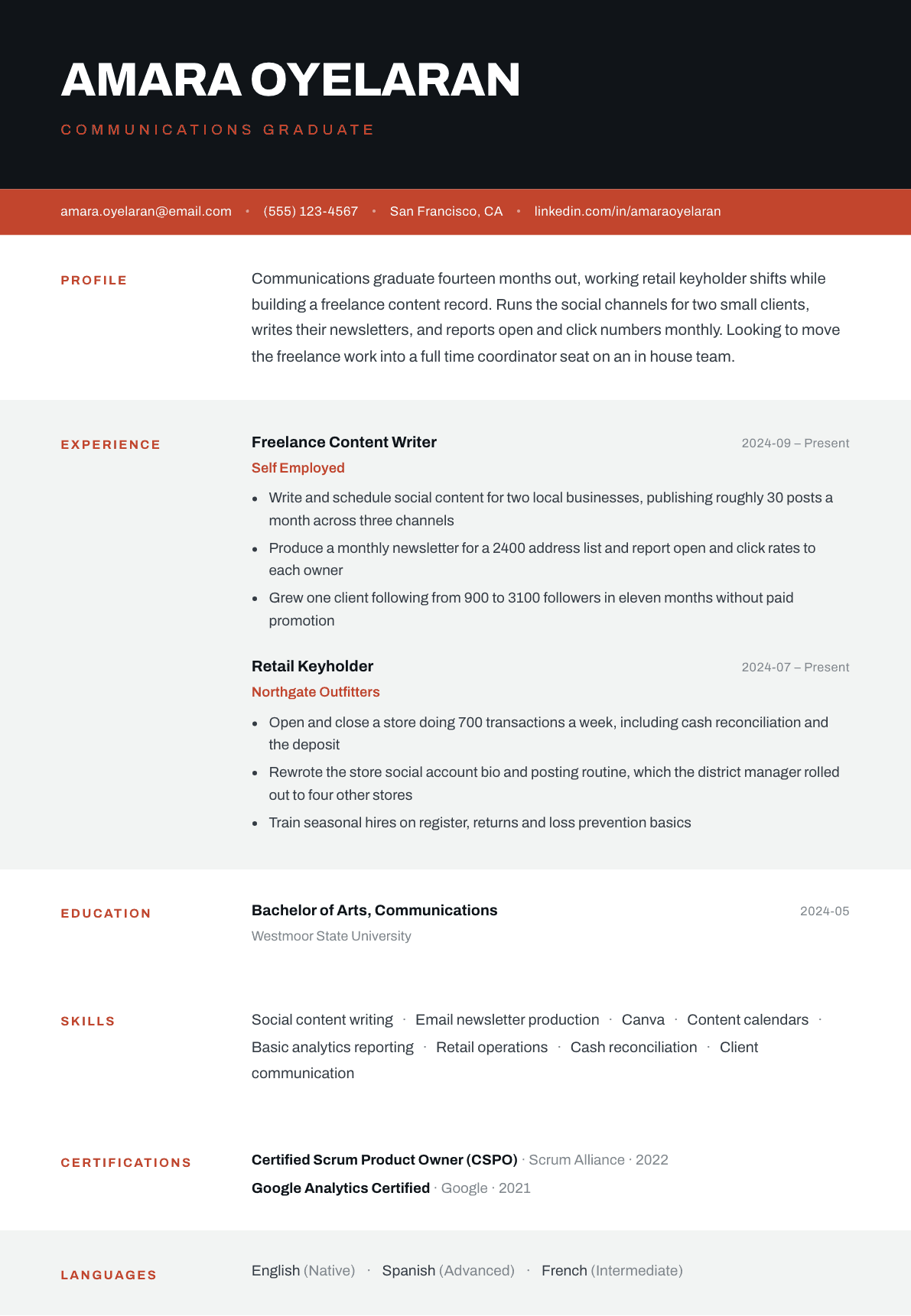
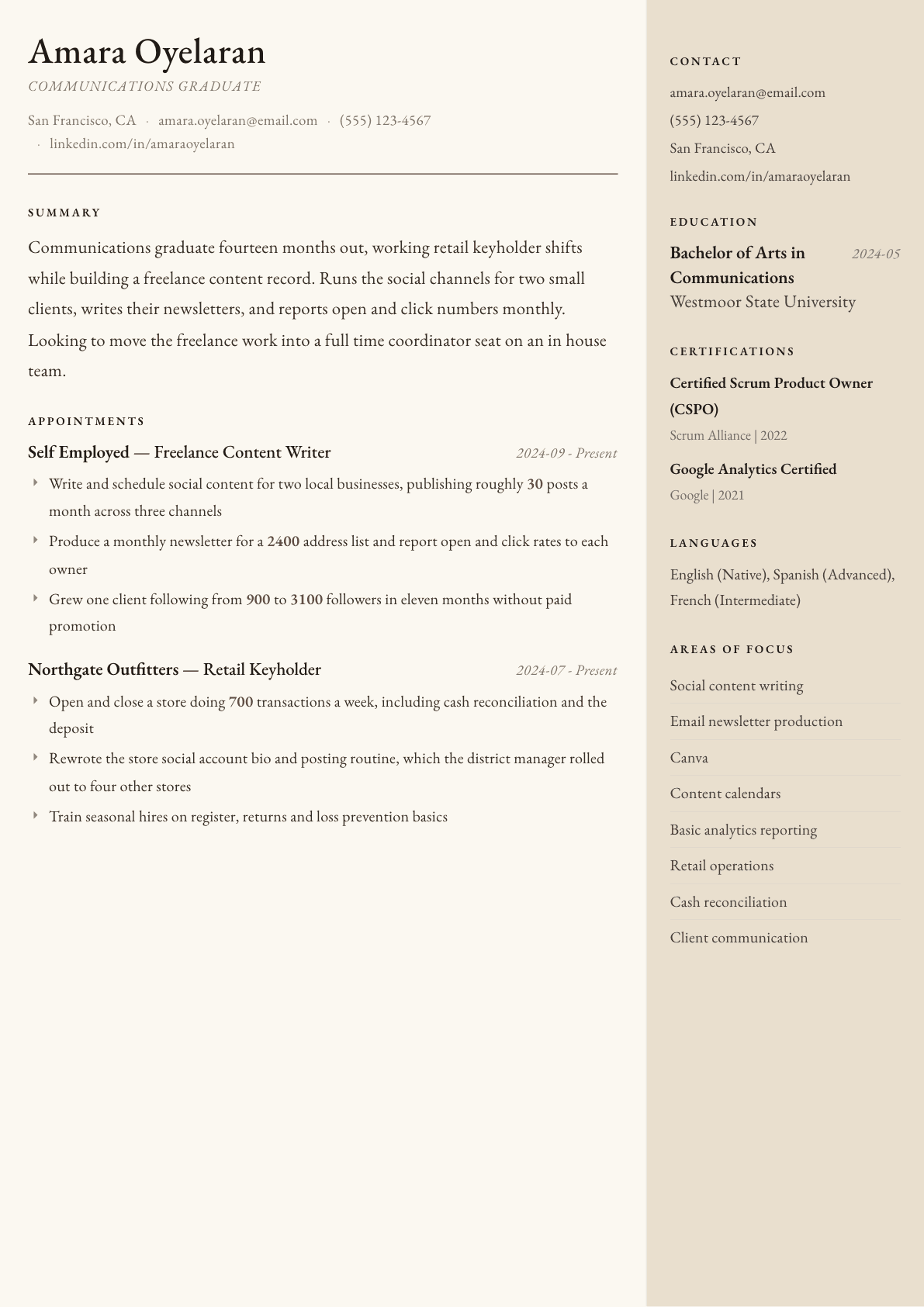
Example Recent Graduate summary
Communications graduate a year out, running social channels and newsletters for two paying clients while holding a retail keyholder job that funds the freelance work. Publishes roughly 30 posts a month, reports open and click numbers to each owner, and grew one client following past 3000 without paid promotion. Ready to bring that output onto an in house team with a real content calendar.
Skills to list on a Recent Graduate resume
- Social content writing
- Content calendar planning
- Email newsletter production
- Canva design basics
- Copy editing
- Analytics reporting
- Client communication
- Retail keyholder operations
- Cash reconciliation
- Staff training
- Freelance project management
- Interview and outreach writing
- Deadline discipline
What actually gets this resume read
- Once you are a year out, move education below experience and cut the high school line entirely.
- Keep the stopgap job on the page and mine it for the parts that match your target field, such as the social account you rewrote.
- Turn freelance or self directed work into a dated entry with a client count, an output volume and a result.
- Explain a gap in one plain line in the summary rather than leaving a hole a screener has to guess about.
- Drop the coursework block once you have real output, and keep only the degree, the school and the graduation year.
- Rewrite the summary for the job you want now, not the one your degree implied when you started the program.
- Keep a portfolio link with three finished pieces, because a hiring manager in communications will click before calling.
How to write a recent graduate resume
The recent graduate window is the awkward stretch between commencement and your second real job. Campus recruiting has moved on to the class behind you, the degree is no longer novel, and whatever you have been doing since spring is now the thing a hiring manager reads first. Most people in this window keep sending the resume they built in their final semester, and that is exactly why it stops working.
A manager looking at a candidate a year out is asking a blunt question: what have you done since. Not what you studied. If the honest answer is a retail job, a delivery route, a caregiving stretch or a run of freelance work, the resume needs to own that and mine it, because a page that pretends the year did not happen creates a hole the reader will fill with the worst explanation available.
This guide is written for the first two years after graduation. It covers the reordering the page needs once the degree stops leading, how to make a stopgap job argue for you, how to write freelance and self directed work as real experience, how to handle a gap in one line, and how to run a search without the campus pipeline that used to bring employers to you.
Reorder the page the moment the degree stops being the newest thing
Once you are several months past commencement, experience moves above education. This feels wrong to people who worked hard for the degree, but the reader is scanning chronologically and wants the most recent evidence first. Education shrinks to the degree, the institution and the year, and the coursework block disappears entirely.
The summary carries the reframe. It should name the role you are targeting now, the two capabilities you actually have, and the work you have been doing since you graduated, in that order. A graduate who names a target instead of describing a degree gives the reader a slot to place her in, and that placement is most of what a first screen is doing.
- Experience above education, with the current job first even when it is unrelated.
- Education reduced to degree, institution and graduation year.
- Coursework, societies and campus awards removed unless the role is academic.
- A summary written for the target job title, not for the degree title.
- A portfolio or work sample link when the field expects one.
Make the stopgap job work instead of apologizing for it
Keep the job that has been paying your rent, and read it for the parts your target field cares about. A retail keyholder handles cash reconciliation, opening procedures, staff training and loss prevention, all of which are operational responsibility. A delivery driver manages a route, a schedule and customer contact. A care assistant handles documentation, confidentiality and a fixed rota. None of that is beneath a graduate, and all of it beats an empty year.
Write two kinds of bullet for that job. The first kind covers the responsibility a manager gave you that they do not give to everyone: keys, the deposit, training new hires, covering the schedule. The second kind covers anything you improved, however small. A graduate who rewrote the store social account and had a district manager copy it to other locations has demonstrated initiative in exactly the way an office employer wants to see.
Freelance, volunteer and self directed work count when they are dated and counted
Anything you have done seriously since graduating belongs in the experience section with a start date, a title and an output volume. Freelance clients, a volunteer committee seat, a self built product, a research assistantship, a community group you administer. The rule is that it must have a schedule, an external party and something produced.
Give the numbers you would give an employer. Clients served, posts published, hours a week, subscribers reached, tickets closed, funds raised. A graduate who writes that she publishes about thirty posts a month for two paying clients and reports open rates back to each owner is describing a job, and a hiring manager will treat it as one.
What does not work is a skills list with nothing behind it. Two years out, an unsupported claim reads as a year spent avoiding the question. One concrete engagement with dates and output outperforms ten confident adjectives.
Handle the gap in one line and move on
Gaps in this window are common and most interviewers are relaxed about them, provided the page does not hide anything. Put a single plain line in the summary or a short dated entry in experience: a caregiving period, a health recovery, a relocation, a full time job search, or study for an exam. Name it, give the months, and add what you did during it if anything is worth adding.
The mistake is silence, because a reader who cannot account for eight months assumes something worse than the truth. The second mistake is over explaining. One sentence is the correct length, and any further detail belongs in the interview if they ask, which many will not.
- A gap entry with months, a plain label, and one clause on what it involved.
- Any course, certificate or volunteering completed during the gap, with the finishing month.
- Consistent dates between the resume, the application form and your professional profile.
- No apology language anywhere on the page.
Running the search without a careers office behind you
The campus pipeline is gone, so the search changes shape. Applications now go through general postings where you are competing against people with two and three years of experience, which means the resume has to be rewritten per posting rather than sent in bulk. Mirror the job title in your summary, put the two requirements you meet best at the top of your skills block, and drop the rest.
Alongside that, work the alumni route deliberately. Graduates one and two years ahead of you sit inside the companies you are applying to and referrals move a page from a general pile to a hiring manager inbox. Keep a simple record of what you sent and where, because in this window volume without tracking turns into repeated applications to the same company under a different job number.
Recent Graduate resume summary examples
Months after commencement
Communications graduate four months out, writing social content for two local businesses while working weekend retail shifts. Publishes about 30 posts a month across three channels and produces a monthly newsletter for a 2400 address list. Seeking a coordinator seat on an in house content team.
A year out with a stopgap job
Communications graduate a year out, holding a retail keyholder role while building a freelance client record. Opens and closes a store doing 700 transactions a week, rewrote the store social account routine that the district manager rolled out to four other locations, and grew a client following from 900 to 3100 followers.
Two years out, reframing toward a new field
Psychology graduate two years out, moving from case support work into people operations. Coordinated intake documentation for a caseload of 60 clients, built the referral tracker the team still uses, and completed a human resources fundamentals course. Seeking a coordinator role in a people team that owns its own data.
Work experience bullets: before and after
Before: Currently working in retail while looking for a job in my field.
After: Open and close a store doing 700 transactions a week, including cash reconciliation and the bank deposit, and train seasonal hires on register and returns.
Owning the keys and the money is operational responsibility, which is what the reader needed to see.
Before: Did some freelance writing after graduating.
After: Write and schedule about 30 social posts a month for two paying clients across three channels, and report open and click rates on a monthly newsletter to each owner.
Client count, publishing volume and a reporting habit turn side work into a describable job.
Before: Took a break after graduation for personal reasons.
After: Provided full time family care for 7 months following graduation while completing a data fundamentals course and two volunteer analytics projects.
A named period with a duration and parallel activity closes the question instead of leaving it open.
Before: Improved the social media at my current job.
After: Rewrote the store account bio and weekly posting routine, which the district manager then rolled out to four other locations in the region.
Adoption beyond your own store is the proof that the improvement was real.
Before: Have experience with analytics and reporting.
After: Grew one client following from 900 to 3100 in eleven months without paid promotion, tracking which post formats drove the gain and dropping the ones that did not.
A tracked result over a stated period replaces a claim you would otherwise have to defend live.
Hard skills
- Content writing and copy editing
- Content calendar planning
- Email newsletter production
- Analytics reporting and dashboards
- Microsoft Excel and Google Sheets
- Customer facing point of sale operation
- Cash reconciliation and deposits
- Scheduling and rota coverage
- Client communication and reporting
- Project scoping for freelance work
Soft skills
- Sustaining a search over months without a pipeline
- Talking about a stopgap job without apology
- Reframing unrelated work toward a target field
- Asking an alumnus for a referral without oversharing
- Taking rejection without changing the whole page after each one
Mistakes that cost recent graduate candidates the interview
- Sending the final semester resume unchanged a year after commencement.
- Leaving the current job off because it feels unrelated, which creates a hole worse than the job itself.
- Keeping the coursework and society block once you have paid work to show.
- Writing freelance work as a hobby instead of dating it and counting what it produced.
- Leaving a gap unexplained rather than closing it with one plain line.
- Applying in bulk with one page, which loses every posting where the title language differs.
- Describing yourself as a recent graduate in the summary instead of naming the role you want.
Recent Graduate resume questions
How long can I keep calling myself a recent graduate?
About two years, and it weakens across that period. Once you have a year of any full time work, lead with the work and let the graduation year sit quietly in the education block rather than framing your whole identity around it.
Should I remove a job that has nothing to do with my field?
No. Keep it and mine it for responsibility, money handling, training others and any improvement you introduced. An unexplained empty stretch damages you far more than an unrelated employer name ever will.
How do I explain months where I was only job searching?
Name it as a search period with the months and add whatever you did alongside it, such as a course, a volunteer role or freelance work. One line is enough, and it stops the reader inventing a story you never told.
Do I still need a portfolio a year after graduating?
In writing, design, media and software the portfolio matters more than the degree by now. Keep three finished pieces, remove student work once you have client work, and put the link in the header where it will be clicked.
Is it worth reaching out to alumni for referrals?
Yes, and it is the highest yield channel in this window. Graduates one or two years ahead of you sit inside the teams you are applying to, and a referral moves your application from a general queue to a person who can act on it.