Building Superintendent Resume Examples: free ATS score
Build a Building Superintendent Resume Owners Trust
By Mustafa Tarabya, founder of CVBooster · Published · Updated
Building superintendent resume example with residential building keywords, plus a guide to writing turnovers, contractors and resident relations.
Sample resumes for a building superintendent
The same building superintendent content laid out in three CVBooster templates, so you can see what the finished document looks like before you write a word.
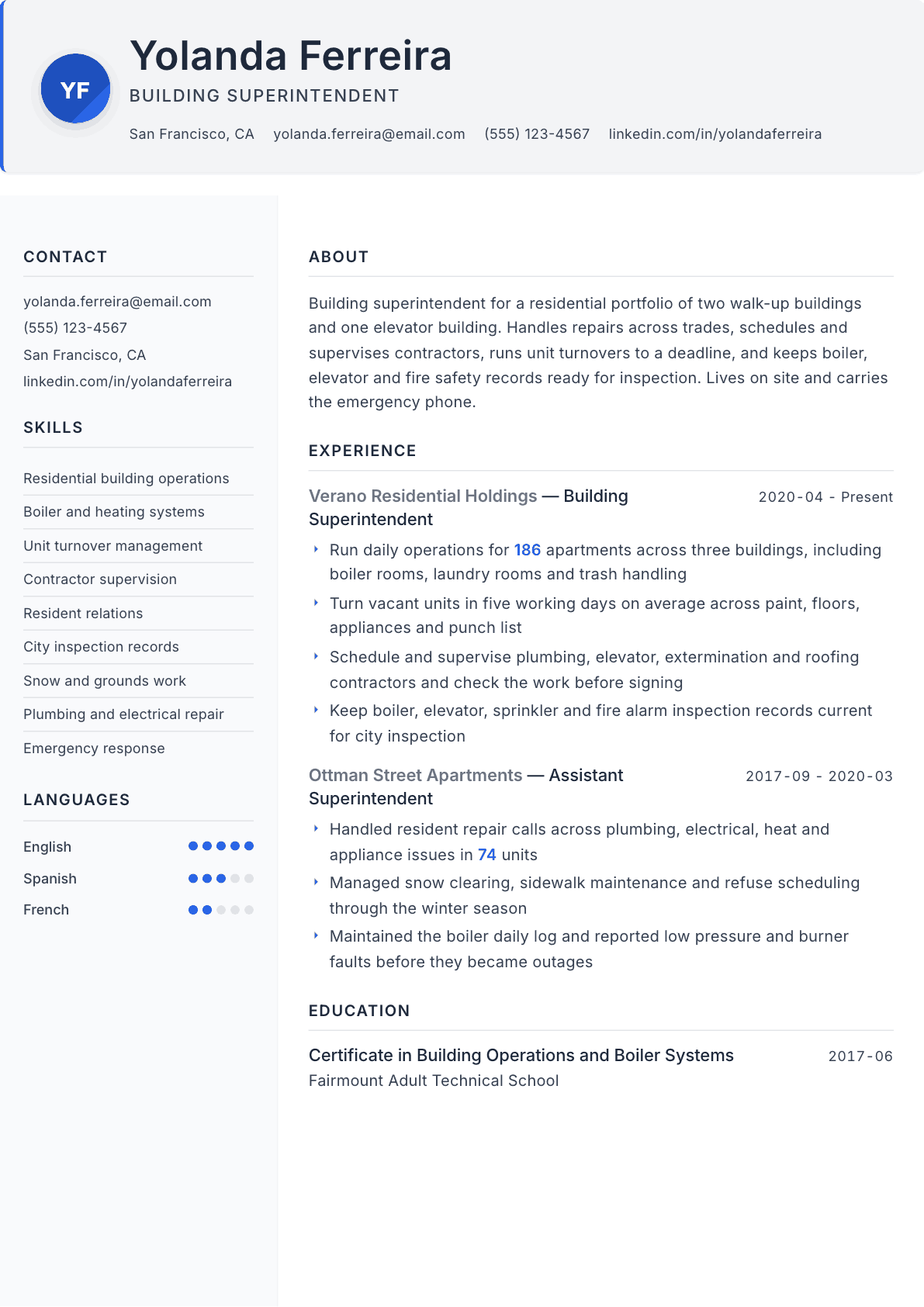
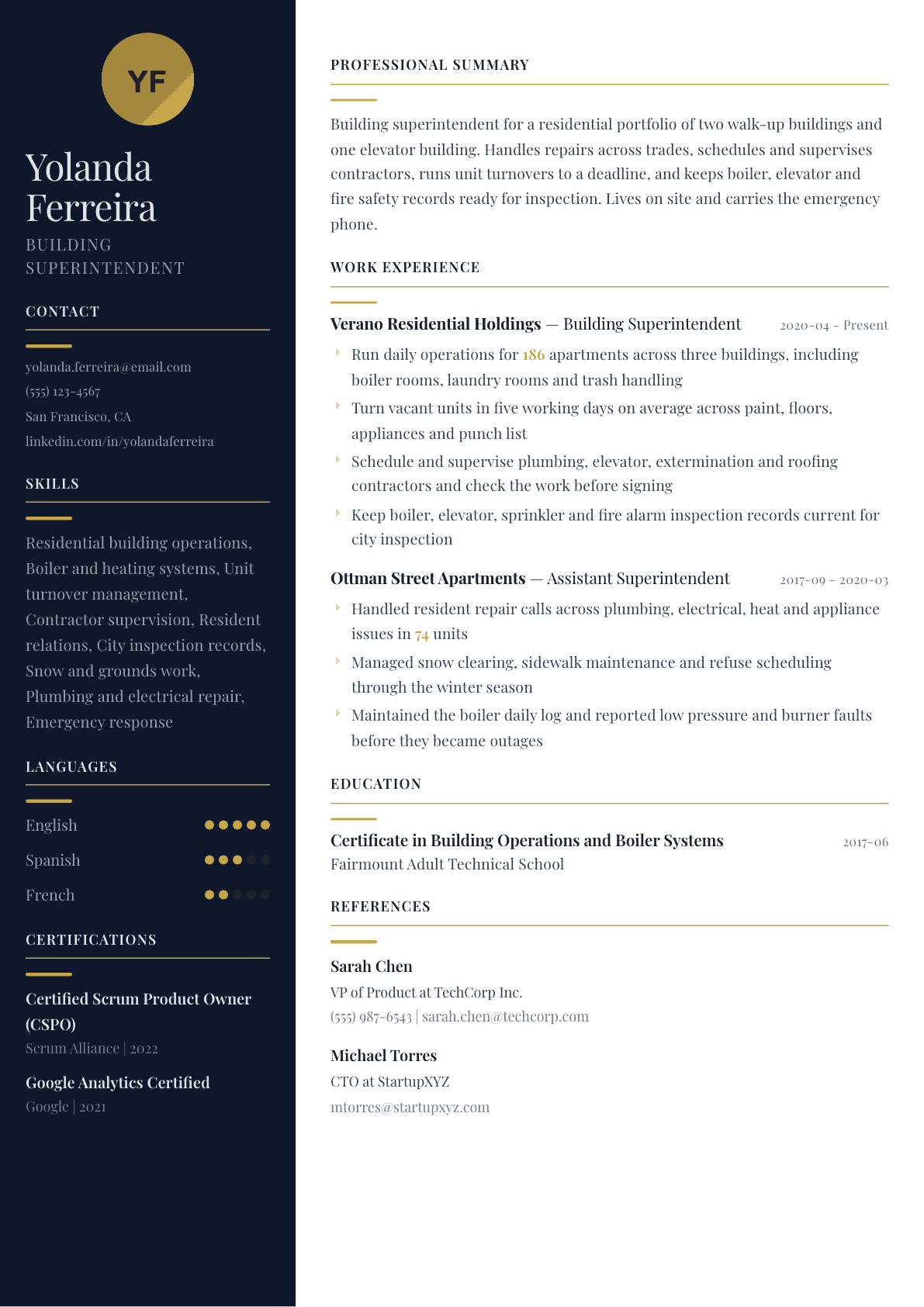
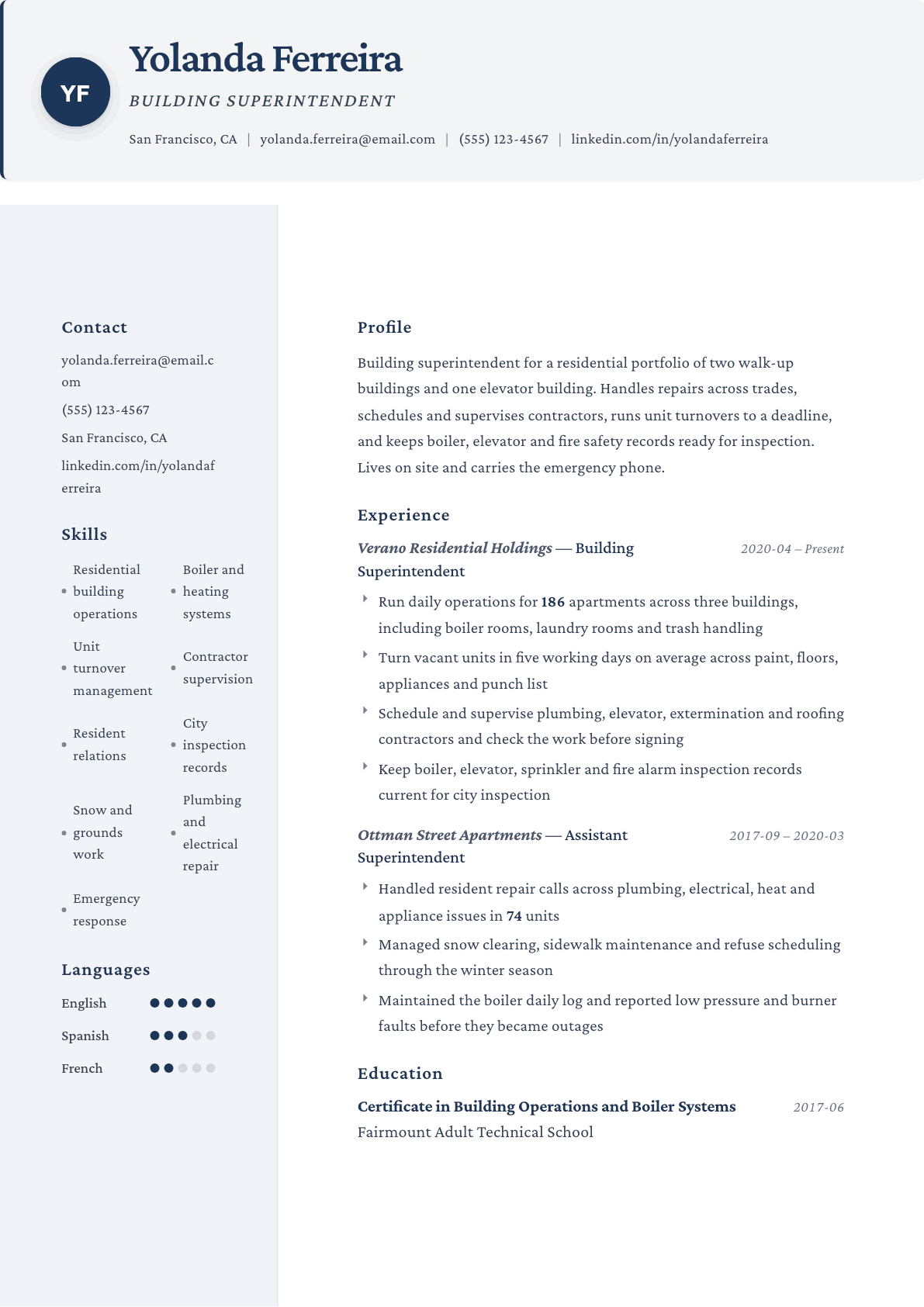
Example Building Superintendent summary
Building superintendent running daily operations for nearly two hundred apartments across three residential buildings, covering repairs in every trade, boiler rooms, laundry, refuse and grounds. Turns vacant units in five working days, schedules and inspects contractor work before signing off, and keeps boiler, elevator, sprinkler and fire alarm records ready for city inspection. Lives on site and carries the emergency phone year round.
Skills to list on a Building Superintendent resume
- Residential building operations
- Low pressure boiler operation
- Heating distribution and radiators
- Plumbing repair and drain clearing
- Electrical repairs and panel work
- Unit turnover and punch lists
- Contractor scheduling and inspection
- Compliance and inspection recordkeeping
- Pest control coordination
- Refuse and recycling management
- Snow removal and grounds care
- Resident complaint handling
- Emergency and after-hours response
- Key control and access management
What actually gets this resume read
- Open with unit count and building count, because that is how an owner sizes a superintendent role.
- Give your average turnover time in working days and say what the scope of a turn includes.
- List the inspection records you maintain, from boiler to elevator to sprinkler and fire alarm.
- Show contractor supervision as verification, not scheduling: say that you check work before you sign it.
- Say whether the role was live-in and whether you carried the emergency phone every night.
- Include heating plant detail, since a superintendent who can nurse an old boiler through winter is valued.
- Add resident relations with a concrete example, because complaints reach the owner faster than repairs do.
How to write a building superintendent resume
An owner or managing agent hiring a building superintendent is choosing who holds the keys to his asset and who answers the phone when a pipe bursts at midnight. The technical bar matters, but it is not the whole decision. He is also asking whether residents will trust you, whether inspectors will find the records in order, and whether contractors will do real work while you watch.
Most superintendent resumes miss two of those three. They list repairs and leave out the inspection record, the contractor oversight and the resident relationship that make an owner sleep at night. A superintendent who writes that he keeps boiler, elevator, sprinkler and fire alarm records current for inspection has answered a question the advert never asked and the owner cares about most.
This guide covers the layout an owner or agent reads, how to write turnovers and heating plant work with real numbers, how to present contractor supervision as verification, what to do about live-in arrangements, and the questions superintendents ask when moving between walk-ups, elevator buildings and larger portfolios.
Format: one page, portfolio and building type stated first
One page, reverse chronological. Under the contact line, state the portfolio: unit count, number of buildings, walk-up or elevator, and the age of the stock if it is older. Building type changes the job completely, because a prewar building with a steam heating plant asks for skills that a newer elevator building never tests.
Follow with a systems block covering the heating plant, plumbing, electrical, elevator interface, laundry and refuse. Then a compliance block naming the inspection records you maintain. Owners and agents look for that second block specifically, and very few candidates provide it.
- Portfolio line: units, buildings, walk-up or elevator, and building age where relevant.
- Systems block: heating plant type, domestic hot water, plumbing, electrical panels, laundry, compactor.
- Compliance block: boiler, elevator, sprinkler, fire alarm and any local inspection you keep current.
- Availability line: live-in or off-site, and whether you carry the emergency phone.
- Vendor block: the trades you schedule and what you verify before signing a ticket.
Summary: units, trades, turnovers, availability
Three lines. Unit and building count, the trades you handle yourself, your average turnover time, and your availability. An agent comparing candidates works almost entirely from those four facts on the first pass.
Say whether the role was live-in, because it changes everything about how an owner reads your history. A live-in superintendent carries a different burden and a different level of trust, and candidates who leave it out are usually undercounting their own experience.
Experience: turnovers, heat, contractors and complaints
Head each job with the portfolio, then write bullets against the four things that decide whether a superintendent is good. Turnover speed with a defined scope, because vacancy costs an owner money every day. The heating plant, because a cold building in January becomes a legal problem quickly. Contractor supervision, because that is where money leaks. And resident complaints, because they reach the owner faster than repairs do.
Write turnovers with a working-day average and say what a turn includes at your buildings. Paint, floor repair, appliance checks, fixture replacement, cleaning and a punch list is a real turn. A page that says units were prepared for new tenants gives an agent nothing to compare.
Heating plant work deserves detail if you have it. Daily boiler log, low water cutoff testing, burner faults caught early, steam trap and radiator work, and the winter routine you run. A superintendent who has nursed an aging boiler through a cold season without an outage should say so in those terms.
- Turnover average in working days, with the scope a turn covers.
- Heating plant routine: daily log, safety device testing, and the faults you caught before an outage.
- Contractor supervision written as verification, including what you check before you sign.
- Repair volume across trades, with the calls that dominate at your buildings.
- Seasonal work: snow clearing, sidewalk maintenance, refuse and recycling schedules, pest control cycles.
Compliance, records and the inspection an owner dreads
Buildings carry statutory obligations, and the superintendent is usually the person who keeps them ready. Say which records you maintain and where they live: the boiler log, the elevator inspection certificate, sprinkler and standpipe tests, fire alarm testing, and any local filing your city requires. Add the outcome of inspections on your watch.
Key control and access are the other half of trust. Master keys, unit access for repairs with proper notice, contractor access without leaving a building open, and a log of who entered which unit and why. Writing this out shows an owner that you understand the liability he is handing you along with the keys.
Skills and keywords a superintendent posting screens on
Adverts reuse a short vocabulary: unit turnover, boiler, heating, plumbing repair, tenant complaints, contractor coordination, violations, snow removal, live-in, emergency response. Use the exact wording from the posting once in a block and once in a bullet.
Add any language you speak beyond English if your buildings have residents who need it. In residential portfolios that is a genuine operational advantage, and it belongs on the page rather than being mentioned for the first time in an interview.
Building Superintendent resume summary examples
Assistant superintendent
Assistant superintendent with three years across a 74-unit walk-up, handling resident repair calls on plumbing, electrical, heat and appliances, plus snow clearing and refuse scheduling. Maintained the daily boiler log and reported burner faults early. Seeking a first full superintendent post on a small residential portfolio.
Superintendent, small portfolio
Building superintendent running daily operations for 186 apartments across three buildings, including boiler rooms, laundry and refuse. Turns vacant units in five working days, schedules and inspects plumbing, elevator and roofing contractors before signing, and keeps boiler, elevator and fire alarm records ready for city inspection.
Resident manager
Resident manager for a 400-unit elevator portfolio, directing two porters and a handyman alongside the full vendor calendar. Cleared a backlog of open violations, rebuilt the preventive routine for the heating plant and roof drains, and has held turnover under a week through three leasing seasons.
Work experience bullets: before and after
Before: Prepared vacant apartments for new tenants.
After: Turned vacant units in five working days on average, covering paint, floor repair, appliance checks, fixture replacement and a photographed punch list before handover to leasing.
A working-day average with a defined scope lets an owner calculate what your turns cost him in vacancy.
Before: Maintained the building boiler.
After: Kept the daily boiler log, tested the low water cutoff on schedule, and caught a failing burner control before the cold weather, avoiding an outage across 186 apartments.
The routine plus a specific catch shows preventive operation rather than reactive repair on the heating plant.
Before: Coordinated with outside contractors on repairs.
After: Scheduled plumbing, elevator, extermination and roofing contractors and inspected each job against the scope before approving the ticket, sending two roofing repairs back for rework.
Verification with a real rejection proves you protect the owner's money instead of just booking the visit.
Before: Handled tenant issues and complaints.
After: Answered resident repair calls the same day, gave written entry notice before every unit visit, and followed up in person after any repair that needed a return trip.
Concrete habits around notice and follow-up are what actually keep complaints from reaching the owner.
Before: Kept the building records up to date.
After: Maintained boiler, elevator, sprinkler and fire alarm inspection records in a single binder and passed three consecutive city inspection cycles with no open violations.
Naming the records and the inspection outcome answers the compliance worry an owner rarely writes down.
Hard skills
- Residential building operations
- Low pressure boiler operation and logs
- Steam and hot water heating distribution
- Plumbing repair and main line clearing
- Electrical repairs and panel work
- Unit turnover and punch lists
- Contractor scheduling and inspection
- Statutory inspection recordkeeping
- Elevator interface and callout procedure
- Pest control coordination
- Refuse, recycling and compactor management
- Snow removal and sidewalk maintenance
- Key control and access management
Soft skills
- Holding a calm line with an angry resident at the door
- Being trusted alone in occupied apartments
- Refusing contractor work that is not finished
- Managing your own week without a supervisor on site
- Absorbing a bad night and still opening the building on time
Certifications worth listing
- Certified Apartment Maintenance Technician (CAMT) (National Apartment Association)
- Residential Manager (ARM) (Institute of Real Estate Management)
- EPA Lead-Safe Renovator (United States Environmental Protection Agency)
- Adult First Aid and CPR (American Red Cross)
Mistakes that cost building superintendent candidates the interview
- Giving repairs but no unit count, so an agent cannot tell whether you have run a portfolio his size.
- Leaving turnover time off the page when vacancy is the cost an owner feels most directly.
- Writing contractor work as coordination rather than as verification before you sign a ticket.
- Omitting the inspection records, which is the quiet compliance question behind every superintendent hire.
- Not stating whether the role was live-in, which changes how the whole history should be read.
- Describing resident relations as a personality trait instead of the notice and follow-up habits you keep.
Building Superintendent resume questions
Should I say I am willing to live on site?
If you are, say it clearly, because many superintendent posts are structured around a unit and around night coverage. If you are not, say that too and target off-site roles, since discovering the mismatch late wastes the interview for both sides.
How do I show I can handle an older building with a steam heating plant?
Name the plant you have run, the daily log you kept, the safety devices you tested and any faults you caught before the season turned. Prewar heating is a specialty, and owners of that stock read for those specifics before anything else on the page.
What if my building work was for a family portfolio with no formal titles?
Use a functional title such as building superintendent and describe the portfolio and duties in the same detail a managed property would. Volume of units, turnover work, contractor oversight and inspection records all count regardless of who owned the buildings.
Do I need certifications to be hired as a superintendent?
Rarely required, but they help you stand out. An apartment maintenance credential shows turnover competence, and a lead-safe renovator card matters in older housing stock. Local boiler or fire safety cards should be listed whenever your city requires them.
How do I move from a walk-up to a larger elevator building?
Lead with the systems you have already operated and the compliance records you have kept, then be direct about the elevator and life safety exposure you want to add. Agents will accept a gap you name honestly far more readily than one they discover.
Related resume examples
- Property Management Resume example
- Building Maintenance Worker Resume example
- Superintendent Resume example
- Apartment Maintenance Technician Resume example
- Maintenance Worker Resume example
- Lineman Resume example