Lineman Resume Examples: free score, then the gap list
Write a Lineman Resume That Reads Like a Safe Set of Hands
By Mustafa Tarabya, founder of CVBooster · Published · Updated
Lineman resume example with distribution, transmission and storm restoration keywords, plus a guide to writing voltage class, climbing and safety history.
Sample resumes for a lineman
The same lineman content laid out in three CVBooster templates, so you can see what the finished document looks like before you write a word.
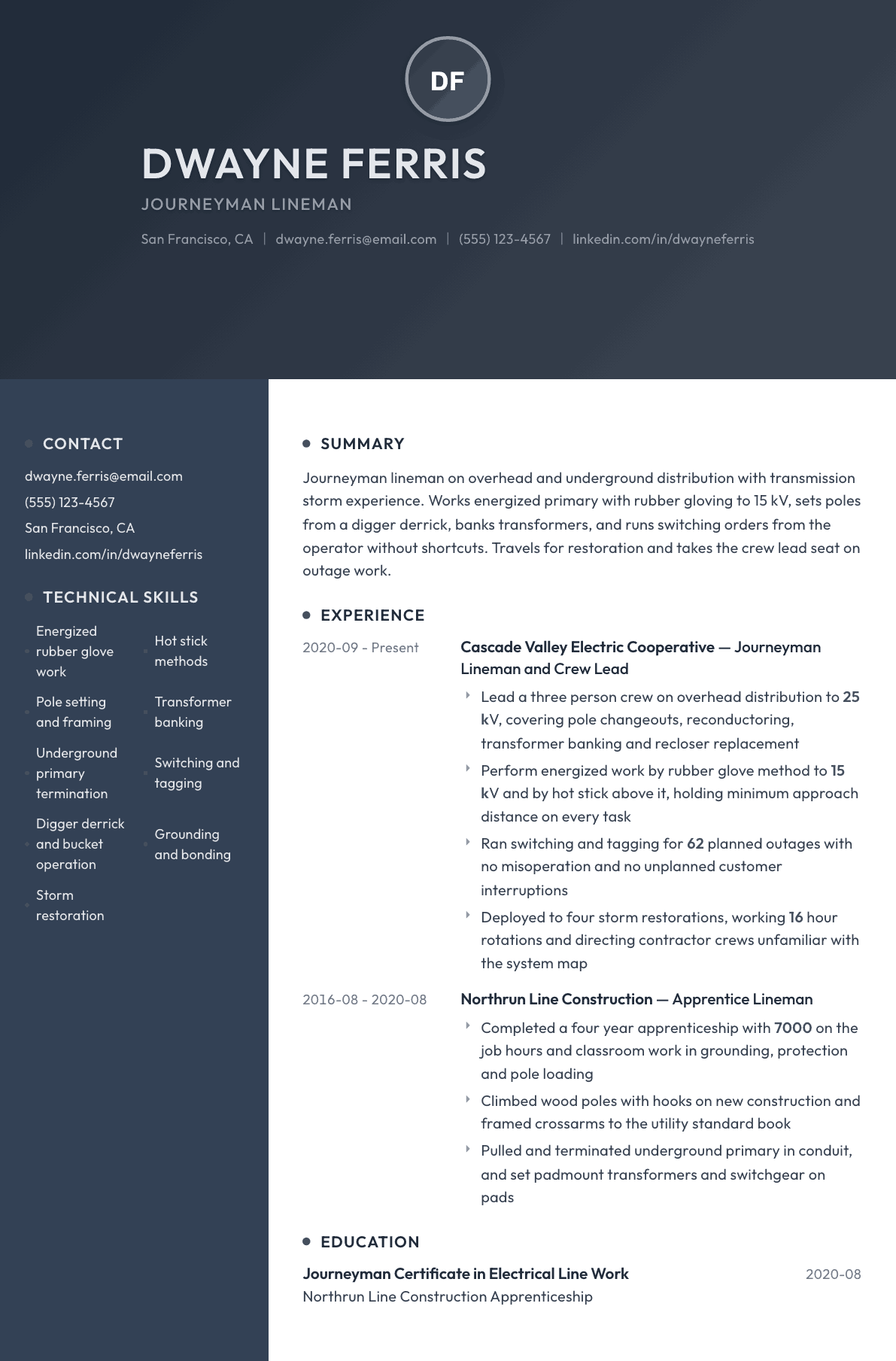
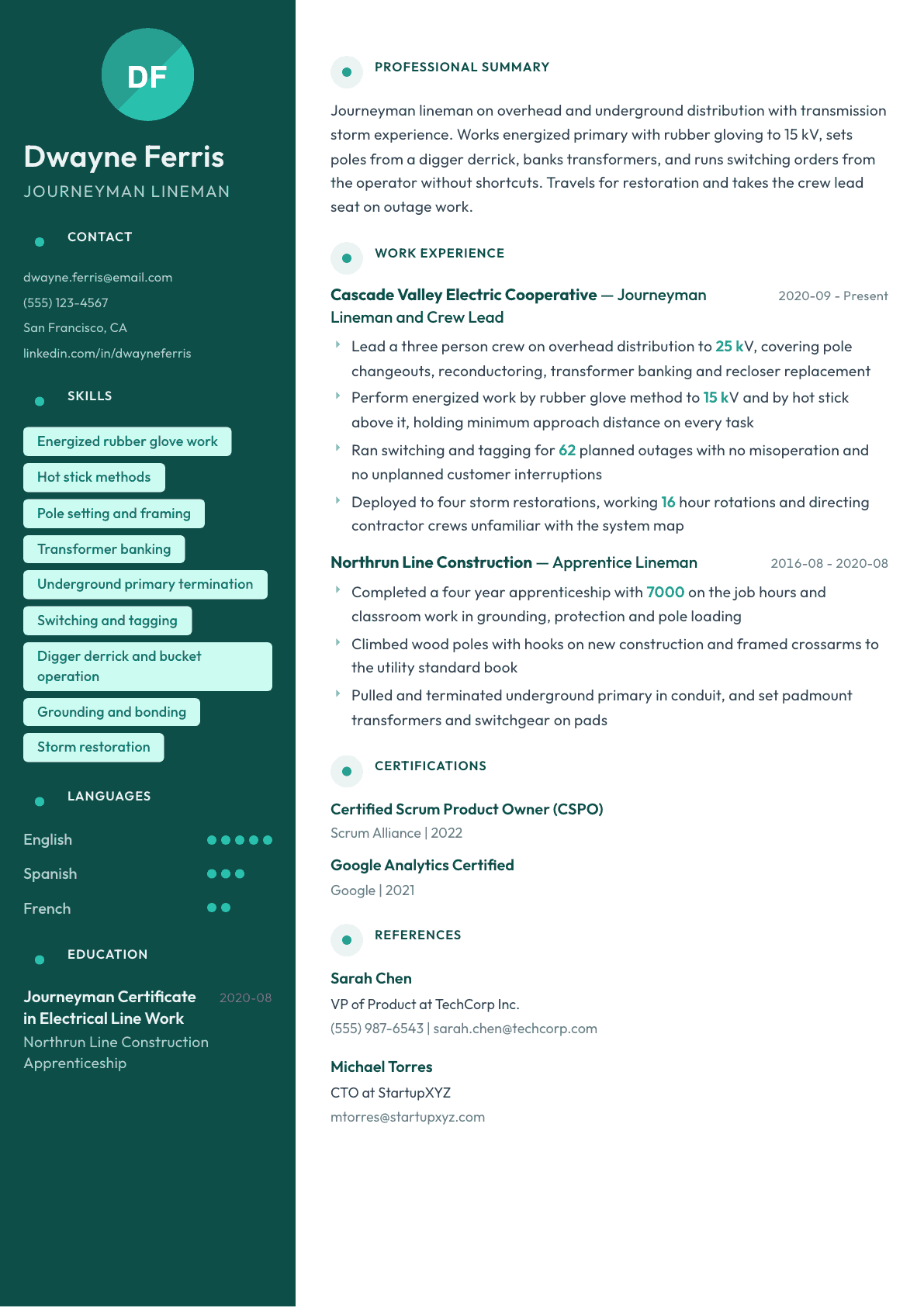
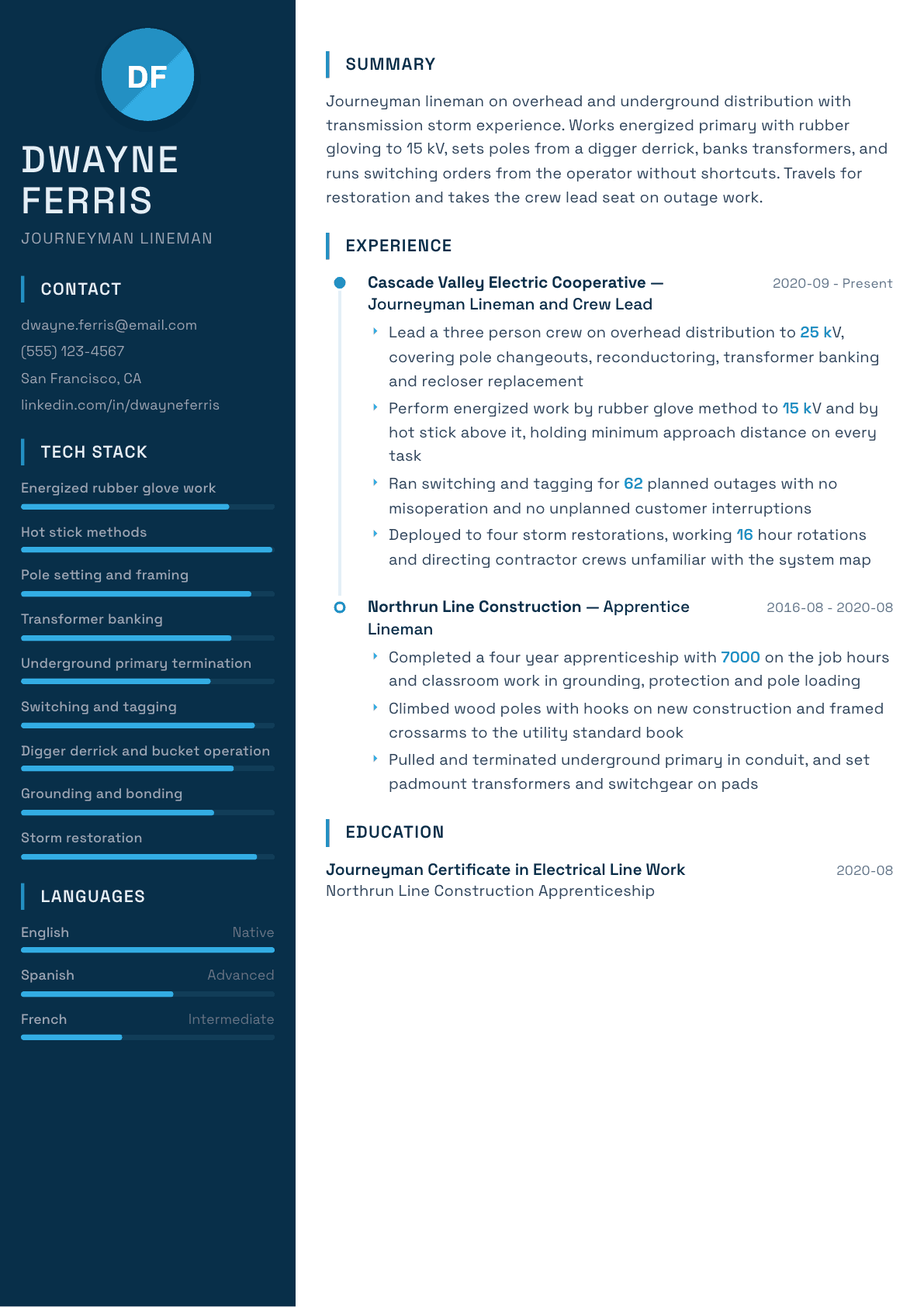
Example Lineman summary
Journeyman lineman with eight years on overhead and underground distribution to 25 kV, including transmission storm restoration. Works energized by rubber glove method within minimum approach distance, sets and frames poles, banks transformers, and terminates underground primary in conduit. Leads a small crew, runs switching and tagging from the operator without deviation, and travels for extended restoration rotations. Holds a commercial driver license and a clean incident record.
Skills to list on a Lineman resume
- Overhead distribution construction
- Underground distribution and URD
- Energized rubber glove method
- Hot stick and live line tools
- Minimum approach distance discipline
- Pole climbing with hooks
- Digger derrick operation
- Aerial bucket operation
- Transformer banking and sizing
- Recloser and sectionalizer work
- Protective grounding
- Switching and tagging orders
- Storm and outage restoration
- Utility standard book framing
- Rubber goods inspection and care
What actually gets this resume read
- State your classification plainly: apprentice with hours completed, journeyman lineman, crew lead or troubleshooter.
- Give the voltage classes you have worked energized and the method used at each, gloving or hot stick.
- List your commercial driver license class and every piece of equipment you are qualified to operate.
- Put storm restoration deployments on the page with the duration, because utilities hire for that availability.
- Show switching experience with counts, since a lineman trusted with switching orders is a different hire.
- Keep a clean safety record visible: near miss reporting, recordable free stretches and the audits you passed.
How to write a lineman resume
A line superintendent reads a lineman resume looking for one thing before anything else: evidence that you will still be alive and uninjured at the end of the outage. Everything technical on the page is filtered through that. Classification, hours, voltage class, method of approach, grounding habits and incident history are not credentials in this trade, they are the risk assessment.
The second read is about coverage. Utilities and line contractors staff for storms, and a lineman who can travel, lead a small crew and run a switching order without deviation is worth more than one who is faster on a pole but has to be told what to open. Your resume should make it obvious which of those you are and where you are heading.
This guide covers how to lay out classification and hours, how to write energized work without overstating it, how to describe storm deployments, three summaries from apprentice through crew lead, before and after bullets, and the questions that come up when moving between contractor and utility work.
Format: classification, hours and equipment before any prose
Reverse chronological, one page for a journeyman, two only when you have run crews on multiple systems. The block a superintendent reads first is classification and hours. An apprentice is placed by the hours completed and the step reached. A journeyman is placed by the topping out date and what has happened since. Neither reader wants to derive that from a paragraph.
Immediately after, list the equipment you are qualified to operate and the license class that lets you drive it. A lineman who cannot legally move the digger derrick to the job changes how the crew is built, and superintendents plan around that before they plan around skill.
- Classification line: apprentice with step and hours, journeyman with topping out date, or crew lead with crew size.
- License line: commercial driver license class, endorsements, medical card status and driving record.
- Equipment line: bucket truck, digger derrick, pole trailer, wire puller, tensioner and any crane qualification.
- Systems line: overhead distribution, underground residential distribution, transmission, substation support.
Summary: voltage, method, systems, availability
Four lines. Give the classification, the voltage classes you have worked energized and by what method, the systems you know, and your availability for travel and storm rotations. Availability belongs in the summary rather than at the bottom, because for many line contractors it is the deciding factor and they will not read to the end to find it.
Be exact about method. Rubber glove work to a stated voltage and hot stick work above it is a precise claim a superintendent can test in a conversation. Saying you have worked energized lines without naming the method or the class is the kind of vagueness that gets a resume set aside quietly.
Experience: what you built, what you switched, what you restored
Split each job into construction, maintenance and restoration, because they use different muscles. Construction bullets carry counts: poles set, spans reconductored, transformers banked, padmount units set on pads, feet of underground primary pulled and terminated. Maintenance bullets carry the equipment: reclosers, sectionalizers, regulators, capacitor banks, cutouts and arresters.
Switching deserves its own bullet with a count. A lineman trusted to take switching orders from the operator, execute in sequence, hang grounds and report back is doing the part of the job where a mistake becomes a headline. Saying you ran a number of planned outages with no misoperation is one of the strongest lines available in this trade.
Storm work should name the number of deployments, the typical rotation length and whether you directed foreign crews. Contractor crews arriving from another state do not know the system map, and a lineman who has led them through unfamiliar territory has proven something that no local job description covers.
Safety history written without bragging
Every candidate claims to be safety minded, so the phrase carries nothing. Replace it with behavior. Minimum approach distance held on energized tasks, rubber goods inspected and rotated on a schedule, protective grounds applied to a documented plan, job briefings led at the start of each task, and near misses reported rather than absorbed.
If you have a clean recordable history, state the span in years rather than claiming perfection. If you have had an incident, do not hide it in an interview, but the resume is not the place to litigate it. What belongs on the page is the practice that keeps a crew whole, described concretely enough that a superintendent recognizes their own standard in it.
- Job briefing habit: who attends, what gets covered, and how the plan changes when conditions do.
- Grounding practice: equipotential zone setup, ground placement and the check before anyone gets in the bucket.
- Rubber goods handling: inspection interval, test dates and how failed gear is pulled from the truck.
- Any safety committee, apprentice mentoring or incident review role you have held on a crew.
Keywords and the difference between contractor and utility resumes
A contractor resume leans on production: spans, poles, footage, travel willingness and long rotations. A utility resume leans on system knowledge: switching, troubleshooting outages alone at night, customer contact at the meter and familiarity with a standard book. The same lineman writes these two documents differently, and applying with the wrong one is the most common self inflicted wound in this trade.
The terms that recur in postings are worth using once each where they are true: journeyman lineman, distribution, transmission, underground, energized, rubber gloving, hot stick, minimum approach distance, grounding, switching and tagging, recloser, transformer banking, storm restoration and troubleshooting. Skip the ones that describe work you have only watched.
Lineman resume summary examples
Apprentice, third year
Third year line apprentice with 5200 on the job hours and completed classroom units in grounding, pole loading and protective equipment. Climbs wood poles with hooks, frames crossarms to the standard book, pulls and terminates underground primary, and assists on energized work under a journeyman. Holds a commercial driver license.
Journeyman, distribution
Journeyman lineman with six years on overhead and underground distribution to 25 kV. Works energized by rubber glove method to 15 kV and by hot stick above it, sets poles from a digger derrick, banks transformers, and troubleshoots outages alone on night call. Two storm deployments on 16 hour rotations.
Crew lead and troubleshooter
Line crew lead with 14 years across a contractor and a cooperative, running three person crews on distribution construction and maintenance. Executed 62 planned outages with no misoperation, directed foreign crews during four storm restorations, and mentors apprentices through their climbing and grounding units.
Work experience bullets: before and after
Before: Worked on power lines for a utility.
After: Built and maintained overhead distribution to 25 kV on a cooperative system, covering pole changeouts, reconductoring, transformer banking and recloser replacement on a three person crew.
Voltage class, system type and the actual task list place you on a real crew instead of a job title.
Before: Performed energized work safely.
After: Performed energized work by rubber glove method to 15 kV and by hot stick above it, holding minimum approach distance on every task and leading the job briefing before the bucket left the ground.
Method and voltage make the claim testable, and the briefing detail shows how the safety actually happens.
Before: Helped restore power after storms.
After: Deployed to four storm restorations on 16 hour rotations, directing contractor crews unfamiliar with the system map and sequencing repairs from the substation outward to restore the largest blocks first.
It shows availability, leadership under pressure and the restoration logic a superintendent wants to hear.
Before: Did switching for outages.
After: Executed switching and tagging for 62 planned outages to the operator order, hung protective grounds to a documented plan, and completed the work with no misoperation and no unplanned customer interruptions.
A count with an outcome turns switching from a listed duty into a record of trust on a live system.
Before: Installed underground cable.
After: Pulled and terminated underground primary in conduit for a residential subdivision, set padmount transformers and switchgear on pads, and phased and tested each run before energizing.
Naming the termination, the equipment and the phasing check shows the underground work was yours end to end.
Hard skills
- Overhead distribution construction
- Underground residential distribution
- Energized rubber glove method
- Hot stick and live line tool work
- Minimum approach distance discipline
- Pole climbing with hooks and belt
- Digger derrick and pole setting
- Aerial bucket operation
- Transformer banking and sizing
- Recloser, regulator and capacitor bank work
- Protective grounding and equipotential zones
- Switching and tagging to operator order
- Outage troubleshooting
- Storm restoration sequencing
- Standard book framing and prints
Soft skills
- Leading a job briefing that people actually listen to
- Saying stop when conditions change on a live task
- Directing crews who do not know the system
- Steadiness on long rotations without sleep
- Mentoring apprentices without embarrassing them
Certifications worth listing
- Certified Utility Safety Professional (CUSP) (Utility Safety and Ops Leadership Network)
- Power Line Worker Certification (NCCER)
- Commercial Driver License Class A (State department of motor vehicles)
- First Aid, CPR and AED (American Red Cross)
Mistakes that cost lineman candidates the interview
- Writing worked on power lines without naming distribution, transmission or underground and the voltage class involved.
- Claiming energized experience with no method attached, which reads as either inexperience or overstatement.
- Leaving out apprenticeship hours, since that number is how an apprentice is placed on a pay step.
- Burying travel and storm availability at the bottom when it is often the first thing a contractor screens for.
- Using safety minded as a bullet instead of describing grounding, briefings and rubber goods handling.
- Sending a production heavy contractor resume to a utility that hires for switching and system knowledge.
Lineman resume questions
How do I write a lineman resume while still an apprentice?
Lead with hours completed and the step you are on, then list the units you have finished in the classroom. Add the tasks you perform under supervision and the equipment you can operate. A superintendent needs to know where you sit on the progression before anything else.
Should transmission and distribution be on the same resume?
Yes, but kept separate so the reader can see the depth of each. A candidate with years on distribution and one transmission storm deployment should say exactly that rather than blending them, because a transmission contractor will find the gap in the first interview.
Does my commercial driver license really belong in the summary?
It does, along with the class and any endorsements. Crew composition depends on who can move the equipment, and a lineman without the license changes the staffing plan for every job. Put the medical card status there too if it is current.
How do I show safety without sounding like every other resume?
Trade adjectives for practice. Describe the grounding plan you follow, the briefing you lead, the inspection interval on your rubber goods and the number of years without a recordable. Concrete habits read as real, while the phrase safety first reads as filler.
What if I want to move from a line contractor to a utility?
Rewrite the page around system knowledge rather than production counts. Emphasize troubleshooting, switching, customer contact and any work you did on a standard book system. Keep one production bullet so the reader still sees you can build, then let the rest speak to operations.
Related resume examples
- Electrician Resume example
- Electrical Technician Resume example
- Line Worker Resume example
- Journeyman Electrician Resume example
- Building Superintendent Resume example
- Aircraft Maintenance Technician Resume example