Building Maintenance Worker Resume Examples: free score
Build a Solid Building Maintenance Worker Resume
By Mustafa Tarabya, founder of CVBooster · Published · Updated
Build a building maintenance worker resume showcasing your facility upkeep, repair skills, and safety compliance record.
Sample resumes for a building maintenance worker
The same building maintenance worker content laid out in three CVBooster templates, so you can see what the finished document looks like before you write a word.
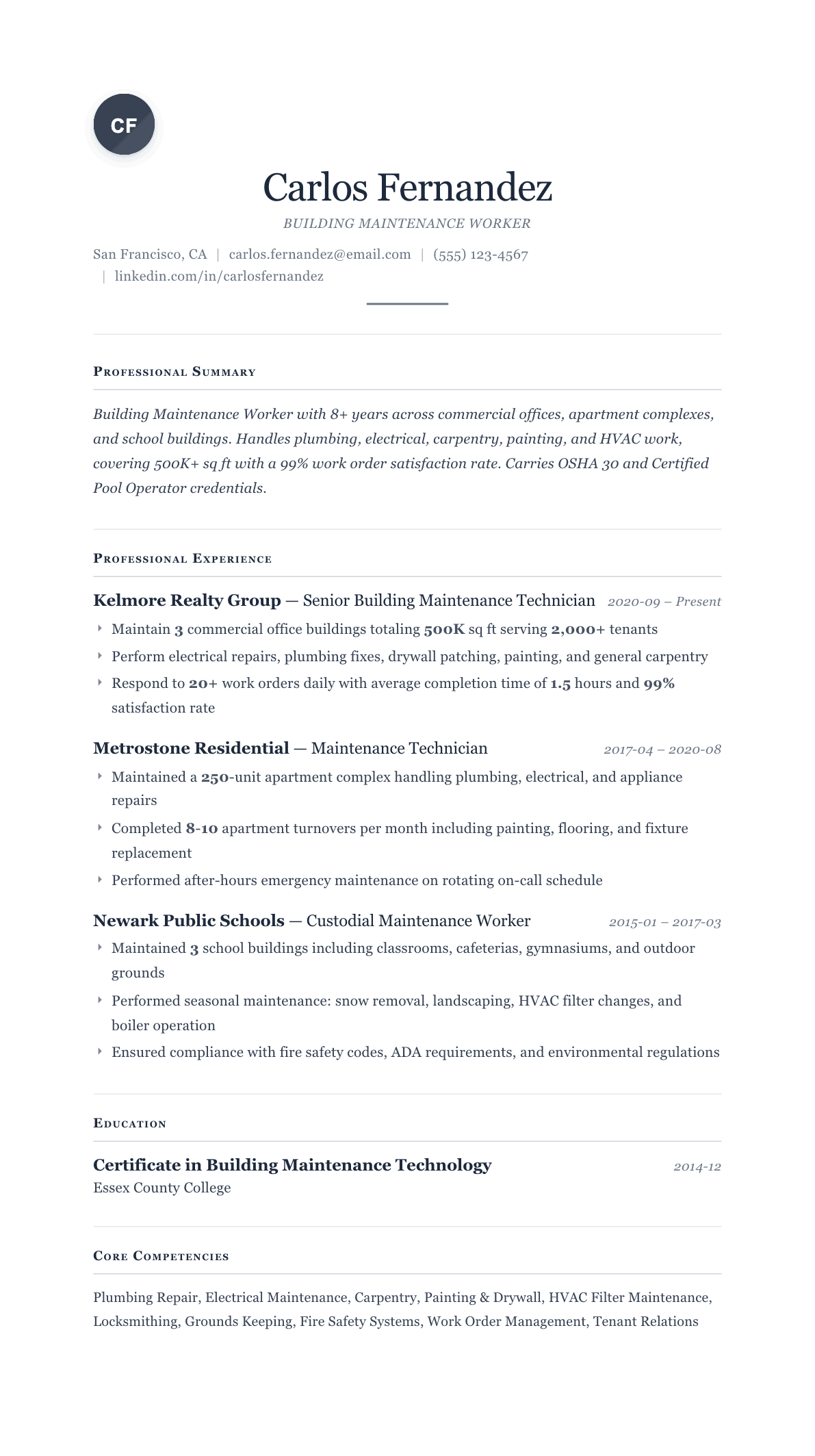
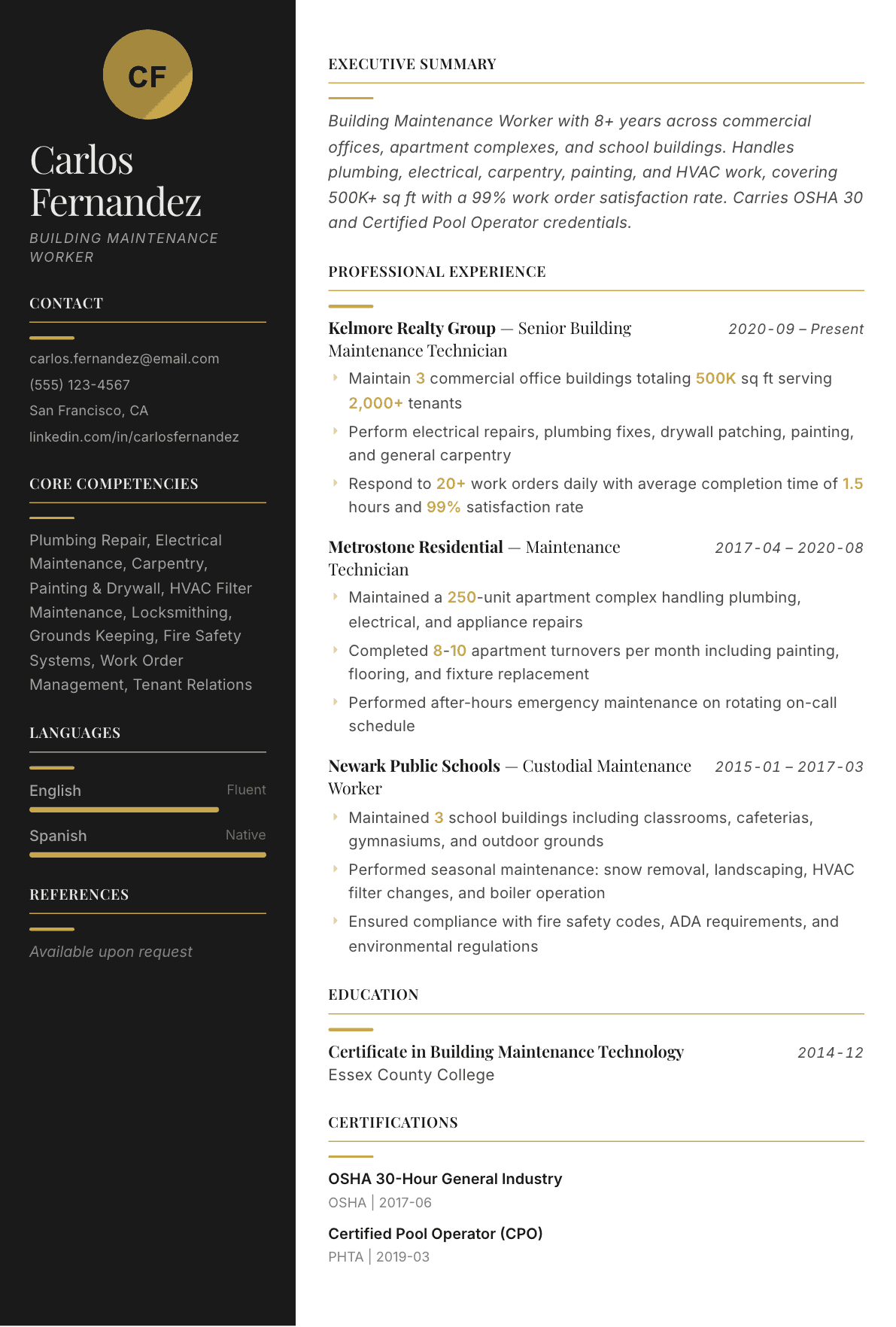
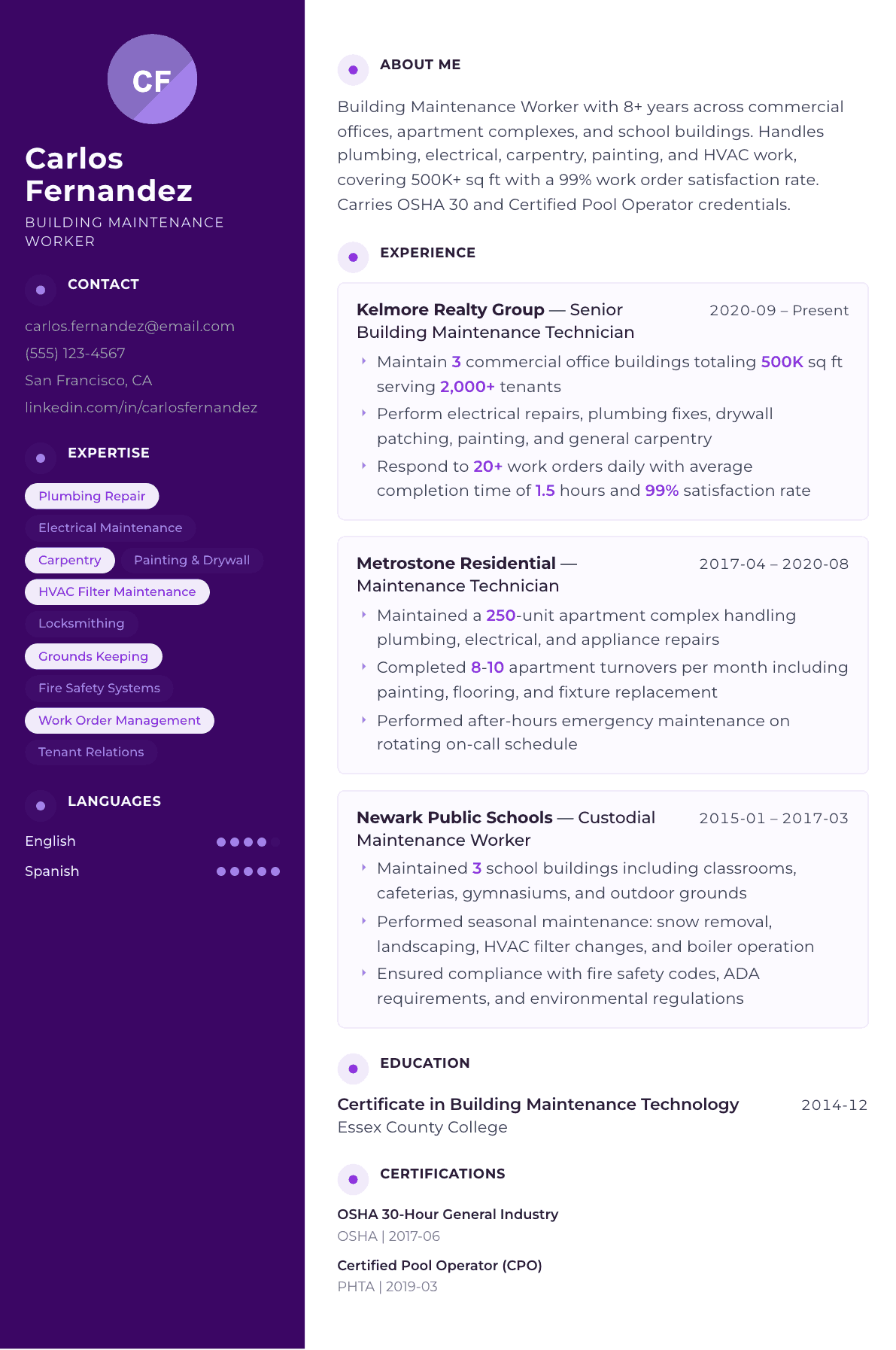
Example Building Maintenance Worker summary
Building Maintenance Worker with 8 years covering 500K+ sq ft of commercial and residential property. Closes 20+ work orders a day at a 1.5-hour average with a 99% satisfaction rate, and runs after-hours emergency calls on rotation. Targeting a chief engineer or maintenance supervisor role.
Skills to list on a Building Maintenance Worker resume
- Plumbing Repair
- Electrical Systems
- Carpentry
- Painting & Drywall
- HVAC Maintenance
- Locksmithing
- Grounds Maintenance
- Fire Safety Systems
- Work Order Management
- Tenant / Customer Service
- Appliance Repair
- Snow Removal
- Building Codes
- Preventive Maintenance
What actually gets this resume read
- List all your maintenance skills: plumbing, electrical, carpentry, painting, HVAC, landscaping.
- Quantify the scope: square footage maintained, number of units or buildings, work orders completed.
- Highlight your work order response time and satisfaction rate.
- Include certifications: OSHA, EPA 608, CPO, boiler operator, elevator operator.
- Mention emergency maintenance and on-call experience.
How to write a building maintenance worker resume
The person hiring a building maintenance worker is usually a property manager or a chief engineer who is short-handed and covering emergency calls themselves. They read a resume looking for two things: the range of trades you can cover without calling a vendor, and whether you can be trusted alone in an occupied building with tenants watching.
That second point is why this resume is different from a pure trade resume. A plumber sells depth in one system. A building maintenance worker sells breadth across plumbing, electrical, carpentry, painting, drywall, locks, appliances and light HVAC, plus the judgment to know which job is yours and which one needs a licensed contractor.
This guide sets out the section order property managers expect, how to describe the portfolio you maintained, three summaries at different stages, before and after bullets, and the certifications that actually get checked.
Format: one page, trades listed early, portfolio described in numbers
Keep it to a single page in reverse chronological order. Property management companies rarely use sophisticated parsing, so a plain layout with clear headings beats anything decorative. Use a wide skills band near the top listing the trades you cover, because that is the line the reader scans for first.
Every employer entry needs a portfolio description before the bullets: what kind of property, how many buildings or units, roughly how much square footage, and whether it was occupied commercial, multifamily residential, school, hospital or industrial. Those settings have different rules and different tenants.
- Header: name, city and state, phone, email, and a driver license note if the job covers multiple sites.
- Order: summary, trade skills, experience, certifications and safety training, education.
- Say whether you carried an on-call rotation. Property managers weight that heavily.
Summary: breadth of trades, property type, response record
Three lines. Name the years, the property types, the trades you self-perform, and one thing about reliability: on-call coverage, work order turnaround, or a record of passing inspections. Avoid the word handyman, which reads as unlicensed and casual to a commercial property manager.
If you are aiming at a different property type, say so. Moving from apartments into commercial office means fewer unit turns and more life safety systems, and the summary is where you signal that you understand the difference.
Experience: work orders, turns, and preventive rounds
The core of the job is the work order queue, so quantify it. Work orders closed per day or per week, average time to first response, and the share you completed without escalating to a vendor. Property managers pay vendors, so a worker who fixes the garbage disposal instead of dispatching an appliance contractor is measurable money saved.
Multifamily work adds unit turns. Give the number of turnovers a month and what a turn included in your hands: paint, patch, flooring, fixtures, appliance swaps, blind and lock changes. Commercial work adds preventive rounds: filter changes, belt inspections, roof drains, exit and emergency lighting testing, backflow scheduling, boiler and cooling tower checks.
Name the work order system you used, such as a computerized maintenance management platform or a property management portal. It tells the reader you can document, not just fix.
Safety, compliance and the vendor line
Occupied buildings are regulated buildings. Show that you know where your work stops: lockout and tagout before touching a panel, ladder and fall protection above a certain height, asbestos and lead awareness in older stock, and confined space rules for pits and vaults. A worker who names those boundaries is safer to hire than one who claims to do everything.
Add the inspection record. Fire marshal walkthroughs, elevator inspections, sprinkler and alarm testing, health department visits in schools and food service settings. If you were the person who prepared the building and it passed clean, that is a bullet.
Skills and keywords in property management postings
The recurring vocabulary is narrow: preventive maintenance, work orders, unit turns, general repairs, plumbing, electrical, HVAC filter and belt service, drywall and painting, appliance repair, groundskeeping, snow removal, and on-call. Mirror the exact phrasing the posting uses once in your skills band and once inside a bullet.
List tools and materials only where they are not obvious. Multimeter, pipe threading, drain auger and camera, tile and vinyl plank installation, door hardware and master key systems, and boiler operation are all worth naming. Do not list a hammer.
Building Maintenance Worker resume summary examples
First maintenance role
Maintenance worker with 2 years in a 180-unit apartment community handling drain clearing, fixture replacement, appliance swaps, patching and painting. Completed an OSHA 10 course and an EPA refrigerant handling certification, and covered a weekend on-call rotation without a missed call.
Six years across property types
Building maintenance worker with 6 years across multifamily and commercial office, self-performing plumbing, electrical, carpentry, drywall and light HVAC. Closes roughly 20 work orders a day, handled 9 unit turns a month at peak season, and keeps preventive rounds current in a property management portal.
Lead maintenance worker
Lead building maintenance worker responsible for three commercial buildings and their preventive maintenance calendar, life safety testing and vendor scheduling. Trains two junior workers, prepares the properties for fire marshal and elevator inspections, and carries the after-hours escalation phone.
Work experience bullets: before and after
Before: Fixed things around the building as needed.
After: Closed an average of 20 tenant work orders a day across three occupied office buildings, covering plumbing leaks, lighting and ballast replacement, door hardware, drywall repair and interior painting.
A daily volume and a named set of trades tell a property manager exactly what stays in house.
Before: Did apartment turnovers.
After: Completed 8 to 10 unit turns a month within a five-day standard, including full repaint, drywall patching, vinyl plank replacement, fixture and blind swaps and appliance installation.
The turn window is the number that decides whether a unit is rentable, so quoting it shows you know the business.
Before: Responsible for preventive maintenance.
After: Ran the quarterly preventive calendar on rooftop units, exhaust fans and pumps: filter and belt changes, coil cleaning, bearing greasing and drain pan treatment, all logged in the maintenance system.
Listing the actual round makes preventive maintenance a routine you own rather than a phrase you copied.
Before: Followed safety rules.
After: Applied lockout and tagout before every panel and motor task, used fall protection on roof and lift work, and escalated suspected asbestos flooring to an abated vendor rather than disturbing it.
Naming where the work stops proves judgment, which is what an owner is really buying.
Before: Helped save the company money on repairs.
After: Brought appliance, garbage disposal and toilet rebuild work in house instead of dispatching contractors, cutting outside vendor callouts on the portfolio by more than half in a year.
The specific work moved in house explains the saving instead of asserting one.
Hard skills
- Plumbing repairs and drain clearing
- Basic electrical and lighting
- Drywall repair and painting
- Carpentry and door hardware
- HVAC filter, belt and coil service
- Appliance repair and installation
- Preventive maintenance rounds
- Work order and CMMS documentation
- Locks and master key systems
- Boiler and pump monitoring
- Groundskeeping and snow removal
- Life safety and fire system testing support
Soft skills
- Tenant courtesy in occupied spaces
- On-call reliability
- Prioritizing a full work order queue
- Vendor coordination
- Clear written job notes
- Discretion around resident units
Certifications worth listing
- OSHA 10-Hour General Industry (Occupational Safety and Health Administration Outreach Training Program)
- OSHA 30-Hour General Industry (OSHA Outreach Training Program)
- Section 608 Technician Certification (United States Environmental Protection Agency)
- Certified Apartment Maintenance Technician (CAMT) (National Apartment Association Education Institute)
- Certified Pool Operator (CPO) (Pool and Hot Tub Alliance)
Mistakes that cost building maintenance worker candidates the interview
- Calling yourself a handyman, which reads as informal and unlicensed to a commercial property manager.
- Describing duties with no portfolio context, so the reader cannot tell a single small building from a large multi-site route.
- Leaving out unit turn counts and turn times, which are the numbers multifamily managers actually budget around.
- Claiming every trade including licensed electrical and gas work, which raises a liability flag rather than confidence.
- Forgetting to mention on-call and after-hours coverage, one of the hardest things for a property manager to staff.
- Listing safety training without ever showing it applied inside a bullet.
Building Maintenance Worker resume questions
Do I need a license to work as a building maintenance worker?
Usually not for general repairs, but the boundaries matter. Refrigerant work requires an EPA certification, and most jurisdictions reserve new electrical, gas and larger plumbing work for licensed trades. Show on the resume that you know which jobs go to a vendor.
How do I show experience if I came from a different trade?
Translate it into the property vocabulary. A former carpenter should describe drywall, doors, trim and turn work, then list the plumbing and electrical basics learned since. Property managers hire for breadth, so name every system you can touch confidently.
Should I list the buildings I have maintained by name?
Name the management company as the employer, then describe the property by type and size rather than address. Three commercial office buildings or a 250-unit garden community tells the reader far more than a street name they do not recognize.
What certifications help a building maintenance worker most?
The maintenance technician credential from the apartment industry, an OSHA outreach course, the EPA refrigerant certification, and a pool operator card if the properties have water features. All four are commonly requested outright in postings.
How long should my building maintenance resume be?
One page in nearly every case. Two pages only if you have supervised crews across multiple sites and need room for the preventive program and compliance record. Repeating similar duties across four employers is what pushes these resumes to a wasted second page.
Related resume examples
- Maintenance Technician Resume example
- Mechanic Resume example
- Appliance Repair Technician Resume example
- Maintenance Worker Resume example
- Lineman Resume example
- Building Superintendent Resume example