Apartment Maintenance Technician Resume Examples: free
Write an Apartment Maintenance Technician Resume Property Managers Act On
By Mustafa Tarabya, founder of CVBooster · Published · Updated
Apartment maintenance technician resume example with unit counts, make-ready and on-call keywords, and a guide to writing work order volume.
Sample resumes for a apartment maintenance technician
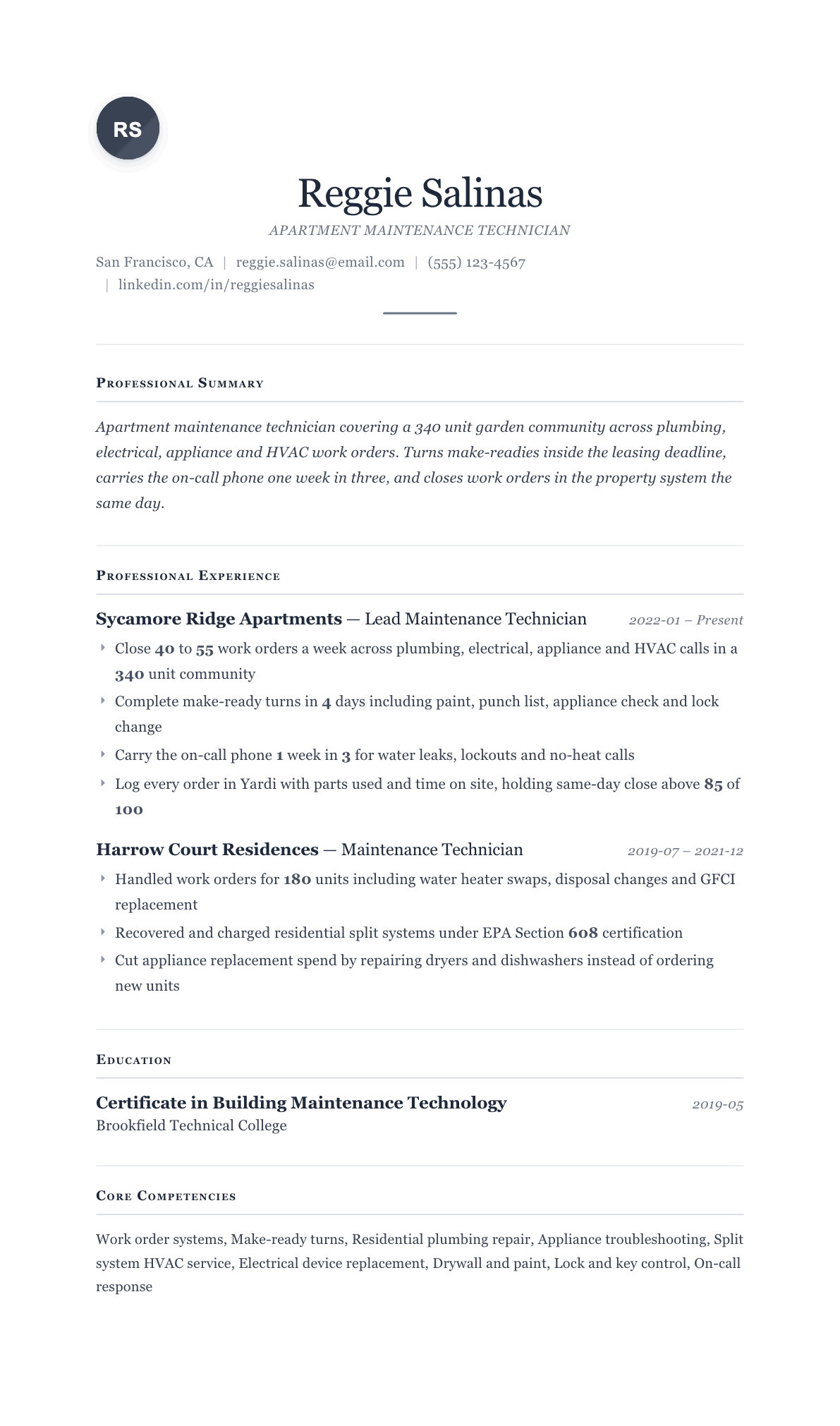
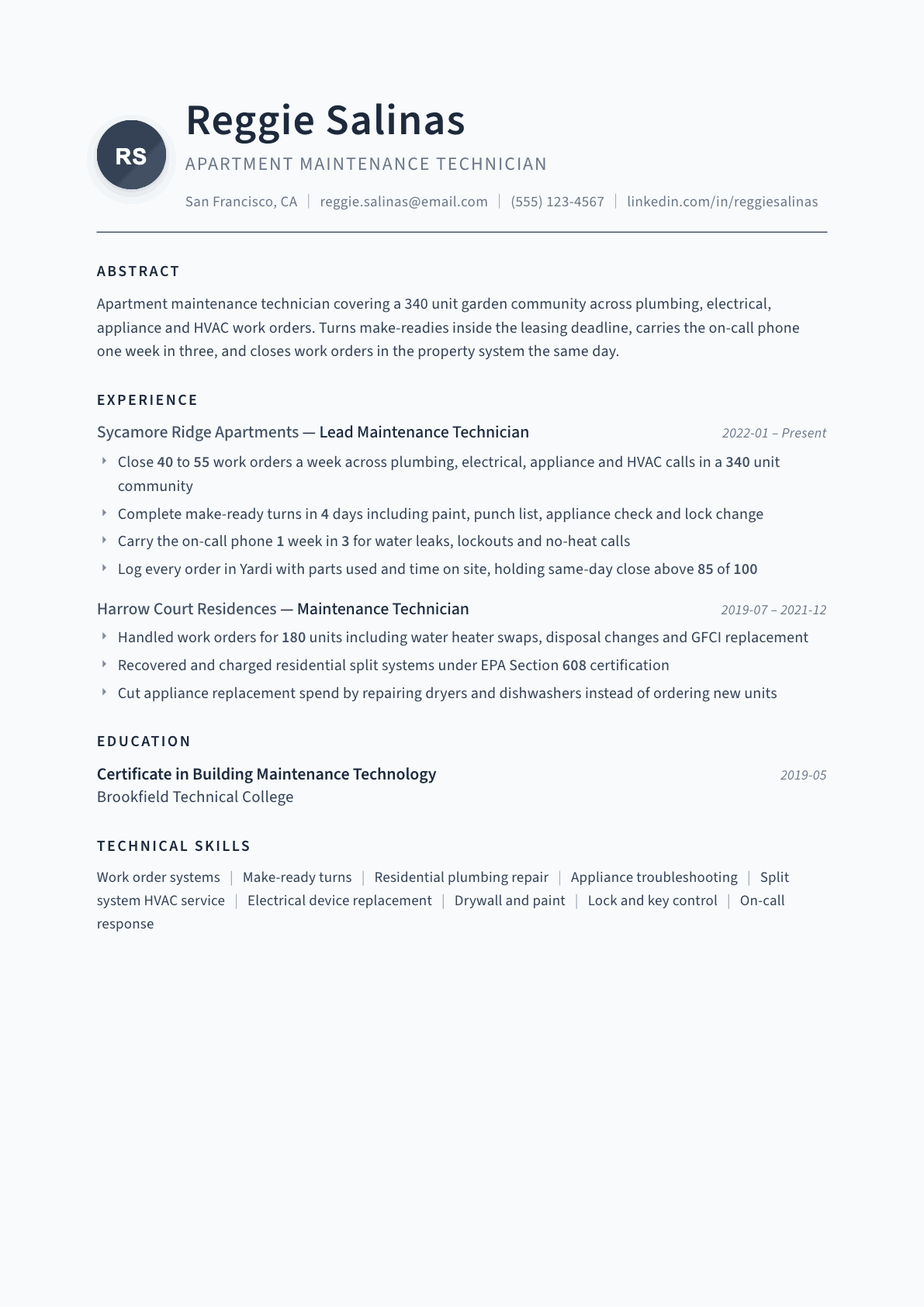
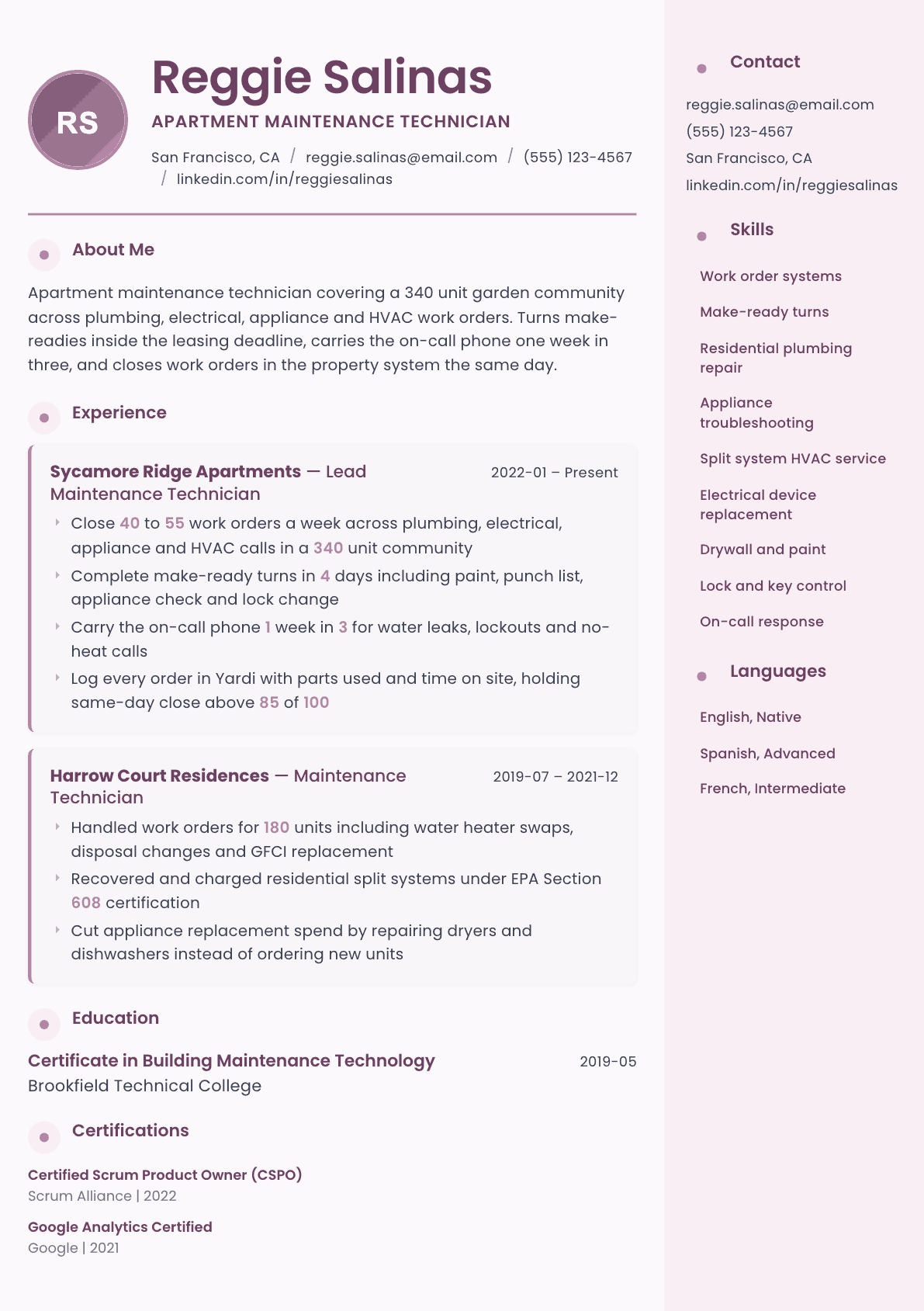
The same apartment maintenance technician content laid out in three CVBooster templates, so you can see what the finished document looks like before you write a word.
Example Apartment Maintenance Technician summary
Apartment maintenance technician covering a 340 unit garden community across plumbing, electrical, appliance and HVAC calls, closing 40 to 55 work orders a week. Turns make-readies in four days including paint, punch list and lock change, and carries the on-call phone one week in three for leaks, lockouts and no-heat calls. EPA Section 608 certified, logs parts and time in Yardi and keeps same-day closeout high.
Skills to list on a Apartment Maintenance Technician resume
- Work order intake and closeout
- Make-ready turnover
- Toilet, faucet and drain repair
- Water heater replacement
- Garbage disposal service
- Appliance diagnosis and repair
- Split system HVAC service
- EPA Section 608 refrigerant handling
- Outlet, switch and GFCI replacement
- Drywall patch and paint
- Door, lock and key control
- Preventive maintenance schedules
- On-call emergency response
- Property management software
- Vendor coordination
What actually gets this resume read
- Open with unit count and work orders per week, because that pair tells a property manager your real capacity.
- Give your make-ready turn time in days and say what the turn included, since leasing lives on that number.
- Name the property software you close orders in, because a manager does not want to retrain you on it.
- List EPA Section 608 by type if you hold it, since HVAC calls are the ones a property cannot outsource cheaply.
- Say how often you carry the on-call phone, which is the duty most technicians quietly leave off the page.
- Show trade breadth with examples in plumbing, electrical, appliance and drywall rather than the word handyman.
How to write a apartment maintenance technician resume
A property manager hiring an apartment maintenance technician is looking at two lists. One is the open work order queue, which she needs closed faster than it fills. The other is the make-ready board, where every day a unit sits empty is rent that never arrives. Your resume gets read against both lists, and nothing else on the page matters as much.
This is why unit count and work orders per week beat every adjective available. A technician covering three hundred forty units and closing fifty orders a week is a known quantity. A technician who performed general maintenance duties in a residential setting is not, and the reader has no way to size the difference.
This guide covers how to lay the page out for a property manager, how to write make-ready turns, on-call duty and trade breadth without sounding like a handyman advert, plus summaries at three levels, rewritten bullets and the questions technicians ask when they move between property types.
Format: unit count, order volume, trades, on-call
One page unless you have more than a decade across several portfolios. Reverse chronological, with each property named by type and size: garden community, mid-rise, student housing, senior living, or scattered site. Property type changes the work more than most applicants expect, and a manager reads it before anything else.
Put the four screening facts in the top third: units covered, work orders closed per week, the trades you carry, and whether you take on-call. Everything else on the page supports those four.
- Property block: community name type, unit count, building age and whether units are individually metered.
- Volume line: work orders per week and your same-day or same-visit closeout rate if the software reports one.
- Trades block split into plumbing, electrical, appliance, HVAC and interior finish work rather than one blob.
- Duty line: on-call rotation frequency, after hours response time and the emergency types you have handled.
Summary: capacity, turn time, certification
Four lines. Community size, weekly order volume, make-ready turn time, and your refrigerant certification. That combination lets a regional manager work out whether you can hold her worst property, which is usually the one she is hiring for.
EPA Section 608 belongs in the summary, not buried in a list. Air conditioning calls are the most expensive thing a property outsources, and a technician who can recover, evacuate and charge a residential split system pays for himself in a single summer.
Experience: work orders, make-readies and the on-call phone
Give each property its size, then write bullets that show the actual mix of calls. Running toilets and drain clears, faucet cartridges, water heater replacement, garbage disposals, dryer vent cleaning, refrigerator and range diagnosis, outlet and switch replacement, ground fault device resets, drywall patch and paint, door and lock work.
Make-readies deserve their own bullet with a turn time in days and a list of what the turn included. Leasing teams live on that number. A four day turn covering paint, punch list, appliance check and lock change tells a manager exactly how quickly you can hand a unit back to her.
Then write the on-call bullet, which most technicians leave off entirely. How often you carry the phone, what you respond to, and how you triage. A no-heat call in January, a water leak above an occupied unit, a resident locked out at midnight. Saying you carry the phone one week in three is honest and it is what she has to staff.
Software, parts and preventive work
Name the property management system you close orders in. Managers do not want to retrain a technician on the software while the queue grows, and the system also produces the numbers you are quoting, so naming it makes your figures checkable.
Preventive maintenance is what separates a technician from a firefighter. Filter changes on a schedule, water heater flushes, gutter and roof checks, dryer vent cleaning, smoke and carbon monoxide detector testing. If you built or ran a preventive schedule, say what it covered and how the emergency call volume responded, because that is the argument for hiring you over someone cheaper.
Skills and the terms a multifamily posting uses
Multifamily adverts recycle a fixed vocabulary: work order, make ready, unit turn, punch list, on-call, HVAC, EPA 608, plumbing repair, appliance repair, drywall, punch, curb appeal, preventive maintenance, vendor coordination. Match the ones you can evidence and drop the rest.
Add the practical screens: a valid driving license, whether you can lift and climb, whether you speak a second language spoken by residents, and whether you live close enough for a genuine after hours response. Those decide more hires at this level than any technical line on the page.
Apartment Maintenance Technician resume summary examples
Entry technician
Maintenance technician with two years of property work covering basic plumbing, appliance swaps, outlet replacement and unit punch lists across a one hundred eighty unit community. Holds EPA Section 608 Type I certification, carries own hand tools, and is comfortable closing work orders in a property system the same day.
Six years in
Apartment maintenance technician covering a three hundred forty unit garden community, closing forty to fifty five work orders a week across plumbing, electrical, appliance and HVAC calls. Turns make-readies in four days including paint, punch list and lock change, and carries the on-call phone one week in three.
Lead technician
Lead maintenance technician running a two person team across a mid-rise and a garden property, holding EPA Section 608 universal certification and the apartment maintenance credential. Built the preventive schedule covering filters, water heater flushes and dryer vents, which cut after hours emergency calls through a full winter.
Work experience bullets: before and after
Before: Completed maintenance work orders for residents.
After: Closed forty to fifty five work orders a week across plumbing, electrical, appliance and HVAC calls in a three hundred forty unit garden community.
Volume against unit count is the capacity figure a property manager staffs a community on.
Before: Prepared vacant units for new residents.
After: Completed make-ready turns in four days including paint touch up, punch list, appliance check, deep clean handoff and lock change.
The turn time plus the scope tells leasing exactly when the unit can be shown again.
Before: Worked on air conditioning units.
After: Recovered, evacuated and charged residential split systems under EPA Section 608 certification, and replaced capacitors and contactors rather than calling a vendor.
It shows the certified work a property would otherwise pay an outside contractor to perform.
Before: Was available for emergencies.
After: Carried the on-call phone one week in three, responding to water leaks, no-heat calls and lockouts, with escalation to a vendor only for gas line work.
Rotation frequency and a clear escalation boundary describe a duty that can actually be scheduled.
Before: Used the maintenance software.
After: Logged parts used and time on site for every order in Yardi, holding same-day closeout above eighty five of every hundred orders.
Naming the system makes the closeout figure verifiable rather than a claim about being organized.
Hard skills
- Work order intake, triage and closeout
- Make-ready turnover and punch lists
- Toilet, faucet, drain and supply line repair
- Water heater replacement
- Garbage disposal service
- Appliance diagnosis and repair
- Residential split system HVAC service
- EPA Section 608 refrigerant handling
- Outlet, switch and ground fault device replacement
- Drywall patch, texture and paint
- Door, lock and key control
- Preventive maintenance scheduling
- Property management software
Soft skills
- Entering an occupied home without making a resident uncomfortable
- Triage when several urgent calls land at once
- Explaining a repair delay to a resident before she escalates
- Staying steady through an after hours emergency
- Working with leasing rather than against the turn board
Certifications worth listing
- Certificate for Apartment Maintenance Technicians (CAMT) (National Apartment Association Education Institute)
- EPA Section 608 Technician Certification (U.S. Environmental Protection Agency)
- Certified Pool Operator (CPO) (Pool and Hot Tub Alliance)
Mistakes that cost apartment maintenance technician candidates the interview
- Leaving out unit count and weekly order volume, the two figures a property manager uses to size the job.
- Describing make-readies without a turn time, when turn time is the number leasing complains about daily.
- Hiding refrigerant certification in a list instead of putting it where it changes the hiring decision.
- Never mentioning on-call, which makes a manager assume you will not carry the phone.
- Using handyman as a summary word rather than showing four separate trades with concrete examples in each.
- Skipping the property software, so every metric on the page becomes an unverifiable claim.
Apartment Maintenance Technician resume questions
Do I need EPA 608 certification for apartment maintenance?
For anything involving refrigerant, yes, and most multifamily postings list it as required or strongly preferred. Type I covers small appliances and Type II covers high pressure systems, while universal covers both and is the version worth holding for property work.
How do I move from residential handyman work into multifamily?
Translate your history into property language. Count the units you have serviced, describe any unit turns as make-readies, and add the software and on-call expectations you are willing to take on. The trades transfer cleanly; the vocabulary is what has to change.
Should I list every appliance brand I have repaired?
No. List appliance types instead, since properties buy whatever is on contract that year. Mention brands only where you have factory training worth naming, because that is a real credential rather than a list of what happened to be installed.
How important is make-ready experience?
It is often the deciding factor. Turns are scheduled work with a hard deadline attached to rent, so a technician who can hold a predictable turn time is easier to plan around than one who is only fast on emergency calls.
What if I have never carried an on-call phone?
Say so and say you are willing to. Managers would rather read a straight answer than discover on week one that you cannot respond after hours. If you have any after hours experience at all, describe the call types you handled and how you triaged them.
Related resume examples
- Maintenance Technician Resume example
- Building Maintenance Worker Resume example
- Maintenance Worker Resume example
- Facilities Technician Resume example
- Pool Technician Resume example
- Locksmith Resume example