School Bus Driver Resume Examples: the lines they read
Build a School Bus Driver Resume Districts Take Seriously
By Mustafa Tarabya, founder of CVBooster · Published · Updated
A school bus driver resume example with route and student numbers, S and P endorsement detail, safety record, ATS keywords and a writing guide.
Sample resumes for a school bus driver
The same school bus driver content laid out in three CVBooster templates, so you can see what the finished document looks like before you write a word.
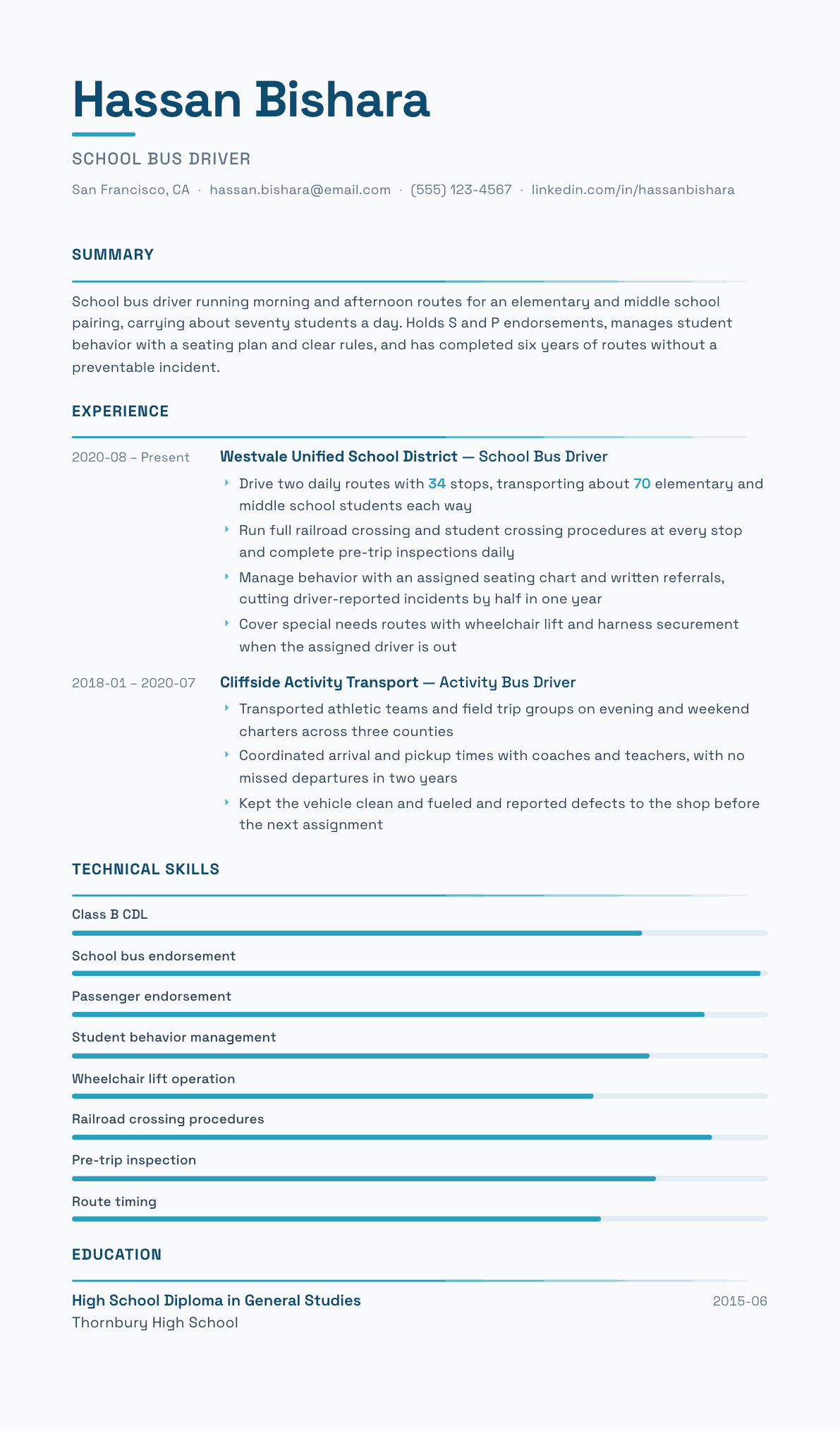
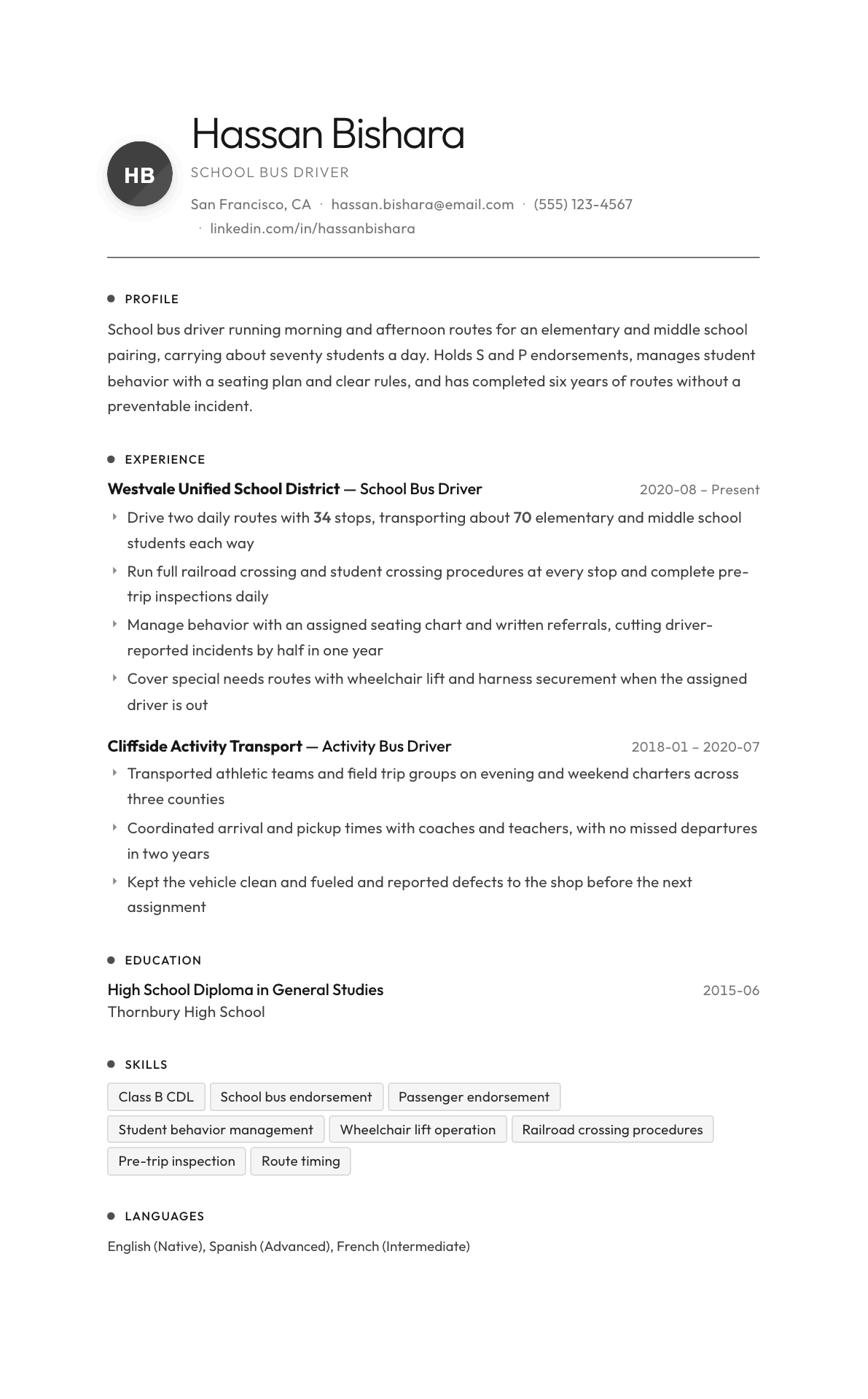
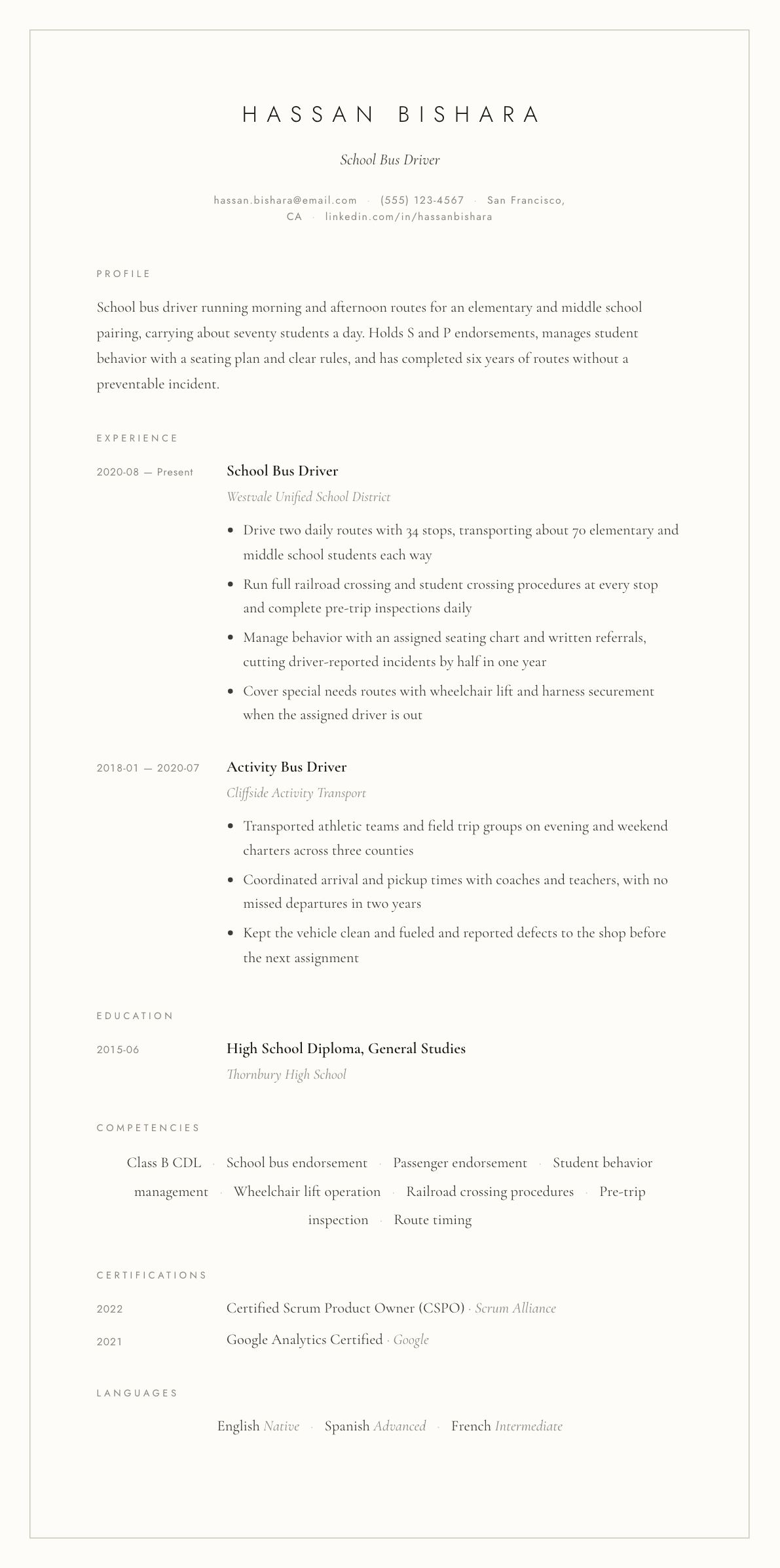
Example School Bus Driver summary
School bus driver with six years of morning and afternoon routes for elementary and middle school students, carrying about seventy children a day across 34 stops. Holds S and P endorsements and a state school bus certificate, covers special needs routes with lift and harness securement, and has driven six years without a preventable incident. Seeking a permanent route with a district that offers steady hours.
Skills to list on a School Bus Driver resume
- Class B CDL
- School bus endorsement
- Passenger endorsement
- Student behavior management
- Route timing
- Railroad crossing procedures
- Wheelchair lift operation
- Harness securement
- Pre-trip inspection
- Emergency evacuation drills
- Parent communication
- Two-way radio use
- Defensive driving
- Incident reporting
What actually gets this resume read
- List the S and P endorsements plus your state school bus certification, because a district cannot interview you without them.
- Give the number of students and stops per route, and say which grade levels you carried each day.
- Show student management: seating charts, referral procedures, and how you keep order without stopping the route.
- Mention special needs route experience, including lifts, harnesses and working with an attendant on board.
- State your background clearance and drug testing status plainly, since districts must confirm both before hiring.
- Include safety training you have completed and any years you finished without a preventable incident.
How to write a school bus driver resume
A school bus driver resume is read by a transportation director whose first duty is child safety and whose second is getting every route covered by the first bell. That order shapes the page. Endorsements, clearances and an unblemished driving record come first, because none of your route experience matters if the district cannot legally put you behind the wheel of a bus full of children.
The part most applicants underwrite is student management. Anyone can be taught the crossing procedure and the railroad stop. Keeping thirty children seated and calm while driving a narrow road in the dark is the skill that decides whether a driver lasts a full school year, and it is what a director hopes to find evidence of on your page.
This guide covers the credential block a district checks, how to write route and student bullets that show both safety and control, the special needs work that gets a driver hired quickly, three example summaries, before and after bullets, and the questions applicants ask about clearances and training.
Format: clearances first, one clean page
Put a credentials block directly beneath your contact line. A district transportation office is checking a legal checklist, and every item you make them search for slows your file down while other applicants move ahead.
Keep to a single page. Districts often hire in a rush before the school year starts, and a page that answers the checklist and shows one strong route job will beat a longer one that buries the same facts.
- Credentials: CDL class, school bus endorsement, passenger endorsement, air brake status and state school bus certificate.
- Clearances: background check and fingerprint clearance status, drug and alcohol testing enrollment, medical certificate.
- Then summary, route experience, student management and safety training, skills, education.
Summary: routes, student numbers and grade levels
Give the shape of your day in the first sentence: how many routes, how many stops, how many students, and which grade levels. Elementary and high school routes demand different management, and a director building an assignment wants to know which one you have handled.
Then add the safety fact and the availability fact. Years without a preventable incident answers the first duty. Willingness to cover activity trips, field trips or an extra afternoon route answers the second, and covering trips is often what turns a part-time driver into a full-time one.
Experience: the route, the crossing, and the students
Write each job with the district or contractor, the bus type and size, and the routes you ran. Then split the bullets between the driving procedures and the student work, because a director is evaluating both and most resumes only show one.
On procedures, name them precisely: railroad crossing stops, activation of the crossing arm and stop sign, the danger zone check before pulling away, student crossing in front of the bus, evacuation drills, and the pre-trip inspection that includes the lift and the securement points.
On students, describe the system you use. An assigned seating chart, a clear set of rules given on day one, a written referral process with the school office, and a relationship with parents at the stop are all concrete and all more convincing than saying you are good with children.
Special needs routes are worth their own lines
Districts struggle to cover special needs routes, so any experience with them moves your application forward. Name the equipment and the practice: wheelchair lift operation, four-point securement, harness and safety vest systems, child safety restraint systems, and working alongside a bus attendant.
Add the human part carefully and plainly. Consistent routine, calm voice, knowing which student needs to board first, and communicating with parents and the special education office are the details that show real experience on those routes.
Skills and the terms district postings use
The recurring terms in district postings are school bus endorsement, passenger endorsement, pre-trip inspection, student management, railroad crossing procedure, danger zone, evacuation drill, route timing, wheelchair lift, child safety restraint and clean driving record.
Include the softer scheduling terms too, since districts hire around them: split shift, morning and afternoon routes, activity trips, midday kindergarten runs, and substitute or extra board availability.
School Bus Driver resume summary examples
Entering student transportation
Class B driver completing school bus and passenger endorsements, with six years of childcare and after-school program work. Holds a current background clearance, comfortable managing groups of young children, and available for split morning and afternoon shifts throughout the school year.
Three years on a district route
School bus driver running two daily routes with 34 stops for about 70 elementary and middle school students. Runs full crossing and railroad procedures at every stop, manages behavior with an assigned seating chart, and covers special needs routes with lift and harness securement when needed.
Senior driver and trainer
School bus driver with eleven years in one district, serving four years as a behind-the-wheel instructor for new drivers on backing, crossings and evacuation drills. Runs the longest rural route personally, holds first aid certification, and has completed eleven years with no preventable incidents.
Work experience bullets: before and after
Before: Drove students to and from school safely.
After: Drove two daily routes with 34 stops, transporting about 70 elementary and middle school students each way on a fixed bell schedule.
Route count, stop count, student numbers and grade levels let a director match you to an open assignment immediately.
Before: Followed all safety procedures.
After: Executed full railroad crossing stops, crossing arm activation and danger zone checks at every stop, and led two evacuation drills a year with each route group.
Naming the specific procedures shows trained practice, while following safety procedures is a phrase any applicant can type.
Before: Kept the students well behaved.
After: Managed behavior with an assigned seating chart and a written referral process with the school office, cutting driver-reported incidents by half within one school year.
A system plus a result shows control that survives a hard route, rather than an unverifiable personal claim.
Before: Drove the special needs bus sometimes.
After: Covered special needs routes with wheelchair lift operation, four-point securement and harness systems, coordinating boarding order with the onboard attendant.
Equipment names and the attendant coordination prove genuine experience on the routes districts find hardest to fill.
Before: Checked the bus before each route.
After: Completed daily pre-trip inspections covering brakes, lights, mirrors, crossing arm, lift and securement points, and reported defects to the shop before pull-out.
Including the crossing arm and lift shows an inspection built for a school bus rather than a generic vehicle check.
Hard skills
- Class B commercial driving
- School bus and passenger endorsement operations
- Railroad crossing and student crossing procedures
- Pre-trip and post-trip inspection
- Wheelchair lift operation
- Four-point securement and harness systems
- Child safety restraint systems
- Evacuation drill instruction
- Route timing and bell schedule management
- Two-way radio communication
- Behavior referral documentation
- Air brake systems
Soft skills
- Calm authority with children
- Consistency and routine
- Parent and school communication
- Alertness in early mornings
- Patience on long rural routes
Certifications worth listing
- School Bus Endorsement (S) (State driver licensing agency)
- Passenger Endorsement (P) (State driver licensing agency)
- First Aid and CPR (American Red Cross)
- Medical Examiner's Certificate (FMCSA National Registry of Certified Medical Examiners)
Mistakes that cost school bus driver candidates the interview
- Burying the endorsements. A district cannot interview a driver whose school bus and passenger endorsements are not visible in the first few lines.
- Skipping the clearance status. Background and fingerprint clearance take time, and a driver who already holds one can start weeks earlier.
- Writing nothing about student management. Behavior is the reason most new school bus drivers quit, so a director looks for evidence you have a system.
- Ignoring special needs experience. Lift and securement routes are the hardest to cover, and mentioning them can move your file to the top.
- Leaving out availability. Split shifts, activity trips and substitute work are how districts build a schedule, so say what you can cover.
- Claiming a spotless record loosely. Motor vehicle records are pulled before any offer, so write the record exactly as it stands.
School Bus Driver resume questions
What licenses does a school bus driver need?
A commercial license, usually Class B, plus the school bus and passenger endorsements and an air brake qualification. Most states add their own school bus certificate with classroom and behind-the-wheel hours. List each item with its status so the district can check the file quickly.
Can I get hired with no school bus experience?
Yes. Many districts train drivers from scratch and pay for the endorsement process. Emphasize licensed driving history, any work with children such as childcare, coaching or classroom aide roles, and your availability for the split shift the routes require.
How do I write about student discipline without sounding harsh?
Describe the system rather than the punishment. Assigned seating, rules given on the first day, verbal redirection first, and a written referral to the office when needed reads as structured and fair, which is exactly what a transportation director wants on a bus.
Does a background check need to be on the resume?
A short line stating that you hold a current background and fingerprint clearance is useful, because it signals you can start sooner. Do not include the reference numbers or documents themselves, since those belong in the district application packet.
Is part-time school bus driving worth listing on a longer career resume?
Yes, when you are applying for driving work. It proves passenger endorsement experience, an unblemished record and reliability at difficult hours. Give the routes, students and years rather than framing it as a side job you did between other roles.
Related resume examples
- Bus Driver Resume example
- CDL Driver Resume example
- Truck Driver Resume example
- Transportation Coordinator Resume example
- Locomotive Engineer Resume example
- Railroad Conductor Resume example