Transportation Coordinator Resume Examples: free score
Write a Transportation Coordinator Resume That Keeps Loads Moving
By Mustafa Tarabya, founder of CVBooster · Published · Updated
Transportation coordinator resume example with scheduling, carrier and appointment keywords, plus a writing guide for transportation coordination applications.
Sample resumes for a transportation coordinator
The same transportation coordinator content laid out in three CVBooster templates, so you can see what the finished document looks like before you write a word.
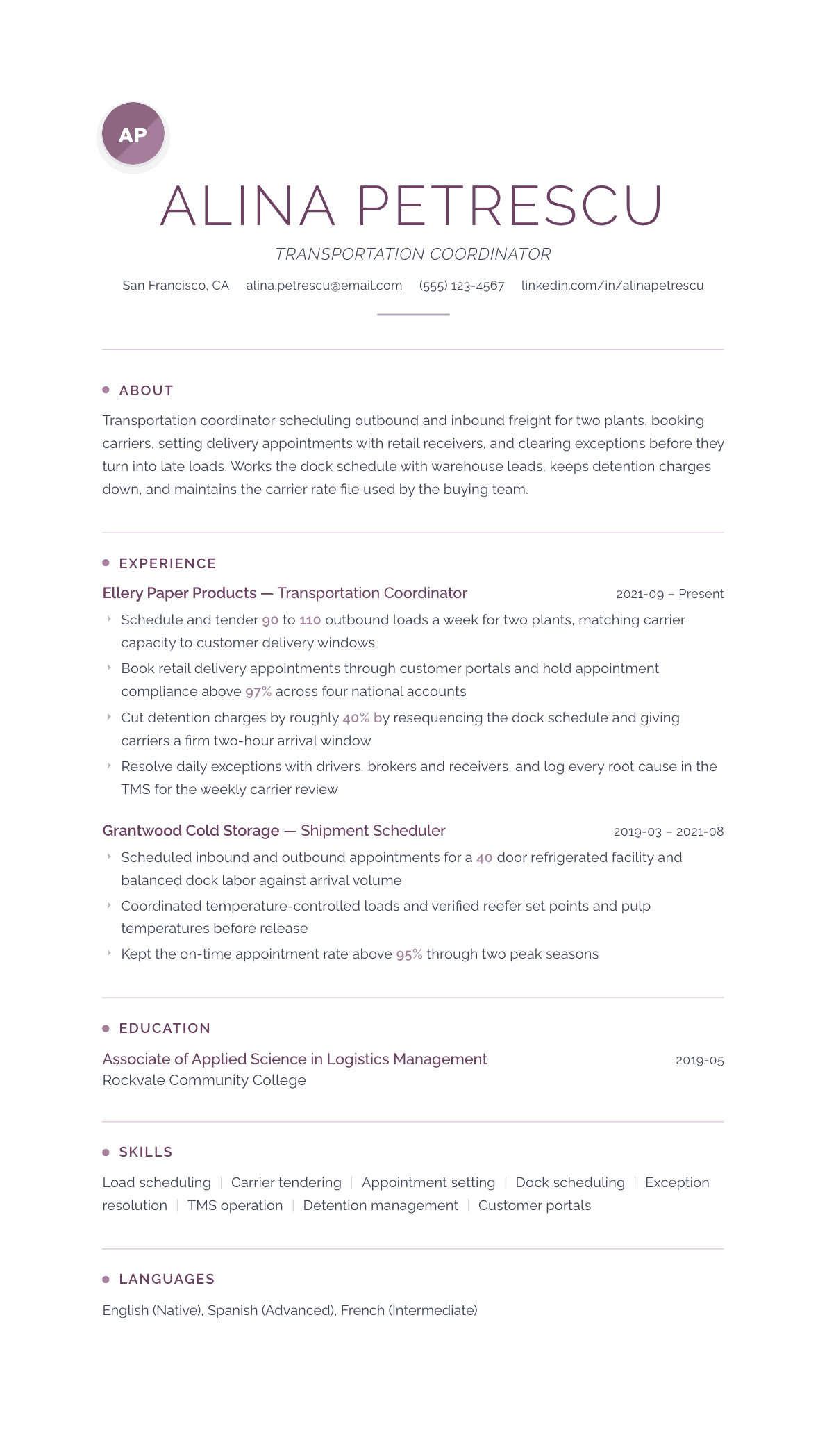
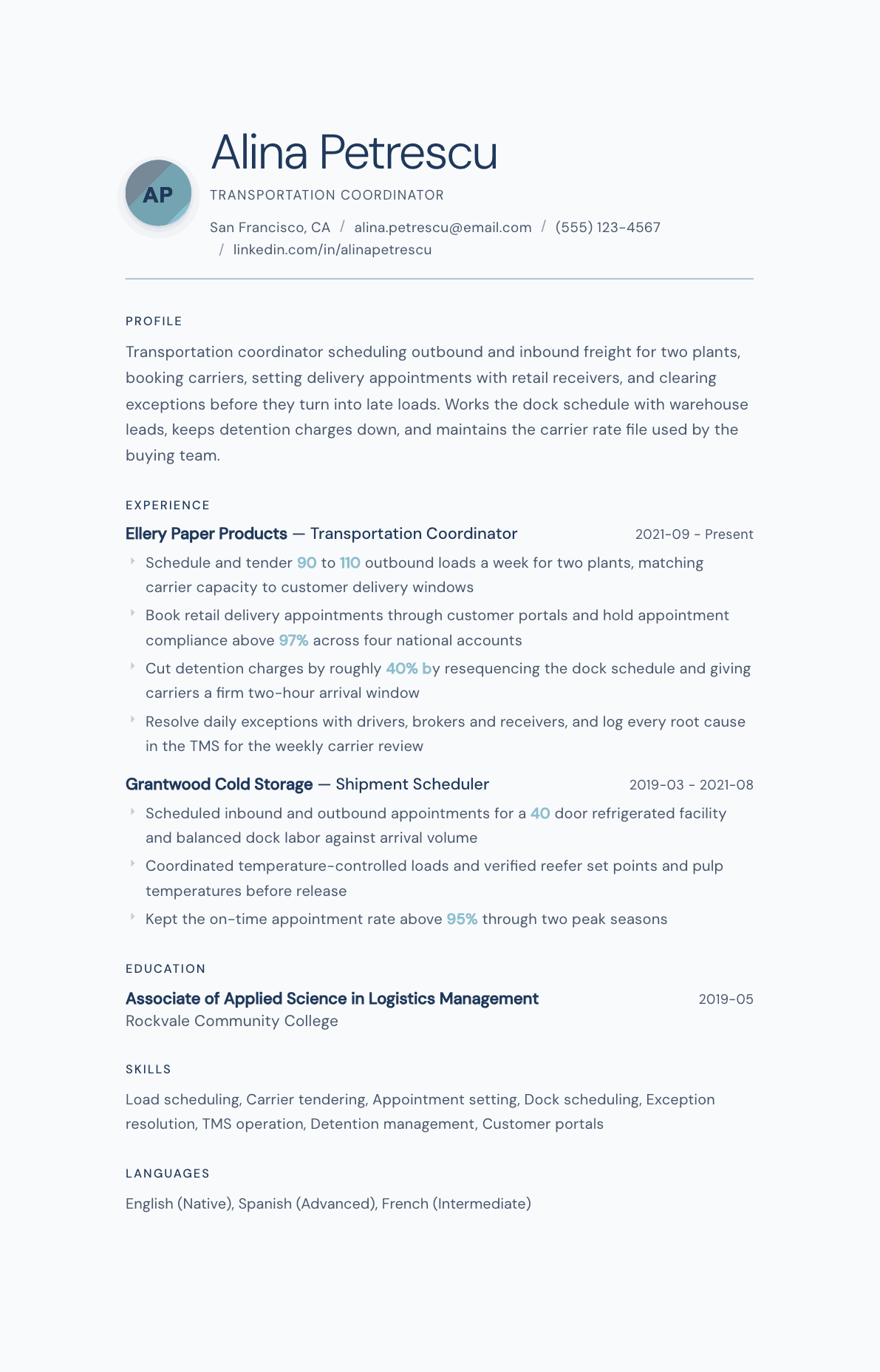
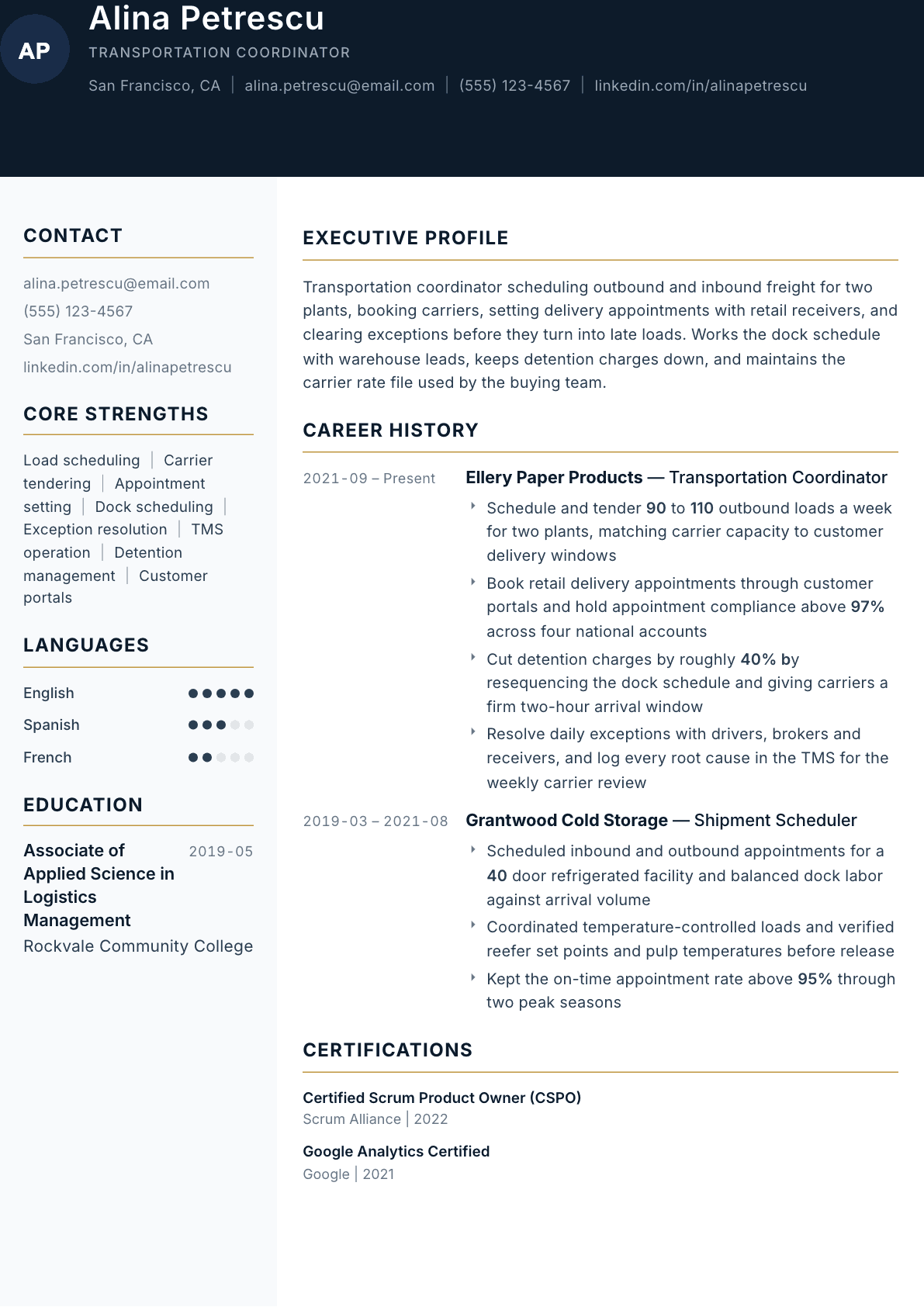
Example Transportation Coordinator summary
Transportation coordinator with five years scheduling freight for manufacturing and cold storage sites, tendering 90 to 110 loads a week across two plants. Books retail delivery appointments through customer portals with compliance above 97%, and cut detention charges by roughly 40% by resequencing the dock schedule. Known for clearing exceptions before a receiver ever calls. Seeking a transportation supervisor role.
Skills to list on a Transportation Coordinator resume
- Load scheduling
- Carrier tendering
- Delivery appointment setting
- Dock scheduling
- Transportation management systems
- Exception resolution
- Detention and accessorial control
- Bill of lading preparation
- Retail vendor portals
- Temperature-controlled freight
- Carrier communication
- On-time delivery reporting
- Rate file maintenance
- Peak season planning
What actually gets this resume read
- Put the weekly load count and the number of sites you cover in the first two lines of your summary.
- Name the retail portals you book appointments in, because receiver scheduling is a specific skill that not every coordinator has.
- Show the accessorial numbers you influence, such as detention, layover or reconsignment, since those charges land on someone budget line.
- Describe how you handle a failed pickup end to end, because exception work is most of the job on a bad day.
- Include temperature-controlled, hazardous or oversize experience if you have it, since those postings filter for it hard.
- Mirror the posting language for the systems, then keep the layout single column so the parser reads your dates correctly.
How to write a transportation coordinator resume
A transportation coordinator keeps a promise date alive after everything that could go wrong has started going wrong. The carrier misses the pickup window, the receiver has no appointment slot until Thursday, the dock is stacked and a driver is sitting in detention. The supervisor reading your resume wants to see that you have lived inside that day and came out of it with the load delivered and the customer informed.
The resume that works for this role is built on volume, appointment discipline and accessorial control. Loads a week tells a reader your pace. Appointment compliance tells him whether receivers trust you. Detention and other accessorial charges tell him whether your scheduling costs the company money it did not have to spend.
This guide covers what to put in a coordinator summary, how to write exception work so it reads as judgment rather than firefighting, three summaries from a first scheduling job to a lead coordinator, before and after bullets, and the questions coordinators ask when they move between plant, retail and cold chain freight.
Format: one page, volume and systems visible immediately
One page, single column, reverse chronological. Coordinator postings attract a lot of applicants, so the screen is fast. Weekly load volume, the systems you work in and the type of freight should all be readable within the first third of the page.
Add a compact systems line under the summary covering the transportation system, the enterprise system where orders and deliveries live, and the customer portals you book appointments in. Portal experience is often the quiet requirement that decides between two otherwise equal candidates.
- Header: name, city and state, phone, email, shift availability if it is broad.
- Systems line: TMS, ERP, retail vendor portals, carrier booking sites.
- Sections: summary, systems, experience, certifications and training, education.
Summary: loads a week, sites covered, freight type, one result
Give the reader pace, scope, freight type and a result. Pace is loads or orders scheduled a week. Scope is how many plants or warehouses you cover. Freight type is dry, refrigerated, hazardous or oversize. The result should be something a supervisor pays for, such as appointment compliance or a reduction in detention.
Avoid the generic opener about being a detail oriented professional who thrives under pressure. Every coordinator claims it and it survives no scrutiny. Pressure handling is proven by the exception bullet further down the page, not asserted at the top.
Experience: schedule, tender, appoint, and clear the exception
Structure each job around the four things you actually do. Scheduling is building the day against dock capacity and labor. Tendering is placing the load with a carrier at a rate and a window. Appointment setting is negotiating with receivers, often inside their portal and on their rules. Exception clearing is everything that happens when one of the first three fails.
The accessorial story deserves its own bullet. Detention, layover, truck ordered not used and reconsignment are charges a coordinator can prevent or cause, and a supervisor knows it. If you resequenced a dock schedule, tightened arrival windows or changed how appointments were confirmed and the charges fell, that is one of the strongest lines available to you.
Write one exception bullet as a full loop: what broke, what you did, who you told, and what got logged. Coordinators who log a root cause give the weekly carrier review something to work with, and that habit distinguishes an experienced coordinator from someone who only reacts.
- Volume: loads or appointments a week, and the number of sites.
- Freight type: dry, temperature controlled, hazardous, oversize, or a mix.
- Accessorials: detention, layover, reconsignment, and how you influenced them.
- Communication: who you notify, how fast, and what the notification prevented.
Receiver and carrier relationships: the part nobody writes down
Much of this job is negotiation with people who have no reason to help you. A receiver scheduler has a full calendar. A carrier dispatcher has a truck he would rather use elsewhere. Coordinators who consistently get an earlier slot or a covered load are doing something specific, and describing it plainly is credible: standing call times, giving carriers accurate load details up front, or building a reputation for loading trucks fast.
If you maintained the carrier rate file or contributed to award conversations, say so. It shows you understand the cost side of the decisions you make every day rather than only the coverage side.
Keywords transportation coordination postings use
Expect load scheduling, carrier tendering, delivery appointments, dock schedule, bill of lading, detention, accessorial, on-time delivery, proof of delivery, exception management, temperature controlled, and the system names. Attach each term to a number or an event. A posting term used inside a bullet that also shows a result carries weight that a keyword list never will.
Transportation Coordinator resume summary examples
First scheduling role
Shipment scheduler with a year booking inbound and outbound appointments for a 40 door refrigerated facility, balancing dock labor against arrival volume and verifying reefer set points before release. Held the on-time appointment rate above 95% through two peak seasons.
Four years in
Transportation coordinator scheduling and tendering 90 to 110 outbound loads a week for two plants, booking retail delivery appointments through customer portals with compliance above 97%. Cut detention charges by roughly 40% by resequencing the dock schedule into firm two hour arrival windows.
Lead coordinator
Lead transportation coordinator across three sites with two coordinators reporting in, owning the daily load plan, the carrier rate file and the weekly carrier performance review. Runs peak season planning and trains new coordinators on portal scheduling and exception handling.
Work experience bullets: before and after
Before: Scheduled trucks for pickups and deliveries.
After: Scheduled and tendered 90 to 110 outbound loads a week across two plants, matching carrier capacity to customer delivery windows and dock labor availability.
Volume, site count and the two constraints you balance show the real shape of the day.
Before: Set up delivery appointments with customers.
After: Booked retail delivery appointments through four national account portals and held appointment compliance above 97% across the year.
Naming the portals and the compliance figure proves the receivers accepted your scheduling.
Before: Worked to reduce extra charges from carriers.
After: Cut detention charges by roughly 40% by resequencing the dock schedule and giving carriers a firm two hour arrival window instead of an open morning.
The specific change and the charge it removed connect scheduling behavior to money.
Before: Handled problems with late loads.
After: Resolved daily exceptions with drivers, brokers and receivers, then logged the root cause in the transportation system for the weekly carrier review.
Logging the cause turns reactive work into an input for a process that improves.
Before: Coordinated refrigerated freight.
After: Coordinated temperature controlled loads and verified reefer set points and pulp temperatures before release, with no product rejections at delivery.
The verification steps and the rejection record show cold chain discipline rather than exposure to it.
Hard skills
- Load scheduling and planning
- Carrier tendering
- Delivery appointment booking
- Dock schedule management
- Transportation management systems
- Retail vendor portals
- Detention and accessorial control
- Bill of lading preparation
- Temperature controlled freight handling
- Exception resolution
- Carrier rate file maintenance
- On-time performance reporting
Soft skills
- Negotiating for earlier slots
- Staying calm on a bad dock day
- Proactive customer updates
- Working with drivers directly
- Prioritizing competing loads
- Handover notes at shift end
Certifications worth listing
- Certified in Logistics, Transportation and Distribution (CLTD) (Association for Supply Chain Management)
- Certified Supply Chain Professional (CSCP) (Association for Supply Chain Management)
- Hazardous Materials Employee Training (Employer program under Department of Transportation rules)
- HACCP Food Safety Training (International HACCP Alliance)
Mistakes that cost transportation coordinator candidates the interview
- Leaving weekly load volume off the page, which makes a small desk and a national one look identical.
- Claiming to work well under pressure without a single exception bullet that shows what pressure looked like.
- Ignoring accessorial charges, which are the clearest link between coordinator decisions and company money.
- Skipping the portals you book appointments in, when portal fluency is often the deciding requirement.
- Describing communication in general terms instead of showing who you notified and how early.
- Omitting temperature controlled or hazardous experience, which many postings screen for before anything else.
Transportation Coordinator resume questions
What is the difference between a transportation coordinator and a dispatcher?
A dispatcher assigns work to drivers and manages them through the shift. A coordinator plans loads, books carriers and negotiates appointments with receivers. Small operations combine both, so read the duty list and mirror whichever emphasis the posting places first.
How do I show appointment compliance if my employer never measured it?
Use what you can defend, such as the number of accounts you scheduled for and how rarely you had to reschedule. If a customer scorecard existed, name it even without a figure. An honest description beats a number you cannot source in an interview.
Is experience with a specific transportation system required?
Postings list the system they run, but most managers accept transferable experience because the workflow is similar across platforms. Name the system you used, describe the transactions you performed in it, and say you have picked up new platforms quickly if you have.
How do I write this resume after only working in cold storage?
Lead with the cold chain discipline, which is a genuine specialty, then translate the rest into general terms: appointments, dock balancing, carrier communication and exception clearing. Those transfer directly, and the temperature experience makes you preferred for any food or pharmaceutical employer.
Should I mention peak season on my resume?
Yes, because peak is when this job gets hard and how you performed then is what a supervisor wants to know. Give the volume increase you absorbed, whether service held, and anything you changed in the schedule to survive it.
Related resume examples
- Logistics Coordinator Resume example
- Logistics Manager Resume example
- Freight Coordinator Resume example
- Dispatcher Resume example
- Route Planner Resume example
- Shipping Coordinator Resume example